
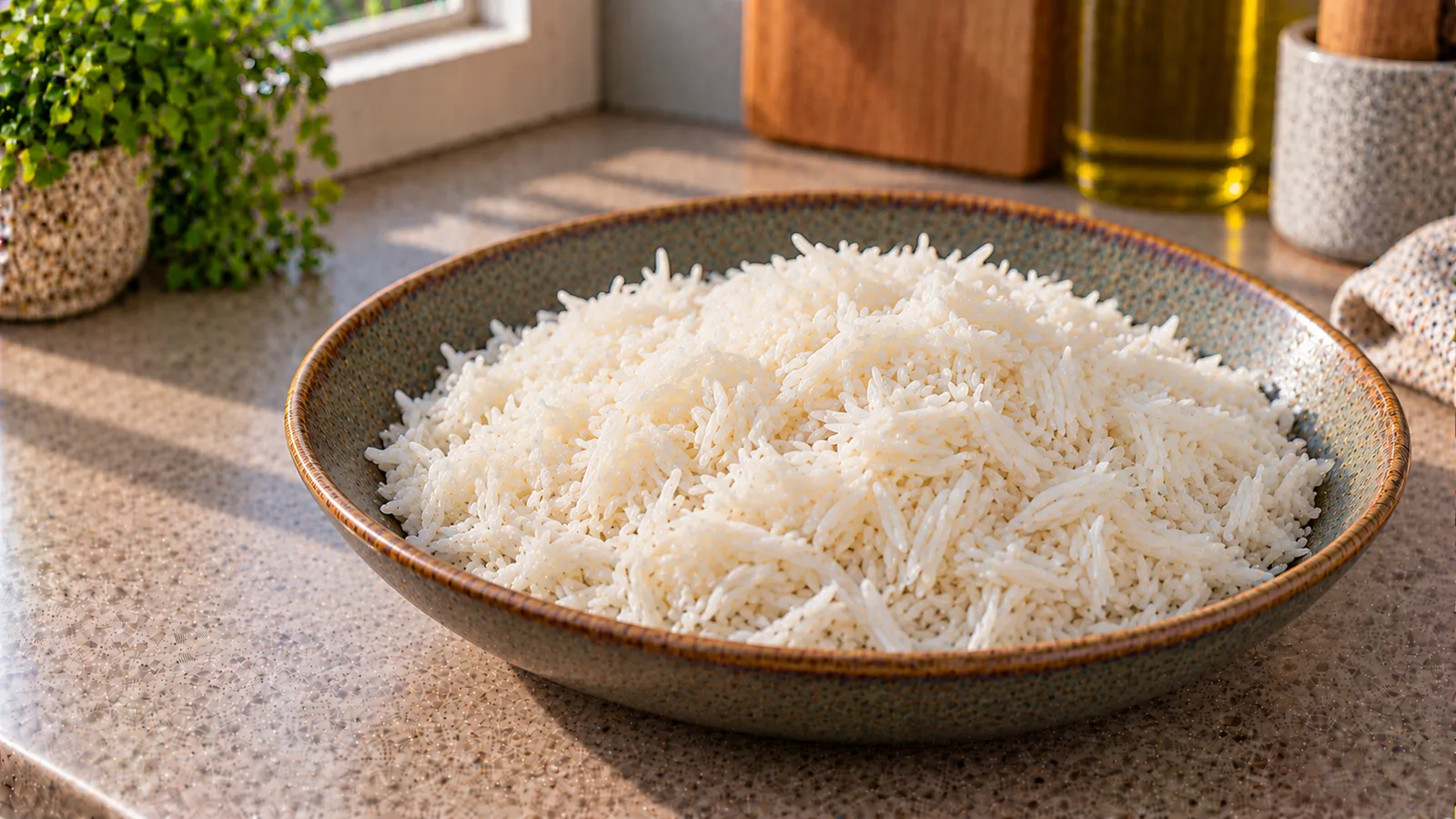
White basmati rice has roughly 351 calories per 100 g uncooked in one Tilda dry-rice product, whereas a Sainsbury's reference for 100 g basmati cooked in water is 125 kcal. The difference is primarily water absorbed during cooking, not an energy loss of nearly two-thirds from the dry grains. These values come from different manufacturers and preparation bases, so they are useful reference examples rather than a before-and-after laboratory experiment on the same batch.
For an accurate food log, the simplest rule is to weigh basmati before cooking and use a dry-rice entry, or weigh what is actually on your plate after cooking and use a cooked-rice entry. This guide also separates plain cooked rice from microwave pouches and wholegrain basmati, which can contain added ingredients and different fibre levels.
Basmati rice nutrition per 100 g: which product is being measured?
Basmati is an aromatic long-grain rice, often sold as polished white grains or as wholegrain (brown) basmati. A rice label only answers your question when you check whether its nutrition panel refers to the product as sold, cooked according to directions, or already steamed. Compare the following explicitly named products, not a supposedly universal basmati average.
| Basmati reference and form | Calories | Carbs | Protein | Fat | Fibre | Ingredients / basis |
|---|---|---|---|---|---|---|
| Tilda dry white basmati | 351 kcal | 77.7 g | 7.8 g | 0.8 g | 1.0 g | dry grains |
| Sainsbury’s basmati cooked as directed | 125 kcal | 26.5 g | 2.8 g | 0.7 g | 0.6 g | cooked, rice only |
| Tilda steamed white basmati pouch | 143 kcal | 28.2 g | 2.9 g | 1.9 g | 0.7 g | steamed, rice-bran oil |
| Tilda wholegrain steamed pouch | 127 kcal | 23.3 g | 2.8 g | 2.1 g | 1.7 g | steamed, added oil and acacia fibre |
The 351 kcal dry figure comes from Tilda Pure Basmati dry rice. Its label also lists 77.7 g carbohydrate, 7.8 g protein, 0.8 g fat and 1.0 g fibre per 100 g. The 125 kcal cooked example comes from Sainsbury's basmati boil-in-the-bag rice, whose cooked-as-directed declaration shows 26.5 g carbohydrate, 2.8 g protein, 0.7 g fat and 0.6 g fibre per 100 g; its sole ingredient is basmati rice.
For comparison, Tilda Pure Steamed Basmati lists 143 kcal per 100 g and includes rice bran oil. A Tilda Wholegrain Steamed Basmati pouch lists 127 kcal and 1.7 g fibre per 100 g, but it also contains added oil and acacia fibre. Neither ready-meal figure should be presented as the nutrient profile of generic boiled white or brown basmati. The difference in moisture and recipe makes a simple 'white versus brown' calorie ranking unreliable.
Calories in 25 to 150 g of dry basmati
These values apply to rice weighed dry, before rinsing and cooking, using the 351 kcal/100 g Tilda example. They exclude butter, oil, coconut milk, meat and sauces. Rounded numbers help with practical logging; tiny decimal differences have little significance compared with a mistaken dry/cooked entry.
| Dry basmati (g) | Calories at 351 kcal/100 g | Protein at 7.8 g/100 g |
|---|---|---|
| 25 g | 88 kcal | 2.0 g |
| 40 g | 140 kcal | 3.1 g |
| 50 g | 176 kcal | 3.9 g |
| 60 g | 211 kcal | 4.7 g |
| 75 g | 263 kcal | 5.9 g |
| 100 g | 351 kcal | 7.8 g |
| 125 g | 439 kcal | 9.8 g |
| 150 g | 527 kcal | 11.7 g |
A 75 g dry portion therefore supplies approximately 263 kcal and 5.9 g protein according to this package. If you cook 75 g and it absorbs water, its cooked weight increases; it is not appropriate to multiply that new cooked weight by 351 kcal/100 g. At the other extreme, putting '100 g uncooked' into your tracker when you ate 100 g cooked can overstate the rice component substantially.
Different households portion rice differently. A 50 g dry side dish may be enough alongside beans and vegetables, while a 100 g dry portion can form a substantial part of a larger meal. There is no metabolic rule requiring exactly 60 or 75 g. The suitable amount depends on appetite, other ingredients and the meal's purpose.
Calories in 50 to 250 g of cooked basmati
The next table uses the 125 kcal per 100 g cooked-as-directed Sainsbury's label, not the dry Tilda numbers. These are cooked food weights after draining, with no separately added sauce or cooking fat.
| Cooked basmati (g) | Calories at 125 kcal/100 g | Carbs at 26.5 g/100 g |
|---|---|---|
| 50 g | 63 kcal | 13.2 g |
| 75 g | 94 kcal | 19.9 g |
| 100 g | 125 kcal | 26.5 g |
| 125 g | 156 kcal | 33.1 g |
| 150 g | 188 kcal | 39.8 g |
| 175 g | 219 kcal | 46.4 g |
| 195 g | 244 kcal | 51.7 g |
| 200 g | 250 kcal | 53.0 g |
| 250 g | 313 kcal | 66.2 g |
For example, 150 g cooked basmati is about 188 kcal, and 195 g is about 244 kcal by this particular cooked reference. A package's 'serving' may describe something other than your actual portion. Our explanation of portion size versus serving size helps distinguish the manufacturer's reference amount from what you actually weigh.
If your basmati is home-cooked and the final water content differs, the true density may be higher or lower than 125 kcal/100 g. The table is a practical cooked-product reference, not a law that all cooked basmati weighs or hydrates alike. For an especially accurate home recipe, count the dry rice input and divide it among the resulting portions.
Why dry rice, cooked rice and microwave pouches differ
Water adds weight without adding calories. Imagine you start with 180 g dry basmati at 351 kcal/100 g. Before adding anything else, that is about 632 kcal in the starting grains. Suppose the cooked pot weighs 540 g after the rice absorbs water. If none of the rice or starchy cooking water containing solids is discarded, the same batch is approximately 117 kcal per 100 g cooked, or 158 kcal per quarter of the pot. This yield is illustrative, not a promise that basmati always triples in weight.
The arithmetic does not contradict the 125 kcal/100 g Sainsbury's label, which represents a different food sample and preparation. If your batch finishes at 480 g instead of 540 g, energy per 100 g from the original dry input is around 132 kcal rather than 117 kcal. Less retained water means more energy in every 100 g, even before any sauce is counted.
Now suppose 10 g of oil is actually eaten with the whole batch. Using approximately 9 kcal/g, that adds 90 kcal, bringing the batch to about 722 kcal. Four equal portions would be around 181 kcal each after rounding. If half the oil remains in the pan, charge the portion only for the amount consumed. Do not add the full oil quantity again if you used a prepared-rice database entry that already includes it.
A ready-to-heat pouch can contain oil, flavourings, salt or ingredients other than cooked basmati. Tilda's steamed pouch has a different calorie and fat profile from Sainsbury's plain boiled reference. Always check whether an energy declaration is per 100 g of pouch contents, per 125 g serving, or per package. The label for a microwave product may be more reliable than selecting a generic rice entry from an app.
White basmati vs wholegrain basmati vs jasmine rice
Most white basmati has had its bran removed. Wholegrain basmati retains more of the original grain layers and often provides more fibre, but packages vary and some prepared products include extra fibre or oil. Comparing Tilda's two steamed pouches gives 0.7 g fibre per 100 g in Pure Basmati and 1.7 g in Wholegrain; this is a product comparison, not proof that every brand will have that exact difference.
The general brown-rice nutrition guide explains how grain processing influences fibre and food choices. Neither rice variety becomes automatically 'better for weight loss' based on the raw calorie number alone. A measured rice serving with protein foods and vegetables can fit many eating patterns; meal balance and total intake remain important.
Basmati and jasmine are both aromatic rice, but they are different varieties and their packaging can show slightly different values. If you're comparing your purchase with an Asian-style rice, see our separate guide to jasmine rice calories. Avoid using the jasmine page's dry-brand figures as exact values for an unlabelled basmati product. The broader rice calorie guide can help when the variety is not specified at all.
What about basmati in curries, biryani and restaurant meals?
A bowl of plain basmati is not nutritionally equivalent to rice fried in butter, ghee, oil or coconut milk. A 200 g serving of the plain cooked reference is about 250 kcal, but 15 g ghee consumed with it can add roughly another 135 kcal. The result would be close to 385 kcal, even before chicken, vegetables, nuts or sauce. These numbers describe an example, not every biryani recipe.
Restaurant portions are hard to identify from photographs. Rice may be hidden under toppings; a spoonful of sauce can include oil that cannot be separated reliably. Estimate the cooked edible rice amount, list distinct sauces or toppings, and record uncertainty rather than calling a mixed meal '200 g basmati'. For a home biryani, start from dry grain and individual ingredients; count them once and divide the completed recipe by the shares eaten.
Is basmati a low-calorie or low-carbohydrate food?
Plain basmati is naturally carbohydrate-rich, not a low-carbohydrate food. The cooked Sainsbury's reference contains 26.5 g carbohydrate per 100 g; 200 g provides about 53 g. The much lower calorie density of cooked rice compared with dry rice reflects water weight and should not be confused with removal of its carbohydrate content from the original batch.
Protein and fibre in white cooked basmati are modest compared with foods such as beans, lentils or vegetables. That does not require eliminating it. A practical balanced plate can combine rice with a substantial source of protein, vegetables and a measured amount of sauce or fat. Blood-glucose responses also depend on portion size, individual physiology and the composition of the whole meal; do not assume aromatic rice has an identical glycaemic effect for everyone.
How to cool and reheat leftover basmati safely
Cooked rice deserves careful handling because spores of Bacillus cereus can survive cooking and become a concern if rice sits warm for too long. The UK's Food Standards Agency advises cooling rice promptly, preferably within one hour, keeping it refrigerated and eating refrigerated rice within 24 hours. Reheat only once, and ensure it is steaming hot throughout. See the Food Standards Agency's cooking and leftovers guidance.
Divide large batches into shallow portions to cool more quickly rather than leaving a big pot at room temperature. Follow the package's storage advice for unopened or opened microwave pouches. If you plan several lunches, freezing promptly cooled individual portions can be safer than keeping a cooked pot for multiple days in the fridge.
How to log basmati without double counting
Choose one weighing basis: dry grams with a dry label, or edible cooked grams with a cooked reference. Use the matching product when possible, note whether it is white, wholegrain or seasoned, and add separately consumed oil, butter, coconut milk or other ingredients. Never record both the raw ingredient and its cooked form as two foods in the same recipe.
Sources: Tilda dry basmati; Sainsbury's plain basmati cooked as directed; Tilda steamed basmati pouch; Tilda wholegrain steamed pouch; FSA food handling. Portion numbers are rounded calculations from these specific reference labels, not separate tests of your meal.