
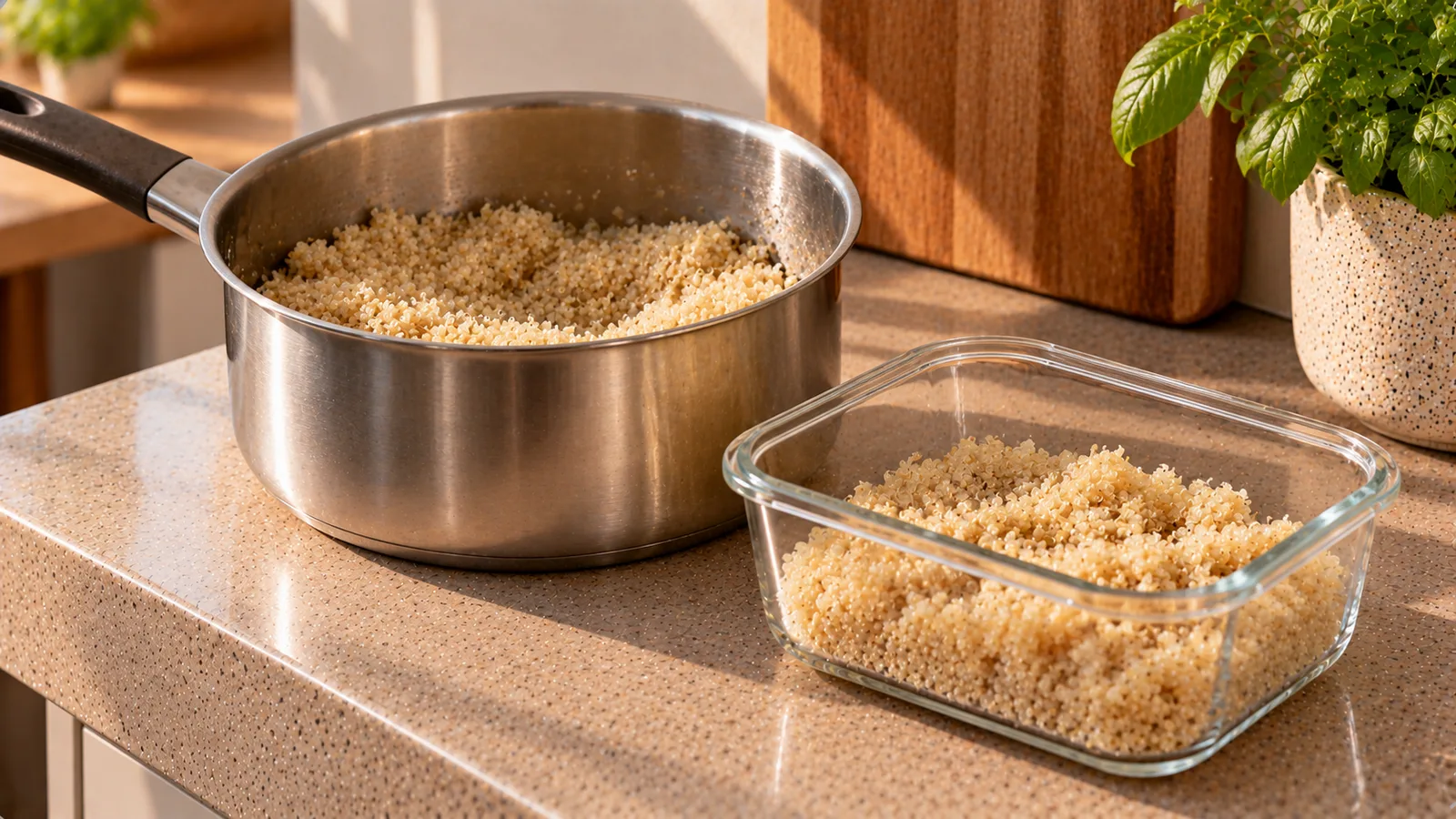
Quinoa can have very different calorie values depending on whether you measure it dry or cooked.
As a practical reference, cooked quinoa provides about 120 kcal per 100 g, while dry quinoa provides roughly 360–370 kcal per 100 g.
The large difference does not mean cooking removes calories. Quinoa absorbs water during cooking, increasing its weight and lowering the number of calories per 100 g of the finished food.
Quinoa nutrition per 100 g
Typical cooked quinoa provides approximately:
| Nutrient | Cooked quinoa, 100 g |
|---|---|
| Calories | ~120 kcal |
| Protein | ~4.4 g |
| Carbohydrates | ~21.3 g |
| Fat | ~1.9 g |
| Fiber | ~2.8 g |
Dry quinoa is much more concentrated because it has not yet absorbed cooking water.
A typical dry quinoa may provide approximately:
| Nutrient | Dry quinoa, 100 g |
|---|---|
| Calories | ~368 kcal |
| Protein | ~14 g |
| Carbohydrates | ~64 g |
| Fat | ~6 g |
| Fiber | ~7 g |
Exact values vary by product and database entry.
Calories in common cooked quinoa portions
Using approximately 120 kcal per 100 g:
| Cooked portion | Approx. calories |
|---|---|
| 50 g | 60 kcal |
| 75 g | 90 kcal |
| 100 g | 120 kcal |
| 125 g | 150 kcal |
| 150 g | 180 kcal |
| 175 g | 210 kcal |
| 200 g | 240 kcal |
| 250 g | 300 kcal |
To calculate any portion:
cooked grams × calories per 100 g ÷ 100
For example:
180 g × 120 ÷ 100 = 216 kcal
Calories in common dry quinoa portions
Using approximately 368 kcal per 100 g:
| Dry portion | Approx. calories |
|---|---|
| 25 g | 92 kcal |
| 30 g | 110 kcal |
| 40 g | 147 kcal |
| 50 g | 184 kcal |
| 60 g | 221 kcal |
| 75 g | 276 kcal |
| 100 g | 368 kcal |
For example:
60 g × 368 ÷ 100 = about 221 kcal
The important point is to match the weight you measured to the correct nutrition entry.
Dry versus cooked quinoa
Suppose you start with 60 g of dry quinoa.
At 368 kcal per 100 g:
60 × 368 ÷ 100 = about 221 kcal
After cooking, the quinoa may weigh around 170–200 g depending on how much water it absorbs and how it is prepared.
The batch still contains approximately the same calories from the quinoa itself.
If the cooked batch weighs 185 g:
221 ÷ 185 × 100 ≈ 119 kcal per 100 g cooked
Water increased the weight, not the calories.
Why dry and cooked entries cause tracking errors
A common mistake is to weigh cooked quinoa but select a dry quinoa database entry.
For example, logging 180 g of cooked quinoa as 180 g dry could produce a value above 600 kcal instead of roughly 200–220 kcal.
The reverse mistake is also possible: weighing dry quinoa and using a cooked entry can substantially underestimate the meal.
Always check whether the database entry says:
- dry;
- uncooked;
- cooked;
- prepared.
How much does quinoa weigh after cooking?
There is no exact universal conversion.
The final weight depends on:
- cooking time;
- water ratio;
- whether excess water is drained;
- resting time;
- variety;
- how much moisture remains after cooking.
This is why a fixed statement such as “50 g dry always equals 150 g cooked” should be treated only as an estimate.
If accuracy matters, weigh your own batch.
The most accurate way to track a cooked batch
Suppose you cook:
100 g dry quinoa
Your package says:
370 kcal per 100 g dry
The whole batch therefore contains:
370 kcal
After cooking, you weigh the finished quinoa and get:
305 g
The cooked batch now contains:
370 ÷ 305 = 1.21 kcal per gram
or approximately:
121 kcal per 100 g
If you eat 180 g:
180 × 1.21 ≈ 218 kcal
This method automatically accounts for the amount of water your particular batch absorbed.
Protein in quinoa
Cooked quinoa provides approximately 4–5 g of protein per 100 g.
Using 4.4 g per 100 g:
| Cooked portion | Approx. protein |
|---|---|
| 100 g | 4.4 g |
| 150 g | 6.6 g |
| 200 g | 8.8 g |
| 250 g | 11.0 g |
Quinoa contributes protein, but a normal cooked serving should not be treated as equivalent to a concentrated high-protein food.
For a higher-protein meal, quinoa can be combined with foods such as legumes, dairy, eggs, fish, meat, tofu or other protein sources depending on the meal.
Carbohydrates in quinoa
Cooked quinoa contains roughly 21 g of carbohydrate per 100 g.
A 150 g cooked portion therefore contains approximately:
150 × 21.3 ÷ 100 ≈ 32 g carbohydrate
A 200 g portion contains approximately:
200 × 21.3 ÷ 100 ≈ 43 g carbohydrate
Exact values should be taken from the product or database entry you are using.
Fiber in quinoa
Cooked quinoa typically provides a few grams of fiber per 100 g.
Using approximately 2.8 g per 100 g:
- 100 g cooked → ~2.8 g fiber
- 150 g cooked → ~4.2 g
- 200 g cooked → ~5.6 g
Quinoa can therefore contribute to overall dietary fiber intake alongside vegetables, fruit, legumes, nuts, seeds and other whole-grain or grain-like foods.
One cup of cooked quinoa
Cup measurements can vary depending on how the food is filled and the cup standard being used.
A commonly cited cup of cooked quinoa is roughly 180–190 g.
At 120 kcal per 100 g:
185 g × 120 ÷ 100 = about 222 kcal
So one cup of cooked quinoa is often around 220 kcal, but weighing the portion is more reliable.
Half a cup of cooked quinoa
If half a cup weighs approximately 90–95 g:
At 120 kcal per 100 g, that would provide roughly:
108–114 kcal
Again, cup measures are useful estimates rather than exact weights.
White, red and black quinoa
White, red and black quinoa may differ slightly in texture, cooking behavior and nutrient composition.
However, color alone is not a reliable way to determine exact calories.
For routine tracking, use the nutrition information for the specific product when available.
A mixed-color quinoa should likewise be tracked using its own package label rather than assuming it is identical to another variety.
Does rinsing quinoa change the calories?
Rinsing quinoa before cooking is commonly used to remove surface compounds such as saponins.
Normal rinsing does not meaningfully remove the starch, protein and fat that account for most of quinoa's calories.
You generally do not need to adjust calories simply because dry quinoa was rinsed before cooking.
Does cooking quinoa add calories?
Cooking quinoa in water does not add calories from the water itself.
If you cook quinoa with other ingredients, however, those ingredients must be counted.
Examples include:
- olive oil;
- butter;
- broth containing meaningful energy;
- coconut milk;
- sauces;
- cheese.
Plain quinoa cooked in water is different from quinoa prepared with oil or other calorie-containing ingredients.
Quinoa cooked with oil
Suppose you cook 200 g dry quinoa and add 20 g olive oil.
If the quinoa provides 368 kcal per 100 g:
200 × 368 ÷ 100 = 736 kcal
If the oil provides about 884 kcal per 100 g:
20 × 884 ÷ 100 = 177 kcal
Total before considering other ingredients:
736 + 177 = 913 kcal
If the finished batch is divided into five equal portions:
913 ÷ 5 ≈ 183 kcal per portion
The actual portion calculation is even more accurate when based on finished recipe weight.
Quinoa salad
A quinoa salad can contain much more than quinoa.
Common additions include:
- olive oil;
- avocado;
- feta;
- nuts;
- seeds;
- beans;
- vegetables;
- dressing.
If you know the recipe, track the ingredients separately or create a recipe entry.
Do not assume that the calorie value for plain cooked quinoa represents an entire quinoa salad.
Quinoa bowls
The same principle applies to quinoa bowls.
For example, a bowl may contain:
- 150 g cooked quinoa;
- chicken or tofu;
- vegetables;
- avocado;
- dressing.
At 120 kcal per 100 g, the quinoa itself contributes approximately:
150 × 120 ÷ 100 = 180 kcal
The remaining ingredients are added separately.
Quinoa in meal prep
If you prepare quinoa for several meals, you can track the full batch once.
Example:
- weigh 250 g dry quinoa;
- record the calories from the dry product;
- cook it;
- weigh the entire cooked batch;
- calculate calories per cooked gram;
- weigh each portion as you serve it.
Suppose 250 g dry quinoa provides:
250 × 368 ÷ 100 = 920 kcal
After cooking, the batch weighs 760 g.
Calories per gram:
920 ÷ 760 ≈ 1.21 kcal
A 200 g portion would contain:
200 × 1.21 ≈ 242 kcal
This method works even when your quinoa absorbs more or less water than an average database value.
Package-first tracking
Your package is usually more useful than a generic value when the product information is available.
Suppose your dry quinoa label says:
- 365 kcal per 100 g;
- 13.5 g protein;
- 62 g carbohydrate;
- 6.2 g fat.
You use 70 g dry.
Calories:
70 × 365 ÷ 100 = 255.5 kcal
Protein:
70 × 13.5 ÷ 100 = 9.45 g
Carbohydrate:
70 × 62 ÷ 100 = 43.4 g
Fat:
70 × 6.2 ÷ 100 = 4.34 g
Cooking changes the water content and final weight, but it does not create extra calories from the quinoa itself.
Common tracking mistakes
Quinoa is often mislogged when people:
- weigh cooked quinoa but choose a dry entry;
- weigh dry quinoa but choose a cooked entry;
- assume a fixed dry-to-cooked weight ratio;
- count cups without checking portion weight;
- forget oil used during cooking;
- log a quinoa salad as plain quinoa;
- divide a batch by estimated portions instead of actual amounts;
- use a generic database value when the package provides better data.
The dry-versus-cooked distinction is the most important one to check.
Quick reference
Typical cooked quinoa at approximately 120 kcal per 100 g:
- 50 g: ~60 kcal
- 100 g: ~120 kcal
- 150 g: ~180 kcal
- 200 g: ~240 kcal
- 250 g: ~300 kcal
Typical dry quinoa at approximately 368 kcal per 100 g:
- 25 g: ~92 kcal
- 50 g: ~184 kcal
- 60 g: ~221 kcal
- 75 g: ~276 kcal
- 100 g: ~368 kcal
For the most accurate result, use the nutrition label on your quinoa, identify whether its values refer to dry or prepared food, and match them to the state in which you weighed your portion.