
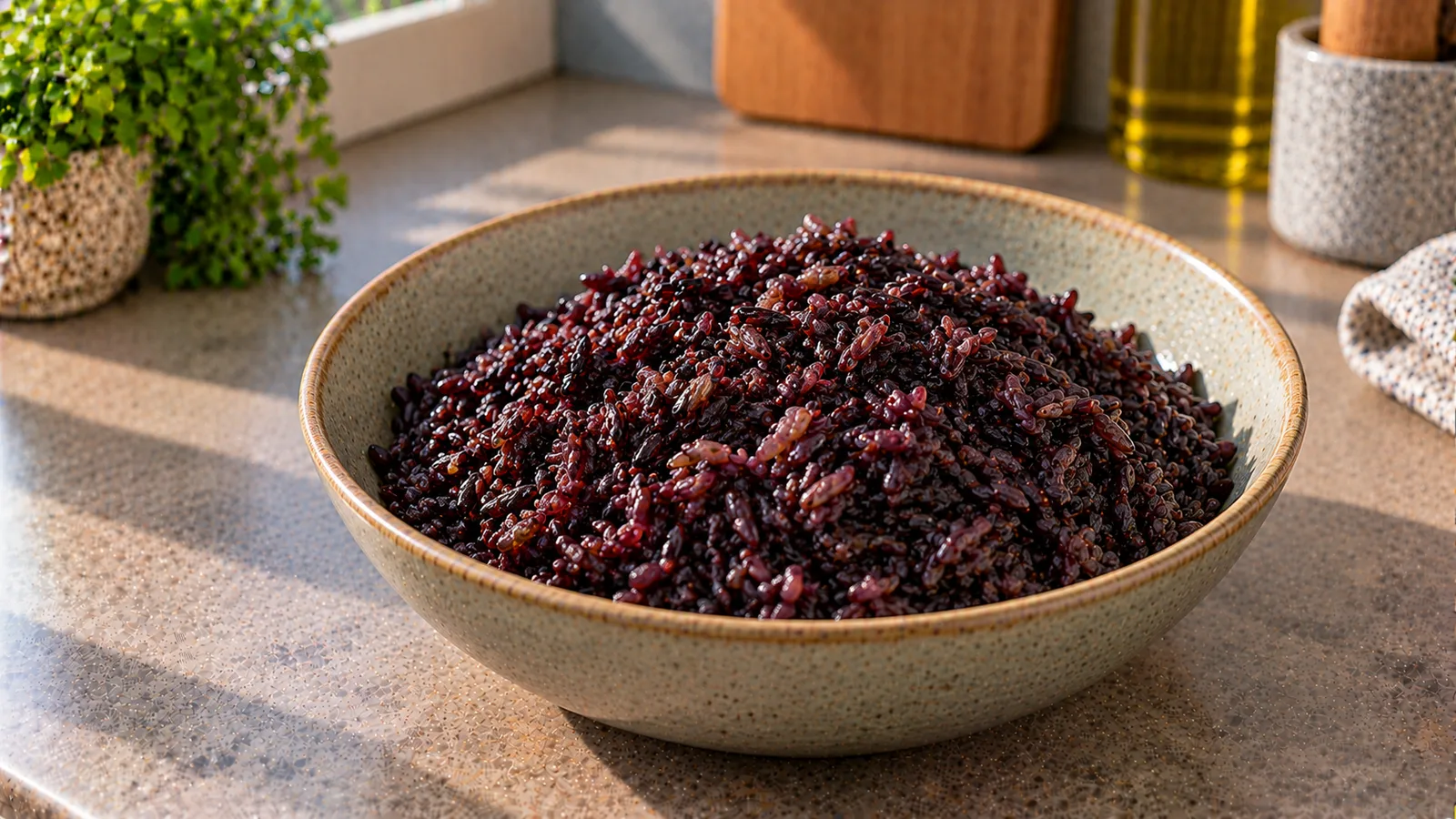
Black rice has different calorie figures depending on whether the grains are dry or already cooked. One dry organic black rice (Bio Nerone) label lists 343 kcal per 100 g, whereas an independent food-composition entry for boiled black rice without oil lists 160 kcal per 100 g. The two figures concern different samples and states; they are not measurements of the same batch before and after cooking.
For meal tracking, the most useful distinction is simple: weigh dry grains against a dry nutrition label, or weigh the cooked rice on your plate against an appropriate cooked entry. Do not log the same grains in both states. Because black rice can absorb different amounts of water, even the cooked figure remains an estimate for your pan.
Black rice nutrition per 100 g: dry versus cooked
The first row is the product declaration for Reishunger organic black Bio Nerone; the second is the TBCA BRC1241A composition record for cooked black rice with no added oil or salt. They have different origins, labelling conventions and moisture contents. Neither row is a universal figure for every cultivar sold as black, purple or forbidden rice.
| Reference per 100 g | Energy | Protein | Carbohydrate | Fat | Fibre | Basis |
|---|---|---|---|---|---|---|
| Dry Bio Nerone (Reishunger) | 343 kcal | 9.9 g | 64 g | 3.4 g | not listed | packaging, dry |
| Boiled black rice, no oil (TBCA) | 160 kcal | 3.5 g | 36.9 g* | 0.3 g | 2.4 g | composition table, cooked |
The Reishunger black-rice product declaration gives 343 kcal, 9.9 g protein, 64 g carbohydrate and 3.4 g fat for 100 g uncooked grains. It does not list a fibre figure in the referenced nutrition panel, so this article does not invent one. The TBCA cooked black-rice record gives 160 kcal, 3.5 g protein, 0.3 g fat and 2.4 g fibre per 100 g. Its 36.9 g total carbohydrate includes 2.4 g fibre; the same source separately identifies 34.5 g available carbohydrate. European package carbohydrate figures are generally expressed as available carbohydrate, so the two carbohydrate columns should not be interpreted as an identical analytical definition.
The TBCA entry is explicitly a cooked food without additional oil or salt, not a rice dish with butter, stock or sauce. The manufacturer's dry values apply to that particular labelled grain, not to every black rice brand. This is especially important when comparing seemingly precise online figures for the same food.
Calories in a dry serving of black rice
These calculations use 343 kcal per 100 g dry from the Reishunger label. All quantities are weighed before cooking. They exclude any calories from oil, nuts, coconut milk or other ingredients. The protein column is based on the same product's 9.9 g protein per 100 g.
| Dry black rice | Calories, 343 kcal/100 g | Protein, 9.9 g/100 g |
|---|---|---|
| 25 g | 86 kcal | 2.5 g |
| 40 g | 137 kcal | 4.0 g |
| 50 g | 172 kcal | 5.0 g |
| 60 g | 206 kcal | 5.9 g |
| 75 g | 257 kcal | 7.4 g |
| 100 g | 343 kcal | 9.9 g |
| 125 g | 429 kcal | 12.4 g |
| 150 g | 515 kcal | 14.9 g |
A 60 g dry portion is approximately 206 kcal before additions. An 80 g dry serving, not shown in the table, would contain about 274 kcal. Dry portions are easy to measure for a shared pot because a scale can record the ingredient once before the grains absorb water. If you cook 60 g for yourself, that portion does not suddenly gain energy because the final rice weighs 140 or 170 g.
Serving size depends on whether black rice is a side, a grain-bowl base or part of a mixed dish. Fifty grams dry alongside tofu and vegetables is a different meal from 125 g dry with rich sauce. A recipe's serving count is only accurate if portions are actually divided accordingly.
Calories in cooked black rice: 50 to 250 g
For the next table, the calculation uses the independent 160 kcal per 100 g cooked TBCA entry. Weights are of edible, prepared rice, without oil, and the fibre estimate uses 2.4 g per 100 g. These are arithmetic estimates, not independent laboratory measurements for every portion.
| Cooked black rice | Calories, 160 kcal/100 g | Fibre, 2.4 g/100 g |
|---|---|---|
| 50 g | 80 kcal | 1.2 g |
| 75 g | 120 kcal | 1.8 g |
| 100 g | 160 kcal | 2.4 g |
| 125 g | 200 kcal | 3.0 g |
| 150 g | 240 kcal | 3.6 g |
| 175 g | 280 kcal | 4.2 g |
| 195 g | 312 kcal | 4.7 g |
| 200 g | 320 kcal | 4.8 g |
| 250 g | 400 kcal | 6.0 g |
For example, 150 g of cooked black rice corresponds to 240 kcal and approximately 3.6 g fibre with this reference. 200 g corresponds to 320 kcal. A bowl can easily hold more or less than 150 g, particularly if rice is mixed with vegetables. The measured food on your plate matters more than the label 'one bowl'. For help distinguishing a reference serving from what was eaten, see portion size versus serving size.
Do not treat 160 kcal/100 g as an inevitable result of simmering black rice. A household pan may finish much wetter or drier than the independently analysed sample. If you have accurate dry weights for a home recipe, the dry-ingredient method can be more consistent than switching between cooked database entries.
Does cooking reduce the calories in black rice?
Water has mass but no calories. Imagine 180 g of dry black rice at 343 kcal per 100 g. The starting grains contain about 617 kcal. Suppose this batch finishes at 450 g cooked, with no grain or starch-containing cooking liquid discarded. As an illustrative yield, that is about 137 kcal per 100 g of the finished batch (617.4 ÷ 450 × 100). It does not mean 160 kcal is 'wrong'; TBCA analysed a different cooked food that may contain less retained water.
If the identical 180 g dry batch instead finishes at 400 g, the estimated density becomes roughly 154 kcal per 100 g, still before extras. A universal 1:2 or 1:3 raw-to-cooked conversion is therefore unreliable. Time, soaking, boiling method, drainage and how much water remains in the kernels affect the final mass.
Now add 10 g of oil actually consumed by the whole 450 g batch. At roughly 9 kcal per gram, that adds 90 kcal. Total estimated energy rises from approximately 617 to 707 kcal, or about 177 kcal for each of four equal shares. Count consumed oil once. If oil stays in the pan, reduce the logged amount; if a premade rice product already includes oil, avoid adding that same fat again.
Is black rice different from brown or wild rice?
Black rice is a pigmented rice, generally a variety of Oryza sativa. Its dark outer layers contain anthocyanins, natural pigments that give cooked grains a purple cast. It is usually sold with the bran layers retained. It is not a separate calorie-free 'superfood', nor does its colour establish a fixed protein or fibre content. A scientific review of coloured rice discusses the diversity of black, red and other pigmented rice varieties, including differences in their plant compounds.
Brown rice also retains grain layers but normally lacks the same dark-purple pigment profile. Both can be useful carbohydrate sources; the nutritional comparison needs actual packages or compatible food tables with the same dry/cooked basis. A rice labelled black-and-brown blend is not equivalent to 100% black rice.
Wild rice is a distinct plant group (Zizania), despite the shared English word 'rice'. Its label and prepared portions should not be copied into a black-rice diary. If your package simply says 'rice' without a variety, our general rice calorie guide is a better starting point; this page specifically addresses black rice and its dry/cooked measurement problem.
Anthocyanins, fibre and the limits of health claims
Anthocyanins are a real nutritional distinction between black and most polished white rice, but laboratory antioxidant activity is not proof that a serving prevents cancer, controls diabetes or treats any condition. The 2025 review of coloured rice composition documents variability among varieties and the need to interpret experimental findings carefully. Pigment concentration is not a calorie measurement.
The TBCA cooked entry provides 2.4 g fibre per 100 g. That is useful context, but it does not establish a 2.4 g value for the Reishunger dry product or for every prepared variety. Black rice is still mainly a starchy grain, not a replacement for diverse vegetables, beans or fruit. If your goal is to plan protein and fibre, judge the entire meal rather than assigning medicinal properties to the grain's colour.
Black rice is naturally gluten-free as a rice grain, although flavoured blends and meals may introduce other ingredients. People who need strict gluten avoidance should check manufacturing and cross-contact information on the particular product. Sweetened black-rice desserts, rice pudding with coconut milk and restaurant sauces require a recipe-level estimate, not a bare rice entry.
Packaged mixes, preparation and food safety
Before using a black-rice package label, check its ingredients and whether the nutrition column is for dry grains, cooked rice or a ready-to-eat pouch. Ready-made grain bowls may add oil, legumes, seeds or dressings; measuring the rice alone will not capture the whole dish. A dry black-rice blend with brown rice or quinoa needs the mixture's own label, because its nutrient profile no longer describes one pure rice type.
Cooked rice requires prompt cooling. Food Standards Scotland's rice storage guidance advises chilling cooked rice as quickly as possible, ideally within one hour, keeping it refrigerated and eating it within 24 hours; reheated rice should be steaming hot throughout and not reheated more than once. These are food-safety rules rather than calorie calculations, and they also apply to black rice.
For consistent tracking, choose one weighing stage, record the correct product or food-table reference and add only ingredients actually eaten. If you have a clearly labelled dry grain, calculate portions from its dry weight; if you only have a restaurant plate, use cooked edible grams and treat the database result as approximate. The differences between 343 and 160 kcal per 100 g are chiefly a reminder to check what the 100 g actually consists of.
Nutrition sources: Reishunger dry Bio Nerone; TBCA cooked black rice, record BRC1241A. Further context: coloured-rice composition review; Food Standards Scotland rice handling.