
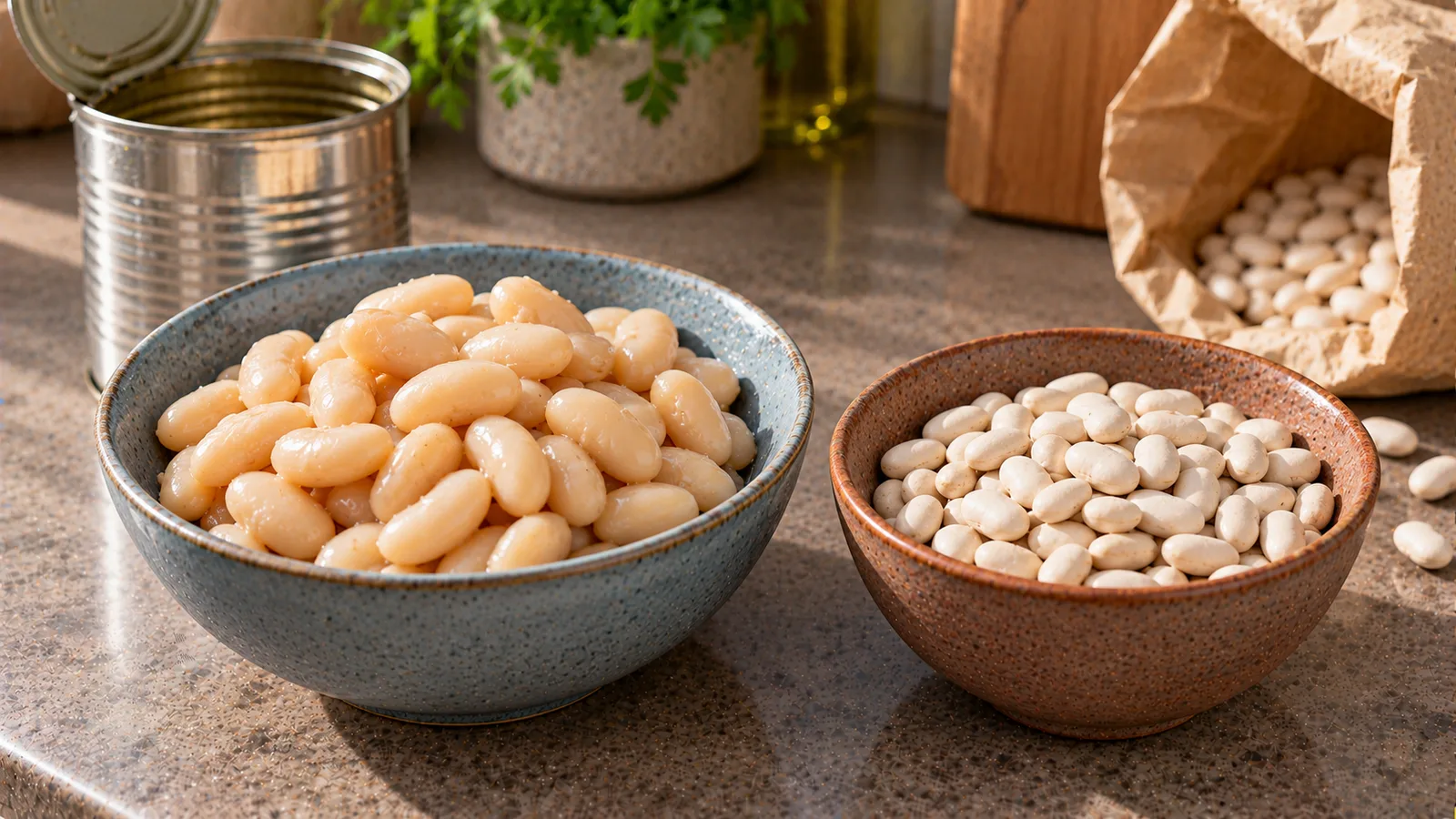
Buying dried beans looks cheaper until the question changes from price per kilogram in the packet to price per kilogram actually eaten. A 500 g bag of uncooked kidney beans is not the same quantity of food as five 400 g cans. The bag absorbs water during cooking; each can includes liquid that may go down the drain. To compare them fairly, weigh or estimate the cooked, drained beans rather than the unopened packaging.
This guide compares canned kidney beans with dried kidney beans cooked at home, using a publicly listed German canned product and a clearly labelled hypothetical price for the dried bag. Our worked example produces 1,200 g of edible beans by either route. At the scenario prices, five cans cost €4.25 and the dry-bean batch costs €2.11 including assumed electricity, but cooking time, safety and convenience may change which option makes sense. Prices do not prove that one format is always cheapest.
The comparison starts with edible weight
A German can sold as 400 g net weight may list only 240 g drained weight. The missing 160 g is largely packing liquid: it is not 160 g of beans to count in a salad. The dmBio kidney-bean product page explicitly gives 400 g total, 240 g drained and, at the time checked, €0.85 per pack. Other brands may use different proportions and prices.
Dried beans work in the opposite direction. They take up water during soaking and cooking. The Oregon State University Extension guide describes about four to six cups cooked from one pound dry, and roughly one and a half to one and three-quarter cups from a standard can. These are volume approximations, not a promise that every bean variety gains the same number of grams. For a gram-based household budget, use a kitchen scale.
| Basis | Canned kidney beans | Dried kidney beans |
|---|---|---|
| Purchased package | 400 g including liquid | 500 g dry beans |
| Assumed edible result | 240 g drained per can | 1,200 g cooked, drained per bag |
| How the yield is defined | Producer's declared drained weight | Illustrative 2.4 × dry-weight yield |
| Preparation | Already heat-treated, ready to serve | Soak as directed, boil fully and drain |
| What not to do | Price 400 g as 400 g beans | Price 500 g as only 500 g cooked beans |
If your dried batch yields 1,050 g rather than 1,200 g, its price per edible 100 g is higher. If it yields 1,350 g, that cost is lower. Record the actual final drained yield if you intend to repeat this comparison regularly.
German cost example: five cans or one dry bag
Here are the complete assumptions, not hidden averages. The canned option is five packs at €0.85 each with 240 g drained per pack. For the dried option we assume a €1.79 price for a 500 g bag, a cooked yield of 1,200 g (the 500 g Suntat dry-bean product confirms the pack format, but not this illustrative price), and €0.32 electricity for the batch. The dry-bag price, electricity cost and cooking yield are editorial assumptions, not a verified shop quote or a measured meter reading. Water, washing-up, storage and the value of your time are excluded.
| Quantity | Canned beans | Cooked from dry |
|---|---|---|
| Purchased | 5 × 400 g cans, 240 g drained each | 500 g dry bag |
| Total edible beans | 1,200 g | 1,200 g |
| Ingredient cost | €4.25 | €1.79 |
| Electricity allowance | €0.00 | €0.32 |
| Total cost | €4.25 | €2.11 |
| Per 100 g edible | €0.35 | €0.18 |
| Per 125 g edible | €0.44 | €0.22 |
| Per 240 g edible | €0.85 | €0.42 |
Both choices provide 1,200 g for eating. The cooked-from-dry batch costs €2.14 less in this particular scenario, or about 50% less when electricity is included. If you use an already heated oven or a pressure cooker, the electricity figure can differ. If your dry beans are more expensive, or you discard part of the batch, the saving shrinks. Note that €0.85 is a visible canned product price, whereas €1.79 is an assumption: the comparison is illustrative rather than a current two-store price survey.
A smaller portion gives a more useful kitchen perspective. At the same assumptions, 125 g edible beans costs around €0.44 canned or €0.22 dried including electricity; 240 g costs €0.85 canned or €0.42 dried. Do not apply either cost to 125 g uncooked dried beans: that represents a different amount of food.
What if the cooked yield or energy cost changes?
The result is not fixed at 2.4 times dry weight. Begin with the dry beans you actually used, drain after boiling and weigh the cooked beans without the pot or water. Divide the ingredient and energy costs by that cooked result. The following sensitivity table holds the €1.79 bag and €0.32 electricity assumptions constant while varying yield.
| Cooked drained yield | Total dry-batch cost | Cost per 100 g edible |
|---|---|---|
| 1,050 g | €2.11 | €0.20 |
| 1,200 g | €2.11 | €0.18 |
| 1,350 g | €2.11 | €0.16 |
Even these examples ignore seasoning, extra oil and equipment wear. For a fair canned comparison, use the same edible variety and recipe. If canned kidney beans replace home-cooked kidney beans in a chili, count the same drained quantity in both versions rather than comparing a can of beans with 500 g dry beans directly.
Cooking fuel is also not automatically free. If you use 0.9 kWh at an illustrative €0.35/kWh, the electricity calculation is €0.315, rounded to €0.32 for the batch. This is an assumed energy scenario, not a measured energy requirement of every bean recipe. Time spent soaking need not consume electricity, while active boiling, appliance efficiency and pan size do.
Nutrition: compare cooked beans, not raw with canned
Kidney beans supply plant protein and dietary fibre whichever format you choose. The German Nutrition Society (DGE) recommends eating pulses regularly and notes their fibre and protein content. However, nutrition panels can differ because of moisture, species, salt, packing liquid and whether the figures refer to the drained beans or the entire contents.
The named dmBio canned beans declare the following per 100 g on their public label: 101 kcal, 7.7 g protein, 6.4 g fibre and 0.35 g salt. These are values for that particular product, not for all canned beans. For home-cooked plain kidney beans the appropriate comparison is a database entry for boiled edible beans, not 100 g raw dried beans. The USDA SR Legacy boiled kidney-bean reference (FDC 173740) is approximately 127 kcal, 8.67 g protein and 6.4 g fibre per 100 g. The USDA record search identifies the reference; the figures are not measurements of the Suntat bag or your home batch.
| Nutrient, per 100 g edible | dmBio canned kidney beans | USDA boiled kidney-bean reference |
|---|---|---|
| Energy | 101 kcal | 127 kcal |
| Protein | 7.7 g | 8.67 g |
| Dietary fibre | 6.4 g | 6.4 g |
| Salt / sodium basis | 0.35 g salt | About 1 mg sodium; unsalted reference |
The rows come from different datasets and products, not two stages of one laboratory trial. A lower number for one canned brand does not prove canning removes a fixed percentage of protein. On an actual grocery trip, compare identical varieties and use the current product labels. Rinsing can also change the sodium and drained weight; the Mealisa guide to rinsing canned pulses covers that separate issue. For a specific bean variety's calorie accounting, use the white-bean calorie reference instead of assuming kidney beans share its exact numbers.
Salt, texture and the time trade-off
Home cooks can choose how much salt to add to their cooking water. Canned products may contain salt, although no-added-salt varieties exist. The canned label's salt line refers to the product's declared nutrition basis, which is not necessarily identical to your rinsed serving. Draining and rinsing may reduce sodium, but it also changes the handling of the product. If sodium matters to you, inspect each can rather than assuming all tins are very salty.
Canned beans are useful when you need dinner immediately, lack a working hob or only want a small serving. They are already cooked. Dried beans offer control over texture, seasoning and batch size but involve sorting, soaking, boiling, cooling, cleaning a pot and reserving fridge or freezer space. The cheapest option on paper is not necessarily the most convenient in a small household.
A large batch also creates a waste risk. If you need just 240 g today, a ready-to-use can may be more practical than producing more than a kilogram of cooked beans with no storage plan. On the other hand, portioning home-cooked beans in freezer containers can make future weeknight dinners almost as convenient as opening a tin. For other food-budget decisions, see Mealisa's protein-and-fibre-per-euro comparison and guide to building a budget grocery list.
Preparing dried kidney beans safely
Dried kidney beans must be cooked properly. The German Federal Institute for Risk Assessment (BfR) warns about lectins such as phasin in raw or insufficiently heated beans. Follow the packaging instructions for soaking and discard the soaking water. Use fresh water and a thorough, sustained boil before simmering until fully tender; do not rely on low-temperature warming or a slow cooker alone to make raw kidney beans safe. The BfR advises soaking dried pulses for at least five hours and thoroughly cooking them in fresh water; follow stricter package instructions when provided. A vigorous initial boil and sufficient overall cooking time are especially important for kidney beans. Canned kidney beans have already been heat-treated and can be eaten without repeating the raw-bean preparation.
After cooking, refrigerate portions promptly in shallow containers. USDA FSIS guidance recommends using most refrigerated cooked leftovers within three to four days, or freezing for later. Follow the label for opened canned beans and transfer them from an opened metal can to a suitable clean container when instructed.
A method you can reuse at the supermarket
Read the drained weight on a canned pack, not just the front-of-pack weight. For dried beans, estimate a yield from previous batches and then replace that estimate with your measured cooked weight. Divide all relevant costs by edible grams, scale to a realistic portion and check whether the cooking time is worthwhile. The price of a dry packet alone cannot tell you the true result.
In our 1,200 g example, dried beans win on ingredient cost even after a modest electricity allowance, while canned beans win on preparation speed. Neither format has an automatic nutritional advantage that applies to every brand, variety and preparation. The useful comparison is like-for-like edible beans, with clear assumptions.
Sources
Source and calculation note: The dmBio price, drained weight and label values come from the linked commercial page; the dry-bag price, yield and energy are illustrative assumptions. Yield ranges and convenience are informed by Oregon State University Extension; bean handling and safety by BfR, FSA and USDA FSIS. This article is a comparison of formats, not a new generic calorie table or an exact household electricity forecast.