
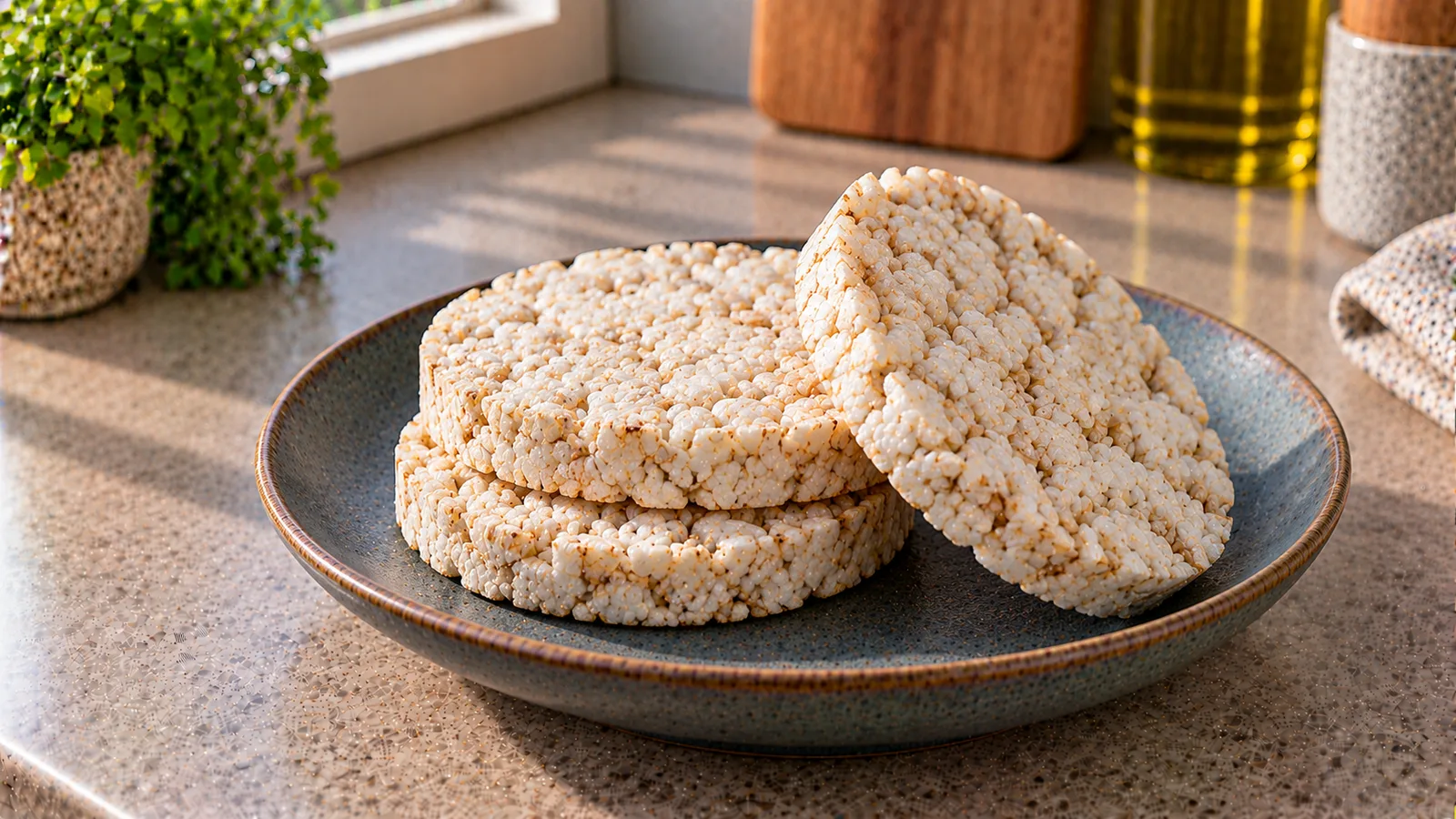
A plain rice cake is light in the hand, but not especially low in calories per 100 g. The USDA's reference for plain, unsalted brown-rice cakes is 387 kcal per 100 g. A cake weighing 9 g works out to about 35 kcal, consistent with the serving stated for Quaker Lightly Salted Rice Cakes. The difference between 35 and 387 is the amount being weighed, not two incompatible nutrition claims.
This guide covers crisp, puffed-rice snack cakes—not Korean tteok, Japanese mochi, rice pudding or cooked rice. The exact calories on your plate depend on the cake's weight, whether it has a coating and what you put on top. Those distinctions matter more than whether a package describes the snack as light or natural.
Rice cake nutrition per 100 g
The first row is the USDA SR Legacy reference for plain unsalted brown-rice cakes. The other rows are specific retail products, included to demonstrate variation rather than to define every rice cake sold worldwide. Nutritional values refer to 100 g of the product as sold.
| Food and reference | Calories | Protein | Fat | Carbohydrates | Fiber |
|---|---|---|---|---|---|
| Plain brown-rice cakes, USDA | 387 kcal | 8.2 g | 2.8 g | 81.5 g | 4.2 g |
| dmBio sesame rice cakes, 99% wholegrain rice | 381 kcal | 8.5 g | 3.7 g | 78 g | 3.4 g |
| dmBio dark-chocolate-coated rice cakes | 488 kcal | 6.6 g | 23 g | 61 g | 5.0 g |
Sources: USDA FoodData Central, plain unsalted brown-rice cakes (FDC 170250), dmBio sesame rice cakes, and dmBio dark-chocolate rice cakes. The chocolate-coated product contains substantially more fat because chocolate constitutes a large part of its ingredients; it is not simply a darker version of the plain snack.
A rice cake is mostly carbohydrate. Plain puffed rice offers some protein and fiber, but the usual small serving supplies less than those per-100-g figures suggest. For example, 9 g of the USDA reference contains approximately 0.74 g protein and 0.38 g fiber. A zero printed on a small US serving label may also reflect nutrient rounding rather than the complete absence of that nutrient.
Calories in one, two or three rice cakes
The next table uses the USDA plain reference of 387 kcal/100 g for every calculation, to make the arithmetic consistent. It is not a substitute for a particular brand's own per-cake label. All results are rounded to whole calories.
| Edible amount of plain cakes | Weight | Estimated calories |
|---|---|---|
| One small cake | 7 g | 27 kcal |
| One example cake | 9 g | 35 kcal |
| Two example cakes | 18 g | 70 kcal |
| Three example cakes | 27 g | 104 kcal |
| Four example cakes | 36 g | 139 kcal |
| Five example cakes | 45 g | 174 kcal |
| Larger weighed snack | 50 g | 194 kcal |
The official Quaker Lightly Salted SmartLabel gives 35 calories per cake (9 g), supporting the practical one-cake example. Some brands sell thinner or smaller cakes, so it would be misleading to log every individual cake as 35 calories regardless of size. A package might use two small cakes for its recommended serving instead of one large one.
The basic calculation is grams eaten × kcal per 100 g ÷ 100. At 387 kcal/100 g, 24 g of plain cakes contributes about 93 kcal. If you do not know the weight, first check the package's serving weight and number of pieces, or weigh a few intact cakes and find their average. Crumbs and pieces still count by weight, even when they cannot be counted as whole cakes.
Why a rice cake feels big but weighs little
Puffing creates a large, crisp shape with many air spaces. Air takes up space but contributes no meaningful food energy. That is why one round cake looks much bigger than its 9 g weight would suggest. The dry finished product, however, has little water and relatively high energy per 100 g. Large-looking is not the same as high-satiety, and low calories per piece are not evidence of a special metabolic effect.
This is different from cooked rice, which contains considerably more water. Do not apply the calorie figure for a bowl of cooked rice to 100 g of dry puffed cakes, or use 387 kcal/100 g to log a plate of boiled rice. The Mealisa rice calorie and portion guide explains that separate food state in detail. Both products start with rice, but their water contents and practical weights differ substantially.
Plain, salted, sesame and chocolate: what changes?
Plain and lightly salted rice cakes can have similar calories while containing different amounts of sodium. Quaker's cited product contains 15 mg sodium per 9 g cake; salt-free versions are another product and should be checked separately. Sesame, seeds and oils can affect fat and allergen content even if the total energy looks similar to a plain cake. The dmBio sesame reference lists 1% sesame, so it is not suitable for someone with a sesame allergy merely because its ingredient list is short.
Chocolate coatings change the calculation far more than a small pinch of salt. The cited dmBio dark-chocolate version reports 488 kcal per 100 g, compared with 387 kcal for the USDA plain reference: a difference of 101 kcal per 100 g. At an equal hypothetical weight of 9 g, that would be approximately 44 versus 35 kcal. It does not follow that the chocolate product's actual cake weighs 9 g; coated pieces often have a different weight. Use the actual per-piece amount where available.
Other flavored versions may include syrups, sugar, spices, cheese powder or added oils. “Brown rice,” “organic,” “wholegrain” and “gluten-free” do not tell you the calories of the finished product. For a package with a coating, the finished-product label is more reliable than the nutritional value of plain rice cakes plus a guessed amount of chocolate.
Toppings can add more calories than the cakes
Consider two plain 9 g rice cakes, about 70 kcal combined using the USDA reference. The examples below use hypothetical topping label values to demonstrate arithmetic; they are not claims about an unnamed manufacturer's product. Check your own packaging before logging a meal.
| Combination | Assumption for topping | Estimated total |
|---|---|---|
| Two plain 9 g cakes | No topping | 70 kcal |
| Two cakes + 15 g peanut butter | Peanut butter assumed 600 kcal/100 g: 90 kcal | 160 kcal |
| Two cakes + 60 g cottage cheese | Cottage cheese assumed 90 kcal/100 g: 54 kcal | 124 kcal |
At a different brand's peanut-butter density, the combined total would change. A thick unweighed layer of nut butter can easily make the cakes the smaller part of the snack's energy. Likewise, cream cheese, hummus, avocado, jam and chocolate spread should each be entered with their own actual amount. Count the rice cake once, then its toppings once; do not use a finished “rice cake with peanut butter” database entry and add peanut butter again.
For perspective, bread calories and serving sizes are useful when deciding between rice cakes and toast. Compare the grams of the actual bread slices with the grams of cakes, plus toppings, rather than comparing one slice and one cake as though they were identical portions.
Are rice cakes filling or a good source of fiber?
They can be a convenient crunchy base, but plain rice cakes are not particularly high in protein or fiber per piece. The USDA reference is about 8.2 g protein and 4.2 g fiber per 100 g; at 18 g, that is roughly 1.5 g protein and 0.8 g fiber. Those figures are too small to make two plain cakes a substantial protein-rich snack on their own.
A topping with protein, fat or fiber—or fruit and vegetables on the side—can make a snack more substantial. This does not mean every snack must be high in all three nutrients. If you are hungry soon after a plain rice cake, the relevant question is what else is in the meal and how much you ate, not whether puffed rice is intrinsically unhealthy. Compared with rice cakes, a measured portion of oats can be used for a different breakfast texture and fiber profile; it should not be equated piece-for-piece.
Buying, allergies and realistic portion tracking
Read the label for the precise flavor, kcal per 100 g, net package weight, serving grams, salt or sodium and allergens. A gluten-free claim on a specific certified product does not make every flavored rice snack safe for someone with celiac disease; check the actual package. Chocolate and yogurt coatings can introduce milk or soy, and seed versions can introduce sesame. This is particularly important when several similar packets share a shelf.
Children and adults can eat rice products as part of a varied diet, but it is sensible not to rely on one rice-based snack as the sole staple. The present calorie estimates do not evaluate contaminants or suitability for babies; those are separate food-safety questions, and age-specific advice should not be inferred from an adult calorie table.
The distinction between the labeled serving and the amount actually eaten matters whenever you take several cakes from the packet. Mealisa's guide to portion size versus serving size helps interpret that difference. The most reproducible diary entry is the specific product plus grams consumed, including any coating, followed by separate measured toppings.
In short, a 9 g plain rice cake is a reasonable 35-kcal estimate, but the same food is approximately 387 kcal per 100 g. Both statements are true. For accurate tracking, prioritize the real product label, the actual number and weight of pieces, and the ingredients served with them. The reference values above are not a promise that every rice cake weighs 9 g.