
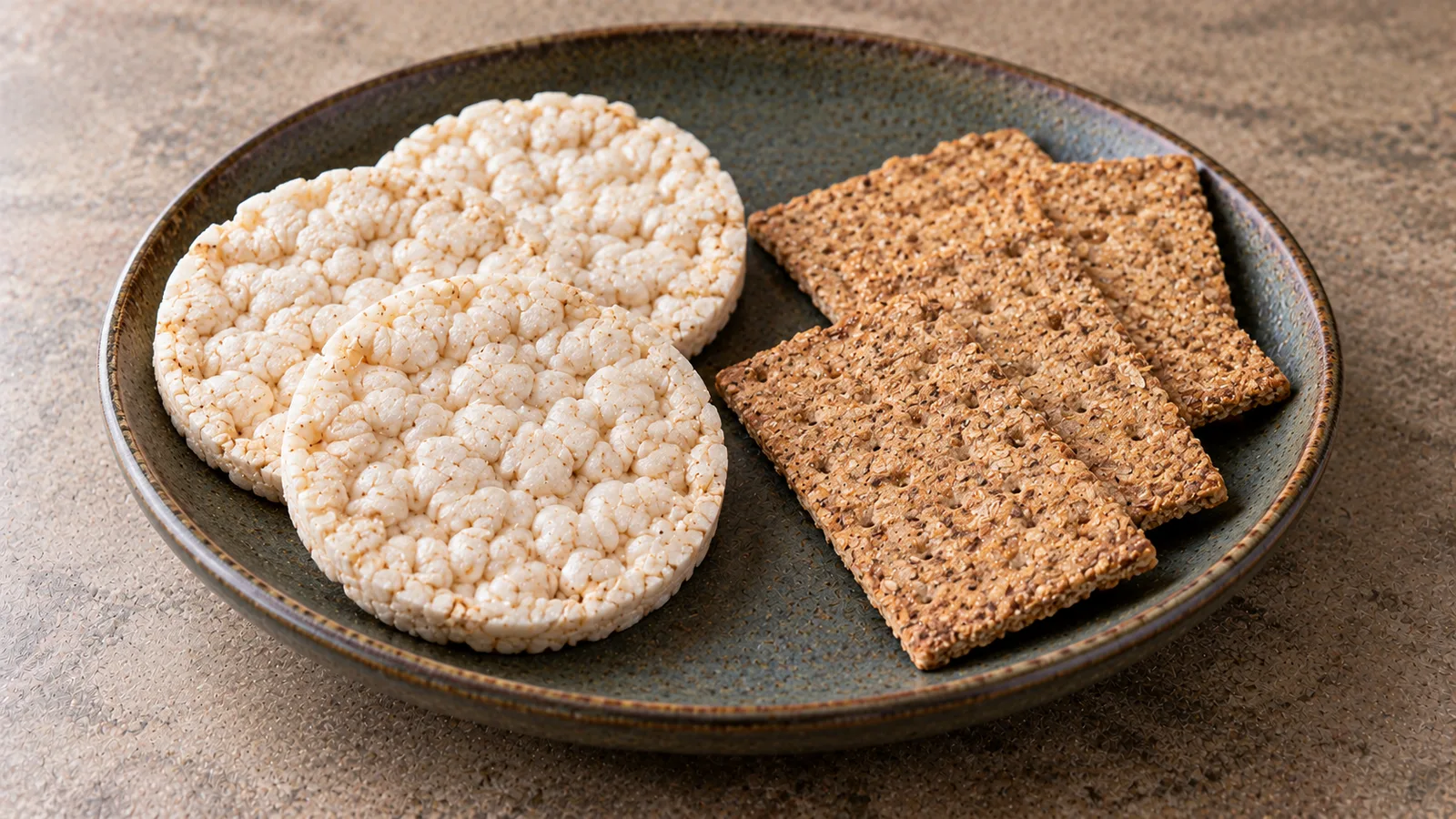
Rice cakes often seem like the obvious lighter snack: each disc weighs very little, feels airy, and may be advertised as gluten-free. Wholegrain crackers look denser and can carry more calories per 100 g. But a useful comparison asks three different questions: what does the label say per 100 g, how much do you actually eat, and what happens after you add toppings? These questions matter more than the number of pieces in an open packet.
This article uses two specifically identified German supermarket products as an auditable example: dmBio Rice Cakes with Sesame (Reiswaffeln Sesam) and dmBio Plain Spelt Crackers (Cracker Dinkel natur). The first contains 99% wholegrain rice and 1% sesame; the second lists 88% wholegrain spelt flour, rapeseed oil and salt among its ingredients. They are not representative of every rice cake or every cracker. The figures below come from their published rice-cake nutrition label and spelt-cracker nutrition label. Check the package in your hand because recipes and labels can change.
The prices are a transparent hypothetical shopping model, not verified current dm shelf prices: €0.99 for a 100 g pack of the rice cakes and €1.49 for a 100 g pack of the crackers. Both packages are assigned the same weight solely to isolate price per edible gram. If you shop elsewhere, replace those inputs with actual pack weights and checkout prices.
What the labels actually compare
The crackers contain more energy, fat, protein, fibre and salt per 100 g. The rice cakes have more carbohydrate but far less declared salt. The difference in fibre is real for these two labels, even though the rice cakes are also made from wholegrain rice. “Wholegrain” describes the ingredient; it does not promise the same fibre quantity across processed products.
| Label value per 100 g | Rice cakes with sesame | Wholegrain spelt crackers |
|---|---|---|
| Energy | 381 kcal | 426 kcal |
| Protein | 8.5 g | 14 g |
| Fibre | 3.4 g | 8.9 g |
| Carbohydrate | 78 g | 61 g |
| Fat | 3.7 g | 12 g |
| Salt | less than 0.01 g | 1.9 g |
| Assumed pack price, 100 g | €0.99 | €1.49 |
There is no need to convert the 100 g rows into a judgement about an entire snack. Nobody should assume a thin rice cake and a small cracker weigh the same. Nor should the energy difference be interpreted as a prediction of fullness: texture, water intake, toppings and the wider meal influence the experience. These are packaged-food composition figures, not results of a satiety experiment.
Notice the salt contrast. The spelt product reports 1.9 g salt per 100 g, so 25 g contributes about 0.48 g before anything is spread on top. The rice product reports less than 0.01 g per 100 g, not exactly zero. Preserve that inequality rather than writing “0 g” in a food diary. For a person watching sodium, the cracker's advantage in fibre may come with an important trade-off.
Compare edible grams, not the number of pieces
A fair test starts by placing an actual snack portion on a kitchen scale. For a light snack base, 20–30 g is a useful comparison range; it is not a universal serving recommendation. A rice cake can weigh only a few grams, while cracker sizes vary considerably. Count out the pieces you normally eat, weigh them together, and apply the label to that mass.
For a 25 g portion, take every label number and multiply by 0.25. The rice cakes supply about 95 kcal and 0.85 g fibre; the crackers supply around 107 kcal and 2.23 g fibre. The energy difference is only about 11 kcal, whereas the fibre difference is about 1.38 g. The crackers also bring more protein and substantially more salt.
| Measured snack base | Rice cakes: kcal / fibre / cost | Crackers: kcal / fibre / cost | Difference in fibre |
|---|---|---|---|
| 20 g | 76.2 kcal / 0.68 g / €0.20 | 85.2 kcal / 1.78 g / €0.30 | +1.10 g |
| 25 g | 95.3 kcal / 0.85 g / €0.25 | 106.5 kcal / 2.23 g / €0.37 | +1.38 g |
| 30 g | 114.3 kcal / 1.02 g / €0.30 | 127.8 kcal / 2.67 g / €0.45 | +1.65 g |
All money figures in this table follow the hypothetical €0.99/100 g and €1.49/100 g inputs. Rounded cents may differ from calculations made with unrounded prices. When comparing your own packets, use the difference between an actual portion and a stated serving size rather than borrowing the manufacturer's suggested number of pieces without weighing them.
Why calories alone are a poor shortcut
Per 100 g, the rice cakes are lower by 45 kcal. Per 25 g, that becomes only 11.25 kcal. If a person chooses an extra rice cake because the first three look insubstantial, the absolute intake can easily converge with—or exceed—that of a weighed cracker snack. This does not make rice cakes misleading; it means an airy food's large apparent volume can conceal a small weight.
The crackers include rapeseed oil, which helps explain some of their higher fat and energy values. But the comparison is not “oil is bad, air is good.” Fat can be part of a satisfying snack, and the overall nutritional choice depends on what else is eaten. The measured benefit here is that this cracker product gives more fibre and protein per gram, not that it guarantees longer-lasting fullness for every person.
Energy tracking should also distinguish plain from coated rice cakes. Chocolate-coated or yoghurt-coated products have a different composition because a significant share of the snack is coating rather than puffed grain. Likewise, a cracker seasoned with cheese or herbs may contain very different salt and fat levels. These two example labels cannot be copied into a tracker for a different product that merely shares the words “rice cake” or “wholegrain.”
Fibre: the legal label claim is not your portion
In the European Union, the authorised “source of fibre” condition is at least 3 g fibre per 100 g or at least 1.5 g per 100 kcal. The “high fibre” threshold is at least 6 g per 100 g or at least 3 g per 100 kcal. These are alternative thresholds; it would be wrong to state that both conditions must be met. See Regulation (EC) No 1924/2006.
Using the per-100-g route, the selected rice cakes meet the numerical threshold for “source of fibre” at 3.4 g, while the spelt crackers exceed the “high fibre” threshold at 8.9 g. That observation is a check against the regulation, not a claim that either packet currently prints those exact promotional words. Legal claims have other general conditions and must not mislead consumers.
A 25 g rice-cake portion contributes just 0.85 g fibre. A 25 g cracker portion contributes 2.23 g. For context, the German Nutrition Society (DGE) uses an adult guiding value of at least 30 g fibre per day, as explained in its fibre FAQ. Neither snack is a substitute for a varied fibre-rich diet. The most useful broader comparison is Mealisa's guide to high-fibre foods, where larger portions of legumes, vegetables and whole grains can be compared.
The same packaging nuance applies to the word “wholegrain.” Both example products contain wholegrain ingredients, yet they have different ingredient proportions, processing methods and fibre concentrations. Read the number of grams rather than treating a front-of-pack word as a fixed nutrient score.
What changes when you add hummus?
Plain crackers or cakes are rarely the whole eating occasion. Toppings can outweigh the base in calories, protein, fibre, salt and cost. To demonstrate this without pretending to know a particular shop's hummus recipe, assume a hypothetical hummus with 200 kcal, 6 g protein, 4.5 g fibre and 1.0 g salt per 100 g. Assign it a made-up price of €1.59 for 200 g, and use 40 g of it on a 25 g snack base.
| Snack as eaten | Energy | Protein | Fibre | Illustrative cost |
|---|---|---|---|---|
| 25 g rice cakes, plain | 95.3 kcal | 2.13 g | 0.85 g | €0.25 |
| 25 g spelt crackers, plain | 106.5 kcal | 3.50 g | 2.23 g | €0.37 |
| 25 g rice cakes + 40 g model hummus | 175.3 kcal | 4.53 g | 2.65 g | €0.57 |
| 25 g crackers + 40 g model hummus | 186.5 kcal | 5.90 g | 4.03 g | €0.69 |
These are calculated examples, not nutrient declarations for a hummus brand or ready-to-eat product. The hummus adds 80 kcal, 2.4 g protein, 1.8 g fibre and about €0.32 to either base. It also adds 0.40 g salt in this model. That raises the modelled rice snack to just over 0.40 g salt and the cracker snack to about 0.88 g. A real hummus recipe might have a different salt or oil content, so transfer the real label into your calculator before making dietary decisions.
The point is not to recommend 40 g as a target. A thinner spread will change the totals; a thicker spread changes them again. If you prefer yoghurt cheese, avocado or peanut butter, the numbers must be recalculated from that ingredient rather than treated as interchangeable “healthy toppings.” A topping may improve protein or fibre but can add calories, allergens or salt at the same time.
Price per snack, versus price per gram of fibre
At the assumed shelf prices, the plain 25 g rice-cake base costs about €0.25 and the cracker base €0.37. On a tight budget, the rice cakes are cheaper per equal gram of snack. But there is a second question: how much do you spend to obtain a gram of fibre from the base itself? Using unrounded values, the model yields about €0.29 per gram of fibre for rice cakes and €0.17 per gram for crackers. The cracker is dearer to eat by weight but less expensive per gram of this one nutrient.
Do not turn the fibre-price ratio into a shopping instruction to eat large amounts of salted crackers. Such a ratio ignores energy, sodium, preferences and everything else in the day. It is more useful as a transparent way to compare the same metric under a stated set of prices. Mealisa's separate comparison of protein and fibre per euro of groceries helps when several different foods compete for the same budget.
The checkout cost is another distinct metric. Buying one 100 g packet of each would cost €0.99 and €1.49 in our assumed example, even though you consume only a fraction during one snack. If hummus is added, the full illustrative 200 g tub costs another €1.59, not just the €0.32 allocated to one 40 g portion. Record leftovers as available pantry stock rather than silently calling them free, and check the product's storage instructions after opening.
Salt, ingredients and allergies deserve their own line
The crackers' salt value deserves attention even if fibre is your priority. At 30 g, 1.9 g salt per 100 g becomes 0.57 g salt before spreads, cheese or savoury toppings. The rice cakes' salt is labelled below 0.01 g per 100 g. Those are data for two specific products, not a rule that all wholegrain crackers are salty or that all rice cakes are unsalted. Look at the row marked “salt” or “Salz” on every European label.
The ingredient list matters as much as the numbers. The selected rice cakes contain sesame, which is a relevant allergen, and their listing is described as gluten-free. The selected crackers are made with spelt, a wheat species, plus barley malt flour; they are not a gluten-free substitute. People with coeliac disease or food allergies should use the exact pack's allergen information, including precautionary statements, rather than relying on a broad food category.
The EU's nutrition-labelling guidance explains that calories, fats, carbohydrates, sugars, protein and salt are generally mandatory on prepacked foods; fibre may be declared voluntarily. The two labels used here do supply fibre values. When a different product does not, do not invent a number from its marketing name.
Does puffed rice make you fuller than a dense cracker?
A visually large rice cake can feel like a generous piece despite being light. A dense cracker may be smaller but more nutrient-packed per gram. Neither observation establishes a universal rule for appetite. The number of pieces you eat, eating speed, crunch, toppings, beverage, meal timing and individual preference can change how filling the snack feels. There is no controlled head-to-head satiety trial underlying this article's two shopping-label examples.
If you want to test what works for you, compare equal weighed bases and a similar topping over several ordinary snack occasions. Note whether you actually enjoy the texture and whether you reach for another snack soon after. Such personal observations are not clinical evidence, but they may help you select a convenient portion. If the goal is a more substantial snack, the wholegrain bread versus protein bread comparison explores a different food format; it should not be confused with this comparison of puffed rice cakes and crisp crackers.
Do not claim that rice cakes “have no nutrients” merely because they are light, or that wholegrain crackers “cause weight gain” because 100 g contains more calories. Body weight trends concern overall food intake and other factors over time. This article can answer a packaging and portion question, not diagnose metabolic responses.
What about rice products and arsenic?
Rice and rice-based products can contain inorganic arsenic from their growing environment. Germany's Federal Institute for Risk Assessment (BfR) recommends variety among grains, including for rice snacks, rather than advising everyone to eliminate rice. The agency specifically says rice cakes and similar products should be eaten in moderation and varied with products made from other cereals, and advises particular attention to variety in children's diets. Read the BfR rice-and-arsenic FAQ.
This is a relevant context point, not a measurement of the two products studied here. We have no laboratory arsenic result for this rice-cake packet and cannot infer one from its nutrition label. Nor does choosing these particular crackers guarantee a lower exposure to every undesirable substance. For most everyday meal planning, dietary variety is a more defensible principle than fear of an isolated ingredient.
How to compare your own packets in a supermarket
Start with the two actual packets rather than a generic comparison chart. Photograph or read each nutrition panel, and make sure that the printed table refers to 100 g of the edible, ready-to-eat product. Write down calories, protein, fibre and salt if listed. Read the ingredient list for whole grains, oils, added sugar and allergens. Choose a portion that matches what you will actually eat, such as 20, 25 or 30 g, and weigh it on a kitchen scale.
Next, calculate each nutrient as label amount × portion grams ÷ 100. Divide the checkout price by net pack weight and multiply by the portion used to get the consumed-food cost. If toppings are involved, add their own weighted nutrition and cost once, not to the per-100-g base and again to the finished snack. Round only when presenting the answer; otherwise repeated rounding can move the totals by a cent or more.
For example, 25 g of the labelled crackers costs €1.49 × 25 ÷ 100 = €0.3725 in the hypothetical pack model, displayed as €0.37. The same amount contains 426 × 25 ÷ 100 = 106.5 kcal and 8.9 × 25 ÷ 100 = 2.225 g fibre, displayed as about 2.23 g. These are straightforward calculations, but they turn an abstract product claim into a realistic snack comparison.
Which one is the better buy?
Choose according to the nutritional feature and practical constraint that matters most to you. The rice-cake example offers a light, low-salt, gluten-free-labelled base at a lower assumed price per 25 g. The spelt cracker offers more fibre and protein at that weight, but more energy and markedly more salt; it contains gluten. Neither wins every category, and different brands can reverse some comparisons. Toppings may matter more than the plain base for a finished snack.
If you already have a protein-rich or fibre-rich topping, a neutral rice cake may be exactly what you need. If your snack is mostly the base and your diet needs more fibre, the specific wholegrain crackers may make better use of the same 25 g. If limiting sodium or avoiding gluten is essential, that changes the answer. Most importantly, weigh what you eat, include the topping, and use the real price of your own pack.
Sources
- dmBio Reiswaffeln Sesam: ingredient list and nutrition per 100 g.
- dmBio Cracker Dinkel natur: ingredient list and nutrition per 100 g.
- EU Regulation (EC) No 1924/2006: fibre nutrition-claim thresholds.
- European Commission: mandatory and voluntary nutrition labelling.
- DGE: frequently asked questions about dietary fibre.
- DGE: why whole grains matter.
- BfR: arsenic in rice and rice products—questions and answers.