
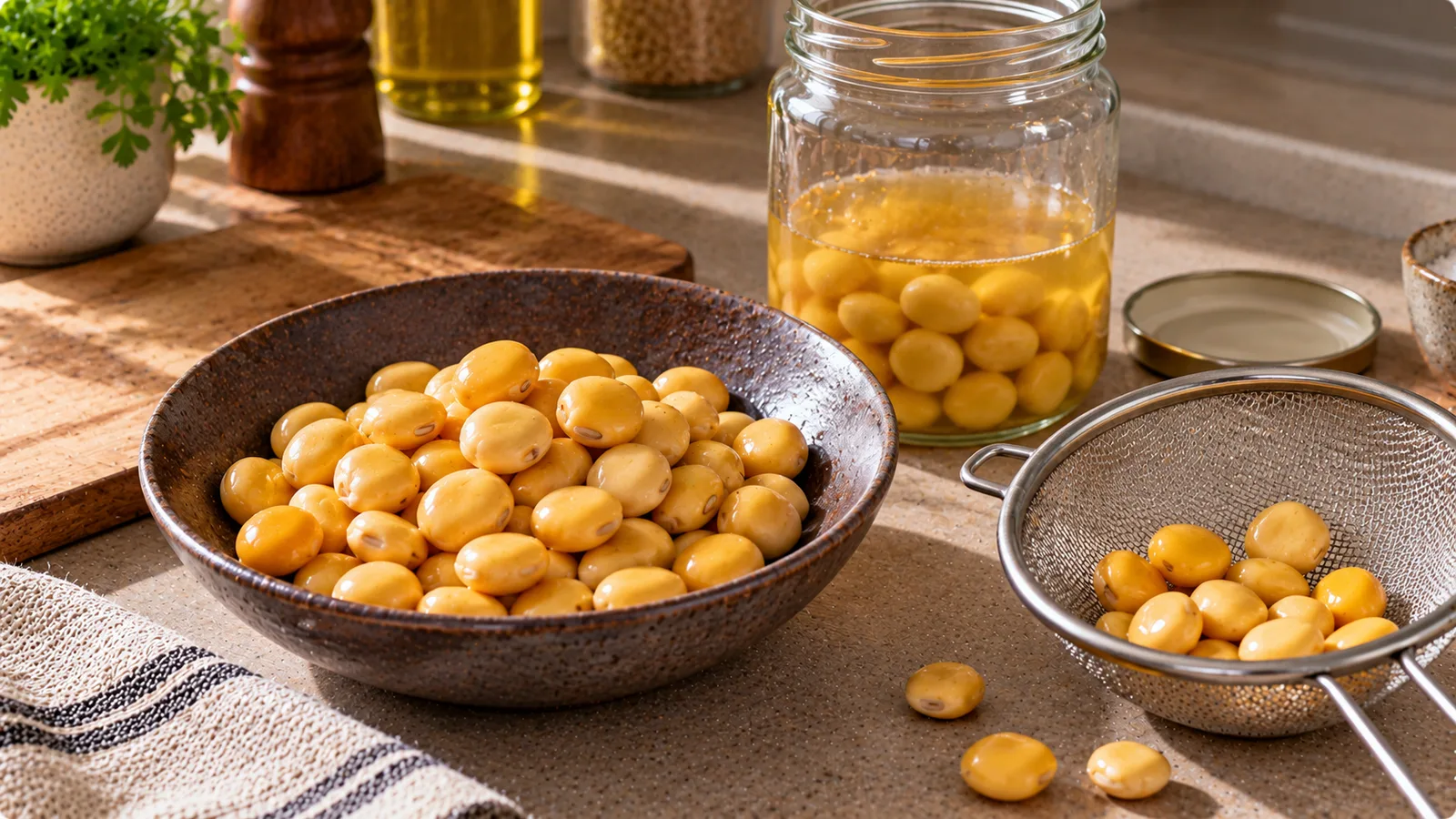
Lupin beans, also called lupini beans, are protein-rich legumes traditionally eaten around the Mediterranean and increasingly used in plant-based foods.
They can be served as a snack, added to salads or processed into flour and other ingredients. Their nutritional composition is distinctive: compared with many other legumes, lupin beans can provide substantial protein and fiber with relatively little digestible carbohydrate.
But there is no single calorie value that applies to every form of lupin.
Cooked lupin beans, canned lupini beans, dry lupin seeds and lupin flour must be tracked separately. Water content, processing, brine and edible portion size all influence the numbers.
How many calories are in lupin beans?
For a practical starting point, some cooked, hydrated lupin bean entries provide approximately 110–140 kcal per 100 g.
This is an orientation range, not a guaranteed value for every variety or commercial product. Some ready-to-eat products have nutritional values outside this range.
| Edible portion | Illustrative calories |
|---|---|
| 30 g | 33–42 kcal |
| 50 g | 55–70 kcal |
| 75 g | 83–105 kcal |
| 100 g | 110–140 kcal |
| 150 g | 165–210 kcal |
| 200 g | 220–280 kcal |
These calculations apply the same illustrative 110–140 kcal per 100 g range to each portion.
For a packaged product, the nutrition declaration is more reliable than a generic estimate.
Importantly, these weights refer to the edible beans, not the combined weight of beans, shells and packing liquid.
Lupin bean nutrition per 100 g
The following table gives approximate reference ranges for hydrated, ready-to-eat lupin beans.
| Nutrient | Approximate amount per 100 g |
|---|---|
| Calories | 110–140 kcal |
| Protein | 14–17 g |
| Total carbohydrates | Varies by database and labeling method |
| Fiber | 4–8 g |
| Fat | 2–4 g |
| Sodium | Highly variable, especially in brine |
The table represents general orientation values, not a matched laboratory analysis of one product.
Carbohydrate figures require particular care. In some food databases, total carbohydrate includes fiber, while EU nutrition labels report carbohydrate separately from fiber.
Therefore, carbohydrate numbers from different sources cannot always be compared directly.
The specific variety, processing method and manufacturer may also change the nutritional profile.
Cooked versus canned lupin beans
The most important distinction is not simply whether beans come from a can or a cooking pot. It is their water content and edible weight.
| Form | What to check | Why it matters |
|---|---|---|
| Dried lupin beans | Dry-weight nutrition | Much more concentrated than hydrated beans |
| Cooked lupin beans | Weight after cooking | Water absorption changes calories per 100 g |
| Canned or jarred lupini | Drained weight and label | Brine adds package weight without adding bean calories |
| Lupin flour | Flour nutrition label | Dry flour is not comparable with cooked beans |
| Roasted lupin snacks | Added oil and final weight | Drying and seasoning can increase calorie density |
Do not apply dry-bean nutritional values to the same weight of cooked beans.
Likewise, do not use the total contents of a jar as the edible serving weight when the jar contains substantial brine.
How to calculate calories from a jar
Imagine a jar labeled:
- Net weight: 350 g.
- Drained weight: 220 g.
- Energy: 125 kcal per 100 g of drained product.
If you eat 80 g of drained beans:
80 × 125 ÷ 100 = 100 kcal.
If you eat the entire drained contents:
220 × 125 ÷ 100 = 275 kcal.
The net weight of 350 g is not the correct basis when the nutrition declaration applies to the drained beans.
Always check the manufacturer's wording. Some labels describe the product as sold, while others specify drained values.
What if the beans have skins?
Lupini beans are sometimes eaten by squeezing the inner bean out of its outer skin.
If you discard the skins, weigh the edible beans when practical.
A 100 g serving weighed with discarded skins included does not necessarily provide the same nutrition as 100 g of edible beans.
This distinction matters most when you want precise tracking rather than a rough estimate.
How much protein do lupin beans contain?
Protein is one of the main nutritional reasons people choose lupin beans.
Some hydrated lupin products provide around 14–17 g protein per 100 g.
| Edible portion | Approximate protein |
|---|---|
| 50 g | 7–8.5 g |
| 100 g | 14–17 g |
| 150 g | 21–25.5 g |
| 200 g | 28–34 g |
These are illustrative calculations. Actual protein content varies by product.
Lupin beans can help increase protein intake in vegetarian and vegan meals.
They also provide fiber, which makes them nutritionally different from concentrated protein powders.
As with other plant foods, it is sensible to consume a variety of protein sources across the day.
Are lupin beans low in carbohydrates?
Lupin beans can contain relatively little digestible carbohydrate compared with many other legumes.
However, carbohydrate claims depend on the measurement system.
On European labels:
- Carbohydrate generally refers to available carbohydrate.
- Fiber is listed separately.
- Sugars are included within carbohydrates.
In some US databases, total carbohydrate may include fiber.
This can make two apparently similar lupin products look very different on paper.
When comparing products, use labels prepared under the same labeling system whenever possible.
Do not subtract fiber from an EU carbohydrate value a second time.
How much fiber is in lupin beans?
Hydrated lupin beans can be a useful source of dietary fiber.
An illustrative 100 g serving may contain around 4–8 g fiber, depending on the variety and processing.
Fiber contributes to the nutritional value of legumes, but suddenly increasing fiber intake may cause bloating or digestive discomfort in some people.
If you do not regularly eat legumes, starting with a smaller serving and increasing gradually may be more comfortable.
Drink fluids normally and consider the total fiber intake from the rest of your meals.
Lupin beans versus chickpeas and lentils
All three foods belong to the legume family, but they differ in composition.
| Food | Common nutritional characteristic |
|---|---|
| Lupin beans | Often particularly protein-rich relative to available carbohydrate |
| Chickpeas | Supply protein, fiber and substantial starch |
| Lentils | Supply protein, fiber and carbohydrate; usually eaten cooked |
Exact calorie comparisons depend on whether the foods are dried, cooked, canned or drained.
For example, comparing 100 g of dry lentils with 100 g of ready-to-eat lupini beans would be misleading.
A useful comparison uses the same edible state and a clearly defined 100 g portion.
Are lupin beans good for weight management?
Lupin beans can fit into a balanced eating pattern for weight maintenance or weight loss.
They offer protein and fiber, two nutrients commonly considered when building satisfying meals.
However, the effect of a meal depends on its full composition and your overall energy intake.
A small portion of lupini beans eaten as a snack is different from a large salad containing lupin beans, oil, cheese, bread and dressing.
For accurate calorie tracking, include the other ingredients rather than treating the beans as the entire meal.
No single legume automatically causes weight loss.
Are salted lupini beans high in sodium?
Many ready-to-eat lupini beans are stored in salted brine.
The salt content can vary substantially.
A product that is moderate in calories may still contain a meaningful amount of sodium.
Read the nutrition label, particularly if you are managing your salt intake.
Rinsing may remove some surface brine, but it does not guarantee a specific reduction in sodium.
Use the manufacturer's values unless you have reliable information about the effect of rinsing on that particular product.
Important: lupin allergy
Lupin can cause serious allergic reactions.
Lupin allergy is especially relevant for people with peanut allergy because cross-reactivity can occur, although not everyone with peanut allergy reacts to lupin.
In the European Union, lupin is one of the allergens that must be declared when used as an ingredient in foods.
Lupin may appear in bread, baked goods, pasta, gluten-free products, meat substitutes and protein-enriched foods.
People with known or suspected lupin allergy should avoid the relevant products and seek individual advice from a qualified healthcare professional.
Do not assume a product is safe merely because it is labeled plant-based or gluten-free.
For EU allergen-labeling information, see the European Commission's food information guidance.
Important: not all lupin beans are ready to eat
Some varieties of lupin contain naturally occurring bitter quinolizidine alkaloids.
These compounds can be toxic if beans are not processed correctly.
Do not eat raw or inadequately prepared bitter lupin beans.
Commercially prepared, ready-to-eat lupini beans are different from untreated dried seeds.
If buying dried lupin beans, follow verified, product-specific preparation instructions. Traditional debittering can require prolonged soaking and repeated water changes, and processing needs depend on the variety.
Do not rely on a short generic cooking time or taste alone to establish safety.
When in doubt, choose a reputable ready-to-eat product rather than attempting to prepare unidentified dried lupin seeds.
How to track lupin beans accurately
Use this sequence:
- Identify whether the product is dry, cooked, canned, roasted or flour.
- Read the calories per 100 g for the exact product.
- Determine whether the label refers to drained beans.
- Remove and exclude packing liquid when appropriate.
- Account for discarded skins if measuring the edible portion.
- Weigh the amount actually consumed.
- Record oil, dressings and other additions separately.
Example: lupin bean salad
Suppose you prepare a salad with:
| Ingredient | Quantity |
|---|---|
| Drained lupini beans | 120 g |
| Tomatoes | 150 g |
| Cucumber | 100 g |
| Olive oil | 10 g |
| Lemon juice | 15 ml |
| Herbs | To taste |
If the lupin label states 125 kcal per 100 g, the beans contribute:
120 × 125 ÷ 100 = 150 kcal.
The olive oil contributes approximately 90 kcal.
Vegetables and lemon juice add further calories, so the entire salad must be calculated rather than logging only the lupin beans.
Practical serving ideas
| Use | Illustrative edible lupin portion |
|---|---|
| Small snack | 40–60 g |
| Salad topping | 60–100 g |
| Main salad protein | 100–150 g |
| Grain bowl ingredient | 80–120 g |
| Shared appetizer | Varies by number of people |
These are examples, not universal serving recommendations.
The appropriate portion depends on appetite, energy needs, other ingredients and individual tolerance.
Sources and interpretation
- USDA FoodData Central — food composition information and database methodology.
- European Commission — Food Information to Consumers — EU nutrition and allergen-labeling framework.
- EFSA — European Food Safety Authority — scientific information on food safety and naturally occurring food substances.
- German Federal Institute for Risk Assessment (BfR) — food safety information, including risks associated with bitter lupin alkaloids.
The nutritional ranges in this article are general estimates and should not be interpreted as a certified analysis of one lupin product.
For the most accurate calorie calculation, use the nutrition label of your specific lupini beans and weigh the edible, drained portion.