
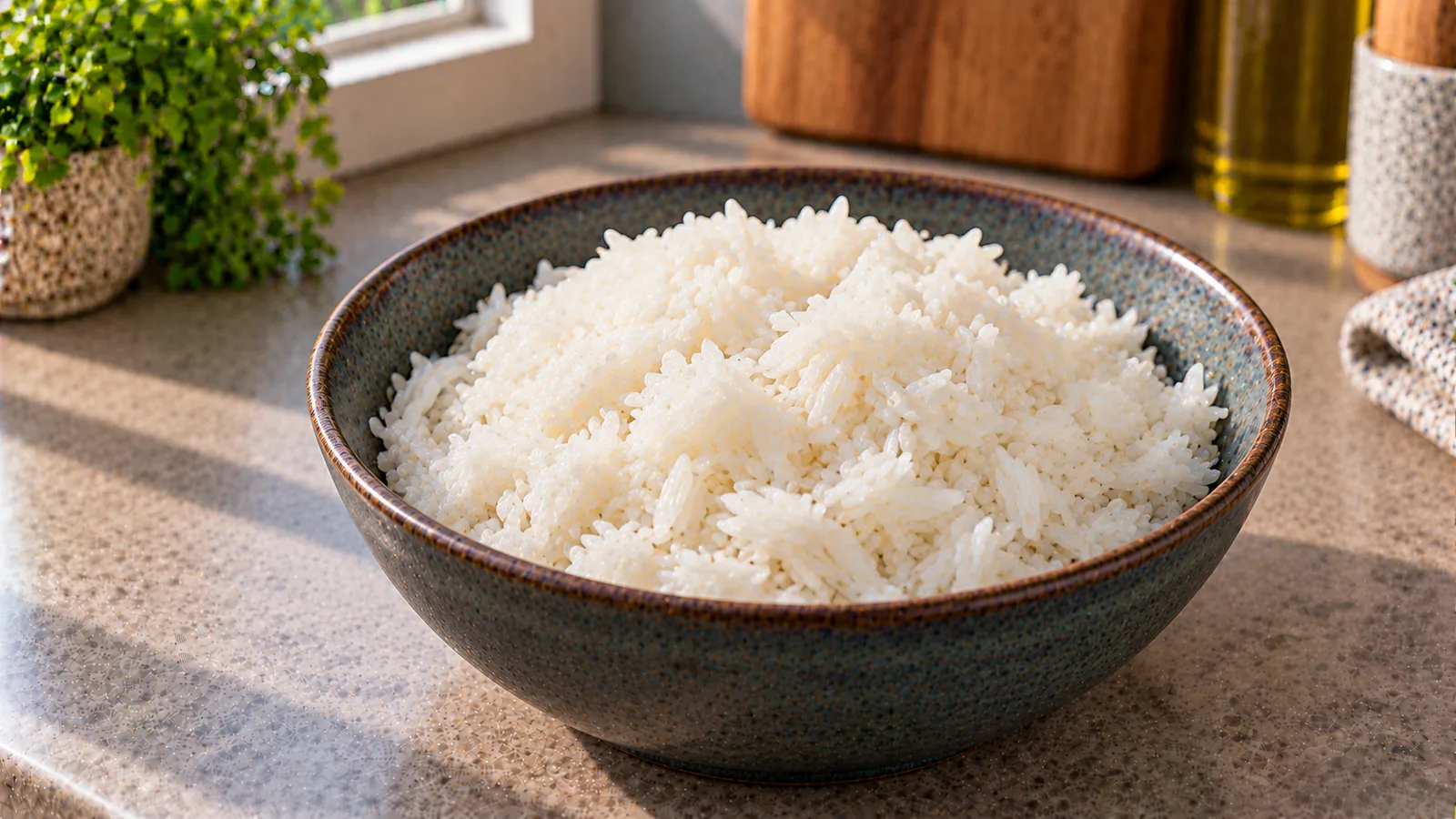
A typical 100 g portion of dry white jasmine rice contains around 347 calories in one German brand’s product label, while 100 g of cooked plain white long-grain rice provides 130 kcal in a USDA reference often used as a proxy for cooked jasmine rice. Those two values do not represent the same weight of the same preparation. Cooking adds water, so a pot of rice becomes heavier without gaining energy from the water itself.
Jasmine rice is the aromatic variety associated with Thai-style rice dishes. The most useful distinction for a food diary is dry weight versus cooked weight. The exact number on your packet, how much water the grains retain and the amount of sauce or oil on the plate usually matter more than tiny differences between similar white-rice varieties.
Calories in jasmine rice per 100 g: what the sources actually show
Unlike a precise laboratory result labelled “jasmine rice, cooked,” the commonly quoted USDA number here belongs to ordinary enriched cooked white long-grain rice (FDC 168878). It is a reasonable approximate comparison for plain cooked white jasmine rice, but it is not a verified jasmine-specific measurement. For the dry jasmine-specific line, the retailer provides the nutritional declaration for its own uncooked product. These records must not be presented as before-and-after measurements of one batch.
| Reference and weighing state | Energy per 100 g | Protein | Carbohydrate | Fat | Fibre |
|---|---|---|---|---|---|
| REISHUNGER white jasmine rice, dry, package | 347 kcal | 6.8 g | 78 g | 0.6 g | Not declared |
| USDA white long-grain rice, dry, enriched; comparison only | 365 kcal | 7.13 g | 79.95 g | 0.66 g | 1.3 g |
| USDA white long-grain rice, cooked, enriched; jasmine proxy | 130 kcal | 2.69 g | 28.17 g | 0.28 g | 0.4 g |
You can inspect the REISHUNGER jasmine rice label, the USDA dry long-grain record, FDC 168877, and the USDA cooked long-grain record, FDC 168878. The label also gives 0.03 g salt per 100 g dry. It does not list fibre in the figures used here, so no jasmine-specific fibre number has been invented.
Another manufacturer illustrates normal product variation and rounding: Mahatma Jasmine White Rice advertises 160 kcal per 45 g dry serving, equivalent to roughly 356 kcal per 100 g if the rounded serving figure is scaled. That calculation is not a separate 100 g laboratory measurement. If your package states 350, 356 or 360 kcal per 100 g, use that figure rather than replacing it with 347 merely because this article uses a German product as one example.
Jasmine rice calories in realistic portions
The first table uses the 347 kcal per 100 g dry REISHUNGER declaration. These weights mean rice before cooking, without any oil or sauce. They are not a recommendation for how much to eat.
| Uncooked jasmine rice | Calculation basis | Estimated calories |
|---|---|---|
| 25 g | 25 × 347 / 100 | 87 kcal |
| 40 g | 40 × 347 / 100 | 139 kcal |
| 45 g | 45 × 347 / 100 | 156 kcal |
| 50 g | 50 × 347 / 100 | 174 kcal |
| 60 g | 60 × 347 / 100 | 208 kcal |
| 75 g | 75 × 347 / 100 | 260 kcal |
| 100 g | 100 × 347 / 100 | 347 kcal |
| 120 g | 120 × 347 / 100 | 416 kcal |
The next portions use 130 kcal per 100 g of cooked white long-grain rice, clearly an approximation for plain cooked jasmine. They apply only to the weighed edible cooked rice, not an uncooked scoop or a rice-and-curry mixture. Rice with substantially different water absorption can have a different calorie density.
| Cooked white long-grain proxy | Calculation basis | Estimated calories |
|---|---|---|
| 75 g | 75 × 130 / 100 | 98 kcal |
| 100 g | 100 × 130 / 100 | 130 kcal |
| 125 g | 125 × 130 / 100 | 163 kcal |
| 150 g | 150 × 130 / 100 | 195 kcal |
| 158 g | 158 × 130 / 100 | 205 kcal |
| 180 g | 180 × 130 / 100 | 234 kcal |
| 200 g | 200 × 130 / 100 | 260 kcal |
| 250 g | 250 × 130 / 100 | 325 kcal |
| 300 g | 300 × 130 / 100 | 390 kcal |
A small bowl weighing 150 g after cooking is roughly 195 kcal by this cooked-rice proxy. A 75 g dry portion is around 260 kcal by the named dry label. These examples are not equivalent serving sizes. The amount of cooked rice produced by 75 g dry depends on how much water is absorbed or evaporates.
A kitchen batch: why you should not mix raw and cooked numbers
Suppose you weigh 180 g of dry jasmine rice from the REISHUNGER example. Before additions, it represents 180 × 347 / 100 = 625 kcal, rounded to the nearest whole calorie. You cook it in water and measure 540 g of finished rice. This 540 g yield is an illustrative kitchen scenario, not a standard absorption ratio.
For that actual batch, its estimated calorie density from the original dry ingredients is 625 / 540 × 100 = about 116 kcal per 100 g cooked. If you divide the whole batch equally into four servings, each 135 g serving contributes around 156 kcal, before additions. That differs from the generic USDA 130 kcal per 100 g proxy because the assumed water content is different, not because either value has to be wrong.
If you stir in 10 g of oil that is all eaten, use approximately 90 extra calories for the batch. The batch then holds 715 kcal and four equal servings around 179 kcal each. If oil remains in the pan, count only the quantity plausibly consumed. If you instead choose a cooked ready-meal database entry already containing oil, do not add that same oil again. The key rule is to record the rice once, on a consistent weighing basis.
Is a cup of jasmine rice dry or cooked?
A “cup of rice” is ambiguous. A cup of uncooked grains and a cup of fluffy cooked rice have different masses and extremely different calorie totals. Brand packaging can also use a specific dry household measure: Mahatma states 1/4 cup dry, 45 g, 160 kcal. That does not establish the weight of every cup, and it certainly does not mean 160 kcal per cup cooked.
For home recipes, a scale is more reliable than measuring by eye. Record dry grams when weighing ingredients before cooking; if you weigh the rice on the plate, use a cooked entry that matches the preparation as closely as possible. The Mealisa guide to portion size versus serving size explains why a label’s suggested portion may not be what you actually eat.
A restaurant rice bowl can be a much larger serving than a household measuring cup. It may also contain butter, oil, sugar, coconut milk or sauces. If the menu says only “jasmine rice,” there is no scientifically fixed restaurant serving weight. Treat the estimate as approximate until you can weigh it or get a product-specific nutrition declaration.
White jasmine, brown jasmine and ordinary white rice
The typical fragrant white jasmine rice is polished, so some outer layers of the grain have been removed. Brown jasmine rice retains the bran layer and can provide more fibre and a different texture. It is not safe to use the white jasmine product numbers automatically for brown jasmine: check the exact packet or a brown-rice entry and pay attention to whether it refers to dry or cooked weight.
The word “jasmine” primarily describes a rice type with a characteristic aroma and texture. It is not a claim that it is uniquely low-calorie, high-protein or better for weight loss. Plain white jasmine remains largely a source of carbohydrate. For the broader category, our guide to calories in rice explains general raw, cooked and portion distinctions; this page narrows the task to specifically labelled jasmine products and their useful serving calculations.
If you prefer whole grains, compare brown rice calories on the same raw or cooked basis. For a distinct edible grain, see quinoa calories and portions. Neither link is a reason to assume the foods have identical calories per 100 g, or that choosing any one of them determines the nutritional quality of a whole meal.
What changes when you add ingredients?
Boiling white jasmine rice in plain water does not add calories from the water. Additions do. Oil, fried aromatics, coconut milk, sweet chilli sauce, nuts and other ingredients must be calculated from the amount in the edible dish. A ready-to-eat microwave pouch may have a different labelled value per 100 g because the manufacturer has already cooked it and may have added ingredients.
For example, a plate with 150 g of plain cooked rice at the USDA proxy of 130 kcal per 100 g is about 195 kcal. If it also contains 10 g of oil consumed, the approximate combined figure becomes 285 kcal, even before vegetables, meat, tofu or sauce. The oil is a separate ingredient, not a change in the grain’s own carbohydrate count.
If you cook a large curry-and-rice pot, record rice and every other ingredient once, then divide by the amount you actually serve. Avoid applying the calories of 100 g dry rice to 100 g cooked rice; that single mistake can more than double the estimate for a normal portion.
Cooked-rice storage is a safety issue, not a calorie trick
Rice deserves careful cooling because heat-resistant spores can survive cooking. According to the NHS guidance on rice and other starchy foods, serve cooked rice promptly or cool it within one hour, refrigerate it, and eat it within 24 hours. Reheat thoroughly, no more than once; leaving cooked rice on the counter overnight can be unsafe even if it looks and smells normal.
None of those safety rules changes the calculation for dry or cooked rice; they determine how safely leftovers are handled. Refrigeration does not turn an earlier oversized portion into a lower-calorie one, and repeatedly reheating it does not remove energy in a predictable way.
The simplest way to log jasmine rice
When you have the dry package and a scale, its per-100-g nutrition label is the strongest reference for that batch. When you have only a cooked portion, a cooked white long-grain reference is an openly labelled proxy, not a jasmine-specific lab result. Weigh the rice, add any oil and sauces you ate, and avoid counting the same rice twice.
The numbers to remember here are therefore 347 kcal/100 g dry for one labelled jasmine brand and 130 kcal/100 g cooked for a comparable USDA white-long-grain reference. Neither number is guaranteed for every brand or hydration level. The most accurate home calculation uses the actual dry label and your own batch yield, while keeping the food’s identity and measurement state explicit.