
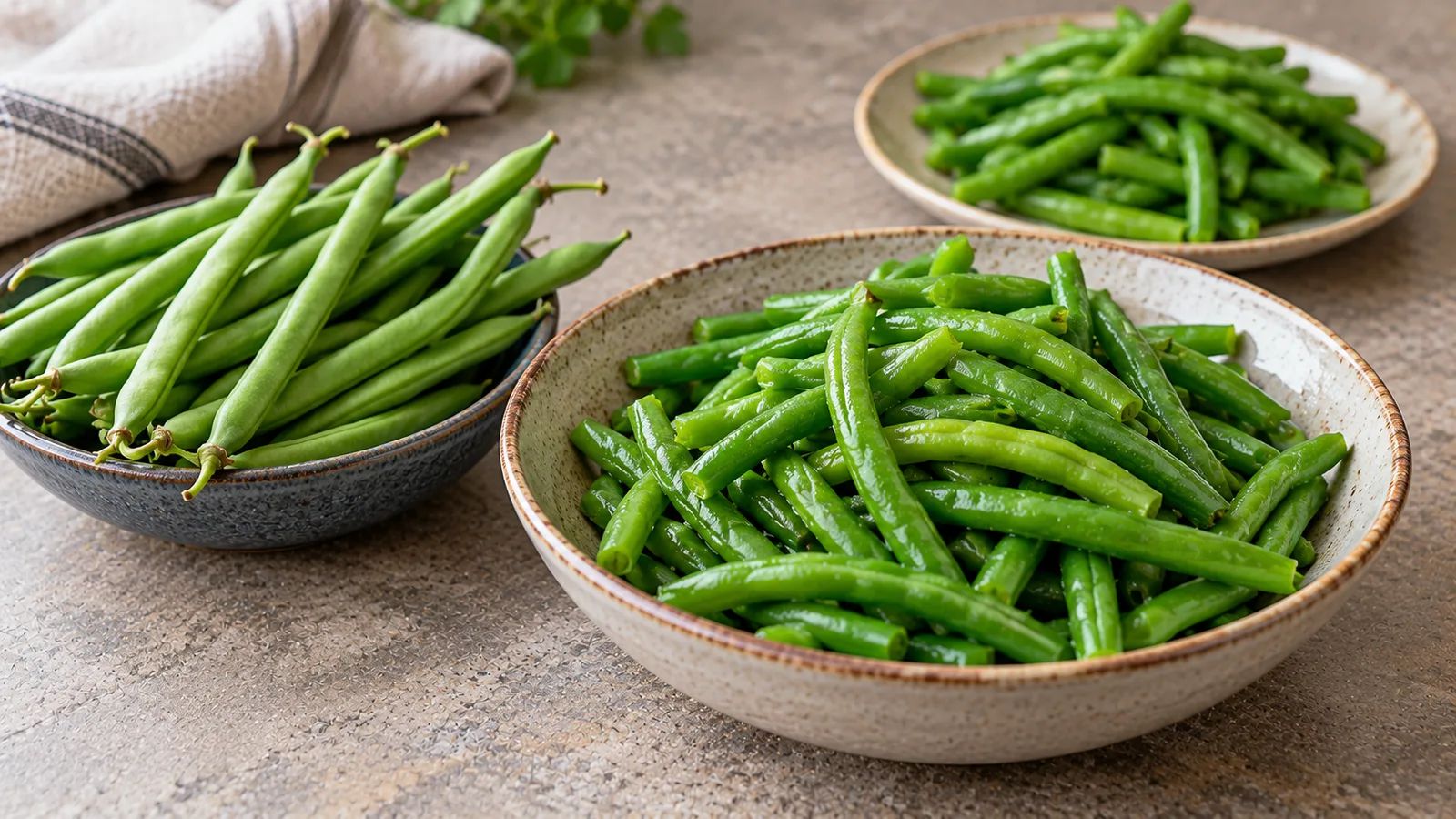
Green beans are light as a plain vegetable side, but the amount you log depends on whether you weighed them raw or after cooking and what went into the pan. The USDA SR Legacy reference gives 31 kcal per 100 g of raw green snap beans (FDC 169961). A different record, for boiled, drained green beans without salt or fat, gives 35 kcal per 100 g (FDC 169141). Steaming is a similar no-added-fat method, but 35 kcal is the boiled-and-drained reference, not a laboratory measurement of every steamed portion.
Green-bean calories at a glance
| Form weighed | kcal per 100 g | kcal per 150 g | What the reference means |
|---|---|---|---|
| Raw, edible pods | 31 kcal | 46.5 kcal, about 47 | Trimmed food before cooking |
| Boiled and drained, no added fat | 35 kcal | 52.5 kcal, about 53 | Cooked food weighed after draining |
| Steamed, no added fat | Use cooked value as an estimate | About 53 kcal | Approximation, not a separate USDA steam record |
The examples use 150 g of edible food in the state shown. One hundred and fifty grams raw and 150 g cooked are not necessarily the same batch: cooking changes moisture and sometimes the mass of the serving. These figures are database estimates, not measurements of your particular beans. Check the relevant entry in USDA FoodData Central under FDC IDs 169961 and 169141.
What a 150 g side actually contains
For 150 g of cooked, drained beans with no dressing, the calculation is `150 × 35 ÷ 100 = 52.5 kcal`, normally rounded to 53 kcal. A 200 g cooked portion is `200 × 35 ÷ 100 = 70 kcal`. For 150 g raw, `150 × 31 ÷ 100 = 46.5 kcal`, about 47 kcal. Use the weight on your kitchen scale; a bowl or a cup is not a constant mass because whole pods and chopped pods fit differently.
| Weighed cooked side | Energy, before sauce |
|---|---|
| 100 g | 35 kcal |
| 125 g | about 44 kcal |
| 150 g | about 53 kcal |
| 200 g | 70 kcal |
A 150 g cooked serving contributes roughly 2.8 g protein, 11.8 g carbohydrate, 0.4 g fat and 4.8 g fibre, calculated from the same cooked USDA entry. Those are components of a vegetable side, not a substantial standalone protein meal. Total carbohydrate and fibre are reported separately; do not subtract fibre from the listed carbohydrate a second time unless you know which labelling system you are using.
Raw versus steamed: do not compare the wrong weights
Raw green beans contain a lot of water, and heating can change the water held in the pods. A cooked sample can contain slightly more calories per 100 g than a raw sample while the whole batch has not gained energy. This is not evidence that steaming adds calories. Water loss or absorption, trimming and sampling differences affect the density. The boiled USDA reference is useful when your steamed beans have been drained and you have no better product-specific record.
Consider an illustration rather than a universal conversion: 150 g edible raw beans start at about 46.5 kcal. Suppose, in one kitchen, they weigh 125 g after steaming and no ingredients were added. Dividing the same estimated energy by the final weight gives `46.5 ÷ 125 × 100 = 37.2 kcal per 100 g` in that particular example. The 125 g yield is hypothetical, not a fixed cooking factor or the USDA 35-kcal measurement. You can use either the raw-weight method for the batch or a matching cooked-food reference for the final plated portion; avoid applying both methods to the same food.
Butter, oil and sauces often matter more
The plain-bean number excludes dressing. If 5 g of oil is actually eaten with 150 g cooked beans, the approximate added energy is `5 × 9 = 45 kcal`, bringing the plate to roughly 98 kcal (`52.5 + 45 = 97.5`). With 10 g of oil, add about 90 kcal, and the same side would approach 143 kcal. These are transparent calculation examples using 9 kcal per gram of fat, not branded-dish nutrition facts. A knob of butter is not pure fat, so use the butter label and weighed grams instead of assuming 9 kcal for every gram of butter.
Garlic, lemon juice and herbs may be used in small quantities, but measured cooking oil, sugary glaze, breadcrumbs, nuts, bacon and a creamy sauce can noticeably change the dish. If some oil stays in the pan, the exact amount swallowed is uncertain. Record what was added as a practical conservative estimate, or divide a fully measured recipe into its actual servings. Do not quietly treat beans cooked with sauce as the plain boiled USDA entry.
Fresh, frozen and canned are separate products
The fresh raw record is not interchangeable with frozen cooked beans, beans packed in brine or seasoned tinned vegetables. The amount of water, pre-cooking and drained weight vary. In particular, a pack may give nutrition per 100 g as sold, per 100 g prepared, or per 100 g drained. Those bases can produce different totals even when all packages say “green beans”. If a brand's label matches what you ate, it normally beats a generic figure for that pack.
For frozen beans with no added fat, read the brand's preparation instructions, cook them safely and weigh the edible serving afterward. For canned beans, check the drained weight when liquid is discarded; the net can weight includes brine. No-added-salt and salted versions can differ substantially in sodium even when calories are close. Salt changes seasoning, not the basic energy of plain beans; oil-packed or buttered products need separate entries.
For related but distinct questions, see raw versus cooked weights · frozen versus canned green beans · frozen green beans versus broccoli.
How to weigh and record your plate
Start by identifying the product: fresh raw pods, plain cooked beans, frozen prepared beans or a mixed dish. Trim off ends and any inedible parts if you are logging raw edible weight. If cooking, choose one method: weigh trimmed raw beans and use 31 kcal/100 g, or weigh the finished undressed beans and use an appropriate cooked reference of about 35 kcal/100 g. Keep your selected reference and weight basis together in the diary.
If the beans are part of a recipe, weigh the additional ingredients too. For a family tray, total the bean energy and the fat or sauce actually added, then divide by the shares served. If individual portions are different sizes, record each plated weight or estimate its share of the full cooked recipe. For restaurant vegetables, the phrase “steamed beans” does not rule out butter added before serving: describe the preparation when estimating the plate.
What these numbers can and cannot tell you
Green beans offer fibre and vegetables at modest energy density, but they cannot replace a balanced meal by themselves. The edible amount, a side dish's sauce and the rest of the meal matter far more than whether a generic database lists 31 or 35 kcal per 100 g. Different cultivars, water content and labs also produce small differences. Avoid implying precision beyond the rounded food reference.
The most useful practical answer is therefore about 47 kcal for 150 g raw or about 53 kcal for 150 g plain cooked/steamed beans using the cooked approximation, before oil or dressing. If you know the actual cooked weight and a matching product label, use those for the final calculation.
Sources
- USDA FoodData Central, SR Legacy 169961 (Beans, snap, green, raw) — 31 kcal/100 g; protein 1.83 g, carbohydrate 6.97 g, fat 0.22 g, fibre 2.70 g per 100 g.
- USDA FoodData Central, SR Legacy 169141 (Beans, snap, green, cooked, boiled, drained, without salt) — 35 kcal/100 g; protein 1.89 g, carbohydrate 7.88 g, fat 0.28 g, fibre 3.20 g per 100 g. Used as a proxy, not a measured steaming entry.