
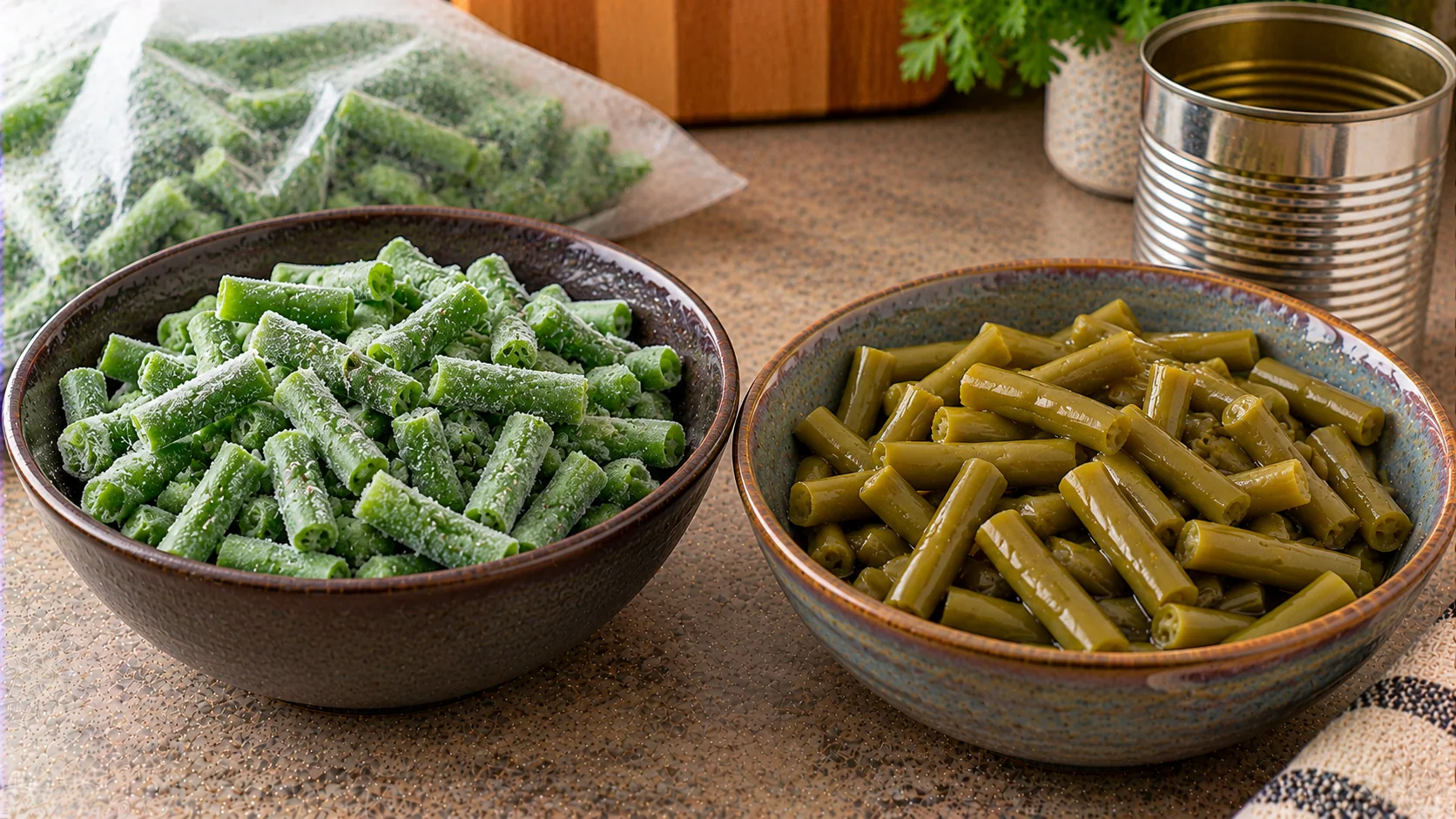
Frozen Green Beans vs Canned Green Beans: Salt and Cost
Frozen and canned green beans both make vegetables easier to keep on hand. The useful comparison is not the shelf price alone: it is what you pay for 100 g or 200 g of edible beans, how much salt the finished portion contains and whether you need a freezer. This guide treats plain frozen beans and canned green beans as vegetables—not dried or canned kidney beans, which are legumes with very different nutrients.
A fair comparison starts with the label
Choose plain frozen green beans without sauce or added salt. For a can, read the drained weight, nutrition declaration and ingredients. Some cans contain just beans, water and salt; low-salt and no-added-salt products also exist. The USDA Foods specifications explicitly list both low-sodium canned green beans and frozen green beans without added salt: processing method does not determine sodium on its own.
| What to check | Frozen green beans | Canned green beans |
|---|---|---|
| Weight denominator | Cooked edible portion after any water loss | Drained edible contents, not total can weight |
| Sodium | Usually lower if no salt is added; check label | Depends on the brine and low-salt claim |
| Texture | Can remain firmer if cooked briefly | Already softened by heat processing |
| Preparation | Must cook as directed on pack | Often ready to heat or add to cooked dishes |
| Storage | Requires freezer space | Unopened cans can be kept in a cool dry cupboard |
The cost formula: use edible yield
Cost per 100 g edible = purchase price ÷ edible grams × 100. For frozen beans that finish with a different cooked weight, use the weighed cooked yield rather than assuming 100% retention. For canned beans use the drained weight. Any leftover beans that spoil should be included as waste in a household cost calculation.
Worked example: 200 g on the plate
These are illustrative prices and measured-yield assumptions, not observed German store offers. Frozen bag: 750 g for €2.25, yielding 720 g cooked; canned beans: €1.09 for a 400 g can with 240 g drained beans.
| Calculation | Frozen | Canned |
|---|---|---|
| Purchased pack | 750 g | 400 g total, 240 g drained |
| Example price | €2.25 | €1.09 |
| Edible beans used for calculation | 720 g | 240 g |
| Price per 100 g edible | €0.31 | €0.45 |
| Price per 200 g edible | €0.63 | €0.91 |
Arithmetic uses full precision before rounding: 2.25 ÷ 720 × 200 = €0.625; 1.09 ÷ 240 × 200 = €0.9083. The frozen example looks cheaper, but an expensive small freezer bag or discounted low-salt can could reverse the result. The frozen example excludes electricity; add your measured cooking energy and tariff if it matters to your decision. A microwave, stove and induction hob will not have identical costs.
What about sodium and salt?
In European nutrition panels, salt is normally expressed in grams rather than sodium in milligrams; salt equivalent = sodium × 2.5 (same mass units). A model label of 0.02 g salt per 100 g frozen beans gives 0.04 g per 200 g. A model can label of 0.60 g per 100 g drained beans gives 1.20 g per 200 g. Those are hypothetical label values, not universal nutrient values or measurements of specific brands.
| Hypothetical label | Frozen, no salt added | Canned, salted |
|---|---|---|
| Salt per 100 g edible | 0.02 g | 0.60 g |
| Salt per 200 g edible | 0.04 g | 1.20 g |
| Sodium equivalent in 200 g | 16 mg | 480 mg |
To convert the 200 g example, 0.04 g salt ÷ 2.5 = 0.016 g sodium = 16 mg; 1.20 ÷ 2.5 = 0.48 g sodium = 480 mg. Compare products using their own panels: canned no-added-salt beans could have a value closer to plain frozen beans.
Does rinsing remove the salt?
Not reliably by a fixed percentage. A USDA Agricultural Research Service test of several canned vegetables observed that draining and rinsing effects varied; for the tested green beans, draining alone reduced sodium by about 2%, and rinsing led to an additional roughly 7% reduction in the study conditions. The sample was small, so it would be incorrect to promise a 30% or 40% reduction for your can. For consistent low salt, buy a specifically low-salt product and use its drained-food label.
Protein, fibre, iron and calories
Both products are mainly a vegetable side. They are not protein substitutes for chickpeas or lentils. Fibre, protein, iron and calorie values vary by cultivar, processing, water content and serving size. Comparing uncooked frozen weight to canned drained weight can mislead. The USDA FoodData Central has separate entries for green beans in different preparation states; match cooked/frozen and drained/canned conditions rather than copying the nutrient value of raw beans. Iron numbers particularly depend on the database entry and cannot be attributed to freezing or canning alone.
Practical buying decision
Choose frozen when you have freezer space, want firmer texture and can use several portions over time. Choose canned when freezer space is limited, when you need shelf-stable vegetables or when quick preparation matters. For someone watching salt intake, the ingredient list and numerical label win over the packaging category. For someone watching spending, divide the shelf price by cooked or drained edible grams, then consider unused leftovers. For vegetable-based dinners using frozen products, see six dinner ideas using frozen vegetables; for a guide to how price and food waste interact, see a family menu with frozen vegetables and beans.
Safe preparation and leftovers
Follow package directions for frozen products, and keep frozen food frozen until needed. After opening a can, transfer leftovers to a covered food-safe container, refrigerate promptly and follow local food-safety guidance. Do not keep food at room temperature for long periods. If a can is bulging, leaking or badly damaged, do not use it. Freshly cooked leftovers should be cooled promptly and reheated thoroughly.
Sources
- USDA Foods: vegetable specifications — confirms low-sodium canned and no-added-salt frozen varieties.
- USDA ARS: draining and rinsing canned vegetables — limited empirical sodium-reduction findings; not a guaranteed percentage.
- USDA FoodData Central — distinguish forms and preparation states before making nutrition comparisons.