
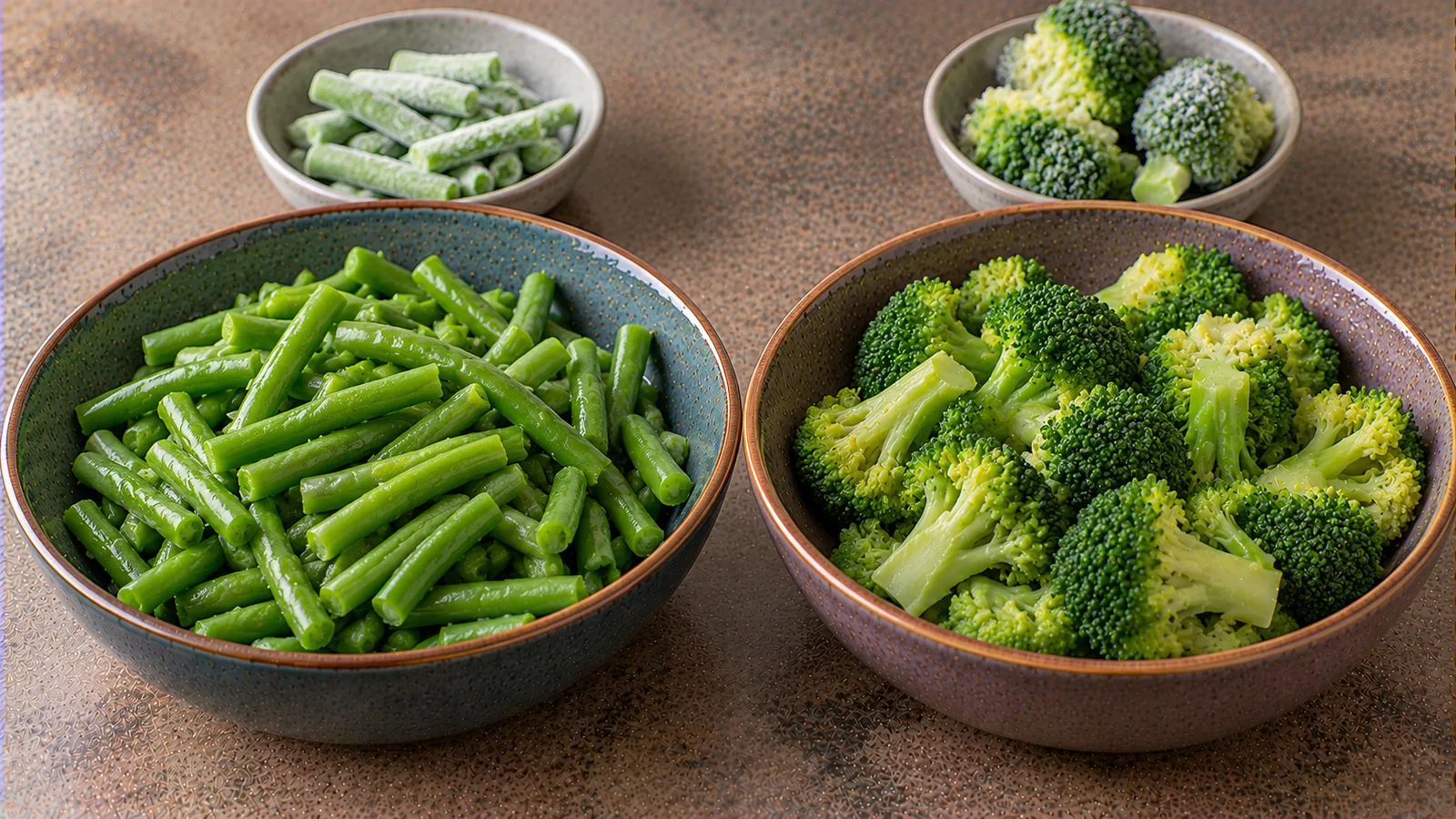
Frozen green beans and frozen broccoli are two convenient vegetables for a weekday side dish. Which gives more fiber, and which costs less for 150 g actually cooked and drained? The answer changes if you mix frozen-package weights with cooked-food figures. This comparison keeps the nutrition basis separate from the supermarket price calculation.
In two matched USDA SR Legacy records, frozen green snap beans and frozen chopped broccoli, both boiled, drained and prepared without salt, supply 3.0 g fiber per 100 g cooked, or 4.5 g per 150 g cooked. That is a tie at the stated precision, not a win for broccoli. Protein differs: 2.24 g in beans versus 4.65 g in broccoli per 150 g cooked, calculated from the same records. Both list 42 kcal per 150 g cooked. These are reference-food values, not promises about the nutrient content of every branded bag.
Frozen green beans vs broccoli: matched cooked servings
| USDA SR Legacy value | Frozen green beans, cooked | Frozen broccoli, cooked |
|---|---|---|
| Comparison weight | 150 g drained | 150 g drained |
| Fiber per 100 g cooked | 3.0 g | 3.0 g |
| Fiber per 150 g cooked | 4.5 g | 4.5 g |
| Protein per 150 g cooked | 2.24 g | 4.65 g |
| Energy per 150 g cooked | 42 kcal | 42 kcal |
| Preparation in the dataset | Boiled, drained, no salt | Boiled, drained, no salt |
Source records: USDA green snap beans, FDC 169963 and USDA frozen chopped broccoli, FDC 169969. The protein for beans is 1.49 g per 100 g, giving 1.49 × 1.5 = 2.235 g, rounded to 2.24 g. The broccoli record lists 3.10 g per 100 g, giving 4.65 g. The 4.5 g fiber number is 3.0 × 1.5 for both vegetables. Figures are approximate database composition and should not be interpreted as a personal laboratory measurement.
Why '150 g cooked' must mean cooked, drained weight
A 150 g portion taken directly from a frozen bag is not necessarily 150 g once boiled and drained. Ice coating, retained water, moisture loss, trimming and preparation can all affect the final weight. To compare what is on the plate, cook each vegetable according to its instructions, drain it the same way, then weigh 150 g of the edible cooked vegetables. Do not include cooking water or sauces in the weigh-in.
USDA cooked values already refer to edible cooked food. Multiplying by 1.5 is therefore valid for a measured 150 g cooked portion. By contrast, using a packet's 100 g frozen nutrition panel and calling its result '150 g cooked' without measuring yield would change the denominator. The method matters more than small differences created by rounding.
Use a kitchen scale and a sieve. Cook enough of each vegetable to ensure a full 150 g remains. Allow both samples to drain for a comparable time, and weigh them in identical dry bowls after taring the scale. That is the simplest way to compare portions at home without pretending there is one universal frozen-to-cooked conversion factor.
What the German frozen-food labels show—and what they do not
At the time of the product-page check (22 October 2026), the Aldi Süd BIO young green beans, 750 g label listed 3.4 g fiber per 100 g product, while Aldi Süd BIO broccoli, 750 g listed 3.0 g fiber per 100 g product. An arithmetic 150 g portion on that label basis would give 5.1 g versus 4.5 g fiber respectively. These are not the figures in the USDA cooked-serving table.
There is no contradiction: the sources refer to different products and preparation states. Label composition can differ by supplier, and Aldi explicitly warns that product values can vary between suppliers; verify the actual pack. Frozen-food labels are useful when tracking what you buy and cook, while the USDA comparison above is appropriate when the goal is one matched cooked and drained serving. Avoid quietly replacing one with the other.
The label values also illustrate why saying 'broccoli always contains more fiber' would be unsound. Depending on the reference and product, the fiber numbers may be close, equal or reversed. Both vegetables can make a worthwhile contribution without claiming that one uniquely supplies fiber.
Verified German shelf price: two comparable 750 g bags
To keep the purchase comparison reproducible, we use two specifically named frozen BIO products, both from Aldi Süd, Germany. Their publicly displayed regular product-page prices on 22 October 2026 were €2.69 per 750 g bag, equivalent to about €3.59 per kilogram as sold. Each product and pack weight can be checked via its linked retailer page.
| Retail product | Pack | Verified listed price | Price per 150 g frozen weight |
|---|---|---|---|
| Aldi Süd BIO young green beans | 750 g | €2.69 | €0.54 |
| Aldi Süd BIO broccoli | 750 g | €2.69 | €0.54 |
The €0.54 calculation is €2.69 × 150 / 750 = €0.538, rounded to cents. It applies to 150 g taken from the bag before cooking, not automatically to 150 g of drained food. This is an evidence-backed same-store pair, not a claim that €2.69 is the lowest price available in all German supermarkets. Cheaper non-organic bags may exist, but a current ordinary price, exact comparable product and retailer link were not simultaneously confirmed for both sides. We do not turn an unverified crowd-reported price or an expired promotion into a verified nationwide minimum. Local stock and prices may vary.
How much does a 150 g cooked side really cost?
The price per cooked portion depends on yield. Define yield = cooked drained grams ÷ frozen grams used. Then cost for 150 g cooked = pack price × (150 g ÷ yield) ÷ 750 g. This assumes a whole bag has the stated weight, the 150 g serving is edible after cooking, and no seasonings, energy or oil are counted.
| Illustrative measured yield | Frozen grams needed for 150 g cooked | Cost at €2.69 / 750 g |
|---|---|---|
| 100% (1.00) | 150 g | €0.54 |
| 90% (0.90) | 166.7 g | €0.60 |
| 80% (0.80) | 187.5 g | €0.67 |
The yields in the table are hypothetical scenarios, not observed losses for either brand. For example, €2.69 × (150 / 0.90) / 750 = €0.598, approximately €0.60. If both vegetables have the same actual measured yield and the same pack price, their calculated 150 g cooked costs tie. If yields differ, the costs may differ even with identical shelf prices.
For your own kitchen, weigh a reasonable sample before cooking, then after draining. If 300 g frozen yields 270 g cooked, that is 90%; enter the actual yield in the formula. Repeat on different occasions if preparation methods change. Do not infer a measured yield from nutrition tables, which describe composition rather than your saucepan's water loss.
Which vegetable makes more sense for a meal?
Choose green beans if you want firmer, slender pieces that work as a side to potatoes, rice or a casserole. They fit stews and mixed vegetable dishes, too. For a separate shopping comparison against a canned alternative, see frozen versus canned green beans; canned beans have a different liquid weight, salt context and purchase denominator.
Choose broccoli if you prefer florets and stems in soup, a pasta dish, a roast tray or a stir-fry-style dinner. In the matched USDA data it contributes more protein per 150 g cooked, although neither side dish alone provides the protein of a main protein ingredient. If you also compare frozen broccoli with cauliflower, frozen broccoli versus frozen cauliflower uses a different vegetable pair and should not be merged with this article.
To build a filling dinner, pair either cooked vegetable with a suitable protein source and a starchy food. Avoid treating this fiber comparison as a claim about weight loss, blood sugar treatment or vitamin retention; none of those outcomes was measured here. Oil, butter, cream sauces and added salt also change the finished meal's nutrition and cost.
Important cooking safety difference: green beans must be heated thoroughly
Do not eat frozen green beans raw or simply thawed. Green beans contain natural lectins, including phasin, which require adequate heating. The German Federal Institute for Risk Assessment (BfR) warns against raw green beans and states that gentle heating may be insufficient. Frozen beans may have been blanched before packaging, but blanching is not proof that they are ready to eat. Follow the exact package's thorough-cooking instructions; if in doubt, boil properly rather than relying on brief steaming or a quick cold-water defrost.
Broccoli does not have the same green-bean phasin warning. Both vegetables should be handled hygienically, stored frozen according to pack directions and cooked as intended for the specific product. Avoid using a single 'five-minute frozen vegetable' rule for all kinds of frozen vegetables, especially beans.
A five-point supermarket check
- Compare actual foods: plain frozen green beans with plain frozen broccoli, not seasoned mixes, cans or fresh vegetables.
- Record pack weight and ordinary shelf price, including retailer and date. Use € per kilogram as sold to compare different pack sizes.
- For nutrients, note whether the source refers to frozen product or cooked drained food. Do not mix those bases.
- For cooked cost, measure yield if exact cents matter. Otherwise show clearly labelled scenarios, not made-up real yields.
- Follow green-bean cooking instructions fully and weigh 150 g after cooking and draining.
For EU products, nutrition labels are generally standardised per 100 g or 100 ml; the European Commission's nutrition-declaration guidance explains that framework. A per-portion conversion is useful only after the underlying state and weight are specified.
Sources and boundaries
- USDA SR Legacy: frozen green snap beans, boiled and drained, FDC 169963: 3.0 g fiber, 1.49 g protein and 28 kcal per 100 g cooked.
- USDA SR Legacy: frozen chopped broccoli, boiled and drained, FDC 169969: 3.0 g fiber, 3.10 g protein and 28 kcal per 100 g cooked.
- Aldi Süd BIO young green beans, 750 g and Aldi Süd BIO broccoli, 750 g: each listed at €2.69 on 22 October 2026, with product-specific frozen-food labels and supplier-variation caveats.
- BfR: only enjoy cooked beans: green-bean lectins and proper heating.
- EU: nutrition declaration: interpretation of values per 100 g.
Method: Fiber and protein use the two USDA cooked-drained records. The Aldi shelf prices are separate retail observations. Cooked-portion cost is a transparent formula with explicitly hypothetical yields, not a field measurement or a guaranteed lowest retail price nationwide.