
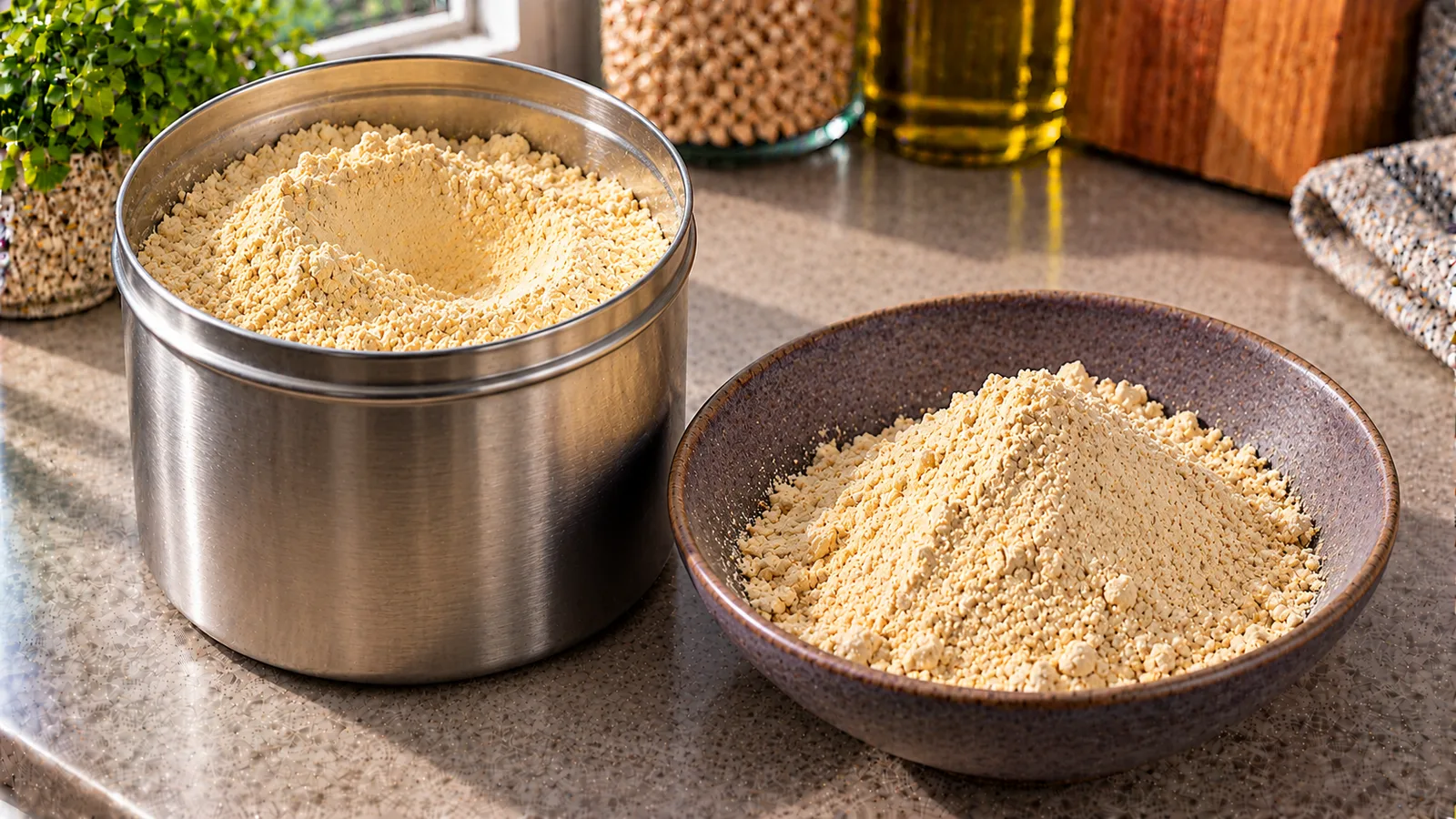
Chickpea flour contains approximately 387 calories per 100 g of dry flour, based on USDA FoodData Central's SR Legacy entry for "Chickpea flour (besan)" (FDC 174288). It provides more protein than many common refined grain flours, but it is still a concentrated dry ingredient. A spoonful of flour, a cooked chickpea pancake and a bowl of boiled chickpeas cannot be assigned the same calorie value.
This guide focuses on plain, dry chickpea flour. It explains calories per tablespoon-sized portion and per 100 g, how moisture and cooking affect the weight shown on a food scale, and which additions matter when you make socca, besan chilla or other batters. Packaged products should always be checked against their own labels.
Chickpea flour nutrition per 100 g
The reference food is finely milled chickpea flour, not cooked chickpeas, a ready-made pancake mix or a packaged batter. USDA describes it as Chickpea flour (besan). These quantities refer to 100 g of the dry flour, without water, oil or seasonings.
| Nutrient | Per 100 g dry flour |
|---|---|
| Energy | 387 kcal |
| Protein | 22.39 g |
| Fat | 6.69 g |
| Total carbohydrate (US method) | 57.82 g |
| Total sugars | 10.85 g |
| Dietary fibre | 10.80 g |
| Sodium | 64 mg |
| Iron | 4.86 mg |
Source: USDA FoodData Central, chickpea flour (besan), FDC 174288. These are reference values, not guaranteed contents of every brand. The US value for total carbohydrate includes fibre, while European food labels generally list available carbohydrate and fibre separately. Comparing the numbers without noticing that convention can make different labels look inconsistent.
Chickpea flour supplies plant protein, some fibre and iron. However, protein content does not turn it into a low-calorie flour. Like other dry baking ingredients, most of its weight consists of nutrients rather than water. Its modest sugar value is naturally occurring in this reference food; it is not proof that a flavoured supermarket mix has no added sugar.
Calories by dry-flour serving size
The simplest calculation is dry grams × 3.87 kcal. Weigh the amount of flour before adding water. A tablespoon is convenient for cooking, but it is not a reliable universal gram measure: how tightly the flour is packed changes its weight.
| Dry chickpea flour | Calories | Protein | Fibre |
|---|---|---|---|
| 20 g | 77 kcal | 4.5 g | 2.2 g |
| 25 g | 97 kcal | 5.6 g | 2.7 g |
| 30 g | 116 kcal | 6.7 g | 3.2 g |
| 40 g | 155 kcal | 9.0 g | 4.3 g |
| 50 g | 194 kcal | 11.2 g | 5.4 g |
| 60 g | 232 kcal | 13.4 g | 6.5 g |
| 75 g | 290 kcal | 16.8 g | 8.1 g |
| 100 g | 387 kcal | 22.4 g | 10.8 g |
Each row is calculated from the same USDA reference and rounded. For example, 35 g dry flour contributes approximately 135 kcal; 80 g contributes approximately 310 kcal. These are estimates for flour alone, not for the finished meal.
One US cup is listed as approximately 92 g in the USDA household measure, equivalent to roughly 356 kcal from the dry ingredient. Cups and spoons are less consistent than scales, especially when different brands are finely or coarsely milled. If you track an exact recipe, weighing the flour usually saves more uncertainty than debating whether a heaped tablespoon was full.
Dry flour versus cooked batter: why 100 g changes
Adding water increases the mass of batter without adding energy. Suppose you mix 80 g chickpea flour (about 310 kcal) with 200 g water (0 kcal). Before any oil or other ingredients, the bowl contains roughly 310 kcal in 280 g of mixture. That is about 111 kcal per 100 g before cooking, not 387 kcal per 100 g. The dry-flour reference is unchanged; only the denominator is larger.
During cooking, water evaporates. If the cooked result weighs 180 g, those same 310 kcal from flour correspond to about 172 kcal per 100 g finished pancake, before other ingredients. You cannot infer the correct cooked value from the name "chickpea pancake" alone because recipes and final moisture differ.
For reliable food logging, calculate the energy of the full batter from the quantities added, then divide by the number of servings or by the fraction of the cooked batch you eat. For a product bought ready to eat, use the manufacturer's values for its stated condition instead.
Worked example: two chickpea pancakes
Here is a deliberately simple batter to demonstrate the method. All the oil is assumed to be consumed; if some is left in the pan, account for that rather than automatically assigning all of it to the food.
| Ingredient | Amount | Energy |
|---|---|---|
| Chickpea flour, dry | 80 g | 310 kcal |
| Water | 200 g | 0 kcal |
| Olive oil used in cooking | 10 g | 90 kcal |
| Entire mixture | — | 400 kcal |
The batch contains approximately 400 kcal, or 200 kcal for each of two equal pancakes, assuming the whole recipe is eaten. Adding onions, spinach, tomatoes or herbs requires their own values; extra cooking oil changes the total too. Using a nonstick pan may change the amount of oil you need, but does not erase calories from oil already added.
Notice how easy it is to double-count fat. If you select a database entry for a fully cooked pancake that already includes oil, do not add the same oil again. Conversely, if you use a raw-flour entry for homemade batter, oil and toppings need to be counted separately.
Besan, gram flour and other names
The term besan commonly refers to chickpea flour in South Asian cooking, while gram flour is a common English-language name. Products may differ in the chickpea variety, degree of milling and any added ingredients. Some blends sold for fritters or instant pancakes also contain salt, spices or raising agents. The USDA value is an appropriate benchmark for plain chickpea flour, not necessarily for every item labelled "besan mix".
Traditional uses include besan chilla, pakora batter, socca and thickening soups or sauces. The same ingredient can appear in meals with very different energy contents. A lightly oiled griddle pancake, a deep-fried fritter and an oven-baked flatbread should be logged as different preparations, not as identical servings of flour.
How chickpea flour differs from whole chickpeas
The ingredient is made by grinding chickpeas, but grinding and cooking states matter. Dry chickpea flour is energy-dense because it has little water. Cooked chickpeas have absorbed water, so 100 g of cooked legumes is not nutritionally equivalent to 100 g of dry flour. Also, the nutrition of canned chickpeas may reflect draining and added salt.
Our dedicated calories in chickpeas guide covers the intact legume and its typical portion states. If a recipe starts with cooked chickpeas that you blend into a paste, use the cooked-chickpea entry rather than silently substituting the dry-flour number. Even though both begin as legumes, the measured ingredient in the bowl is different.
Chickpea flour can be compared to wheat flour on a per-100-g dry basis, but its protein, fibre, flavour and water absorption differ. See the broader flour calories guide for general flour comparisons. Replacing wheat flour gram for gram in baking may not produce the same texture, and the final recipe may need different amounts of liquid and fat.
Is chickpea flour gluten-free?
Pure chickpeas do not naturally contain gluten from wheat, barley or rye. However, a bag of flour may have been processed or packaged near gluten-containing ingredients. If you have coeliac disease, read the label and look for an appropriate gluten-free claim or certification rather than relying on the ingredient name alone. The FDA's explanation of gluten-free labelling discusses cross-contact and the rules for a gluten-free claim in the United States. Regulatory standards vary across markets.
Mealisa's gluten-free versus wheat-free explanation also clarifies why the two descriptions are not interchangeable. A wheat-free recipe can still contain gluten from another grain, and a naturally gluten-free ingredient can be contaminated during handling.
Chickpeas are legumes, so people with a known chickpea or other relevant food allergy should assess the ingredients and allergen warnings appropriate to their situation. A food being gluten-free does not mean it is allergen-free.
Food safety: cook batter properly
Flour is generally a raw ingredient. Avoid tasting uncooked batter or raw flour unless a specific product has been processed and labelled as ready to eat. The FDA's flour-handling guidance recommends cooking foods made with raw flour, following package instructions and cleaning equipment after handling flour or dough. The guidance is general flour safety advice; it does not establish a special calorie difference for cooked chickpea flour.
Cooking does not create energy from nothing. It can change moisture, texture and edible yield. If you fry batter, the amount of oil retained can matter much more to total calories than the heating process itself. For a prepared refrigerated or shelf-stable product, follow its label for storage and preparation.
Choosing a portion and logging it consistently
If you use 50 g dry chickpea flour to make a single savoury pancake, log approximately 194 kcal from the flour, plus anything added. If 120 g dry flour goes into a batch of six portions, the flour contributes about 464 kcal to the batch, or around 77 kcal per equal portion, before oil and toppings. The visible size of a cooked pancake is not enough to know its calorie contribution.
A portion printed on a bag is a reference amount, not a requirement to eat precisely that much. The difference is explained in our portion size versus serving size guide. Choose the gram amount you actually used, the recipe's total yield and the amount you served yourself.
For packaged chickpea flour, use the per-100-g nutrition declaration when present. For homemade flatbreads, weigh the dry ingredient, record cooking fats, and divide the batch fairly. That method is more dependable than copying a random "calories in one socca" figure without knowing its recipe.
Primary data: USDA FoodData Central, Chickpea flour (besan), FDC 174288. Additional guidance: FDA on gluten-free labelling and FDA on safe flour handling. Serving figures and recipe numbers above are rounded calculations, not measured values of a particular branded product.