
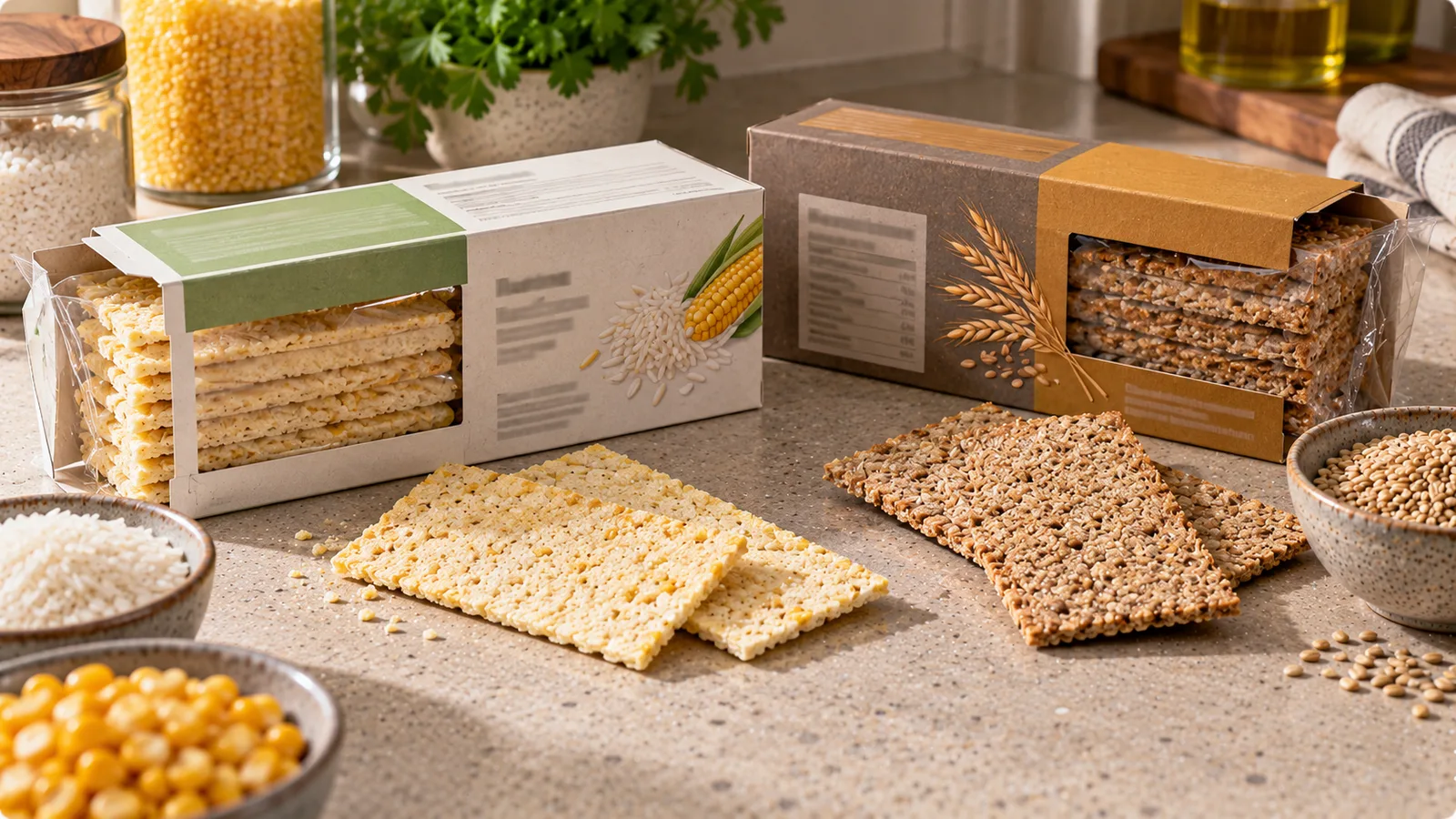
A package labeled gluten-free is not necessarily the same as a product described as wheat-free.
The distinction matters because wheat is only one source of gluten. Barley, rye and related grains also contain gluten proteins that are relevant to people with celiac disease.
At the same time, avoiding gluten does not always address every concern associated with a wheat allergy.
Understanding these differences helps you read food labels more accurately, choose suitable ingredients and avoid relying on claims that do not answer your specific dietary question.
The difference at a glance
| Question | Gluten-free | Wheat-free |
|---|---|---|
| Main meaning | Gluten is controlled to meet the applicable claim requirements | Wheat is absent according to the product's claim and relevant ingredient information |
| Wheat gluten | Restricted by the gluten-free standard | Wheat ingredients should not be present |
| Barley and rye | Must be considered because they contain gluten | May still be present |
| Suitable for celiac disease? | Products meeting the applicable gluten-free standard are generally intended for this use | Not automatically |
| Suitable for wheat allergy? | Not automatically; some gluten-free foods can contain wheat-derived ingredients | Requires careful allergen assessment |
| What to verify | Gluten-free claim, ingredients and contamination information | Wheat allergen information, ingredients and other relevant warnings |
The two terms describe different properties. Neither should be treated as a universal guarantee for every medical condition.
What is gluten?
Gluten is a collective term for proteins found in certain cereal grains.
The grains of greatest relevance to gluten avoidance include:
- Wheat, including spelt, durum, semolina, farro and einkorn.
- Barley.
- Rye.
- Triticale, a wheat–rye hybrid.
Products made from these grains can contain gluten unless they have been specially processed and meet an applicable gluten-free standard.
Gluten may appear in obvious foods such as bread and pasta, but also in less obvious ingredients, including malt-containing products, sauces, coatings and processed foods.
An ingredient list is therefore important even when a product does not look like a conventional grain food.
What does gluten-free mean on a label?
In the European Union, Regulation (EU) No 828/2014 establishes conditions for statements about the absence or reduced presence of gluten.
A food labeled gluten-free must contain no more than 20 mg of gluten per kilogram of food, equivalent to 20 parts per million (ppm).
The regulation also defines the separate claim very low gluten, with a maximum of 100 mg/kg under specified conditions for specially processed ingredients.
These claims are not interchangeable.
In the United States, the FDA also generally uses a threshold of less than 20 ppm for foods bearing a gluten-free claim, alongside additional regulatory conditions.
The precise regulatory framework can differ by market, so the rules relevant to the country where a product is sold should be considered.
A gluten-free claim does not mean that laboratory testing could never detect a single molecule of gluten. It means the product must satisfy the applicable regulatory requirements.
Does gluten-free always mean no wheat?
No.
Under EU rules, specially processed wheat-derived ingredients can appear in products labeled gluten-free when the finished food satisfies the gluten-free conditions.
For example, some products use specially processed wheat starch.
This is an important distinction for people with wheat allergy, because a gluten-free claim concerns gluten rather than the complete absence of all potentially allergenic wheat proteins.
A person avoiding wheat because of an allergy should not assume that every gluten-free product is suitable.
What does wheat-free mean?
Wheat-free indicates that wheat is not intended to be present in the food.
However, unlike the regulated gluten-free claim, the term wheat-free should not be interpreted as a standardized guarantee of gluten content.
A wheat-free product may still contain barley, rye or ingredients derived from them.
Examples include:
- Bread made with rye flour but no wheat flour.
- Foods containing barley malt.
- Products containing barley-based ingredients.
- Certain grain mixtures without wheat.
These foods may be wheat-free but are not necessarily gluten-free.
The ingredients and allergen information determine whether the product meets the individual's requirements.
Gluten-free, wheat-free and grain-free
These three expressions describe different things.
| Claim | What it suggests | What it does not establish |
|---|---|---|
| Gluten-free | Compliance with the relevant gluten-free claim conditions | Absence of every wheat-derived substance |
| Wheat-free | No wheat according to the product claim | Absence of barley or rye gluten |
| Grain-free | No cereal grains according to the manufacturer's description | A legally equivalent gluten-free certification |
| Naturally gluten-free | An ingredient such as plain rice or quinoa does not naturally contain gluten | Freedom from cross-contact during manufacturing |
The term grain-free may be used for foods based on nuts, seeds or legumes, but the wording alone is not a substitute for checking allergen and gluten information.
Celiac disease and wheat allergy are different
Celiac disease
Celiac disease is an immune-mediated condition triggered by gluten in genetically susceptible individuals.
Treatment requires a strict, lifelong gluten-free diet under appropriate medical guidance.
Wheat, barley and rye are relevant because they contain gluten.
A product described only as wheat-free may still contain gluten from barley or rye and therefore may be unsuitable.
For people with diagnosed celiac disease, a properly labeled gluten-free product is generally more informative than a wheat-free claim alone.
Wheat allergy
Wheat allergy is an allergic response to proteins in wheat.
It can produce symptoms ranging from mild reactions to severe, potentially life-threatening anaphylaxis.
The relevant avoidance strategy depends on the individual's allergy diagnosis and medical advice.
A gluten-free product may contain specially processed wheat ingredients. Consequently, gluten-free does not automatically establish safety for someone with wheat allergy.
People with a diagnosed wheat allergy should follow their allergist's instructions and read wheat allergen declarations carefully.
Non-celiac gluten sensitivity
Some people report symptoms associated with gluten-containing foods without having celiac disease or wheat allergy.
This is a separate clinical consideration, and symptoms may overlap with other digestive conditions.
It is important not to self-diagnose solely from a response to eliminating bread or pasta.
Other wheat components, including fermentable carbohydrates, may contribute to symptoms in some individuals.
Why medical testing should come before eliminating gluten
If celiac disease is suspected, starting a gluten-free diet before testing can interfere with diagnostic results.
Blood tests and other investigations are generally most informative while gluten is still being consumed.
If you suspect celiac disease, speak with a qualified healthcare professional before removing gluten from your diet.
Do not deliberately reintroduce gluten for testing without medical advice if you have a history of severe allergic reactions.
Wheat allergy evaluation follows a different diagnostic pathway and may involve an allergist.
How to read a food label step by step
Consider a packaged product with a long ingredient list.
Step 1: Look for a gluten-free claim
If gluten avoidance is medically required, check whether the product makes an appropriate gluten-free claim.
In the EU, the gluten-free claim is subject to the 20 ppm threshold.
A gluten-free claim can be more informative than a general statement that a food contains no wheat.
Step 2: Read the entire ingredient list
Check for wheat, barley, rye and their derivatives.
Pay attention to ingredients such as:
- Wheat flour.
- Semolina and durum wheat.
- Spelt.
- Rye flour.
- Barley malt.
- Malt extract where its source is relevant.
- Triticale.
Some ingredients have specialized names. If their origin or suitability is unclear, consult the manufacturer rather than guessing.
Step 3: Check emphasized allergens
EU food labels generally require specified allergens, including cereals containing gluten, to be emphasized in the ingredient list when present as ingredients, subject to applicable exceptions.
The declaration should be read in context: wheat allergy and gluten avoidance do not always require the same decisions.
Step 4: Review precautionary information
Warnings such as “may contain wheat” or “may contain gluten” can indicate possible unintended allergen presence.
Precautionary labeling practices and their regulatory treatment vary.
The absence of a precautionary statement is not proof that cross-contact is impossible.
For medically necessary avoidance, follow individualized advice and the applicable labeling guidance.
Step 5: Check the specific product, not just the brand
Different products from the same manufacturer can have different ingredients and manufacturing processes.
Recipes can also change.
Review the package you are actually buying, especially when the product is unfamiliar.
Practical label examples
| Product description | Gluten-free? | Wheat-free? | Explanation |
|---|---|---|---|
| Plain rice with no gluten cross-contact | Naturally gluten-free | Naturally wheat-free | Rice does not contain wheat, barley or rye |
| Bread made from rye flour | No | May be wheat-free | Rye contains gluten |
| Product containing barley malt | Not automatically | May be wheat-free | Barley is a gluten-containing grain |
| Certified or appropriately labeled gluten-free bread made with processed wheat starch | May meet gluten-free requirements | No | Wheat-derived ingredient remains present |
| Plain buckwheat | Naturally gluten-free | Naturally wheat-free | Buckwheat is not wheat |
| Ordinary wheat pasta | No | No | Made from wheat |
The examples illustrate ingredient logic rather than certifying any particular commercial product.
Actual suitability also depends on processing, cross-contact and labeling.
What about oats?
Oats deserve separate attention.
Oats do not contain the same gluten proteins as wheat, barley and rye, but they are frequently exposed to cross-contact with gluten-containing cereals during growing, transport or processing.
For a person with celiac disease, ordinary oats should not automatically be treated as suitable.
Oats specifically produced and labeled to meet gluten-free requirements are a different case.
A small minority of people with celiac disease may also react to oat proteins.
Individual guidance is important, especially when oats are being introduced into a gluten-free diet.
What about spelt, farro and ancient wheat?
Names such as ancient grain or traditional wheat do not make a cereal gluten-free.
Spelt, einkorn, emmer, durum and other wheat varieties contain gluten.
A product marketed as easier to digest is not automatically suitable for celiac disease.
The same applies to sourdough made from ordinary wheat or rye flour.
Fermentation does not, by itself, establish that a product meets gluten-free requirements.
Naturally gluten-free foods
Many basic foods do not naturally contain gluten.
Examples include:
- Rice.
- Potatoes.
- Quinoa.
- Buckwheat.
- Plain beans and lentils.
- Vegetables and fruit.
- Eggs.
- Unseasoned meat and fish.
- Plain milk and many unflavored dairy products.
However, processing can introduce gluten-containing ingredients.
A plain potato is different from a breaded potato product. Plain beans are different from beans prepared with a sauce containing wheat flour.
Always evaluate the finished food rather than only its main ingredient.
Eating at restaurants
Restaurant meals present additional challenges because ingredients and preparation methods may not be fully visible.
For a gluten-free requirement, ask about:
- Wheat, barley and rye ingredients.
- Flour used to thicken sauces.
- Breadcrumbs and coatings.
- Shared fryers.
- Shared preparation surfaces.
- Cross-contact during cooking.
For wheat allergy, explain the allergy specifically rather than saying only that you prefer gluten-free food.
The restaurant needs to understand which allergen must be avoided.
A menu symbol alone may not provide enough information for every medical situation.
Is gluten-free healthier for everyone?
Not necessarily.
A gluten-free diet is medically necessary for people with celiac disease and may be indicated in other circumstances after appropriate assessment.
For people without a relevant medical reason, avoiding gluten does not automatically improve nutritional quality.
Some gluten-free packaged foods are lower in fiber or contain different proportions of starch, fat, sugar or salt than their conventional equivalents.
Others are nutritionally well balanced.
The better comparison is between specific foods and overall dietary patterns, not between labels alone.
A practical decision guide
| Your situation | Most relevant consideration |
|---|---|
| Diagnosed celiac disease | Strict gluten avoidance and appropriate gluten-free labeling |
| Diagnosed wheat allergy | Wheat allergen avoidance based on specialist guidance |
| Unexplained symptoms after eating wheat | Medical assessment before eliminating gluten |
| Choosing a product for general preference | Ingredients, nutrition and personal priorities |
| Preparing food for someone with an allergy | Confirm the exact allergen and cross-contact requirements |
If someone tells you they cannot eat wheat or gluten, ask which restriction they need rather than assuming the terms are interchangeable.
Sources and regulatory references
- European Commission — Food Information to Consumers — EU ingredient and allergen labeling framework.
- Commission Implementing Regulation (EU) No 828/2014 — conditions for gluten-free and very-low-gluten claims.
- US FDA — Gluten-Free Labeling of Foods — US gluten-free labeling requirements.
- NIDDK — Celiac Disease — diagnosis and treatment information.
- Food Allergy Research & Education — food allergy education and allergen avoidance.
The central distinction: gluten-free addresses gluten from wheat and other relevant cereals under applicable labeling rules. Wheat-free addresses wheat, but does not automatically exclude gluten from barley or rye. For medical dietary restrictions, the diagnosis, ingredient list and applicable labeling requirements must be considered together.