
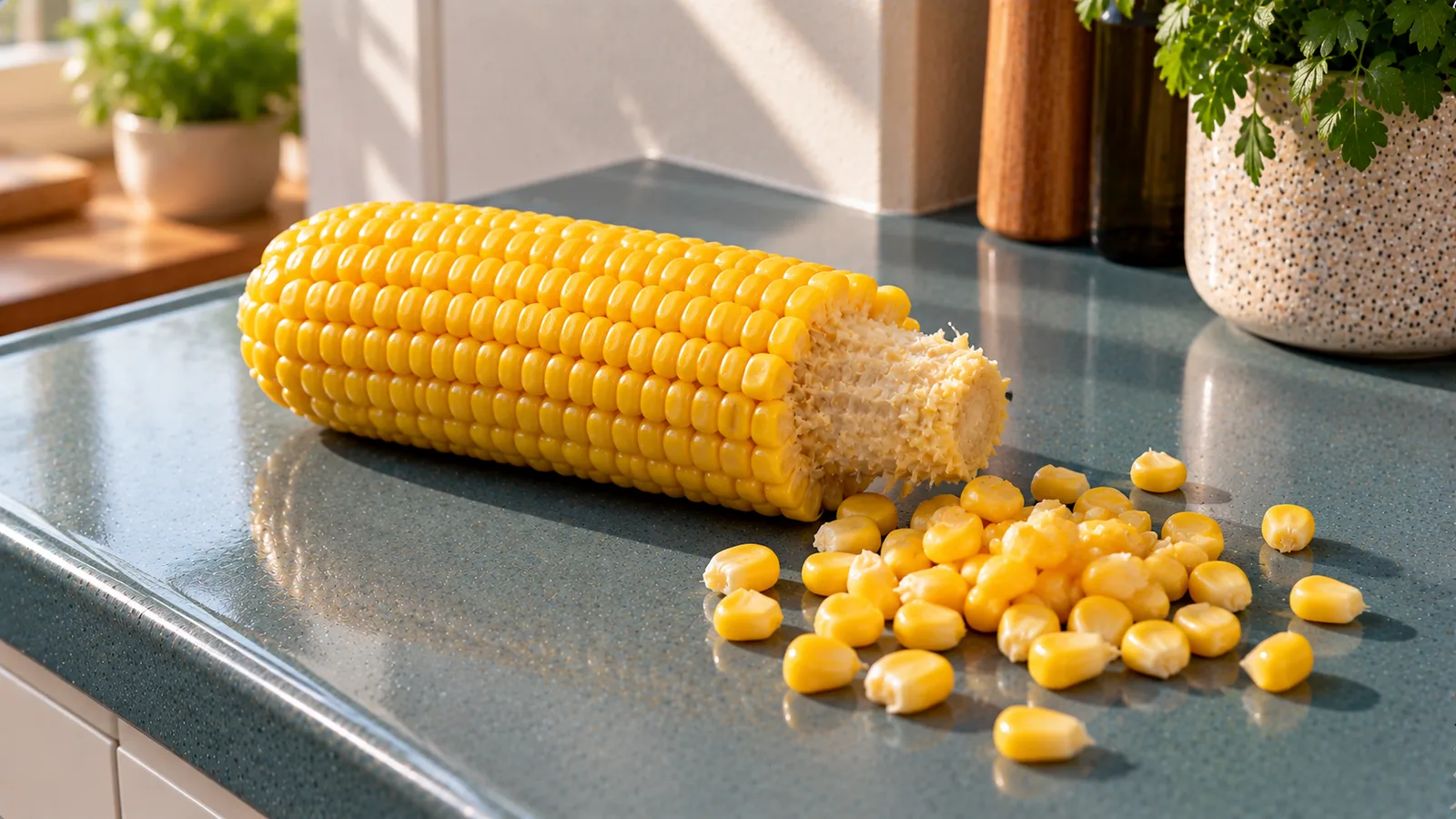
Corn can be eaten as kernels, directly from the cob, canned, frozen or as part of mixed dishes. The calorie count depends on the form, preparation and portion size.
As a practical reference, plain cooked sweet corn kernels contain roughly 95–100 kcal per 100 g. Exact values vary by variety and preparation, so the product label should take priority when available.
Corn nutrition per 100 g
A typical 100 g portion of cooked sweet corn kernels provides approximately:
| Nutrient | Approx. amount |
|---|---|
| Calories | ~96 kcal |
| Protein | ~3.4 g |
| Carbohydrates | ~21 g |
| Fat | ~1.5 g |
| Fiber | ~2.4 g |
Corn is primarily a carbohydrate-containing food, while also contributing some protein and fiber.
Calories by portion size
Using approximately 96 kcal per 100 g:
| Corn kernels | Approx. calories |
|---|---|
| 50 g | 48 kcal |
| 75 g | 72 kcal |
| 100 g | 96 kcal |
| 125 g | 120 kcal |
| 150 g | 144 kcal |
| 200 g | 192 kcal |
| 250 g | 240 kcal |
For any weighed portion:
grams × calories per 100 g ÷ 100
For example, 175 g of corn at 96 kcal per 100 g:
175 × 96 ÷ 100 = 168 kcal
How many calories are in one ear of corn?
An ear of corn is not a standardized portion.
Cobs differ in:
- length;
- diameter;
- kernel size;
- variety;
- maturity;
- edible kernel weight.
The most accurate method is therefore to track the edible kernels rather than the total weight of the cob.
If one cooked ear provides around 90 g of edible kernels, then at 96 kcal per 100 g:
90 × 96 ÷ 100 ≈ 86 kcal
A larger ear with 120 g of edible kernels would contain approximately:
120 × 96 ÷ 100 ≈ 115 kcal
These are examples rather than fixed calorie values for every cob.
Do not count the cob as edible weight
If you weigh an entire ear of corn, part of that weight is the inedible cob.
Using the full weight with a nutrition value intended for edible kernels will overestimate the amount eaten.
For more accurate tracking, you can:
- weigh the whole cooked ear;
- eat the kernels;
- weigh the remaining cob;
- subtract the remaining weight from the starting weight.
For example:
- whole ear before eating: 240 g;
- remaining cob: 145 g;
- estimated edible amount: 95 g.
At 96 kcal per 100 g:
95 × 96 ÷ 100 ≈ 91 kcal
Half an ear of corn
“Half an ear” is also variable because ears differ in size.
If a whole cob contains approximately 100 g of edible kernels, half would be about 50 g:
50 × 96 ÷ 100 = 48 kcal
If the cob is much larger or smaller, the result changes accordingly.
One cup of corn
Volume measurements are convenient but less precise than weighing.
A cup of cooked corn kernels may weigh roughly 160–170 g depending on how the cup is filled.
If the serving weighs 165 g:
165 × 96 ÷ 100 ≈ 158 kcal
So a cup of plain cooked corn can be roughly 155–165 kcal using this reference.
Half a cup of corn
If half a cup weighs approximately 80–85 g:
82 g × 96 ÷ 100 ≈ 79 kcal
For calorie tracking, an actual gram weight is more reliable than assuming every cup contains exactly the same amount.
Protein in corn
Using approximately 3.4 g protein per 100 g:
| Portion | Approx. protein |
|---|---|
| 50 g | 1.7 g |
| 100 g | 3.4 g |
| 150 g | 5.1 g |
| 200 g | 6.8 g |
Corn contributes protein, but it is not usually a concentrated protein source.
In a complete meal, protein may also come from beans, lentils, eggs, dairy, tofu, fish or meat.
Carbohydrates in corn
At roughly 21 g of carbohydrate per 100 g:
- 50 g → ~10.5 g carbohydrate
- 100 g → ~21 g
- 150 g → ~31.5 g
- 200 g → ~42 g
Because corn contributes a meaningful amount of carbohydrate, it is useful to include the actual portion when tracking meal macros.
Fiber in corn
A typical cooked sweet corn reference provides around 2–3 g of fiber per 100 g.
At approximately 2.4 g per 100 g:
- 100 g → ~2.4 g fiber
- 150 g → ~3.6 g
- 200 g → ~4.8 g
Exact values depend on the variety and product.
Fresh corn
Fresh corn can be boiled, steamed, grilled or roasted.
If no calorie-containing ingredients are added, the main differences between these methods usually come from changes in water content rather than large amounts of added energy.
The portion itself still matters most.
Boiled corn
Corn boiled in plain water does not absorb meaningful calories from the water.
If you boil an ear without butter or oil, track the edible corn portion.
Salt changes sodium intake but does not add calories.
Grilled corn
Plain grilled corn can have a similar total energy content to corn prepared without added fat.
However, grilling can reduce water content, and recipes frequently include:
- butter;
- oil;
- mayonnaise;
- cheese;
- sauces.
Those ingredients need to be tracked separately.
Corn with butter
Butter can substantially change the total calories.
Suppose you eat 100 g cooked corn at approximately 96 kcal and add 10 g butter.
If the butter contains roughly 717 kcal per 100 g:
10 × 717 ÷ 100 ≈ 72 kcal
Total:
96 + 72 = approximately 168 kcal
In this example, the butter adds almost three-quarters as many calories as the corn itself.
Corn with olive oil
If 100 g of corn contains about 96 kcal and you add 10 g olive oil at approximately 884 kcal per 100 g:
10 × 884 ÷ 100 ≈ 88 kcal
Total:
96 + 88 = approximately 184 kcal
Small amounts of cooking fat can therefore make a meaningful difference.
Canned corn
Canned sweet corn can have a different calorie value from a generic cooked-corn reference.
Check whether the nutrition label refers to:
- the product as sold;
- drained corn;
- a specified serving weight.
If the corn is packed in liquid and you drain it before eating, use a value that matches the drained product when possible.
For packaged foods, the product label is generally more relevant than a generic database value.
Frozen corn
Plain frozen corn is usually straightforward to track.
If the package gives nutrition per 100 g, weigh the amount according to the label instructions and use that value.
Avoid assuming that every frozen product has exactly the same calories, particularly if it contains:
- butter;
- sauces;
- seasoning mixes;
- other vegetables.
Raw versus cooked corn
Raw and cooked corn may show somewhat different values per 100 g because cooking changes water content.
This does not mean cooking creates calories.
If you weigh corn after cooking, use a cooked entry. If you weigh it raw, use an entry that corresponds to the raw product.
Matching the database state to the state you actually weighed is more useful than trying to apply a universal conversion.
Sweet corn versus field corn
The corn commonly eaten as kernels or on the cob is usually sweet corn.
Other corn products can have very different nutrition profiles.
For example, values for:
- dried corn;
- cornmeal;
- popcorn kernels;
- tortillas;
- polenta;
- cornflakes
should not be used interchangeably with values for cooked sweet corn.
They are different foods or differently processed forms with different water content and serving patterns.
Is corn high in calories?
Compared with many non-starchy vegetables, corn provides more calories per 100 g because it contains more carbohydrate.
But “high calorie” is relative to the portion and the rest of the meal.
For example:
- 100 g corn → ~96 kcal;
- 150 g → ~144 kcal;
- 200 g → ~192 kcal.
The portion size and added fats often matter more than the label “high” or “low.”
Corn as part of a mixed meal
Suppose a bowl contains:
- 120 g cooked corn;
- 150 g beans;
- vegetables;
- avocado;
- dressing.
At 96 kcal per 100 g, the corn contributes:
120 × 96 ÷ 100 ≈ 115 kcal
The remaining ingredients should be tracked separately.
Do not apply the corn calorie value to the total weight of the mixed bowl.
Corn salad
Corn salads can vary dramatically.
A simple salad with corn, tomato, onion and herbs differs from one containing:
- mayonnaise;
- cheese;
- avocado;
- oil;
- tortilla chips;
- creamy dressing.
If you prepare the salad yourself, calculate the ingredients individually or create a recipe based on the total finished weight.
Restaurant corn
Restaurant corn may be served with ingredients that are difficult to see or estimate.
Common additions include butter, oil, cheese, mayonnaise and sauces.
If nutrition information is unavailable, separate the visible components where practical and avoid assuming that restaurant corn has the same calories as plain boiled corn.
Tracking corn from a recipe
For a homemade recipe, use the actual amount of corn added.
For example, if a recipe contains 300 g corn at 96 kcal per 100 g:
300 × 96 ÷ 100 = 288 kcal
If the entire recipe makes four equal portions, the corn contributes:
288 ÷ 4 = 72 kcal per portion
Other ingredients are calculated separately.
Package-label example
Suppose your canned corn label states:
- 82 kcal per 100 g drained;
- 2.8 g protein;
- 15.5 g carbohydrate;
- 1.3 g fat.
You eat 140 g drained.
Calories:
140 × 82 ÷ 100 ≈ 115 kcal
Protein:
140 × 2.8 ÷ 100 ≈ 3.9 g
Carbohydrate:
140 × 15.5 ÷ 100 = 21.7 g
Fat:
140 × 1.3 ÷ 100 ≈ 1.8 g
This product-specific calculation is more appropriate than replacing the label with a generic corn value.
Common tracking mistakes
Corn is often mislogged when people:
- include the inedible cob in the food weight;
- use a generic kernel value for an entire weighed ear;
- forget butter, oil or mayonnaise;
- use drained corn but select an entry that refers to corn with packing liquid;
- treat popcorn, cornmeal or polenta as equivalent to sweet corn;
- estimate cups when an accurate weight is available;
- apply plain-corn values to a mixed corn salad;
- ignore the package label for a specific canned or frozen product.
Quick reference
Using approximately 96 kcal per 100 g of plain cooked sweet corn kernels:
- 50 g: ~48 kcal
- 75 g: ~72 kcal
- 100 g: ~96 kcal
- 150 g: ~144 kcal
- 200 g: ~192 kcal
- 250 g: ~240 kcal
A medium ear may contain roughly 80–120 g of edible kernels, but cob size varies substantially.
For the most accurate result, weigh the edible portion and use the nutrition information for the specific form of corn you are eating.