
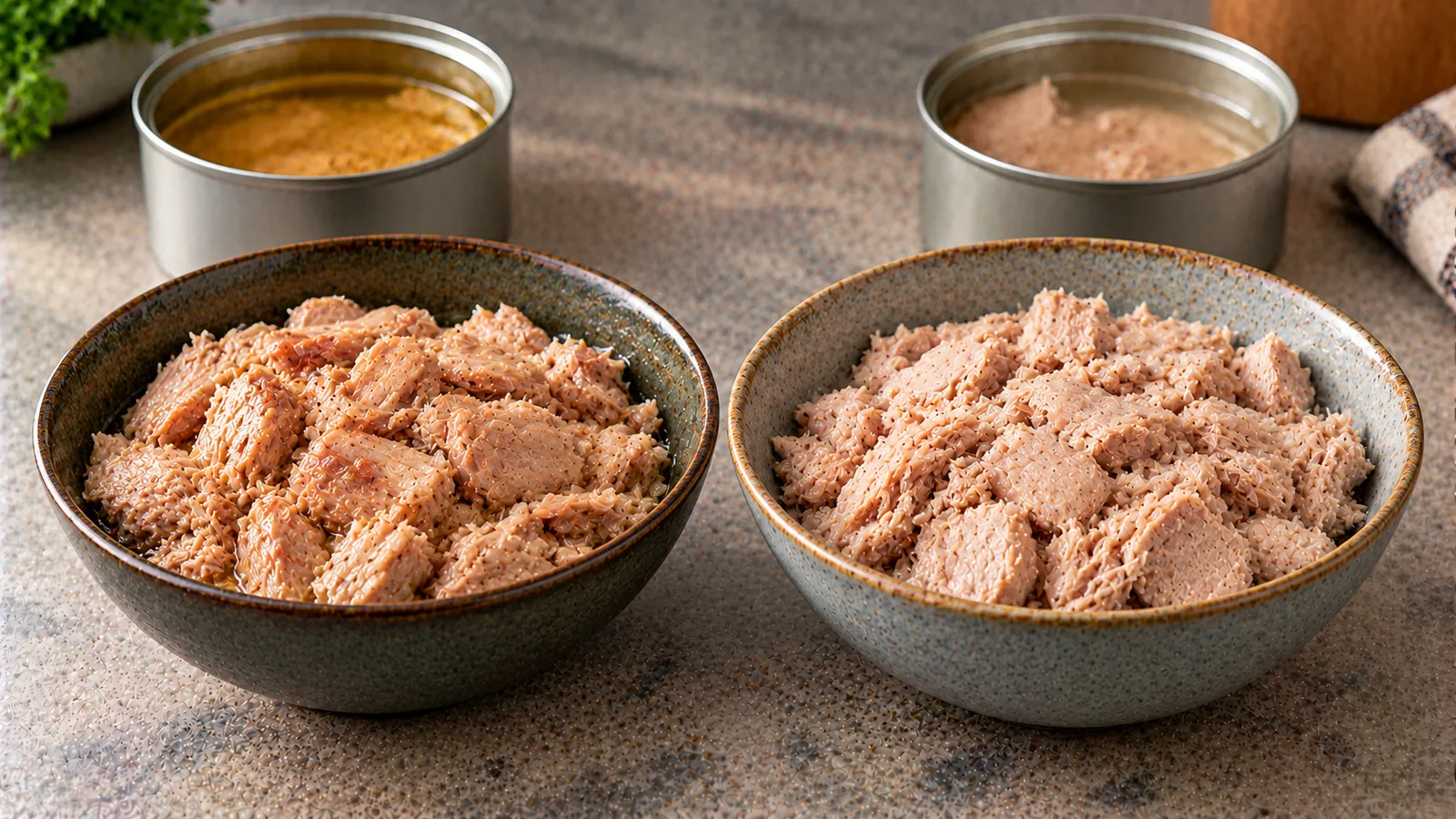
Canned tuna in oil and tuna in water can look nearly identical once you lift them from the tin. Yet the packing medium affects the calories and fat recorded for the product. The fair comparison is not simply “one can versus one can”: it starts by checking the net weight, drained weight and, crucially, what the nutrition figures actually describe. This guide uses two named Saupiquet products and gives a calculation you can repeat with any supermarket brand.
Quick answer: which has more calories?
For the selected Saupiquet tuna fillets, the manufacturer reports 101 kcal per 100 g for the Naturale version packed in its own juice and 195 kcal per 100 g for the version in sunflower oil. Both report 24 g protein per 100 g. That is 94 additional labelled kcal per 100 g for the oil-packed version, while the protein figure is the same. The difference is mainly fat: 0.5 g versus 11 g per 100 g. These are specific formulations, not guaranteed averages for every brand. See the Naturale manufacturer label and the sunflower-oil manufacturer label.
The headline numbers are useful, but do not skip the small print. A nutrition panel might describe drained fish or fish together with its packing liquid. An oil-packed tin that is thoroughly drained can still retain some oil in and around the fish. The label basis must match the quantity you are multiplying.
Match the same products and the same edible weight
For a controlled illustration, compare two Saupiquet fillet tins sold by REWE in 185 g net sizes. Both retailer listings give 130 g drained weight. The version in its own juice contains tuna, water and salt; the oil version contains tuna, sunflower oil and salt. Both are presented as skipjack tuna (Katsuwonus pelamis), helping to reduce — though not eliminate — differences caused by fish species. Check the precise SKU rather than assuming all packs in a brand are interchangeable. The relevant water-packed listing and oil-packed listing provide their weights and label values.
| Label detail | Tuna in own juice | Tuna in sunflower oil |
|---|---|---|
| Total net contents | 185 g | 185 g |
| Listed drained fish weight | 130 g | 130 g |
| Energy shown per 100 g | 101 kcal | 195 kcal |
| Protein shown per 100 g | 24 g | 24 g |
| Fat shown per 100 g | 0.5 g | 11 g |
| Salt shown per 100 g | 1.3 g | 1.3 g |
These are published label figures, not laboratory tests of fish weighed in your kitchen after different draining times. Before using the next table as a precise meal-log entry, check whether your actual can states that the panel is for the drained contents.
Why 185 g net is not a 185 g serving of fish
The front of a can can show its overall contents: solid fish plus water, brine or oil. Net weight measures everything in the sealed package. Drained weight aims to describe the solid food left after the packing liquid has been removed under the applicable method. In our examples the difference is 55 g: 185 − 130 = 55 g. This is not proof that you can recover exactly 55 g of pure sunflower oil; packing media may contain moisture, and some liquid remains with the fish.
A 185 g tin therefore does not automatically supply 185 g of drained tuna. Multiplying a per-100-g number by 1.85 when you eat only 130 g can inflate the calculation. On the other hand, using 130 g is not necessarily correct when the manufacturer reports the nutrition for the total contents including the liquid. Your two denominators — nutritional basis and edible mass — must refer to the same state.
EU food-information rules explain when a drained net weight must be shown. More importantly, the European Commission's interpretive notice says that nutrition information must make clear whether it refers to the drained product or the product with its liquid. Some declarations may cover the whole product, with drained figures supplied additionally; for products whose liquid is normally discarded, drained values can be more relevant. Consult the Commission notice, section 3.8.1 and Regulation 1169/2011.
Worked calculation for one drained 130 g portion
Conditional example: suppose you have established from the physical packaging or the manufacturer's clarification that each per-100-g nutrition declaration applies to the same drained edible fraction. In that case, multiply the label figure by 130 ÷ 100 = 1.30. The resulting amounts are shown below. If the label actually covers the whole tin including oil, do not present these numbers as measured drained nutrition; ask the manufacturer or use a verified drained-food reference instead.
| Quantity, assuming a drained-food label | Own juice: 130 g | Sunflower oil: 130 g | Difference |
|---|---|---|---|
| Energy | 131.3 kcal | 253.5 kcal | +122.2 kcal |
| Protein | 31.2 g | 31.2 g | 0 g |
| Fat | 0.65 g | 14.30 g | +13.65 g |
| Salt | 1.69 g | 1.69 g | 0 g |
For example, 195 × 1.30 = 253.5 kcal; 101 × 1.30 = 131.3 kcal. Protein is 24 × 1.30 = 31.2 g in either example. These results are conditional arithmetic, not independently verified laboratory values for drained tins. For a broader discussion of tuna as a food, see our tuna nutrition and serving-size guide.
What changes if you eat 80 g instead of the whole tin?
Portion sizes often matter more than the words on the front. You might divide one can across two sandwiches, mix 80 g into a salad or use an entire 130 g drained can in a larger meal. Once the label basis has been checked, the same formula applies to any edible amount: label value per 100 g × amount eaten in grams ÷ 100.
| Example drained serving | Own-juice label energy | Oil-packed label energy | Protein for either |
|---|---|---|---|
| 50 g | 50.5 kcal | 97.5 kcal | 12.0 g |
| 80 g | 80.8 kcal | 156.0 kcal | 19.2 g |
| 100 g | 101.0 kcal | 195.0 kcal | 24.0 g |
| 130 g | 131.3 kcal | 253.5 kcal | 31.2 g |
Again, these figures assume that the same per-100-g panel applies to drained fish. They illustrate the method, not a guarantee for every drained can. If you struggle to relate label servings to your own meals, our guide to serving size versus portion size explains why manufacturer portions and what you eat are separate concepts.
Does draining remove all the oil and all the extra calories?
No. Draining removes some free oil, but oil can remain attached to the flakes or within their crevices. Pressing the fish, letting it rest in a strainer or using a fork may change how much oil is removed. That change cannot be quantified accurately from the words “packed in oil” or from the difference between net and drained weights alone. Never assume that drained oil-packed tuna is nutritionally identical to water-packed tuna.
If you intentionally spoon some packing oil into the dish, it needs consideration too. As an illustrative separate calculation, 5 g of additional oil contributes roughly 45 kcal using the common 9-kcal-per-gram energy factor; this is not a measurement of oil retained in a particular can. Likewise, rinsing fish under water is not a validated way to erase its original fat or salt content. It may also change taste and texture.
An actual kitchen scale solves the edible-weight problem but not the nutritional-basis problem. You still have to establish whether your label describes that weighed state. If the label is ambiguous, log a clearly marked estimate rather than pretending the answer is exact.
Protein: compare the meal you will actually prepare
With these two products, the manufacturer lists 24 g protein per 100 g for both packing styles. Under the same-basis assumption, a 130 g portion supplies 31.2 g of labelled protein. The packing liquid itself is not a reliable protein source, however, and the number can change when comparing different cuts, brands or formulations. Tuna in water is not automatically higher in protein per can just because it is lower in calories.
For a meal where you want more protein without many accompanying calories, the water-packed option is often convenient according to this particular label comparison. But a meal's actual protein depends on whether you eat half a tin, a whole tin, bread, beans or added dressing. Our tuna-versus-sardines comparison gives a separate look at another canned-fish choice without conflating oil with fish species.
Protein is also not the only nutrient in a meal. Vegetables, whole grains and beans can provide fibre, which plain tuna does not supply. For example, tuna on its own and a tuna-and-bean salad are different nutritional choices even when the same can is used.
Does oil-packed tuna have a nutritional advantage?
Sunflower oil supplies fat and adds calories, but dietary fat is not inherently undesirable. Someone preparing a substantial lunch might value a richer texture and may omit separate dressing. Another person may prefer the clearer control over added oil that comes with tuna packed in water. Neither choice automatically determines the quality of the overall diet.
The type of packing oil also matters: sunflower oil, olive oil and mixed oils are not interchangeable ingredients. Do not apply this 195-kcal label value to a different brand's olive-oil tin, a seasoned tuna salad or a tuna pouch in tomato sauce. Check the exact panel. Likewise, skip claims about a particular can's omega-3 quantity unless the producer supplies reliable figures for that product.
A useful way to compare is to decide the role of the tuna. Is the oil intended to become part of the salad dressing? Will you drain and discard the liquid? Are you using bread or mayonnaise? Those practical choices can dwarf small label differences between products.
Salt and ingredients: the packing liquid is only part of the story
Both selected Saupiquet examples list 1.3 g salt per 100 g in the product information. Under the conditional drained-label model, 130 g contains 1.69 g. Do not infer that the oil-packed version is necessarily lower in sodium, or that water-packed tuna always has no added salt. Ingredients vary widely. Some water-packed fish uses brine; some uses water and salt; some contains flavourings.
Read the ingredient list and the salt line separately. Sodium and salt are related but not identical labels: under EU labelling conventions, salt is conventionally derived from sodium using a factor of 2.5. A product listing 0.5 g salt is not displaying 0.5 g elemental sodium. For someone monitoring salt intake, the cumulative amount in a full sandwich or prepared salad matters, including any pickles, sauce and bread. The European Commission's nutrition-labelling overview identifies the required label fields.
Choosing tuna for everyday meals
For a plain tuna sandwich with mayonnaise or olive oil already included, water-packed fish can simplify control of added fat. For a lemon-and-herb salad with no other dressing, oil-packed fish can save a separate ingredient and create a fuller mouthfeel. For pasta, either can work, although the amount of cooking oil already in the sauce influences the final meal considerably.
For a convenient lunch, combine measured tuna with white beans, tomato and greens; the beans add substantial fibre and change the energy balance compared with eating fish alone. Our tuna and white bean salad recipe gives one recipe-specific approach. The important principle is to calculate the whole dish, not judge its calories by the type of tuna can alone.
If purchasing multipacks, also compare actual drained fish grams per euro, not only the price displayed in large print. A product can appear inexpensive because the overall net weight includes more packing liquid. Retail prices change by market and promotion; this guide does not invent a current price comparison without verified local prices.
Food safety, mercury and frequency of tuna meals
Tuna is a fish allergen. Once a can is opened, follow the producer's refrigeration instructions; Saupiquet advises refrigerating opened products and consuming them within two days. Put leftovers in a covered food-safe container, refrigerate promptly and do not rely on a sealed tin's unopened shelf life after the lid has been removed.
Mercury risk is primarily related to the fish species and frequency of consumption, not whether the can uses oil or water. The FDA/EPA fish advice distinguishes canned light tuna (including skipjack) from albacore, yellowfin and bigeye. Its recommendations target people who may become pregnant, those who are pregnant or breastfeeding, and children; they should be interpreted for the relevant age and circumstances rather than as a universal tuna allowance. Draining oil does not remove mercury found within fish tissue.
Food safety and nutrient calculation answer different questions. A lower-fat tin does not automatically confer greater contaminant safety. Varying seafood choices and following official species-specific recommendations is more useful than using packing oil as a safety signal.
A reusable three-step can comparison
First, photograph or write down the exact product, ingredients, total net weight and drained weight. For the selected two products, these are 185 g net and 130 g drained. Second, check the nutrition declaration's basis. Does “per 100 g” mean the drained fish, all contents, or a prepared serving? When this remains unclear, ask the company and do not silently combine two bases. Third, multiply by the weight you will eat and then include all other recipe ingredients. If you keep and use the oil, log it as part of the meal without double-counting any oil that the label has already included.
For an 80 g portion only when the panel covers drained fish, the examples yield 80.8 versus 156.0 kcal, with 19.2 g protein either way. Those numbers help compare the selected tins, not all tinned tuna on the shelf. Check the label again whenever you switch brand, species, packing medium or product size.
Sources
- Saupiquet — tuna fillets Naturale without oil: product energy, protein and fat.
- Saupiquet — tuna fillets in sunflower oil: product energy, protein and fat.
- REWE — Naturale 185 g tin, drained weight 130 g: net and drained weights, ingredients, salt.
- REWE — sunflower-oil 185 g tin, drained weight 130 g: net and drained weights, ingredients, salt.
- European Commission — interpretation of nutrition declarations for foods in liquid: section 3.8.1.
- EU Regulation 1169/2011: drained weight and label requirements.
- European Commission — nutrition labelling: required nutrition information.
- FDA/EPA — questions and answers on eating fish: species and mercury distinctions.