
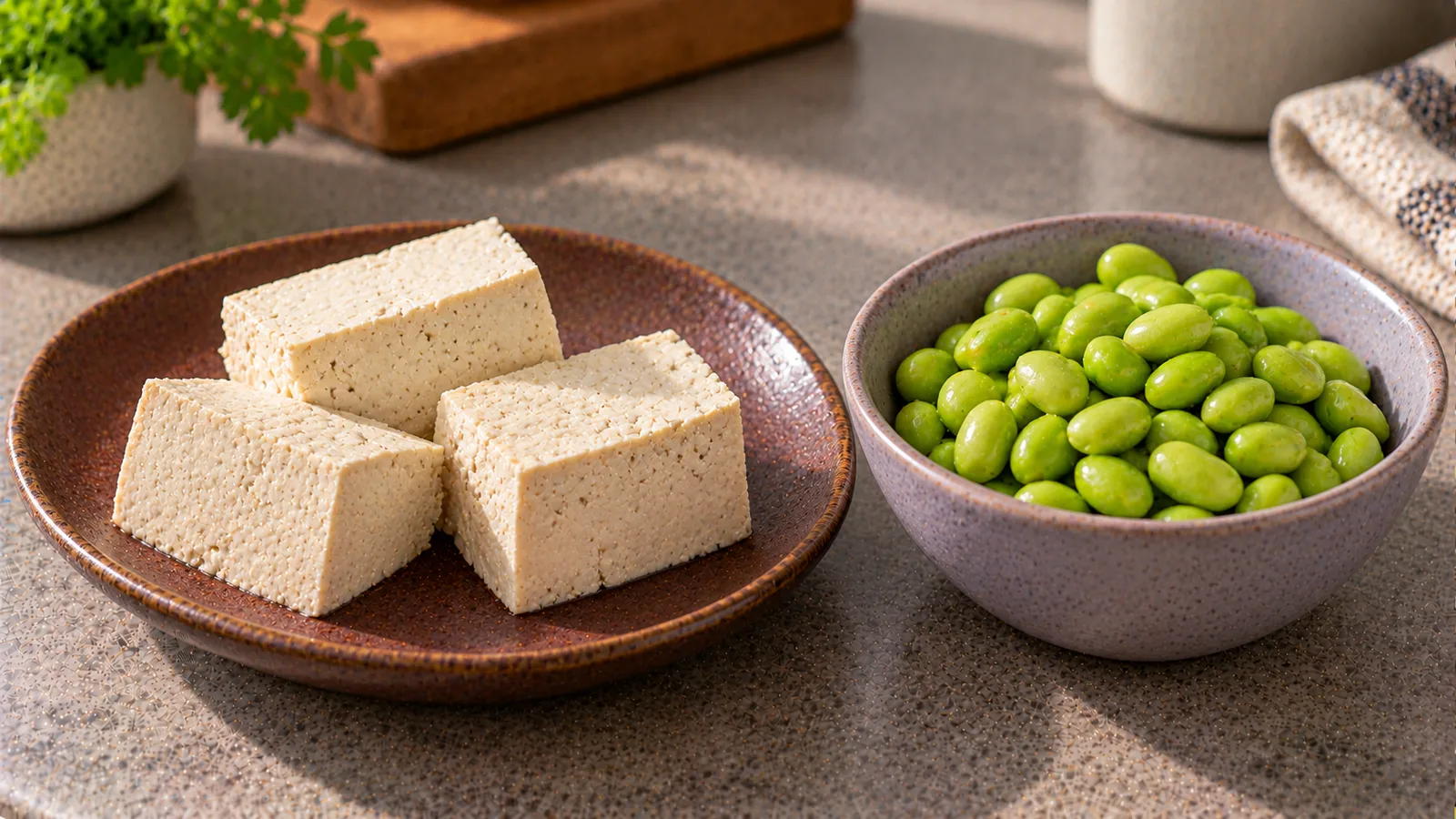
Firm tofu and edamame both come from soybeans, yet they are not the same food in a nutrition table or at checkout. Tofu is made by coagulating soy milk and pressing the curds; edamame are immature soybeans typically steamed or boiled and eaten without their pods. The difference affects protein, dietary fiber, water content, cooking work and what you pay for an edible serving. For a useful comparison, specify the product form first rather than relying on the word “soy.”
This guide compares a USDA reference for plain, firm, calcium-set tofu with cooked, shelled edamame, then tests realistic portions and an explicitly hypothetical German grocery scenario. Neither example is a live store offer. Branded tofu can be very different from this particular reference, and an edamame pod is not part of the edible weight.
Tofu vs edamame at a glance: defined food states
The figures below are from three identifiable USDA FoodData Central SR Legacy records, not an average of unrelated products. The main tofu is Tofu, raw, firm, prepared with calcium sulfate, FDC 172475; edamame is Edamame, frozen, prepared, FDC 168411. A second legitimate tofu record, FDC 172448, shows why a generic “firm tofu” number can mislead. “Raw” in the tofu database description identifies its unheated packaged form; the table is not comparing dried beans with cooked beans.
| Per 100 g of the specified edible food | Firm calcium-set tofu (172475) | Cooked shelled edamame (168411) | Different firm tofu (172448) |
|---|---|---|---|
| Energy | 144 kcal | 121 kcal | 78 kcal |
| Protein | 17.27 g | 11.90 g | 9.04 g |
| Dietary fiber | 2.30 g | 5.20 g | 0.90 g |
| Fat | 8.72 g | 5.20 g | 4.17 g |
| Carbohydrate, USDA by-difference | 2.78 g | 8.91 g | 2.85 g |
Look up the stated records in USDA FoodData Central: calcium-set firm tofu, 172475, prepared edamame, 168411, and the other firm tofu, 172448. The linked USDA search interface can require JavaScript; the ID and food description, rather than a guessed direct-details URL, identify each source record.
For these two main reference foods, the denser tofu supplies 5.37 g more protein per 100 g (17.27 minus 11.90), while edamame supplies 2.90 g more fiber (5.20 minus 2.30). Those differences are valid for the named records, not a universal verdict about all tofu.
Why tofu protein varies so much
Most of the striking variation comes from water and manufacturing. Tofu starts as soy milk. Its protein-rich curds can be pressed to different degrees; firm, extra-firm, regular and silken styles do not all retain the same proportion of water. Coagulants and recipes differ, too. For example, the USDA calcium-set reference has about 69.8 g water per 100 g, while the other firm-tofu entry has about 82.9 g. Less water generally means more soybean solids in the same 100 g, although it is not a substitute for checking the actual label.
The second tofu record contains 9.04 g protein per 100 g, compared with 17.27 g for the first. It is therefore possible for cooked edamame at 11.90 g to exceed one “firm tofu” example but fall below another. Claims such as “tofu always has more protein” or “edamame always wins” fail this simple record check.
Calcium is another formulation-dependent nutrient. The calcium-sulfate tofu record is calcium-rich; tofu set with other coagulants may be substantially different. Do not copy its calcium figure into every product in a nutrition tracker. Salted, smoked, marinated or fried tofu also needs its own data because seasoning and absorbed oil change the profile.
Real portions: 150 g tofu versus 120 g edamame
A 100 g table standardizes a comparison but does not tell you what ends up on a plate. Consider 150 g of the named plain firm tofu in a stir-fry and 120 g of cooked beans removed from their pods as a side dish. Both quantities are examples, not prescribed portions. The multiplication is straightforward: listed value per 100 g × edible grams ÷ 100.
| Portion calculation | 150 g specified firm tofu | 120 g shelled cooked edamame |
|---|---|---|
| Energy | 216 kcal | 145.2 kcal |
| Protein | 25.91 g | 14.28 g |
| Fiber | 3.45 g | 6.24 g |
| Fat | 13.08 g | 6.24 g |
| Hypothetical ingredient cost | €0.82 | €0.90 |
| Hypothetical cost per 10 g protein | €0.32 | €0.63 |
One tofu portion here provides about 11.63 g more protein, but the edamame portion provides 2.79 g more fiber. The portions differ in weight and food role: this is a practical plate comparison, not a controlled equal-weight experiment. For the relationship between standardized label servings and the quantity you eat, see Mealisa's portion size versus serving size guide.
Do not include an empty edamame shell in the 120 g. If a bag contains whole pods, weigh the beans after shelling or use an independently established edible yield. The yield of pods differs with variety and preparation; no single conversion factor is sufficiently reliable for every product.
How much protein and fiber do you get per calorie?
Protein per 100 kcal is a useful secondary lens, especially when recipe portions are different. On the two main USDA references, tofu provides about 12.0 g protein per 100 kcal (17.27 ÷ 144 × 100), while cooked edamame provides about 9.8 g (11.90 ÷ 121 × 100). That supports choosing this denser tofu when protein relative to energy is your principal comparison.
Fiber points the other way. Tofu has approximately 1.6 g fiber per 100 kcal (2.30 ÷ 144 × 100); edamame supplies approximately 4.3 g (5.20 ÷ 121 × 100). The numbers describe ingredient density, not guaranteed satiety. Vegetables, grains, sauces and the rest of your meal can alter how satisfying it feels.
Fiber reporting also needs care when comparing a US database with a European food label. EU nutrition declarations emphasize values per 100 g; fiber may be voluntarily included. Check the actual product and the declared measurement basis rather than assuming two different labeling systems or databases are interchangeable. The European Commission's nutrition-labelling explanation explains the required declaration and optional fiber entry.
A transparent supermarket-cost example
Imagine a 400 g package of plain tofu for €2.19 and a 400 g package of shelled frozen edamame for €2.99. These are fictional demonstration prices, not checked current supermarket listings, recommendations for any retailer or a claim that all packages are the same size. For the model, both amounts are 100% usable edible weight, with no losses, packaging liquid or discarded pods; that is an assumption, not a promise about a product.
For tofu, €2.19 ÷ 400 × 150 = €0.82125, displayed as €0.82. For edamame, €2.99 ÷ 400 × 120 = €0.897, displayed as €0.90. Those calculations use the unrounded numbers for subsequent cost-per-nutrient figures.
Cost per 10 g protein is portion cost ÷ grams of protein in that portion × 10. Thus tofu costs €0.82125 ÷ 25.905 × 10 = about €0.32 per 10 g protein. Edamame costs €0.897 ÷ 14.28 × 10 = about €0.63 per 10 g protein. In this model the tofu is the more economical source of these protein grams, not necessarily the better ingredient for every meal.
If you measure fiber, the story changes: €0.82125 ÷ 3.45 gives roughly €0.24 per gram fiber for tofu, while €0.897 ÷ 6.24 gives about €0.14 for edamame. These are separate goals; adding protein and fiber grams into one arbitrary “health value” would not be sound. Mealisa's protein and fiber per euro guide explains when to use these price comparisons and when not to.
What if the edamame comes in pods?
This changes the shopping calculation before it changes the nutritional comparison. A 400 g in-pod bag does not deliver 400 g of shelled beans. Buying 400 g of edamame with the same printed pack price as 400 g shelled edamame is not an equal-value purchase because you discard the pod. A menu may use “edamame” to mean a bowl of pods or a bowl of shelled beans; the distinction matters when logging food.
For instance, if a 400 g in-pod bag delivered 200 g edible beans after cooking and shelling, that would be a hypothetical 50% yield, not a universal observed yield. At €2.99 per bag, a 120 g edible bean portion would use €2.99 × 120 ÷ 200 = €1.79 of the purchase. This is roughly double the €0.90 in the shelled-bag model. A different yield changes the outcome. Record an actual kitchen yield if this comparison will guide repeated purchases.
For tofu, the analogous mistake is treating water drained from a package as purchased edible tofu or pretending a pressed block weighs what it did before pressing. Weigh the part you actually cook; use the package's nutrition reference appropriately. If you drain or press tofu vigorously, its final mass changes, and logging the original food's 100 g values against the new weight may overstate or understate nutrients depending on the losses.
What actually changes when you cook them?
Plain tofu may be eaten cold where the package says it is ready to eat; it can also be cubed, baked or browned. Edamame should be prepared according to the package instructions, because products sold frozen may require heating. Frozen prepared edamame in a database does not mean every frozen supermarket bag can be eaten without following its label.
Heating can change water weight. Frying or roasting with oil adds calories, while salty sauces can markedly increase sodium. A tablespoon-scale addition of oil may matter more to the finished dish's calories than a small difference between plant proteins. Compare tofu and edamame in their stated edible states, then calculate seasonings, grains and oil as separate recipe ingredients rather than silently attaching them to the base food.
Both are perishable after opening or cooking. Keep them properly chilled and follow pack-specific storage limits. The USDA FSIS food-safety advice recommends prompt refrigeration of perishables; it is not a special blanket shelf-life guarantee for either soy food.
Building two meals without distorting the comparison
For a tofu-centered dinner, use the 150 g plain tofu reference with a generous portion of vegetables, a measured amount of rice or another grain, and a measured dressing. If the goal is a higher-protein vegetarian plate, the tofu contributes about 25.91 g protein before the other ingredients. The vegetables and grains contribute additional nutrients; count them separately rather than attributing the whole dish to tofu.
For an edamame bowl, start with 120 g shelled cooked edamame, add vegetables and a grain, and consider whether another protein source is needed for your intended meal. Edamame brings 14.28 g protein and 6.24 g fiber before additions in this reference. More edamame or tofu, a different grain, or additional beans can change the result. There is no requirement that both meals have identical calories or identical ingredients.
Another option is a combination: 100 g specified tofu plus 100 g shelled prepared edamame provides approximately 29.17 g protein, 7.50 g fiber and 265 kcal before cooking extras. That combination is not claimed to be superior; it simply lets the two ingredients serve different roles in the same dish.
Soy protein, allergies and label checks
Both foods naturally supply soy protein, but grams of protein alone do not capture digestibility, amino-acid availability or an entire diet's adequacy. They also contain different accompanying fiber, fat and minerals. For more technical background see Mealisa's protein digestibility and quality guide, rather than assuming one nutrient-density number is a complete protein-quality rating.
Soy is a major food allergen. Anyone with a diagnosed soy allergy should not treat tofu and edamame as unrelated alternatives. The US FDA allergen guidance lists soybeans among major allergens. Check ingredient and cross-contact information relevant to your circumstances, especially in marinated or composite foods.
If you are comparing tofu with another soybean product, Mealisa's tofu versus tempeh comparison covers a distinct issue: pressed soy curd versus a fermented soybean cake. It should not be merged with the present question about intact young beans, discarded pods and edible portion cost.
A sensible buying decision
Choose the particular dense firm tofu in the main model when you want more protein per portion for the illustrated purchase cost and a neutral base for cooking. Choose shelled edamame when you especially value fiber in a ready-to-portion soybean side dish, even if it is not cheapest per gram protein in the model. If your tofu is water-rich, or your edamame is bought in pods, recalculate: the winner can change.
A practical supermarket check is short: identify plain versus seasoned products; note whether the beans are shelled; match the nutrition data to the edible state; read protein and fiber per 100 g; divide the paid package price by edible grams; and calculate for the amount you actually plan to eat. Taste, cooking time, use of leftovers and dietary requirements still count. There is no single universally healthier or cheaper soy food.
Sources
- USDA FoodData Central: firm tofu prepared with calcium sulfate, FDC 172475 — named reference for denser tofu.
- USDA FoodData Central: edamame, frozen, prepared, FDC 168411 — named reference for cooked edible beans, not pods.
- USDA FoodData Central: firm tofu with calcium sulfate and magnesium chloride, FDC 172448 — shows variation among tofu formulations.
- European Commission: nutrition labelling — declarations per reference amount and fiber reporting.
- US FDA: food allergies — soybean allergen labeling.
- USDA FSIS: steps to keep food safe — safe handling and refrigeration.
Methods note: USDA values represent the specified historical SR Legacy records and may differ from current products; the example German euro prices, package weights, in-pod yield and resulting cost rankings are explicitly hypothetical. Round figures are shown for readability; calculations were performed before monetary rounding. No independent, current retailer price is claimed.