
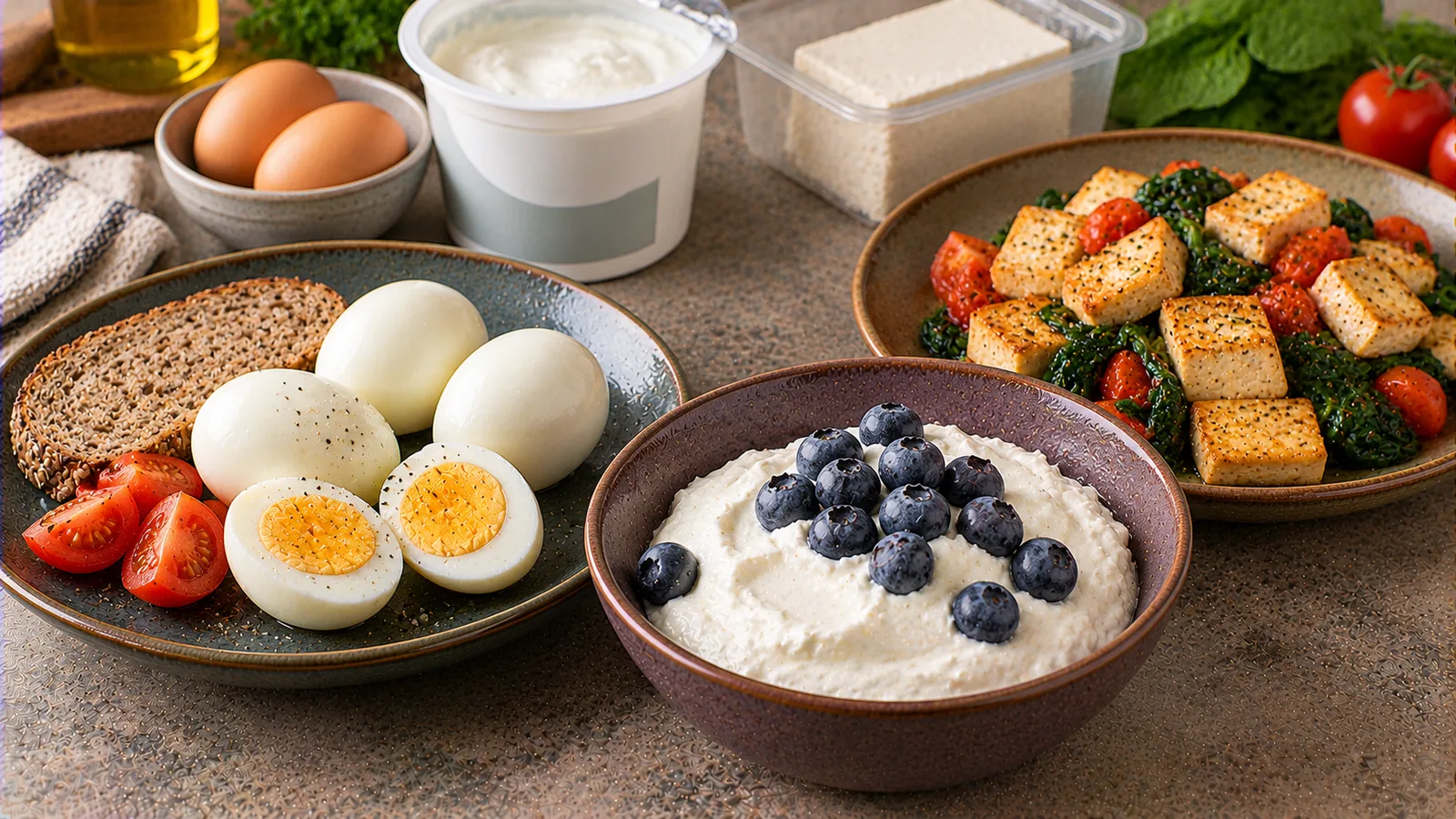
Which breakfast gets you 20 g of protein for less?
Eggs, plain skyr and firm tofu can all supply about 20 g of protein, but comparing one egg, one spoonful and one tofu cube is misleading. A fair first pass matches protein quantity, checks the edible portion, and then divides the relevant price by the protein bought. For this comparison the reference quantities are about 2.86 cooked reference eggs, 181.8 g plain skyr, or 133.3 g firm tofu. The eggs are a calculation unit rather than a breakfast instruction to split a raw egg into hundredths.
Using illustrative German shopping prices—€2.99 for ten eggs, €1.79 for a 400 g skyr tub, and €2.49 for a 400 g tofu twin-pack—the amounts of product supplying 20 g protein cost roughly €0.85, €0.81 and €0.83, respectively. These are not verified current shop prices. REWE explicitly varies its online price by selected location. Your local prices can reverse the ranking. The figures below show both the cost of what goes onto the plate and the higher cash needed to purchase whole packs.
The main difference from a general budget high-protein breakfasts without protein powder is that this is a three-food, single-meal comparison at matched protein. It is not a claim that 20 g is the correct breakfast target for everyone. The DGE gives reference intake across the whole day: 0.8 g/kg/day for healthy adults aged 19–64 and 1.0 g/kg/day for adults 65+; individual needs vary.
Verified protein starting points, with the right units
The DGE protein FAQ lists 7 g protein for one cooked egg with a 60 g edible reference portion. This is a practical benchmark, not a guarantee for any supermarket size M egg: eggs are sold with shells, which are not food, and the actual edible quantity varies. The REWE Bio plain skyr 400 g listing reports 11 g protein/100 g, and REWE Bio plain tofu 2 × 200 g reports 15 g/100 g. These are named products, not universal averages for all skyr and tofu brands.
| Reference food and basis | Label/reference protein | Calculated amount for 20 g | Everyday portion |
|---|---|---|---|
| Cooked egg, edible DGE reference | 7 g per 60 g edible egg | 2.857 reference eggs, about 171.4 g edible | 3 reference eggs ≈ 21 g protein |
| REWE Bio plain skyr | 11 g per 100 g | 181.8 g | 182 g ≈ 20.02 g protein |
| REWE Bio plain tofu | 15 g per 100 g | 133.3 g | 133 g ≈ 19.95 g protein |
For skyr, calculate 20 ÷ 11 × 100 = 181.8 g. For tofu, 20 ÷ 15 × 100 = 133.3 g. For the DGE egg unit, 20 ÷ 7 = 2.857 eggs, equivalent to about 171.4 g of cooked edible egg if each reference portion is 60 g. When purchasing eggs by count, round to three whole eggs; with the DGE reference assumption they deliver approximately 21 g, not an exactly met laboratory target. Egg grades by shell-inclusive weight are separate from this edible calculation; EU egg marketing rules define size classes, not the edible protein of each egg.
Cooking can change food weight through water changes. That is why this table does not calculate cooked tofu using an invented moisture-loss percentage. Weigh the tofu as sold, or use a nutrition declaration that explicitly refers to the prepared state. For eggs we use the DGE's already cooked, edible reference unit and do not pretend the 60 g includes shell.
Illustrative German basket: checkout versus used portion
The following basket is a deliberately hypothetical price model, not a REWE receipt or a nationwide price claim. Its purpose is to show reproducible arithmetic. Use prices from the same store, date and pack size when doing your own comparison. Eggs are counted individually, skyr by its 400 g tub, and tofu by its complete 2 × 200 g twin-pack. One tofu inner block is 200 g; the entire example pack is 400 g.
| Food | Assumed whole pack | Cash paid at checkout | Protein in whole pack (reference) | Used cost for 20 g protein |
|---|---|---|---|---|
| Eggs | 10 eggs | €2.99 | 70 g | €0.85 |
| Plain skyr | 400 g tub | €1.79 | 44 g | €0.81 |
| Firm tofu | 2 × 200 g = 400 g | €2.49 | 60 g | €0.83 |
Egg cost: €2.99 ÷ 10 = €0.299 per reference egg. Multiply by 20 ÷ 7 = 2.857: €0.299 × 2.857 = €0.854 ≈ €0.85 for the theoretical 20 g target. Buying and eating three whole eggs instead costs €0.897 ≈ €0.90 and supplies about 21 g, provided your eggs resemble the edible reference portion.
Skyr cost: €1.79 ÷ 400 × (20 ÷ 11 × 100) = €0.814 ≈ €0.81 for about 181.8 g. If measuring out 182 g, the estimate rounds to €0.81. The remaining approximately 218 g of the tub is food you have already paid for, not refunded cash.
Tofu cost: €2.49 ÷ 400 × (20 ÷ 15 × 100) = €0.830 ≈ €0.83 for about 133.3 g. If using 133 g, the rounded cost is €0.83. You still purchased 400 g, even if you only cook part of it. Keep the remainder refrigerated and follow the package's after-opening advice.
Those few cents between first and third are too small to treat as a durable market ranking. The egg conversion depends on actual edible egg size, prices are examples and product composition varies. Furthermore, if you must buy the product today and have no pantry stock, the immediate checkout total is €2.99 / €1.79 / €2.49, not €0.85 / €0.81 / €0.83. Portion cost and cash required answer different questions.
A second way to compare: grams of protein per euro
A reusable formula is protein per euro = grams of protein in the purchased package ÷ price of the package. This yields 70 ÷ 2.99 = 23.41 g/€ for eggs, 44 ÷ 1.79 = 24.58 g/€ for skyr, and 60 ÷ 2.49 = 24.10 g/€ for tofu under the same assumptions. More protein per euro means a lower cost per 20 g; it does not mean the breakfast has better overall nutrition or tastes better.
For a quick sensitivity test, the egg example costs about €0.854 per 20 g. Skyr would match this only if a 400 g tub cost about €1.88 (44 g total protein, €0.854 × 44 ÷ 20). Tofu would match at about €2.56 for 400 g (60 g total protein, €0.854 × 60 ÷ 20). A promotion, different pack size or a local price change can move either food above or below those thresholds. The label matters too: a skyr at 9 g/100 g needs a bigger serving than the 11 g/100 g example.
Do not divide the shelf price of a 200 g tofu block by the protein content of 400 g. And never compare the price of an egg box against the protein in one egg while comparing the per-100 g value of skyr. For a wider shopping method, see how to compare protein per euro in German supermarkets, which discusses protein-per-euro comparisons across categories rather than this matched breakfast trio.
Breakfast option 1: fully cooked eggs with a complete plate
The most practical version is three cooked eggs, which represent roughly 21 g protein under the DGE reference assumption. Scramble the eggs until set, or boil until the yolk and white are firm. Serve with vegetables and a slice of wholegrain bread if desired; add those components to the nutritional and price tally separately. Three eggs alone are a source of protein, not an automatically balanced breakfast, and the model's €0.90 used-egg cost does not cover bread, vegetables, oil, spices or electricity.
Egg size affects the true count. If the shells are small or a portion is unusually light, weigh the edible cooked eggs and adjust the reference estimate. The German Federal Institute for Risk Assessment (BfR) recommends careful handling of eggs, avoiding cross-contamination, and thoroughly cooked eggs for more vulnerable people. Refrigerate and use eggs as advised on the pack; do not claim every raw or runny-egg preparation is equally safe.
Breakfast option 2: plain skyr with fruit and grains
Measure 182 g plain skyr into a bowl to obtain approximately 20.02 g protein from skyr itself, based on the specified 11 g/100 g product. Add fruit and a measured amount of oats or other cereal according to appetite and dietary requirements. The protein contribution from fruit or grains is not included in the 20 g calculation; adding them changes both total cost and nutrients.
Plain skyr offers a fast option without cooking, but it contains milk and is unsuitable for a milk allergy. Flavoured skyr may have different protein content and added sugars: read the actual pack. The product in the example has a 400 g tub; using less than half for one breakfast does not make the rest of the pack free. Reseal, chill and observe the use-by date and instructions after opening.
Breakfast option 3: warm tofu scramble without eggs or dairy
Weigh 133 g of REWE Bio plain tofu as sold for approximately 19.95 g protein from the tofu itself. Drain surface water if needed; crumble and cook with peppers, spinach and optional herbs in a non-stick pan until heated through. Count added oil, vegetables and bread separately. Tofu from other producers may be softer, drier or have a different protein value: the 15 g/100 g label is not universal.
This is the plant-based option in the comparison, but it contains soy, a declared allergen. The sampled REWE twin-pack is 400 g, comprising two 200 g blocks. The label says to keep it refrigerated after opening and consume within two days. If splitting a block for a breakfast now and later, plan the next meal rather than ignoring food waste or silently counting the whole pack as one serving.
What the 20 g protein target does not tell you
Matching 20 g protein makes the prices comparable on one axis. It does not equalise calories, saturated fat, calcium, fibre, sodium, biological protein quality or dietary suitability. Plain skyr is a dairy food; tofu is a soy food; eggs have their own nutrient profile. Price per 20 g can reward high-protein products but overlooks the food needed to make a filling meal. A breakfast with vegetables, fruit or whole grains will have a different final price than protein alone.
Nor is there a universal rule to eat 20 g at breakfast. The DGE's 0.8 g/kg/day adult reference (19–64 years) corresponds to 56 g per day for a reference-weight 70 kg adult, not necessarily 20 g each meal. For adults 65+, the DGE estimates 1.0 g/kg/day. Sports activity, clinical needs and individual circumstances can differ; a meal calculator cannot diagnose protein deficiency. The article uses 20 g solely to compare three plausible portions.
Buying decision: a practical label-and-budget checklist
At the shelf, verify the protein per 100 g, then calculate edible quantity for the same protein target; with eggs, distinguish shell weight from edible egg. Copy the actual checkout price and true package size. Compute both portion cost and whole-pack cost. Ask whether the remaining product can be used before spoiling. Finally, account for dairy, soy or egg allergies and whether you want a cold bowl or a cooked meal.
In this transparent example, skyr has the lowest calculated used-food cost at €0.81, followed by tofu €0.83 and eggs €0.85; in practice, three whole eggs cost approximately €0.90 and give about 21 g by the reference. These figures are teaching examples, not local offers. A real shop comparison can produce a different winner, and buying the smallest suitable pack may sometimes matter more than a tiny unit-price advantage.
Sources
- DGE — questions and answers about protein: egg 7 g protein per cooked 60 g edible reference portion, adult protein intake references.
- REWE Bio Skyr Natur 400 g — label: 11 g/100 g protein; store-dependent price.
- REWE Bio plain tofu 2 × 200 g — label: 15 g/100 g protein and post-opening storage guidance.
- BfR — safe household handling of eggs: temperature, hygiene and thorough cooking for vulnerable groups.
- EU rules for egg size classes: egg sizes refer to shell-inclusive weights, not exact edible protein.
Method: model prices were selected only to demonstrate the mathematics. No current checkout quote or guaranteed nationwide savings are asserted.