
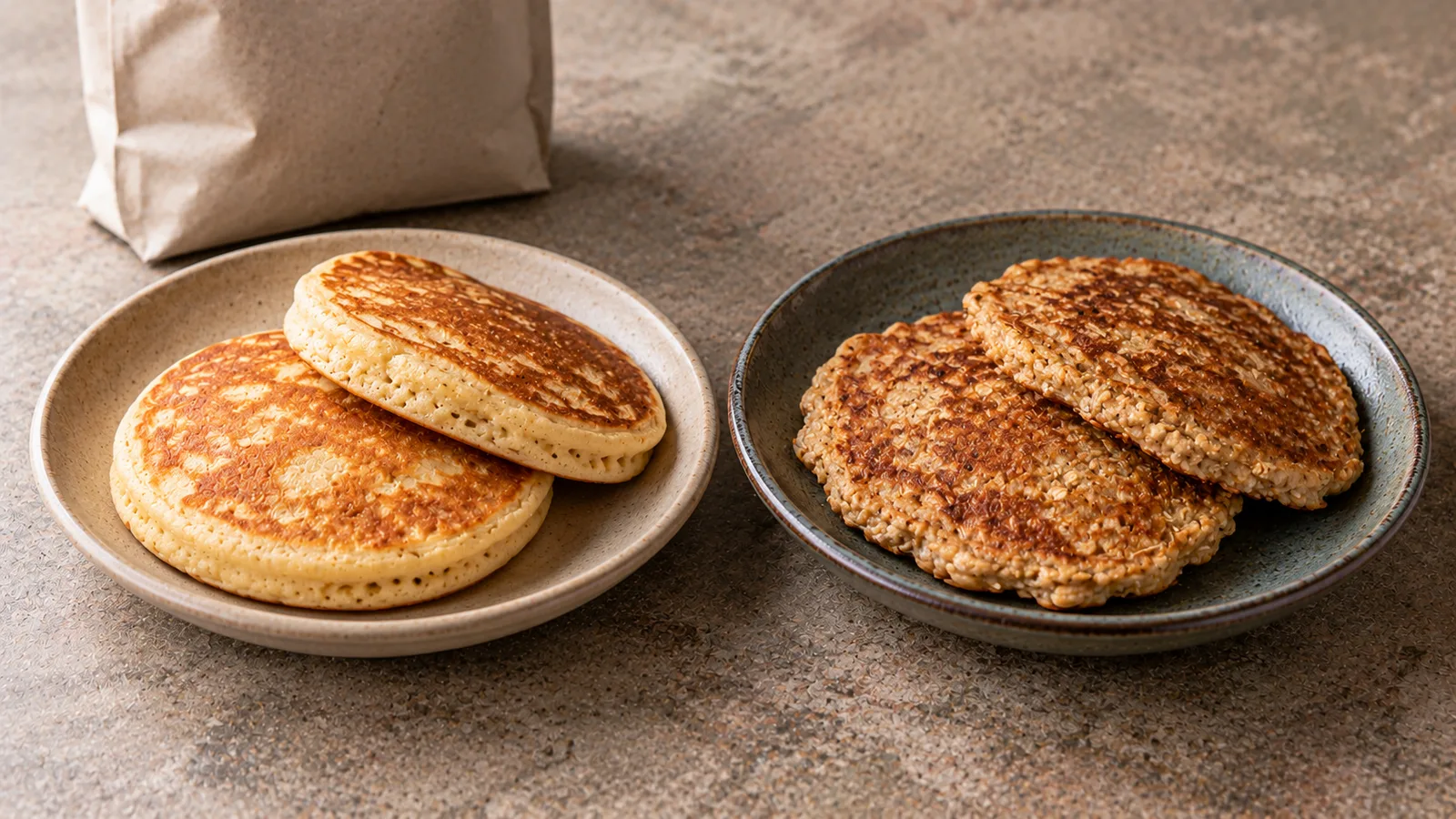
Protein pancake mix promises a shortcut: add water, heat a pan and get a breakfast with a prominent protein number. Oat pancakes made from supermarket ingredients take a little more mixing, but their price, fibre and ingredient flexibility may be attractive. The meaningful question is not which pancake looks healthier in a photograph. It is what the same practical batch supplies, how much it costs and what changes when the comparison basis changes.
This worked comparison uses one clearly identified product, Bulk Complete Protein Pancakes, against a fixed oat, egg and skim-milk recipe. The manufacturer's German label and mixing directions supply the branded figures. The home recipe uses the dmBio oats label and the USDA's specific whole-egg record and skim-milk record. These are illustrative calculations based on named inputs, not laboratory analyses of finished pancakes. Prices below are deliberately hypothetical euro assumptions, not quotations from a retailer.
What exactly are we comparing?
The ready mix is a formulated dry product containing milk protein concentrate, oat flour, whey protein concentrate, raising agent and xanthan gum. For the product version cited, the label states 359 kcal, 56 g protein, 26 g carbohydrate, 3 g fat, 2 g fibre and 1.68 g salt per 100 g powder. It recommends mixing 50 g powder with 100 ml water or milk. Here we choose water, so additional milk nutrition is not accidentally credited to the mix.
The home recipe uses 60 g fine rolled oats, one 50 g edible whole egg, 40 g skim milk and 3 g frying oil. The commercial side also receives the same 3 g oil, so neither is granted a free non-stick pan. Each starts from roughly 153 g of ingredients including added water. The homemade batter is naturally thicker and may need a splash more liquid; any extra water changes weight, not the input calories. The mixes need not cook to identical moisture or texture.
For a practical baseline, the two quantities each represent one prepared batch for one person, perhaps two or three small pancakes. Neither is a diet prescription. A larger appetite, toppings or different equipment change what ends up being eaten. If your product is another flavour or a changed formulation, use its own printed numbers instead.
Nutritional inputs: keep dry weights distinct from cooked weights
The table deliberately separates package data from reference data. The oat figures are taken from the named dmBio fine-flake product, not from an assumed universal oat average. Egg and milk values are USDA reference descriptions, while oil is a conventional calculation assumption of about 900 kcal per 100 g. Salt for reference egg and milk is estimated from sodium multiplied by 2.5; actual labels may round differently.
| Input, before cooking | Energy per 100 g | Protein per 100 g | Fibre per 100 g |
|---|---|---|---|
| Bulk pancake mix, dry | 359 kcal | 56 g | 2 g |
| dmBio oat flakes, dry | 372 kcal | 14 g | 10 g |
| Whole egg, edible raw mass | 143 kcal | 12.56 g | 0 g |
| Skim milk | 34 kcal | 3.37 g | 0 g |
| Oil used for frying | 900 kcal, assumed | 0 g | 0 g |
The commercial dry mix has four times as much protein as the cited oats per 100 g; that is an ingredient comparison, not yet a breakfast comparison. A whole egg contributes both protein and fat. Oats add fibre and carbohydrates, which the ready mix contains in much smaller amounts per recipe batch. Neither system includes fruit, syrup or yogurt at this stage.
One complete batch: protein, calories, fibre and salt
We scale each ingredient as grams used ÷ 100 × the per-100-g value. The ready-mix batch is 50 g powder + 100 g water + 3 g oil. The oat batch is 60 g oats + 50 g raw edible egg + 40 g skim milk + 3 g oil. Water contributes no energy, protein or fibre. The tabulated quantities are computed from input weights, not from a post-cooking scan.
| One full batch, no toppings | Bulk ready mix | Homemade oat pancakes |
|---|---|---|
| Ingredients before cooking | 50 g powder + 100 g water + 3 g oil | 60 g oats + 50 g egg + 40 g skim milk + 3 g oil |
| Estimated energy | 207 kcal | 335 kcal |
| Estimated protein | 28.0 g | 16.0 g |
| Estimated carbohydrate | 13.0 g | 37.7 g |
| Estimated fat | 4.5 g | 12.0 g |
| Estimated fibre | 1.0 g | 6.0 g |
| Estimated salt | 0.84 g | 0.23 g |
The mix gives about 12 g more protein with about 128 fewer calories in these chosen batches. That result reflects the product's concentrated dairy proteins and the larger oat-and-egg home portion; it does not prove every manufactured mix is superior. Conversely, the homemade recipe has about 5 g more fibre, but also more energy and carbohydrate because it uses more dry grain plus an egg.
The ready mix has 0.84 g labelled salt in this 50 g dose before any salted topping. The home recipe's approximate 0.23 g comes mainly from naturally occurring sodium in egg and milk; extra salt, baking powder or salted butter would increase it. Do not treat the reference salt estimate as a guaranteed value for all eggs and milks.
Why the cooked-weight comparison needs its own warning
A pan removes water from batter. Adding more water may make pancakes larger or thinner without adding calories. Consequently, 100 g cooked is not equivalent to 100 g dry mix, and 100 g of one finished pancake may contain a different amount of dry ingredients from 100 g of another. To illustrate the mathematics, imagine that each 153 g raw batch finishes at exactly 125 g after losing 28 g of water. That is a hypothetical yield for demonstration, not a measured manufacturer instruction or universal result.
Under that same assumed 125 g cooked weight, the commercial recipe has approximately 166 kcal and 22.4 g protein per 100 g cooked; the home recipe has 268 kcal and 12.8 g protein per 100 g cooked. Those densities are the full-batch values multiplied by 100/125. If your home batter instead finishes at 135 g and the prepared mix at 115 g, you must divide each actual batch total by its own actual finished weight. The nutritional totals of each batch do not change just because water evaporates.
To make a fair kitchen test, weigh the empty plate, cook both without toppings, rest briefly and weigh each completed batch. Then note whether you ate the whole batch or only a piece. The serving-size concept also appears in Mealisa's portion-size versus serving-size guide.
Compare equal calories as well as equal batches
A person watching energy intake may reasonably ask what 200 kcal supplies rather than what each recipe happens to yield. Using proportional scaling of the untopped batches, about 200 kcal of the prepared Bulk recipe provides 27.1 g protein, while 200 kcal of these oat pancakes provides 9.6 g protein. This mathematical scaling assumes a uniformly mixed batch; it does not tell you how many centimetres wide either pancake will be.
The higher protein concentration of this specific product is real in its current label, but protein is only one criterion for choosing breakfast. The oat version adds whole-grain fibre and can use pantry staples. A shopper who already meets protein needs across meals might care more about price, taste and dietary variety than maximal protein at breakfast. The DGE protein reference guidance provides context for daily needs rather than a target that every single breakfast must independently deliver.
The European Commission's nutrition-claims rules define high protein as at least 20% of energy coming from protein. That is a regulatory threshold for claims, not proof that a product produces greater fullness or is appropriate for all diets. Compare the full ingredient list and the nutrients that matter to your individual purpose.
Cost per serving and per 10 g protein
Shelf prices change with retailer, flavour, discount, pack size and date. To make the calculation transparent rather than invent a current offer, assume the following fictional German grocery basket: 500 g pancake mix at €11.99; 1 kg oats at €1.49; ten eggs at €2.99; 1 litre skim milk at €1.15; and 1 kg of cooking oil at €3.49. The oil assumption is a simplified weight model; actual bottle labels frequently use litres, for which density matters. Both recipes use 3 g oil.
Here each ingredient's allocated cost is rounded to the nearest cent before the components are added. This explains why summing unrounded fractional cents may differ by one cent from a receipt-style display.
| Hypothetical grocery cost | Bulk mix batch | Oat batch |
|---|---|---|
| Powder / oats | €1.20 | €0.09 |
| Egg | — | €0.30 |
| Skim milk | — | €0.05 |
| Frying oil | €0.01 | €0.01 |
| Ingredient cost per full batch | €1.21 | €0.45 |
| Approximate cost per 10 g protein | €0.43 | €0.28 |
The homemade breakfast costs €0.76 less per batch under this model. The protein mix supplies about 1.75 times the protein and costs about 2.7 times as much per batch. Per 10 g protein, the concentrated mix still costs more in this particular hypothetical basket: €0.43 versus €0.28. Change any package price or recipe and the ranking can change. For a broader framework rather than only this breakfast, see Mealisa's protein and fibre per euro guide.
A different question is money needed at checkout. Purchasing all the assumed packages for the ready mix plus oil requires €15.48 upfront, versus €9.12 for oats, eggs, milk and oil, though the latter basket contains many remaining ingredients. Those upfront totals are not the cost of a single pancake batch and should not be mixed with the per-serving amounts.
What happens when you make four breakfasts?
If the entire recipe is repeated four times, the ready mix consumes 200 g powder and 12 g oil; the oat recipe consumes 240 g oats, four eggs, 160 g milk and 12 g oil. Four complete untopped breakfasts supply approximately 112 g protein and 826 kcal from the ready mix, versus 64.1 g protein and 1,341 kcal from the oat option. The nutritional amounts reflect four full batches, not one person’s recommended daily intake.
Multiplying the displayed rounded per-batch cost by four gives €4.84 for the mix and €1.80 for homemade. This is consumption cost; you might still have unused powder, oats, eggs, milk and oil after buying the packs. A realistic budget comparison accounts for whether those remainders will be used in other meals or wasted. If you only want one pancake once, the price of the full mix bag may outweigh its convenient preparation; if you already keep it for regular breakfasts, the decision changes.
Convenience, texture and ingredients
The commercial powder usually needs only measured water, whisking and a hot pan. That can save cleanup and reduce the number of opened fresh items. It also brings dairy-derived protein and formulation ingredients such as xanthan gum, while some versions or flavour variants may contain sweeteners. Read the actual packet: do not assume every pancake mix is dairy-free, gluten-free or low in salt simply because it is labelled protein-rich.
The home version needs oats (blended fine if desired), a cracked egg and a small amount of milk. It tends to taste more like oats and has a different bite from airy commercial pancakes. Blending oats and resting the mixture for five minutes can improve cohesion. Thin batches spread more easily, whereas thick batches can brown outside before the egg interior is done. Keep the pan at moderate heat; aim for a fully cooked centre rather than relying on colour alone.
Both are vegetarian under the stated ingredients, but neither is suitable for every allergy or intolerance. The mix contains milk proteins and oats; the home recipe contains egg, milk and oats. Gluten cross-contact and relevant package warnings must be considered for people with coeliac disease. Changing to plant milk, egg replacer or added protein powder creates a new recipe with new nutritional and price calculations.
Toppings can reverse an apparently simple result
Neither baseline includes oil beyond the measured 3 g. Adding 100 g berries, 100 g yogurt, a tablespoon of nut butter or maple syrup can meaningfully alter energy, fibre, protein and cost. It is easy to compare plain high-protein mix against topped homemade pancakes and declare the first a winner, but that compares different breakfasts.
For a controlled comparison, either serve both without toppings or use the same weighed toppings on each. A spoon of syrup may raise energy without much protein; yogurt may increase protein; berries contribute fruit and additional fibre. Add the toppings using their own package or database values. The easiest practical tracking mistake is entering dry powder as though it were the finished cooked gram weight, then counting syrup inconsistently. Mealisa's high-protein snacks guide gives other ordinary-food alternatives if pancakes are not convenient.
Safety, storage and realistic substitutions
The homemade batter contains raw egg; do not taste it uncooked. Cook egg-containing pancakes thoroughly. USDA's safe temperature chart gives 71°C / 160°F for dishes containing eggs, and food thermometers can help when pancakes are unusually thick. Keep utensils that touched raw egg away from the cooked serving.
If preparing ahead, refrigerate the cooked pancakes promptly in shallow containers. USDA leftover guidance advises prompt refrigeration and generally using cooked leftovers within three to four days; follow any shorter ingredient- or product-specific instructions. Frozen portions can be useful, but texture may change. Avoid leaving egg-containing cooked food at room temperature for extended periods.
If budget is the priority, try reducing oil with a reliable pan, buying oats in a larger pack, or sharing ingredients across recipes. If higher protein at similar energy is the priority, adjusting the homemade formula with some egg whites or protein-rich dairy may help, but then compare the new ingredient amounts, purchase costs and allergens. Do not quietly attribute the adjusted version's protein to the original oat recipe.
How to choose at the supermarket
Start with the label of the exact flavoured or unflavoured mix you plan to buy. Record powder grams actually used, water or milk added, oil absorbed or poured into the pan and any toppings. For homemade pancakes, record dry oats, edible egg mass, milk and oil in the same way. Make a simple two-column comparison on three bases: full batch, equal energy, and cost per amount of protein. None of those bases alone settles taste, dietary fit or value.
Choose the branded mix when high protein per calorie and fast preparation justify a higher ingredient cost for you. Choose homemade oats when a smaller food budget, higher oat fibre, control over ingredients and flexibility are more important. You can also combine the approaches with a modest amount of protein powder in oats, but calculate that as a third, separate recipe. A price tag or a protein claim is not a substitute for checking what ends up on your plate.
Sources
- Bulk Complete Protein Pancakes: manufacturer ingredients, nutritional table and preparation instructions.
- dmBio fine oats: label per 100 g.
- USDA FoodData Central: whole egg, raw, SR Legacy 171287.
- USDA FoodData Central: skim milk, SR Legacy 171269.
- European Commission: permitted nutrition claims.
- DGE: protein reference values.
- USDA FSIS: safe cooking temperatures.
- USDA FSIS: leftovers and food safety.