
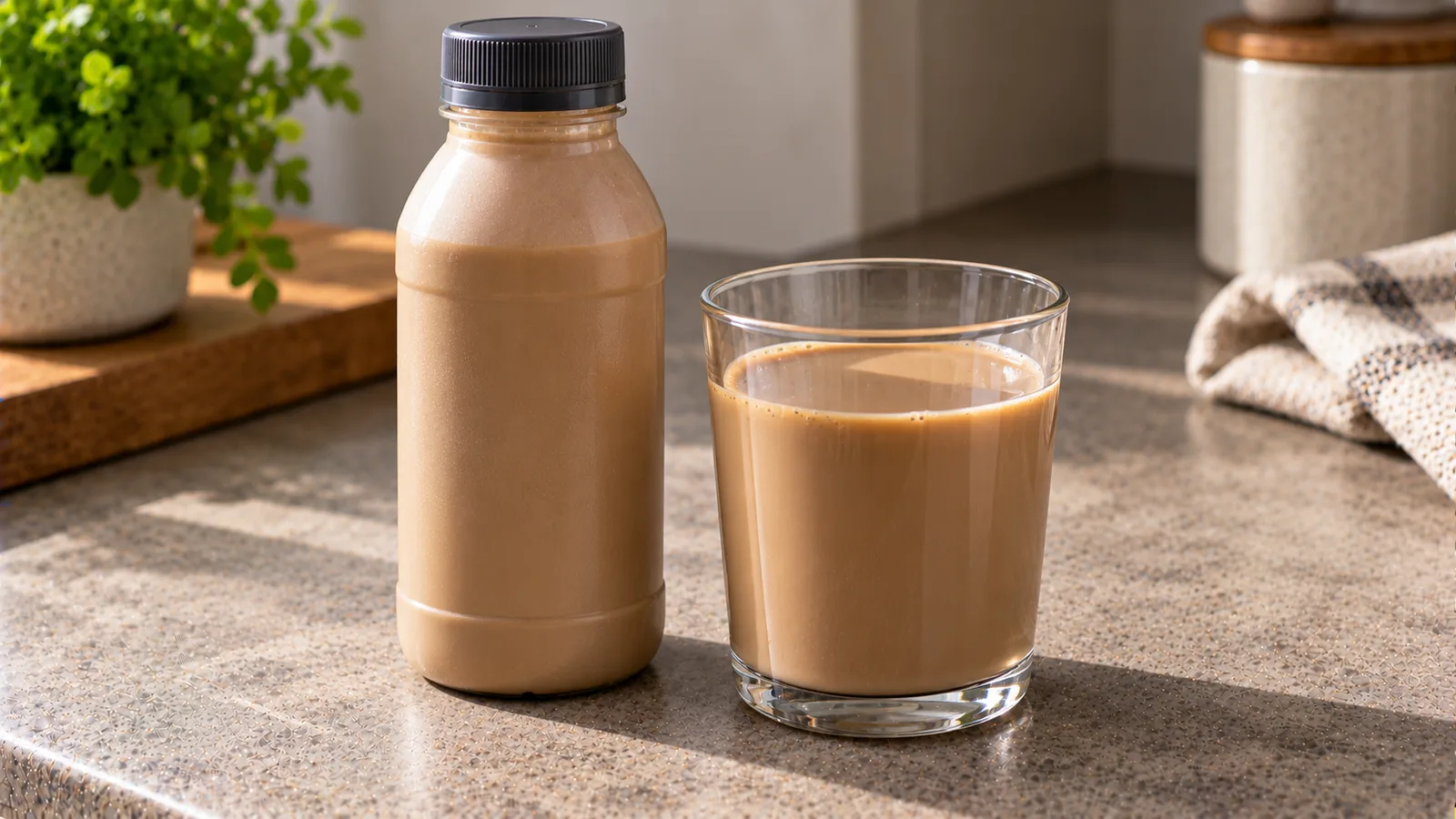
What a ready-to-drink protein coffee actually contains
A chilled protein coffee looks like a regular iced latte, but it is usually a milk-based protein drink with coffee, not coffee magically containing twenty grams of protein. The protein comes chiefly from milk and, in some formulas, additional milk protein; the coffee supplies flavour and caffeine. That difference matters when you compare calories, an ordinary cup of coffee, a protein shake, or buying a separate protein-rich food.
This guide compares specific German product listings rather than inventing an average “protein coffee”. Dr. Oetker High Protein Kaffeedrink Espresso Macchiato is listed as a 250 ml ready-to-drink cup with approximately 20 g protein; the Starbucks Protein Caffè Latte is a 330 ml ready-to-drink bottle with approximately 20 g protein. Both include coffee and milk, but their calorie and sugar totals differ because their containers and formulas differ. Packaging, recipe and local availability can change, so check the unit in your hand rather than relying on an older online listing.
The first question is not whether “protein coffee is healthy” in the abstract. It is whether a particular container fits your protein needs, calorie budget, caffeine tolerance, preferences and price better than another convenient option. Our guide to tracking caffeine in coffee and tea covers daily intake across drinks rather than comparing protein labels.
The label comparison: 100 ml is not one bottle
The Dr. Oetker Espresso Macchiato retail listing gives 63 kcal, 8.1 g protein and 4.8 g sugar per 100 ml. The Starbucks Caffè Latte label at REWE gives 51 kcal, 6.1 g protein and 3.8 g sugar per 100 ml. Multiplying by 2.5 or 3.3 produces the actual packaged serving. The resulting figures are approximate because the published labels round each 100 ml value.
| Published reference | Dr. Oetker Espresso Macchiato | Starbucks Protein Caffè Latte |
|---|---|---|
| Container size | 250 ml | 330 ml |
| Calories per 100 ml | 63 kcal | 51 kcal |
| Calories per whole pack, calculated | 157.5 kcal (about 158) | 168.3 kcal (about 168) |
| Protein per 100 ml | 8.1 g | 6.1 g |
| Protein per whole pack, calculated | 20.25 g (about 20) | 20.13 g (about 20) |
| Sugar per 100 ml | 4.8 g | 3.8 g |
| Sugar per whole pack, calculated | 12.0 g | 12.54 g (about 12.5) |
| Caffeine in mg per pack on these listings | 137 mg (manufacturer) | Not specified |
A lower number per 100 ml does not automatically mean a lower number per bottle. Starbucks is less caloric per 100 ml in this example, but its larger 330 ml package comes to roughly 168 kcal compared with 158 kcal for 250 ml of the Dr. Oetker drink. Conversely, the two packages provide almost the same amount of protein despite their different volumes. Comparing only “per 100 ml” would obscure that point.
The sugar row is not a measurement of spoonfuls of sugar added to the recipe. The Starbucks ingredients list includes milk, coffee preparation, milk protein, stabilisers and sweetener; much of its sugar comes from milk. A front-of-pack claim such as “no added sugar” does not mean “zero sugar”. Read both total sugars and the ingredients list, especially if the product is sweetened. The EU guidance on nutrition labelling explains why these quantities are displayed per 100 ml. For a more general method, see how to read a nutrition label.
How much caffeine is there? Use the actual product declaration
The amount of caffeine is not the same across protein-coffee brands. In fact, the Dr. Oetker manufacturer's own Espresso Macchiato page specifies 137 mg caffeine per 250 ml cup. A separate REWE listing for the same named product states 55 mg per 100 ml; multiplying the rounded 100-ml value yields 137.5 mg, consistent with approximately 137–138 mg per cup. Use the manufacturer's per-cup declaration rather than guessing from the flavour.
In contrast, the Starbucks 330 ml retailer listing used in this comparison does not give a numerical caffeine amount. It contains coffee, so the amount cannot be assumed to be zero, but it cannot reliably be assigned a number from the available label information. A completely different protein-coffee powder, even from the same supermarket, is not a valid substitute measurement.
For context, the European Food Safety Authority (EFSA) gives a typical 90 mg caffeine in 200 ml filter coffee and approximately 80 mg in a 60 ml espresso. Those are broad beverage examples, not tests of the Starbucks bottle. The Dr. Oetker manufacturer's declared 137 mg exceeds either of these illustrative single-coffee figures, even though it comes in a milk-based cup.
EFSA states that caffeine from all sources up to 200 mg in one dose and 400 mg across a day generally does not raise safety concerns for healthy non-pregnant adults. For pregnancy it identifies up to 200 mg in a day, across all sources. These are population-level safety assessments, not targets, and individual sensitivity, disrupted sleep, medication or medical conditions may justify less. EFSA also notes that even 100 mg close to bedtime may affect sleep duration in some adults.
For a worked daily example, one declared 137 mg Dr. Oetker cup plus an illustrative 90 mg filter coffee equals about 227 mg caffeine. That is more than the EFSA's 200 mg single-dose reference if consumed together; spread over a day, 227 mg is below the 400 mg/day general-adult assessment, although timing and individual sensitivity still matter. It is also above the EFSA pregnancy daily reference of 200 mg. Do not treat 227 mg as a universal recommendation. If a bottled coffee does not disclose its caffeine figure, ask the manufacturer before attempting a precise total.
Does an EU caffeine warning have to appear?
There is an easy-to-miss legal detail. Under Regulation (EU) No 1169/2011, Annex III, point 4.1, a specified warning for drinks exceeding 150 mg caffeine per litre has an exception for drinks based on coffee or tea (or their extracts) whose food name includes “coffee” or “tea.” The legal category and precise composition matter; this is not a blanket exemption for everything marketed as protein.
That is why absence of a prominent “high caffeine” warning is not evidence of zero caffeine, especially for a coffee-based product. The threshold itself is 150 mg per litre, which equals 15 mg per 100 ml, not 150 mg per 100 ml. A warning should never be used as a substitute for knowing the actual amount consumed. The ingredient list and any additional manufacturer's caffeine declaration are more useful for an individual calculation.
Coffee-based protein drinks should also not be confused with dry powders mixed at home. A powder can state caffeine per 30 g scoop or per prepared 250 ml; mixing with more water changes concentration but not the amount of caffeine in the measured powder. Adding real coffee adds caffeine on top. A ready-to-drink bottle is already diluted and its container volume is the practical serving unit.
What does “high protein” buy you nutritionally?
Both example drinks offer around 20 g protein in one container without requiring a meal or shaker. That convenience can be useful on a busy commute, but does not guarantee that the drink is a balanced lunch. Protein, fibre, vegetables, total calories and how long a meal keeps you satisfied are separate considerations. These products are typically milk-based and not appropriate for people with milk allergy; some versions may contain lactose or other ingredients that affect tolerance.
A drink containing 20 g protein also does not tell you how much protein you should aim for each day. Requirements depend on body size, activity, health and the rest of the diet. Our guide to protein quality and digestibility explains why a simple grams figure is not the whole protein discussion. It would be misleading to imply that more protein per bottle invariably means better nutrition.
Check the rest of the package. One reference label shows about 12 g sugar per whole 250 ml pack and another about 12.5 g per 330 ml; neither figure by itself says whether sugar was added. The larger Starbucks reference also contains about 3.63 g fat and 0.43 g salt by its 100 ml label, values that should not be blindly copied to other flavours. “Low fat” and “no added sugar” are different claims; neither replaces the quantitative table.
If you drink one instead of an unsweetened black coffee, you are adding substantial protein and around 160–170 kcal in these examples. That can be desirable when it replaces a snack or breakfast component, yet unhelpful if you simply add it on top of a usual meal without accounting for the extra energy. An iced coffee is not a free source of protein just because the coffee portion itself is low-calorie.
The real cost question: price per drink or price per protein?
For a reproducible Germany-based illustrative price scenario, assign €1.39 to the Dr. Oetker 250 ml cup and €1.99 to the Starbucks 330 ml bottle. These are modelling assumptions, not verified current retail prices; the comparison remains valid as arithmetic even when a shop charges something else. A refundable bottle deposit, when applicable, increases cash paid at checkout but should be shown separately from the drink cost if it is returned.
A fair comparison uses protein in the actual pack rather than price per litre alone. The simple calculation is price ÷ packaged protein grams × 20. Using unrounded protein calculated from the displayed labels gives approximately €1.37 or €1.98 per 20 g protein, respectively. These results measure only price-to-protein, not flavour, convenience, caffeine, shelf life or overall nutrition.
| Comparison basis | Dr. Oetker 250 ml | Starbucks 330 ml | Coffee + 200 g plain skyr |
|---|---|---|---|
| Protein from food | 20.25 g | 20.13 g | 22 g |
| Drink or food cost used | €1.39 | €1.99 | €1.10 |
| Cost for equivalent 20 g protein | €1.37 | €1.98 | €1.00 |
| Caffeine quantity | 137 mg per cup (manufacturer) | Not disclosed on listing | About 90 mg for example 200 ml filter coffee |
| Price status | Illustrative (€1.39) | Illustrative (€1.99), excluding refundable deposit | Illustrative (€0.20 coffee + €0.90 skyr) |
The separate-food example uses 200 g REWE Bio plain skyr, with 11 g protein and 60 kcal per 100 g on the published REWE label. That makes 22 g protein and 120 kcal from the skyr; the black coffee adds some energy and about 90 mg caffeine only if it resembles EFSA's example 200 ml filter coffee. The €1.39 and €1.99 drink prices and the €0.90 skyr and €0.20 home coffee allocations are editorial assumptions, not live store prices. This is a coffee alongside food, not a claim that thick skyr poured into coffee becomes a comparable bottled latte. Find more about the dairy food itself in calories in skyr.
The three options are not interchangeable in use. An unopened chilled bottle is portable; skyr needs a spoon and cold storage; freshly brewed coffee requires preparation. If convenience matters more than a few cents, the ready-made drink may be worth its premium. If protein is your only buying objective, a conventional food can do the job without an expensive protein-coffee label.
A repeatable comparison for a different brand
Take the drink's container volume, not the serving suggested in an advert. Multiply the published per-100 ml calories, protein and sugars by container millilitres divided by 100. Record any milk, sweeteners and allergens in the ingredient list. If caffeine is declared per 100 ml, multiply that number by the same volume factor; if it is declared per bottle, do not multiply again. When caffeine is missing, mark it unknown rather than borrowing a typical figure from espresso.
For example, a purely hypothetical 300 ml drink carrying 55 kcal, 7 g protein and 4 g sugar per 100 ml would provide 165 kcal, 21 g protein and 12 g sugar per container. If it were priced at a hypothetical €1.65, its protein cost would be €1.57 for 20 g. These are practice inputs, not a fourth actual product. Change the label or price and the result changes immediately.
A second common mistake is comparing a dry powder's kcal per 100 g powder with a prepared bottled beverage's kcal per 100 ml. You must convert the powder to the grams used, then add the milk, coffee or sweeteners used to make it. Prepared-with-water and prepared-with-milk values are not the same. An advert stating “20 g protein per serving” may be referring to a particular dilution or a full prepared recipe.
When does a protein coffee make sense?
It is a reasonable choice when you like coffee, want a convenient chilled drink and genuinely need a portable protein-containing snack. It can be less attractive if its price replaces more useful groceries, if you already get enough protein, or if caffeine disturbs your sleep. For a child, someone pregnant, someone sensitive to caffeine or anyone managing a condition where caffeine is restricted, an unspecified caffeine amount is a reason to ask for details rather than assume the drink is suitable.
Do not interpret 20 g protein as 20 g extra protein you need. You can count it toward an ordinary day's meals, just as you would dairy, beans or eggs. Nor should a protein coffee be promoted as a substitute for varied meals. Assess food and drink together over the day: calories, protein, fibre, micronutrients, cost and enjoyment all matter.
If you are reading a new package in a shop, prioritise (1) full-container calories, (2) full-container protein, (3) sugars and ingredients, (4) measured caffeine, if disclosed, and (5) total price including refundable deposit separately. This sequence avoids both the “coffee has almost no calories” trap and the “high protein therefore automatically better” trap.
Sources and calculation notes
- REWE: Dr. Oetker Espresso Macchiato, 250 ml — nutritional label and caffeine per 100 ml; actual shop price depends on location.
- Dr. Oetker: Espresso Macchiato, 137 mg caffeine per cup — manufacturer declaration of caffeine.
- REWE: Starbucks Protein Caffè Latte, 330 ml — ingredients and nutrition per 100 ml.
- REWE Bio plain skyr — food-only comparator, 11 g protein per 100 g.
- EFSA: Caffeine — typical beverage examples and safety assessment for caffeine from all sources.
- EU Regulation 1169/2011 — caffeine warning requirements and coffee-based exception.
- European Commission: Nutrition labelling — standardised per-100 ml comparisons.
All drink and separate-food prices are editorial model assumptions, not today's checkout prices. The skyr-and-coffee prices and the 300 ml example are illustrative editorial inputs. All container totals are straightforward products of published per-100 ml values, with rounding shown explicitly. The Dr. Oetker caffeine figure is documented by its manufacturer; no unsupported figure is assigned to Starbucks.