
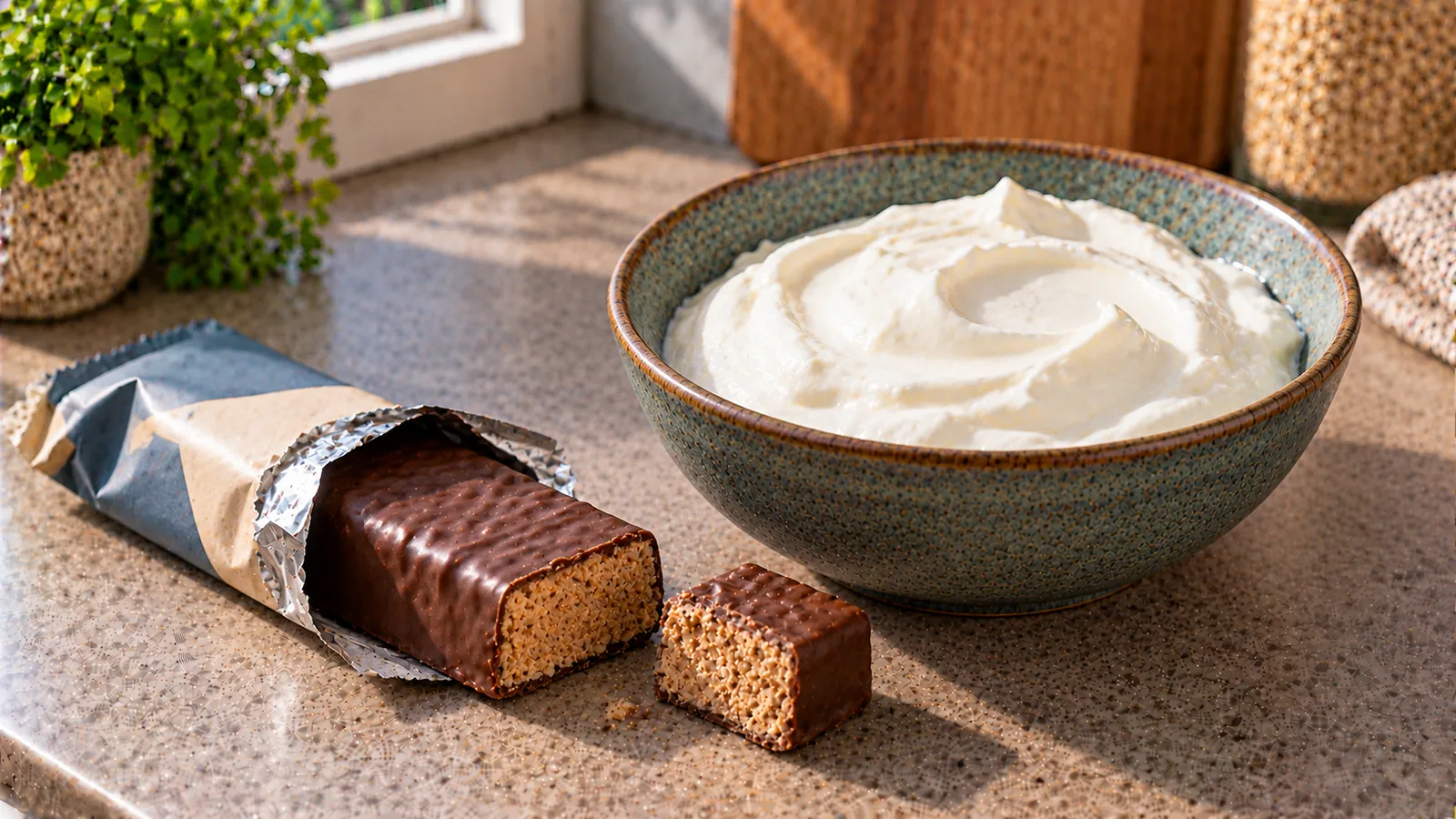
A protein bar and a tub of plain Greek yogurt can both make a protein-rich snack, yet the best choice changes with your objective. In one specific German retail comparison, a 45 g Sportness 50% Crispy Stracciatella bar provides about 167 kcal and 22.5 g protein for €0.85, while a 150 g FAGE Total 0.2% Greek yogurt provides about 83 kcal and 15.5 g protein for €1.49. These are named products, not average values for every bar or yogurt. The yogurt price is a documented March 2026 retail observation; current prices can change.
That makes the selected bar cheaper per 20 g protein, despite the yogurt offering more food by weight and roughly half the calories per pack. The trade-off also includes fiber, added sweeteners, refrigeration, taste, and how satisfying the snack feels to the individual. Use the label on the product you actually buy, especially when pack sizes change.
Real-product comparison: one bar versus one yogurt pot
The bar's dm listing gives 370 kcal, 50 g protein, 2.1 g fiber, 0.9 g sugar, 12 g fat and 20 g polyols per 100 g. For the 45 g bar, we multiply each by 0.45. The REWE listing for FAGE Total 0.2% gives 55 kcal, 10.3 g protein, 3 g sugar and 0.2 g fat per 100 g. We calculate the yogurt figures for a 150 g pot; REWE's older page title still refers to 170 g, while the Hamburg consumer organization documented a reduction to 150 g and a €1.49 price in March 2026. This is a dated example, not a live checkout quote.
| Metric | Sportness bar, 45 g | FAGE Total 0.2%, 150 g |
|---|---|---|
| Energy | 167 kcal | 83 kcal |
| Protein | 22.5 g | 15.5 g |
| Sugar | 0.4 g | 4.5 g |
| Fat | 5.4 g | 0.3 g |
| Fiber | 0.9 g | Not stated on cited label |
| Polyols | 9 g | Not listed |
| Price used | €0.85 | €1.49 |
The yogurt's sugars are naturally present milk sugars in the plain product; they are not evidence of added table sugar. Likewise, the bar's tiny sugar figure does not imply that all of its carbohydrates are conventional starch: its label separately declares sugar alcohols (polyols). The yogurt fiber value is not reported, so it would be dishonest to invent an exact 0.0 g laboratory measurement. Plain dairy generally offers little fiber unless fiber-containing ingredients are added.
Which gives more protein for the money?
Price per pack can be misleading because the protein quantities differ. To compare the same amount of protein, divide the pack price by grams of protein and multiply by 20. The result is a cost benchmark, not a recommendation to eat a fractional packaged item.
| Comparable basis | Sportness bar | FAGE yogurt |
|---|---|---|
| Protein in one pack | 22.5 g | 15.45 g |
| Price for one pack | €0.85 | €1.49 |
| Cost per 20 g protein | €0.76 | €1.93 |
| Approx. kcal per 20 g protein | 148 kcal | 107 kcal |
| Quantity for 20 g protein | 40 g | 194 g |
Here, the bar wins on cash cost per gram of protein, while the yogurt wins on calories per gram of protein. The yogurt amount needed for 20 g protein is larger than a 150 g pot. The rounded 15.5 g display and more precise 15.45 g calculation refer to the same label; calculations use the unrounded figure. A large supermarket own-label pot could change the price ranking. For more examples of inexpensive foods, see our budget protein guide.
Why a full 150 g pot and a 45 g bar are not equivalent sizes
A bar is dense, individually wrapped, and easy to carry. Yogurt is heavier because it contains much more water; the 150 g pot takes up more room and usually requires a spoon and refrigeration. Comparing nutrition per 100 g alone would make a tiny bar and a larger dairy snack appear directly exchangeable, which is often unhelpful in real life.
For a 200 g portion of the same plain yogurt, the label implies about 110 kcal and 20.6 g protein. If purchased at the illustrative €1.49 per 150 g, 200 g costs about €1.99 on a simple proportional basis. In practice you may need to purchase two small pots, creating leftovers, or choose a larger format with a different per-kilo price. This is why the package cost and the consumed-portion cost are not always identical.
Sugar, fiber and sweeteners: read three different lines
Protein bars are not one standardized food. Some are essentially chocolate-coated confectionery with added protein; others contain nuts, cereal fiber or substantial polyols. The example bar is labelled low in sugar but contains 20 g polyols per 100 g, equivalent to 9 g in the 45 g portion. The manufacturer warns that excessive consumption can have a laxative effect. Tolerance differs among people and products; this cannot be turned into a universal safe serving threshold.
The chosen bar supplies approximately 0.9 g fiber, not the several grams some competing bars advertise. So it is not automatically a high-fiber snack simply because the wrapper emphasizes protein. The plain Greek yogurt does not supply a meaningful fiber claim on its cited label either. Adding berries, oats, ground seeds or fruit to yogurt can change its fiber and total calories. Such additions must be counted rather than pretending the original pot has the same nutrition as a topped bowl.
There is a practical hierarchy when reading these labels: check pack size, then protein per actual pack, then energy, then fiber and sugars or polyols, and only then price per relevant target. Our snack-label analysis guide explains the general method; the present comparison applies that method to two distinctly different ready-to-eat snacks.
Is Greek yogurt automatically more filling?
Not necessarily. Yogurt has greater volume and water content in this particular comparison; a bar is compact and has more protein in one pack. Chewing time, texture, flavor, meal timing, and personal preferences may also influence hunger. We cannot conclude from the label alone which keeps a given person full until dinner.
In a small randomized crossover study of 32 healthy women, a higher-protein yogurt snack did not significantly outperform a normal-protein yogurt snack for the measured hunger, fullness, or next-meal energy outcomes. That published study compared two yogurt snacks, not yogurt against a protein bar, and cannot establish an overall winner for this comparison. Promises that any named snack will cause fat loss or suppress appetite are unjustified.
If you use Greek yogurt as a flexible base for a bowl with fruit, its final satiety and calories depend on the extras. For yogurt fat percentages and portion examples, see our Greek yogurt nutrition guide. For variety beyond these two products, our high-protein snack ideas article offers other snack formats.
Storage, allergies and convenience may decide the choice
The chosen yogurt must be refrigerated according to its product guidance. This is straightforward at home or at an office with a fridge, but less convenient in a backpack without cooling. The wrapped bar is easier to transport and can work when you have no spoon or cold storage. Both are dairy-derived products in this comparison; the bar also lists soy ingredients and potential traces of other allergens. Someone with an allergy needs the current full product label rather than broad assumptions about the product category.
A plain yogurt ingredient list can be very short: in the cited FAGE product, it is milk and live yogurt cultures. The bar's ingredient list is longer and contains protein ingredients, sweeteners and other texture components. Ingredient-list length by itself does not measure health effects. Neither a shorter label nor a marketing word such as "high protein" replaces a balanced eating pattern.
Three buying situations
| Situation | More practical starting point | Reason and limitation |
|---|---|---|
| No fridge, limited time | Bar | Transportable, but check polyols and allergens |
| Low-calorie snack at home | Plain Greek yogurt | The selected 150 g pot has fewer calories; toppings change the result |
| Cheapest 20 g protein from these packs | Bar | €0.76 per 20 g versus €1.93 for this dated yogurt price; other brands may reverse it |
Decision in one sentence
For these two specific German products, the Sportness bar provides more protein at a lower purchase price, while plain FAGE yogurt provides fewer calories in its pot and a simpler refrigerated base. Neither reliably wins on fullness; neither should be judged by a front-of-pack claim alone. Check the current label, the true serving size, and the cost per amount of protein that matters to you.
Data and limitations: dm bar label and price; REWE yogurt nutrient panel; Verbraucherzentrale Hamburg, March 2026 package and price change; published yogurt appetite trial. Figures are arithmetic estimates rounded for display, not direct measurements of a mixed snack meal.