
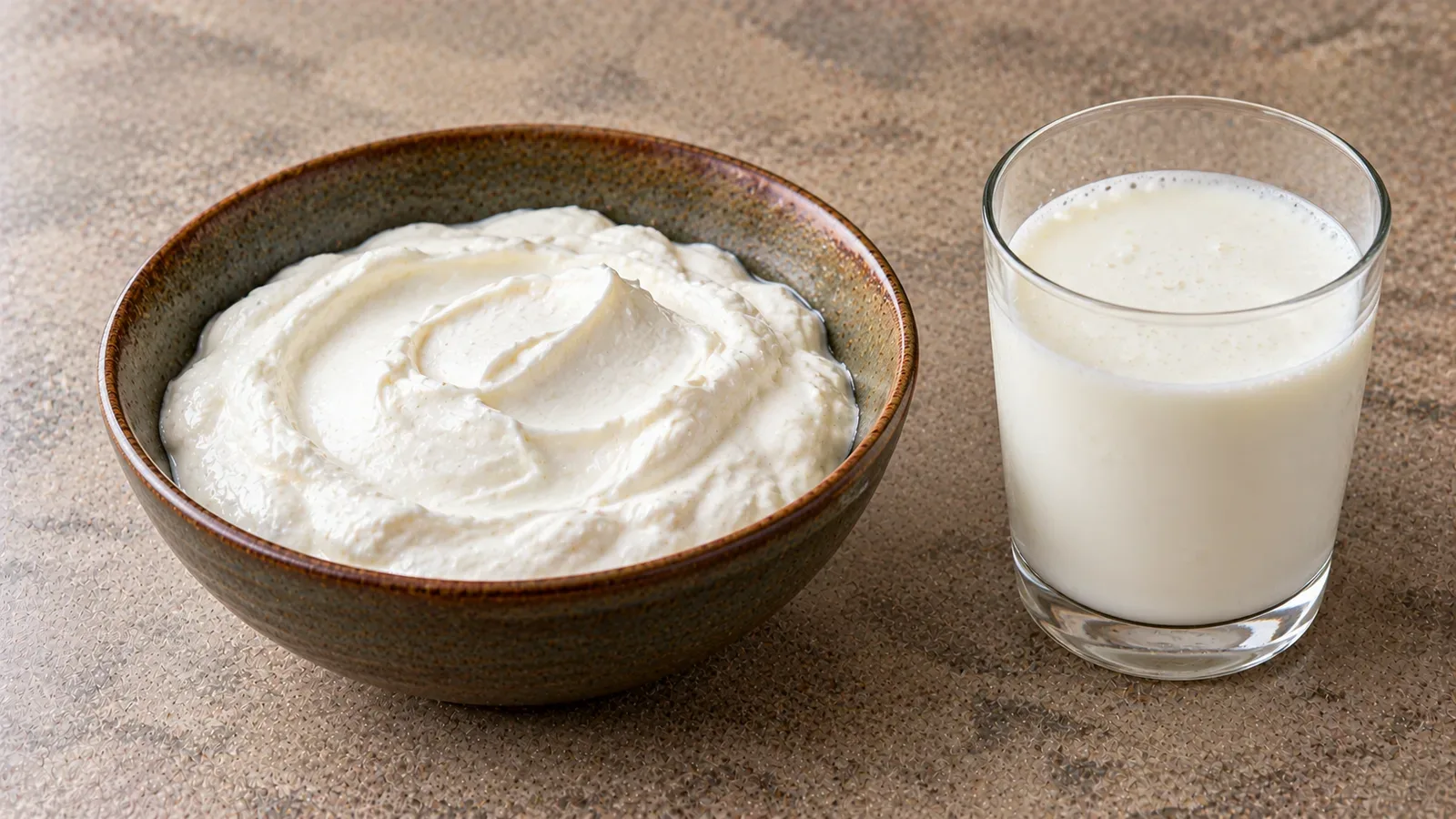
Greek yogurt and kefir are both fermented dairy foods, but they solve different everyday problems. Thick Greek yogurt can be eaten with a spoon, while kefir is easy to drink. Their nutritional difference is not determined by the word fermented: protein density, fat, sugar, live-culture information, serving size and cost all depend on the product in your hand.
For a reproducible example, this comparison uses Fage Total 0.2% strained yogurt and ja! Kefir Natur 1.5%, both listed by REWE in Germany. These are two individual product labels, not category averages. Fage lists 10.3 g protein per 100 g; ja! kefir lists 3.4 g. The comparison also shows how results change when you buy a different Greek-style yogurt, use a 170 g bowl rather than a 250 g drink, or compare protein per euro instead of protein per 100 g.
The two reference products and what their labels actually say
Fage Total 0.2% is a strained yogurt made from skimmed milk and live yogurt cultures. REWE lists 55 kcal, 10.3 g protein, 3 g carbohydrate, 0.2 g fat and 0.1 g salt per 100 g. The listed sugar is 3 g per 100 g, consistent with the unsweetened dairy product rather than added sugar. Its product page also lists 120 mg calcium per 100 g. Read the Fage product label when checking a package sold in your region.
The second product, ja! Kefir Natur 500 g, is a mild, 1.5%-fat kefir. Its listed figures per 100 g are 45 kcal, 3.4 g protein, 4.4 g carbohydrate, 1.5 g fat and 0.1 g salt. It is a refrigerated fermented dairy drink. Its page does not give the same strain-by-strain live-organism details or a comparable viable-cell count that would allow us to rank the products by microbial dose.
| Label per 100 g | Fage strained Greek yogurt 0.2% | ja! natural kefir 1.5% |
|---|---|---|
| Energy | 55 kcal | 45 kcal |
| Protein | 10.3 g | 3.4 g |
| Fat | 0.2 g | 1.5 g |
| Carbohydrate / sugars | 3.0 / 3.0 g | 4.4 / 4.4 g |
| Salt | 0.10 g | 0.10 g |
| Fiber | 0 g (typical; not specified as a separate value on this label) | 0 g (listed) |
Do not treat this table as a comparison of all Greek yogurt and all kefir. Greek-style products sold in Germany range from high-protein, low-fat strained yogurt to rich 10%-fat cream yogurt. For example, REWE's Bio Greek-style cream yogurt label lists only 3 g protein and 116 kcal per 100 g. That is less protein and more energy than the kefir in this example. The exact label outranks assumptions based on the product name.
The practical serving comparison: a bowl versus a glass
A useful comparison must reflect how a food is actually used. A 170 g bowl of Fage and a 250 g glass of ja! kefir are realistic illustrative portions; they are not recommended intake amounts and not manufacturer-defined standard servings. Multiply the 100 g label values by 1.7 or 2.5 respectively.
| Nutrient in the example serving | Greek yogurt, 170 g | Kefir, 250 g |
|---|---|---|
| Calories | 93.5 kcal | 112.5 kcal |
| Protein | 17.51 g | 8.50 g |
| Fat | 0.34 g | 3.75 g |
| Carbohydrate / sugars | 5.10 / 5.10 g | 11.00 / 11.00 g |
| Salt | 0.17 g | 0.25 g |
The yogurt supplies just over twice the protein at these chosen amounts: 17.51 ÷ 8.50 = about 2.06. That does not prove kefir is a poor choice; it describes different serving patterns. Kefir may be a convenient drink alongside food, whereas the thick yogurt can be the principal protein ingredient in breakfast or a snack.
The comparison would look different for equal 200 g portions: 20.6 g protein from Fage versus 6.8 g from ja! kefir. This is a protein-density difference, not a claim that fermented cultures in one are superior. For additional serving examples, consult Mealisa's Greek yogurt calorie guide and kefir calorie guide; those describe individual foods, while this page compares two shopping choices.
Where the protein difference comes from
Greek strained yogurt is often thicker because liquid whey is removed or the manufacturing process is designed to concentrate solids. Concentrating milk solids can increase protein per 100 g. Kefir is usually a drinkable fermented milk with much more liquid remaining in each glass. Fermentation alone does not generate an extra 7 g protein per 100 g; starting ingredients, straining and formulation are decisive.
However, Greek-style is not a fixed protein specification. Some products are strained and genuinely protein-dense; others are creamier because of added cream or fat. A 10%-fat Greek-style yogurt can supply considerably less protein per spoonful than a 0.2%-fat strained version. To find a meaningful protein snack, start at the back label: protein per 100 g, intended portion, and total package amount.
A food's protein content also does not determine whether it is a complete meal. A bowl of yogurt without fruit or oats may deliver protein but relatively little fiber. Kefir with a sandwich or a bean-based lunch may be a better fit for a different occasion. Compare the whole eating occasion rather than selecting a winner for every context. Mealisa's high-protein foods guide covers other everyday options, without substituting for this product-level comparison.
Live cultures: what is known and what is not
Both yogurt and kefir are fermented, but the microorganisms involved can differ. Traditional yogurt commonly uses specific lactic-acid bacteria; kefir can include bacteria and yeasts, depending on the starter and process. Industrial mild kefir does not necessarily reproduce every organism or concentration present in traditional grain-fermented kefir. Production, heat treatment, refrigeration and storage all affect what remains in the final product.
The Fage label explicitly describes live yogurt cultures. That is a useful ingredient statement, not evidence of a particular clinical benefit for this purchaser. The selected ja! kefir's public nutrition panel does not provide species, strain identities or viable counts. We therefore cannot conclude that either product has more live organisms or stronger probiotic effects just because one is named kefir.
According to the U.S. National Center for Complementary and Integrative Health, probiotic effects are organism- and condition-specific. Research involving one strain cannot automatically be applied to another, or to every fermented food. Ordinary consumers should be cautious about broad promises of improved immunity, cured digestive problems or guaranteed microbiome changes.
The European Commission's guidance on nutrition and health claims distinguishes authorized, evidence-based claims from unsupported marketing. Fermentation does not create a general license for health claims. “Contains cultures,” “fermented” and “probiotic effect demonstrated for this specific product” mean different things.
A narrow but important EU claim about lactose digestion
There is a specific authorized EU claim for live yogurt cultures improving digestion of the lactose in the product for people who have difficulty digesting lactose. It applies under defined conditions: at least 100 million (10^8) colony-forming units per gram of the specified starter organisms Lactobacillus delbrueckii subsp. bulgaricus and Streptococcus thermophilus. See Commission Regulation (EU) No 432/2012.
That legal threshold is not a laboratory measurement of the two products in our table, and it does not authorize every probiotic or immunity claim. Without product-specific microorganism data and an applicable label claim, it would be incorrect to present either one as proven superior for lactose digestion. For a person with lactose intolerance, practical tolerance varies; for milk allergy, neither ordinary cow's-milk product is suitable.
The German Nutrition Society's information on dairy foods also emphasizes dairy as a source of protein and several micronutrients. This does not imply that all fermented dairy products provide identical levels of calcium, iodine or vitamins. Check specific pack labels rather than assign one universal micronutrient value to both.
Price per serving versus price per useful protein
Retail prices vary by store, promotion and date, and REWE listings can require a location before showing a price. The following is an illustrative budget scenario, not a verified current quote: imagine a 450 g Fage tub costing €2.49 and a 500 g ja! kefir bottle costing €0.89. If your receipt is different, replace those two numbers. The label values above are sourced; the prices here are assumptions.
The formulas are simple: used portion price = package price × grams eaten ÷ package grams; grams of protein = portion grams × label protein ÷ 100; price per 10 g protein = portion cost × 10 ÷ portion protein.
| Budget metric (illustrative prices) | Fage yogurt | ja! kefir |
|---|---|---|
| Assumed pack and price | 450 g / €2.49 | 500 g / €0.89 |
| Price per 100 g | €0.553 | €0.178 |
| Chosen portion | 170 g | 250 g |
| Used-ingredient cost per portion | €0.94 | €0.45 |
| Protein in that portion | 17.51 g | 8.50 g |
| Price per 10 g protein | €0.54 | €0.52 |
On a per-gram product basis, kefir is much cheaper in this scenario. Once costs are normalized to 10 g of protein, the gap largely disappears: about €0.54 from yogurt and €0.52 from kefir. That result is contingent on the two hypothetical pack prices and the specific nutrient labels. It is not a permanent ranking of brands.
Buying a whole package changes the checkout spend. The yogurt bowl uses €0.94 worth of a €2.49 tub, while the glass uses €0.45 worth of a €0.89 bottle. The remaining food is still stock, not automatically wasted or free. If the product is unlikely to be finished before its labelled use-by or post-opening instructions, calculate potential waste rather than assuming every gram is used.
What happens if you target 20 g protein?
At the reference yogurt's 10.3 g per 100 g, 20 g protein requires about 194 g of yogurt. At the selected kefir's 3.4 g per 100 g, it takes about 588 g of kefir—more than one 500 g bottle. Under our assumed prices, the used quantity would cost approximately €1.07 for yogurt and €1.05 for kefir. The ingredient spend is remarkably similar, while food volume, calories and convenience are not.
The kefir amount is about three typical 200 g glasses, which may not be an appealing single snack; yogurt concentrates the same target in a much smaller bowl. This matters when trying to reach an individually appropriate protein goal, but it does not mean every meal requires 20 g protein. Daily needs vary with body size, age and circumstances.
If you want to combine kefir with protein-rich food, you might have a smaller glass with eggs, legumes or a normal sandwich. If you prefer yogurt, adding berries, oats or nuts alters calories, protein, fiber and checkout cost. Count toppings independently. Neither plain dairy product supplies meaningful fiber by itself.
Calories, saturated fat, sugar and salt: read the full label
Fage 0.2% has little fat, but that is not true of Greek-style yogurt generally. The 10%-fat cream yogurt cited earlier contains about 116 kcal and 10 g fat per 100 g, with 3 g protein. Compared with the selected kefir, this would substantially change the energy and fat discussion. A product can be labeled Greek-style yet be chosen for creaminess rather than protein concentration.
For the chosen low-fat examples, the yogurt's 170 g bowl has fewer calories than the kefir's 250 g glass, but that is because these are different portions and formulations. A 250 g portion of Fage is 137.5 kcal; a 170 g serving of ja! kefir is 76.5 kcal. Neither statement is a weight-loss recommendation. Total daily energy and food preferences matter more than one isolated comparison.
Both unsweetened products contain naturally occurring dairy sugars. The 3 g and 4.4 g sugar per 100 g on these labels should not be presented as added sugar. Flavored kefir or fruit yogurt may contain much more sugar or other ingredients; do not transplant these unsweetened values to sweetened versions. Salt is 0.1 g per 100 g in both of our example labels, but the larger 250 g kefir serving contains more total salt because it weighs more.
Calcium and other nutrients: missing data are not zeros
The Fage page specifies 120 mg calcium per 100 g, equating to about 204 mg in a 170 g bowl. The selected public ja! kefir nutrition table does not give a calcium value. That omission does not mean kefir has zero calcium. Comparing calcium numerically here would require a confirmed pack value or matching food-composition data for the exact product.
This is a general label-reading principle. A compulsory EU nutrition panel may omit nutrients that nevertheless exist in the food. Do not use a missing line for calcium, iodine or live-culture counts as proof of absence, and do not invent a cross-product micronutrient comparison. The German Nutrition Society's dairy overview gives wider context without replacing a specific label.
Digestion, allergies and everyday practicality
Fermented milk may be tolerated differently from unfermented milk, but individual responses vary. Lactose content, portion size, added ingredients and personal sensitivity all matter. If you have an established lactose intolerance, choosing a clearly labelled lactose-free product is more reliable than assuming all yogurt or kefir is lactose-free. If you have a cow's milk protein allergy, fermentation does not remove that allergy risk.
Both reference products are refrigerated. Follow the actual storage and post-opening instructions: the kefir listing advises refrigeration and consumption within one to two days after opening; the Fage listing gives a separate opened-pack instruction. Clean utensils and prompt chilling matter, particularly when using a larger tub across several breakfasts.
Convenience is a legitimate nutritional consideration. Kefir can be poured and consumed during a break. Thick yogurt can hold fruit or cereal without becoming a drink. A 500 g drink may be inexpensive per gram but impractical as a single protein-focused snack; a concentrated yogurt may be convenient for protein but cost more upfront. Neither texture is inherently healthier.
Three shopping decisions that avoid misleading comparisons
For a small high-protein bowl, begin with a strained yogurt listing roughly 10 g protein per 100 g, then check sugar, fat and cost. Do not assume every carton marked Greek-style reaches that figure. For an easy drink, kefir may be the more convenient choice; count the protein in your actual glass rather than comparing 100 g figures to a full bottle.
For budget shopping, divide the real shelf price by edible weight and compute both cost per serving and cost per 10 g protein. If the cheapest item is not finished, account for leftovers and storage. If the aim is enjoying fermented dairy rather than meeting a protein target, culture claims should be assessed on their exact wording and supporting evidence, not enthusiasm about a product category.
To apply a consistent serving method to these or other groceries, see portion size versus serving size. For these two named products our worked example shows a clear protein-density advantage for strained Fage, a cheaper price per gram for ja! kefir under hypothetical prices, and no defensible general winner for microbial health benefits.
Sources
- Fage Total 0.2% product label — REWE
- ja! Kefir Natur 1.5% product label — REWE
- REWE Bio Greek-style cream yogurt, 10% fat — alternative formulation
- European Commission — Nutrition and health claims
- Commission Regulation (EU) No 432/2012 — live yogurt cultures and lactose digestion
- NCCIH — Probiotics: Usefulness and Safety
- German Nutrition Society — Milk and dairy products