
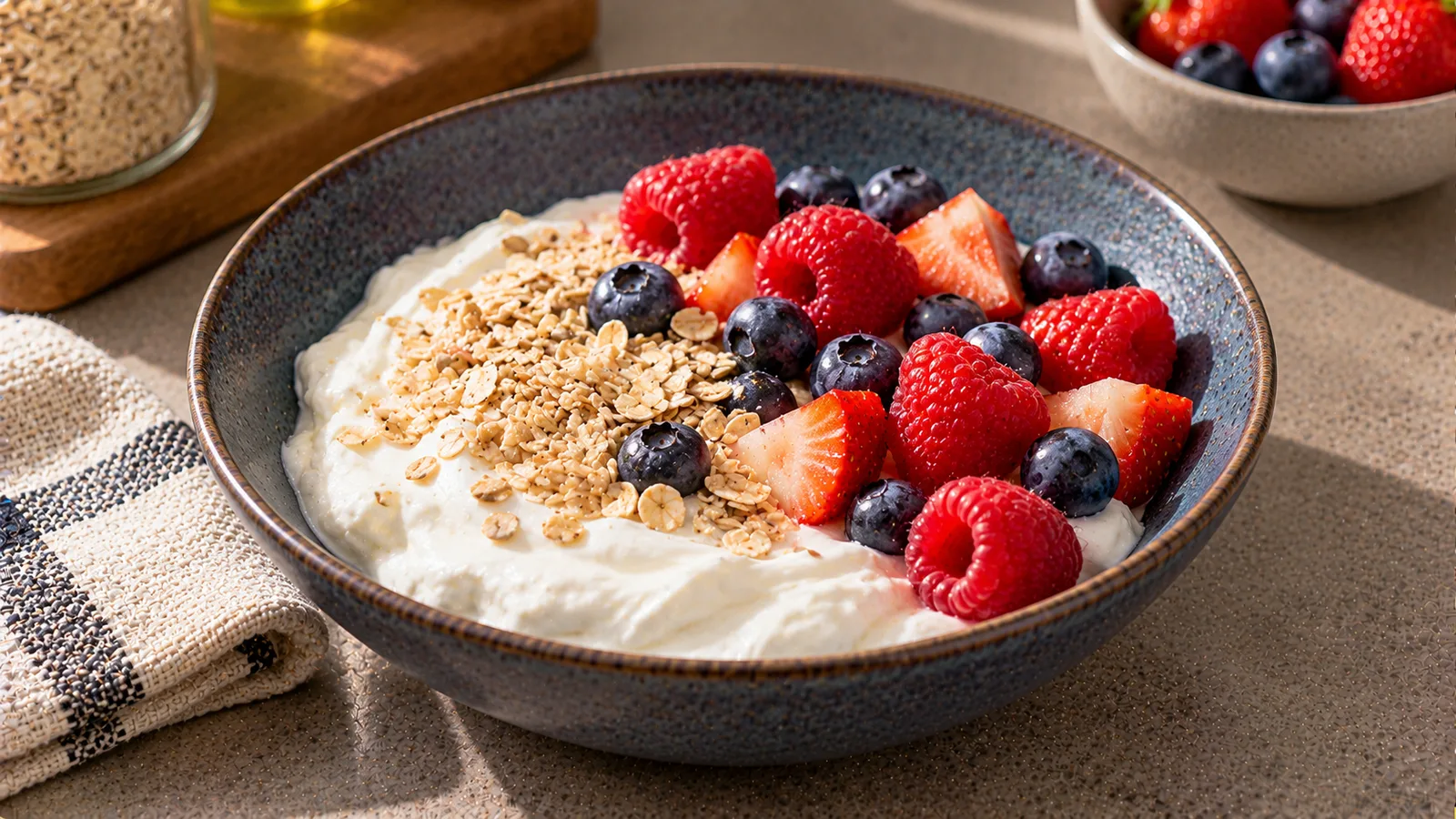
A Greek yogurt and berry bowl can be a practical breakfast or substantial snack without relying on a ready-made “protein parfait.” The useful question is not whether the bowl looks healthy; it is what you actually put into it, how much protein and fiber that portion provides, and what the edible ingredients cost. This recipe uses measured quantities and a transparent, deliberately hypothetical supermarket basket. It is one recipe with variations, not a claim that a homemade bowl always beats a packaged product.
Here is the reference bowl: 200 g plain nonfat Greek yogurt, 100 g raw blueberries, 35 g dry oats, and 10 g dry chia seeds. Together they weigh 345 g before any soaking, have approximately 360 kcal, 28.69 g protein and 9.55 g fiber, and cost €1.96 under the example prices below. These are calculated food-composition estimates, not laboratory results for a particular brand. Fat, sugar and nutrition claims require the label of the yogurt and toppings you purchase.
Ingredients for one exact bowl
| Ingredient and food state | Amount used | Preparation purpose |
|---|---|---|
| Plain Greek yogurt, nonfat, unsweetened | 200 g | Thick, high-protein dairy base |
| Blueberries, fresh and raw, edible weight | 100 g | Fruit, moisture, flavor and fiber |
| Plain dry oats | 35 g | Whole-grain texture and extra fiber |
| Dry chia seeds | 10 g | Additional fiber and a slightly thickened texture |
Use a kitchen scale at least the first time. A “handful of berries” varies with berry size; two yogurts both called “Greek-style” can have very different protein and fat levels. The formulation assumes actual Greek plain nonfat yogurt with 10.19 g protein per 100 g in the referenced USDA record, not a dessert, a flavored yogurt or a Greek-style product whose label shows less protein. For the fruit, weigh edible blueberries, not a punnet or packaging. For oats, the 35 g measurement is dry weight before milk or water is absorbed.
This bowl contains milk and is not suitable for a person who must avoid dairy. Oats may require certified gluten-free sourcing for someone with celiac disease, since cross-contact is possible. Chia is optional for taste and tolerance, but removing it substantially changes the fiber result; do not keep the headline numbers after changing ingredients.
Make the bowl in five minutes
- Spoon 200 g yogurt into a clean, deep bowl. Stir to even out the texture, but avoid adding sugar automatically.
- Rinse 100 g fresh blueberries under running water and let excess water drain. If using commercially frozen berries, follow package instructions about any required heating or preparation; do not assume every frozen product is ready to eat without treatment.
- Add 35 g dry oats. For a softer bowl, let the mixture rest refrigerated for 10–20 minutes. The oats absorb some water but add no nutrients just because they become heavier.
- Sprinkle 10 g chia over the top and stir some into the yogurt. Chia can absorb liquid and thicken the mixture. If a drier texture is unpleasant, add a measured splash of water or milk and log its nutrients if significant.
- Eat promptly or keep chilled while preparing to serve. Add any optional honey, nuts or granola as additional ingredients, not as free decorations.
There is no cooking oil, syrup, sweetened granola or protein powder in the calculated recipe. If you use flavored yogurt, the energy and sugar profile will likely change. If you prepare it the night before, keep yogurt and berries refrigerated and oats/chia separately if you prefer crunch. Food safety and texture are different issues: a pleasantly softened overnight oat topping does not create permission to leave dairy at room temperature.
Nutrition: calculate the portion, not a marketing promise
The values below use identified USDA SR Legacy foods: nonfat plain Greek yogurt (FDC 170894), raw blueberries (171711), oats (169705), and dried chia seeds (170554). Values are per the stated edible raw or ready-to-eat state. Each item is multiplied by its used mass divided by 100 g. Approximate calories and nutrient grams are rounded only for display.
| Ingredient | Kcal | Protein | Fiber |
|---|---|---|---|
| Yogurt, 200 g | 118.0 | 20.38 g | 0.00 g |
| Blueberries, 100 g | 57.0 | 0.74 g | 2.40 g |
| Oats, 35 g dry | 136.2 | 5.91 g | 3.71 g |
| Chia, 10 g dry | 48.6 | 1.65 g | 3.44 g |
| Whole bowl, 345 g | 359.8 | 28.69 g | 9.55 g |
The line items add to 359.75 kcal, 28.6855 g protein and 9.55 g fiber before display rounding. For example, oats contribute 389 × 0.35 = 136.15 kcal, and their fiber is 10.6 × 0.35 = 3.71 g. Yogurt supplies most of the protein; oats, berries and chia supply essentially all the fiber. Mixing a fiber-rich topping into yogurt does not make plain Greek yogurt itself a fiber source.
The USDA carbohydrate value for chia seeds includes fiber in its total-carbohydrate convention. European nutrition labels report carbohydrate and fiber differently; do not simply add and compare “USDA carbs” to an EU package label without checking how each is defined. The European Commission's labeling guidance explains compulsory energy, fat, carbohydrate, sugars, protein and salt declarations; fiber can be volunteered. Use the actual pack for logging a branded product.
What the bowl costs: a reproducible example
Assume a completely illustrative euro price list: a 500 g yogurt tub for €2.25, 300 g berries for €2.70, 500 g oats for €0.85, and 200 g chia for €1.99. These are teaching assumptions, not live prices, checked German offers, or claims about specific manufacturers. Replace them with prices from your own receipt. All the grams in the calculation are assumed edible; spoilage, excess fruit discarded and promotions are excluded.
| Purchase item | Example package | Amount actually used | Cost charged to bowl |
|---|---|---|---|
| Plain nonfat Greek yogurt | 500 g / €2.25 | 200 g | €0.90 |
| Blueberries | 300 g / €2.70 | 100 g | €0.90 |
| Oats | 500 g / €0.85 | 35 g | €0.06 |
| Chia | 200 g / €1.99 | 10 g | €0.10 |
| Total edible ingredients | — | 345 g | €1.96 |
Use the equation purchase price × grams used ÷ edible grams purchased. The precise amounts before rounding are €0.9000 for yogurt, €0.9000 for berries, €0.0595 for oats, and €0.0995 for chia: €1.9590 in total. Dividing by the reference 28.6855 g protein gives €0.0683 per gram protein, or roughly €0.68 per 10 g protein. Dividing by 9.55 g fiber gives about €0.21 per gram fiber. These are accounting tools, not a score of overall health.
A four-bowl batch would consume 800 g yogurt, 400 g berries, 140 g oats, and 40 g chia. That costs €7.84 of ingredients used in the model, but you cannot shop for exactly those grams if only the specified package sizes are sold. At the counter you would need two yogurt tubs (€4.50), two berry packs (€5.40), one oats pack (€0.85), and one chia pack (€1.99): €12.74 cash outlay, with yogurt, berries, oats and chia remaining. Keep the distinction between basket spending and per-portion ingredient costs; unused food is pantry inventory, not automatically waste.
Can frozen berries lower the price?
Often they can, but do not claim that frozen is always cheaper. Compare edible grams for the exact product and season. If your hypothetical frozen unsweetened blueberries cost €4.20 for a 750 g bag, the 100 g portion costs €0.56, saving €0.34 compared with the €0.90 fresh-berry assumption. The modeled bowl would then cost €1.62. These frozen-berry numbers are illustrative prices only, not independently observed retail offers.
That substitution keeps the portion at 100 g, but the nutritional total is not necessarily identical: freezing, losses of liquid, berry variety and the product's actual label can affect values. The published model uses raw fresh blueberry composition for consistency, not a verified profile for the hypothetical frozen product. If precise tracking matters, enter the frozen product's labeled nutrients separately.
A second option is changing the berry ratio rather than buying more volume. Using 50 g blueberries instead of 100 g reduces the original modeled price by €0.45, but also removes half the blueberries' fiber and calories. Do not display the original bowl's totals next to the reduced recipe. Smaller fruit portions are a legitimate preference, not an automatically better nutrition choice. For grocery planning and the distinction between pack spending and ingredients used, see Mealisa's budget grocery list guide.
Homemade bowl versus a packaged parfait
Packaged parfaits can save preparation time and provide predictable packaging sizes. Their ingredient lists are not the same as the bowl above: they may have sweetened yogurt, sauce, cookies, granola, fruit purée or separate toppings. Consequently, the word “protein” on a front label does not tell you how much fiber a product has, and an attractive berry picture does not prove it contains 100 g of berries.
For an arithmetic illustration, not a real market product, imagine a 180 g packaged parfait costing €2.49, labeled 15 g protein, 3 g fiber and 280 kcal per pot. Against our reference homemade bowl, that imaginary item supplies less protein and fiber at a higher sticker price, but also a smaller serving and fewer calories. Those differences are not a verified comparison of similar products. Always replace the invented example with the actual brand's nutrition declaration and edible portion.
Three useful comparisons are price per entire edible serving, protein and fiber per serving, and ingredients/energy relative to your goal. Price per 100 g may help compare sizes but is not a synonym for cost per satisfying breakfast. A packaged cup might be discounted, closer to your preferred calorie target or more practical during travel; a homemade bowl may win on customization. For another genuine food-versus-packaged-snack comparison see Mealisa's protein bar versus Greek yogurt article.
Adjust protein and fiber without inventing numbers
If you want a lighter bowl, start with 150 g yogurt, 75 g blueberries, 25 g oats and 5 g chia. You must recalculate all nutrients and costs for these new masses. Reducing yogurt also reduces protein, so calling a smaller bowl “equally high protein” would be misleading. If you want more protein, an additional 100 g of the same reference nonfat yogurt adds approximately 10.19 g protein and 59 kcal, plus its package-derived price of €0.45 in this example.
If fiber is the priority, the oats and chia are doing substantial work. Replacing 10 g chia with another 10 g oats, at these reference values, substitutes 1.06 g oat fiber for 3.44 g chia fiber, a decrease of 2.38 g fiber. It also changes calories, fat, texture and price. A person unfamiliar with chia may prefer to introduce it gradually and drink adequate fluids rather than abruptly increasing fiber. Mealisa's high-fiber food guide provides a broader food-level perspective without substituting for the recipe's own math.
A scoop of commercial protein powder is not part of the reference recipe. Different powders contain different nutrients; some also have sweeteners or fibers. Only add protein powder to your log using the exact label and measured scoop. Greek yogurt with full fat also differs materially from nonfat yogurt. A switch from nonfat to a 5%-fat brand can change calories even if its protein grams look similar.
Portion size, sugars and allergy considerations
The bowl weighs 345 g before the ingredients absorb moisture. This is a fairly large edible serving, not a portable “small yogurt” cup. The fruit's naturally occurring sugars and the yogurt's lactose still count as sugars on a nutrition label, even without syrup. “No added sugar in our recipe” does not mean sugar-free or suitable for every dietary requirement. If using honey or jam, measure and add them explicitly.
Dairy is a relevant allergen. For lactose intolerance, some people can use a lactose-free high-protein yogurt, but its actual protein and carbohydrate values must be read from the label. Soy-based alternatives may change protein substantially; coconut-based desserts are not automatic protein substitutes. For gluten avoidance, use oats and toppings appropriate to your medical needs and check package cross-contact information. These are food-selection cautions, not medical treatment advice.
If you track portions routinely, weigh your favorite bowl once and save a recipe with the actual brands, rather than entering four generic ingredients every day. Mealisa's portion-size versus serving-size explanation helps explain why the serving shown on a package may not be the amount you ate. A package may list nutrients per 100 g or per pot; match that basis before comparing it with the full homemade bowl.
Storage and advance preparation
Wash fresh berries under running water before eating; do not use soap. Use clean utensils and keep open yogurt refrigerated according to its package. If you assemble bowls in advance, store them in covered food-safe containers in the refrigerator and use the shorter applicable storage instruction for the individual ingredients. The USDA FSIS basic food-safety guidance recommends refrigerating perishables promptly and maintaining a sufficiently cold refrigerator; the USDA advice on washing produce covers fresh-fruit handling.
For texture, it is often better to portion dry oats and chia into small containers, then stir them into yogurt just before serving. Frozen berries can add water while thawing. A prepared bowl may be safe under proper refrigeration yet become watery or soft; do not confuse a texture preference with a safety assessment. Do not leave yogurt bowls out for hours at a picnic or on an office desk without cooling.
When this recipe is good value—and when it is not
In the illustrated basket, €1.96 buys one measured 345 g yogurt, berry, oat and chia bowl with approximately 28.68 g protein and 9.55 g fiber. A bowl made with a discounted bulk yogurt tub and cheaper frozen berries might cost less; an organic single-serve yogurt and out-of-season fresh berries could cost considerably more. These are possibilities to test on real receipts, not claims of current supermarket pricing.
Use this exact recipe if you like its taste, have access to refrigeration and want a breakfast with a clear nutritional breakdown. Choose a packaged product when convenience, portability or a particular energy portion matters more, but read its label rather than assuming a front-of-pack promise. The practical habit is to compare measured edible portions, ingredient quality, texture and the grocery money you really spend.
Sources
- USDA FoodData Central: plain nonfat Greek yogurt, SR Legacy FDC 170894 — reference nutrient values per 100 g.
- USDA FoodData Central: raw blueberries, SR Legacy FDC 171711 — berry composition and edible basis.
- USDA FoodData Central: oats, SR Legacy FDC 169705 — dry-oat energy, protein and fiber.
- USDA FoodData Central: dried chia seeds, SR Legacy FDC 170554 — seed energy, protein and fiber.
- European Commission: nutrition labelling — EU nutrition declaration and optional fiber reporting.
- German Nutrition Society: wholegrain foods — wholegrain and fiber context.
- USDA FSIS: keep food safe — refrigeration and handling.
- USDA FSIS: washing food — washing fresh produce.
Method: Nutritional calculations use named USDA records, with fractional-portion multiplication before rounding. Exact supermarket-brand labels, edible losses, seasonal retail prices and frozen-product nutritional differences are not independently measured here. Every price is hypothetical; no commercial brand endorsement is implied.