
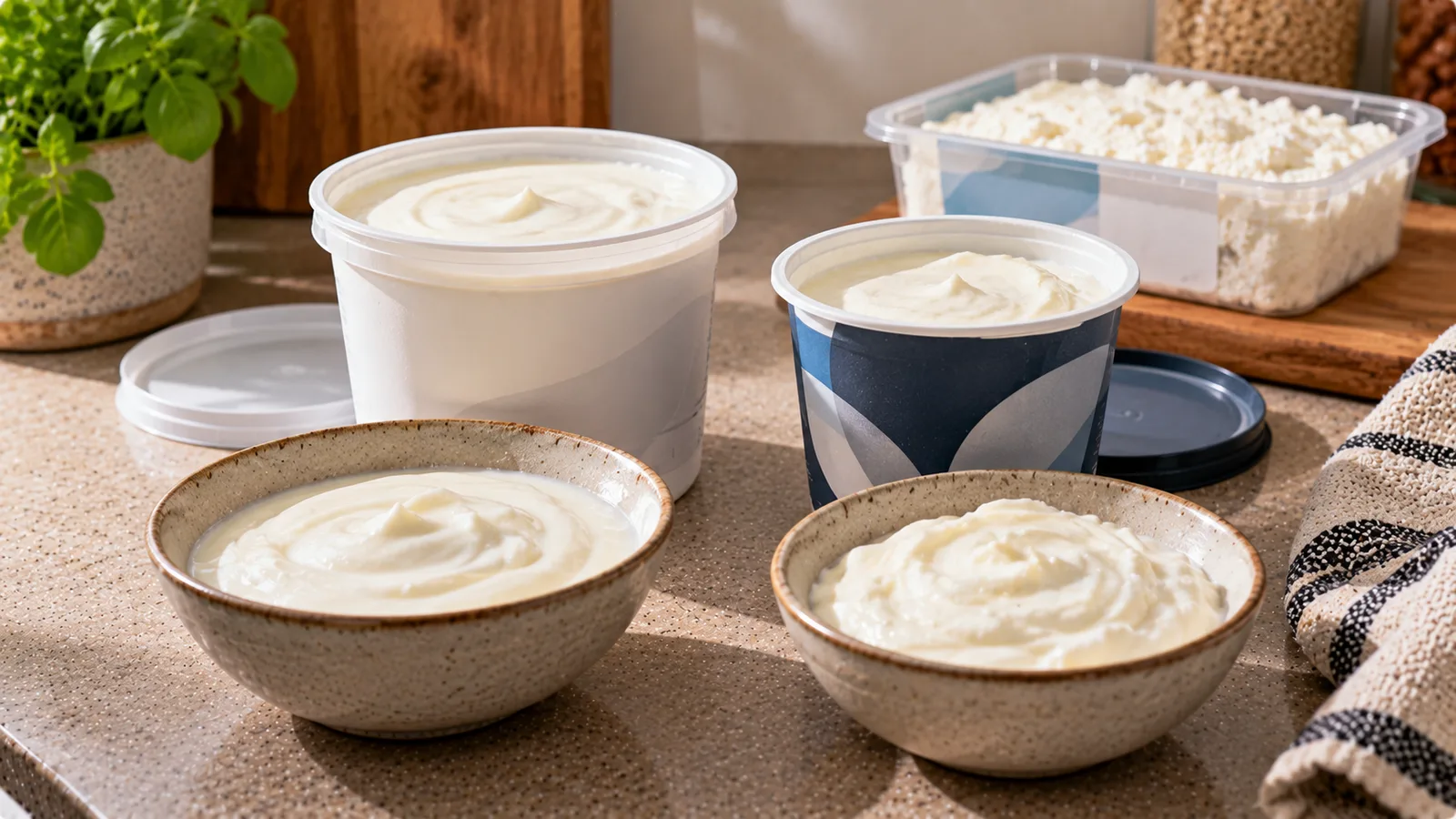
Protein-enriched foods have become a familiar sight in supermarkets. You can find high-protein puddings, yogurts, breads, cereals, snacks and drinks alongside conventional alternatives.
Some offer a convenient way to increase protein intake. Others cost substantially more while providing only a modest amount of extra protein.
The useful question is not simply whether a product contains a lot of protein. It is:
How much additional protein do you actually get for the extra money, and does that benefit fit your diet?
This guide explains how to compare products fairly using the nutrition label, serving size, total price and the food you would otherwise buy.
What does protein-enriched actually mean?
A product marketed as protein-enriched may contain added milk proteins, whey, soy protein, pea protein or other protein ingredients.
However, a product can also be naturally rich in protein without added protein ingredients.
In the European Union, the regulated nutrition claims “source of protein” and “high protein” are based on the proportion of the food's energy supplied by protein.
Under Regulation (EC) No 1924/2006:
| EU nutrition claim | Requirement |
|---|---|
| Source of protein | At least 12% of the food's energy value comes from protein |
| High protein | At least 20% of the food's energy value comes from protein |
These rules concern the energy share from protein, not a fixed number of grams per package.
A small snack may meet the high-protein claim while contributing fewer total grams of protein than a larger serving of an ordinary food.
Therefore, always read the actual nutrition declaration.
First check whether you need more protein
Buying additional protein has limited value if your existing diet already meets your needs.
The European Food Safety Authority (EFSA) established a population reference intake of 0.83 g protein per kilogram of body weight per day for healthy adults.
The German Nutrition Society (DGE) provides a reference value of 0.8 g/kg/day for adults aged 19–64, with different guidance for some other groups.
These are general reference values. Protein requirements may differ with age, activity, health conditions and individual circumstances.
For illustration:
| Body weight | At 0.83 g/kg/day |
|---|---|
| 60 kg | 49.8 g/day |
| 70 kg | 58.1 g/day |
| 80 kg | 66.4 g/day |
| 90 kg | 74.7 g/day |
The calculations are simple reference examples, not individualized protein prescriptions.
If your ordinary meals already supply sufficient protein, an expensive high-protein dessert may offer convenience or taste rather than a necessary nutritional improvement.
The four numbers that matter on the shelf
When comparing two foods, record:
- Protein per 100 g — useful for comparing nutritional density.
- Protein per realistic serving — what you will actually eat.
- Price per serving — what that portion costs.
- Total calories and other relevant nutrients — whether the product fits the meal.
The EU's food-information regulation establishes requirements for nutrition declarations on prepacked foods.
Do not compare the protein per 100 g of one product with the protein per package of another.
Always use the same basis.
Worked example: regular yogurt versus high-protein yogurt
Imagine two fictional products.
These are illustrative numbers, not verified supermarket products or current prices.
| Measure | Regular yogurt | Protein-enriched yogurt |
|---|---|---|
| Package size | 200 g | 200 g |
| Package price | €0.70 | €1.50 |
| Protein per 100 g | 4 g | 10 g |
| Protein per package | 8 g | 20 g |
| Price per 10 g protein | €0.88 | €0.75 |
The enriched yogurt provides 12 g more protein for an additional €0.80.
The cost of the extra protein is:
€0.80 ÷ 12 g = approximately €0.067 per additional gram.
That is a different measure from the overall price per gram of protein.
Both calculations can be useful, but they answer different questions.
Formula 1: price per gram of protein
Use:
Price per gram of protein = package price ÷ protein grams in the package.
For the regular yogurt:
€0.70 ÷ 8 = €0.0875 per gram.
For the enriched yogurt:
€1.50 ÷ 20 = €0.075 per gram.
In this fictional comparison, the enriched product costs more per package but less per gram of protein.
That does not automatically make it the best purchase. You may not need the additional protein, and the products may differ in ingredients, calories or portion suitability.
Formula 2: cost of the additional protein
If the enriched product is intended to replace a regular version, calculate:
Incremental protein cost = (enriched price − regular price) ÷ (enriched protein − regular protein).
Using the same example:
(€1.50 − €0.70) ÷ (20 g − 8 g)
= €0.80 ÷ 12 g
= approximately €0.067 per extra gram of protein.
This formula is especially useful when both products have similar package sizes and serve the same purpose.
If one package is much larger, normalize the comparison to the same edible quantity first.
Example: high-protein pudding versus ordinary pudding
Consider another fictional comparison:
| Measure | Ordinary pudding | High-protein pudding |
|---|---|---|
| Portion | 200 g | 200 g |
| Price | €0.85 | €1.79 |
| Protein | 6 g | 20 g |
| Extra protein | — | 14 g |
| Price premium | — | €0.94 |
The additional protein costs:
€0.94 ÷ 14 = approximately €0.067 per extra gram.
But there is another question: would you otherwise eat the pudding at all?
If the high-protein pudding replaces a dessert you already planned to buy, the incremental comparison makes sense.
If you buy it in addition to your usual food, the entire €1.79 is additional spending.
This distinction is important when evaluating a grocery budget.
Compare the product with a different food, not only its regular version
A high-protein product can look attractive when compared with a low-protein dessert.
It may look less attractive when compared with other ordinary protein-rich foods.
Depending on local prices and dietary preferences, alternatives might include:
- Plain skyr or quark
- Eggs
- Lentils and beans
- Plain yogurt
- Cottage cheese
- Tofu
- Canned fish
These foods are not nutritionally interchangeable in every respect.
For example, dry legumes provide fiber and other nutrients, while dairy foods may supply calcium. Compare the complete meal rather than treating protein grams as the only relevant feature.
For product-specific nutrition information, consult the actual packaging or a reliable database such as USDA FoodData Central.
Example: comparing three hypothetical shopping options
Suppose you want approximately 20 g of protein from one convenient food.
| Option | Edible portion | Assumed protein | Example price |
|---|---|---|---|
| Protein pudding | 200 g | 20 g | €1.79 |
| Plain skyr | 200 g | 22 g | €0.99 |
| Cottage cheese | 200 g | 24 g | €1.29 |
These values are fictional examples chosen to demonstrate the method.
The price per 10 g of protein is:
| Option | Example cost per 10 g protein |
|---|---|
| Protein pudding | €0.90 |
| Plain skyr | €0.45 |
| Cottage cheese | €0.54 |
On these assumptions, plain skyr supplies protein at the lowest cost.
However, this comparison does not establish current prices or nutritional values for specific brands.
Check the product label and actual shelf price before making a decision.
Protein per calorie can also matter
Some shoppers want more protein without increasing total energy intake substantially.
For this purpose, calculate:
Protein per 100 kcal = protein grams ÷ calories × 100.
Suppose:
- Product A provides 20 g protein and 160 kcal.
- Product B provides 20 g protein and 260 kcal.
Then:
- Product A: 20 ÷ 160 × 100 = 12.5 g per 100 kcal.
- Product B: 20 ÷ 260 × 100 = approximately 7.7 g per 100 kcal.
Both contain the same total protein, but their energy density differs.
This does not mean the lower-calorie product is always preferable. Total energy needs, satiety, taste and the rest of the diet matter.
Check the ingredients and full nutrition label
The words “high protein” should not replace reading the label.
Consider:
| Label detail | Why it matters |
|---|---|
| Protein | Total grams per realistic portion |
| Calories | Energy contribution to the meal |
| Sugars | Useful for comparing similar products |
| Saturated fat | Relevant to overall dietary composition |
| Salt | Especially relevant for savory protein snacks |
| Fiber | May differ greatly between cereals, bars and whole foods |
| Ingredients | Shows protein sources, sweeteners and other additions |
| Allergens | Important for individual dietary restrictions |
A product can legitimately qualify for a protein claim while still containing other ingredients you may prefer to limit.
EU nutrition and food-information rules provide the framework for these declarations. See Regulation (EC) No 1924/2006 and Regulation (EU) No 1169/2011.
When paying more can be reasonable
A protein-enriched product may be worth the premium when it:
- Helps fill a genuine protein gap in your diet.
- Is easy to carry or eat when ordinary meals are impractical.
- Replaces a food you would otherwise purchase.
- Fits your preferences and dietary restrictions.
- Offers a useful combination of protein, calories and convenience.
- Prevents waste because you reliably finish the portion.
Convenience has value, even when it cannot be measured in protein grams.
For someone with limited cooking time, a ready-to-eat product may be more practical than an ingredient requiring preparation.
The comparison should include your actual routine.
When the premium may not be justified
The extra cost may offer little value if:
- Your daily protein intake is already sufficient.
- The enriched version provides only a small additional amount.
- A regular product offers similar protein at a lower price.
- You buy the product only because the packaging emphasizes protein.
- The portion is larger than you want.
- You regularly discard part of the package.
A high-protein label is not evidence that a product is necessary.
A practical supermarket comparison
Imagine standing in front of two products.
Use this sequence:
- Check both package weights.
- Read protein per 100 g.
- Calculate protein per portion.
- Compare actual prices.
- Calculate price per 10 g protein.
- If one replaces the other, calculate the cost of the additional protein.
- Compare calories, ingredients and other relevant nutrients.
- Decide whether the convenience justifies the difference.
If the products serve very different purposes, compare them as meal choices rather than pretending they are identical.
Track the premium over a month
Small price differences can add up when a product becomes a daily habit.
Suppose an enriched snack costs €0.80 more than the regular alternative.
At five purchases per week for four weeks:
€0.80 × 5 × 4 = €16 extra spending.
At seven purchases per week:
€0.80 × 7 × 4 = €22.40 extra spending.
These are illustrative calculations, not predictions of your grocery costs.
To judge whether the expense is worthwhile, compare the added protein and convenience with what you could obtain from other foods.
A reusable decision table
| Question | Record |
|---|---|
| What product would I buy otherwise? | Regular alternative |
| What is the package price difference? | Euro amount |
| What is the difference in protein per serving? | Grams |
| What is the price per 10 g protein? | Calculated amount |
| Does the enriched version change calories or other nutrients? | Label comparison |
| Will I eat the whole portion? | Yes / no |
| Is the convenience useful? | Personal judgment |
| Does it fit my weekly food budget? | Yes / no |
The best-value option is not necessarily the cheapest package or the one with the largest protein number.
A protein-enriched food is worth its premium when the extra protein or convenience is genuinely useful to you and the total product offers better value than your realistic alternatives.