
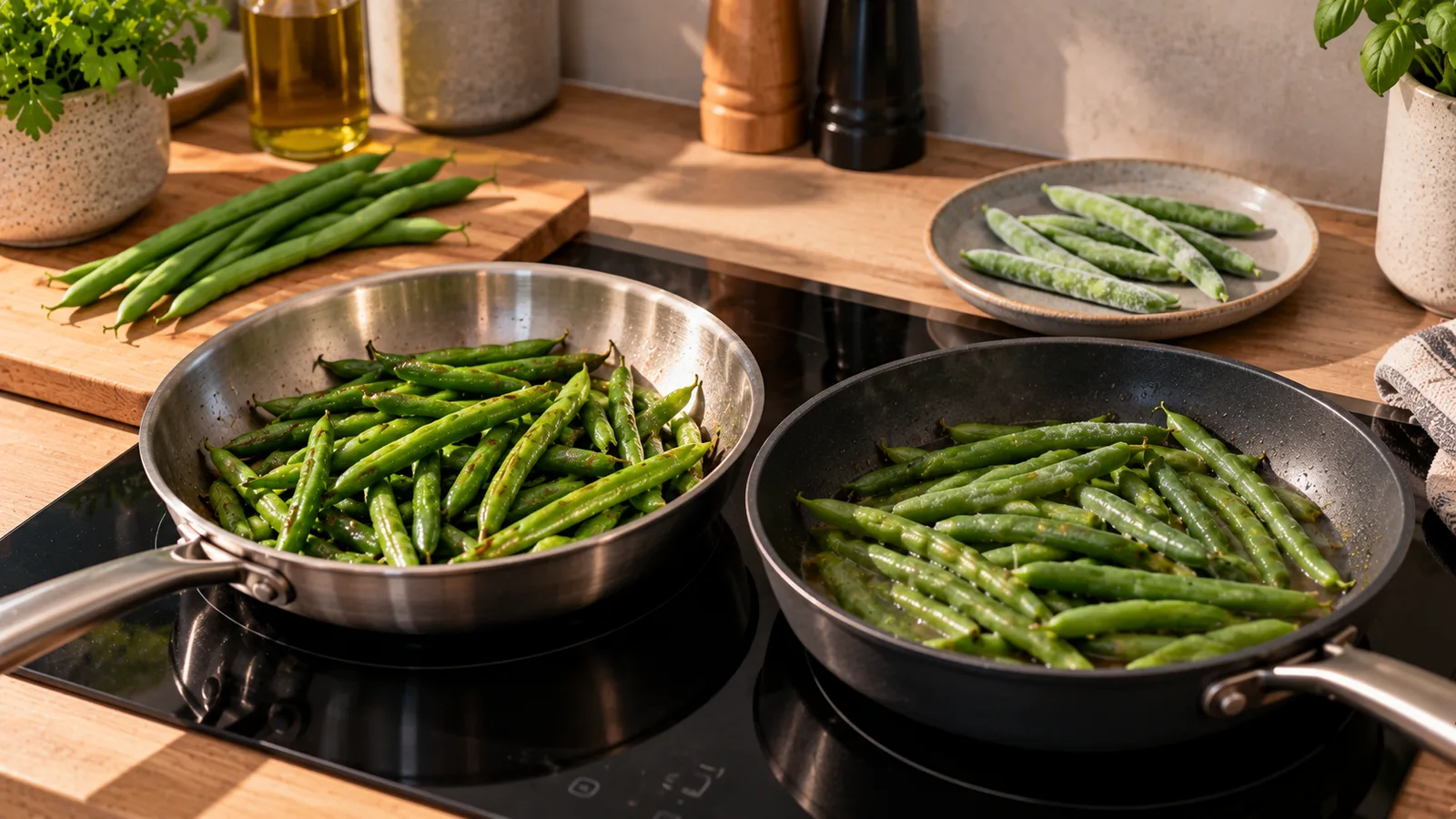
Fresh and frozen vegetables are often treated as nutritional opposites: fresh is assumed to be superior, while frozen is seen as a compromise.
The reality is more nuanced.
Both can contribute valuable nutrients, fiber and variety to the diet. Their differences depend on the vegetable, how quickly the fresh product is eaten, processing before freezing, storage time and the way the food is cooked. The same choice also arises with fruit; the fresh versus frozen berries comparison compares berries for nutrition and price.
For most everyday decisions, the better choice is the format that fits the dish and that you will actually eat.
Fresh vs frozen vegetables at a glance
| Factor | Fresh vegetables | Frozen vegetables |
|---|---|---|
| Nutrient quality | Can be excellent | Can also be excellent |
| Storage time | Usually shorter | Usually much longer |
| Texture | Often firmer or crisper | Often softer after cooking |
| Preparation | May require washing, trimming or chopping | Often already prepared |
| Portion flexibility | Depends on the vegetable | Easy to remove only the amount needed |
| Best uses | Salads, raw dishes, roasting, fresh-texture dishes | Soups, curries, stir-fries, sauces, cooked dishes |
| Seasonality | Greater variation | More consistent availability |
Neither column is automatically "better."
Why frozen vegetables can retain nutrients well
Vegetables intended for freezing are generally processed relatively soon after harvest.
They are commonly blanched before freezing. Blanching uses heat for a short period to reduce enzyme activity that would otherwise continue to affect quality during storage.
This processing can reduce some heat-sensitive or water-soluble nutrients.
However, freezing then slows many processes that contribute to further deterioration.
Fresh vegetables follow a different path.
After harvest they may spend time in:
- transport;
- distribution;
- supermarket storage;
- your refrigerator.
Some nutrients can decline during that period.
This is why the word fresh alone does not guarantee that every vitamin concentration will be higher than in the frozen equivalent.
There is no single nutrient winner
Different nutrients behave differently.
For example:
- some vitamins are sensitive to heat;
- some are sensitive to oxygen or light;
- minerals are generally more stable;
- fiber remains an important component in both fresh and frozen vegetables.
The exact comparison also changes by vegetable.
A frozen pea, fresh spinach and frozen broccoli cannot be reduced to one universal rule.
A more accurate conclusion is:
plain frozen vegetables can be nutritionally comparable to fresh vegetables, while individual nutrients may be higher or lower depending on the food and handling.
What blanching changes
Many vegetables are blanched before commercial freezing.
This can cause losses of some water-soluble and heat-sensitive compounds.
But blanching also helps preserve:
- color;
- flavor;
- texture quality during storage;
- overall product stability.
It would therefore be misleading to compare a freshly harvested vegetable directly with a frozen vegetable and assume that represents the typical supermarket situation.
The fresh vegetable may already have spent days in storage and transport.
Fresh vegetables also change during storage
A vegetable does not stop changing when it is placed in the refrigerator.
Time, temperature, oxygen and light can affect quality.
This means there can be an important difference between:
- vegetables harvested recently and eaten quickly;
- vegetables kept for many days before consumption.
If you buy fresh vegetables and eat them promptly, they can provide excellent nutritional quality.
If they remain in the refrigerator for a long time, the comparison with frozen vegetables becomes less straightforward.
Frozen does not mean nutritionally empty
Freezing itself does not remove all vitamins or minerals.
Plain frozen vegetables still provide the underlying vegetable's nutrients.
The nutritional profile can become meaningfully different when the package includes additional ingredients such as:
- butter;
- cheese sauce;
- cream sauce;
- added salt;
- sugar;
- breading.
When comparing fresh and frozen vegetables nutritionally, compare the fresh vegetable with a plain frozen version whenever possible.
Texture is where the difference is often obvious
Freezing affects the physical structure of plant tissue.
Water inside cells forms ice crystals, and blanching also softens tissue.
After thawing or cooking, some frozen vegetables therefore become softer than their fresh equivalents.
This matters more for certain dishes than for others.
Fresh vegetables often work particularly well when you want:
- crispness;
- crunch;
- a raw texture;
- firm roasting pieces.
Frozen vegetables often work well when the final dish is already cooked and softness is not a disadvantage.
Vegetables where texture may matter a lot
Fresh versions may be preferable for dishes such as:
- raw cucumber salad;
- leafy salads;
- raw tomato preparations;
- crudités;
- dishes where crisp bell pepper is central.
Freezing these types of vegetables can produce a noticeably softer or more watery texture after thawing.
That does not make them nutritionally useless. It simply changes their culinary role.
Vegetables that often work very well frozen
Frozen vegetables can be particularly practical for:
- peas;
- spinach;
- broccoli;
- cauliflower;
- green beans;
- mixed vegetables;
- corn.
They can be added directly to many cooked dishes without needing the texture of a raw vegetable.
Best uses for frozen vegetables
Frozen vegetables are particularly convenient in:
Soups
Texture changes are usually unimportant because the vegetables are cooked in liquid.
Curries and stews
Frozen vegetables can be incorporated directly into the cooking process.
Pasta sauces
Spinach, peas and mixed vegetables can be easy additions.
Stir-fries
Many frozen vegetables work well, although excess water should be managed to avoid steaming everything.
Omelets and egg dishes
Small portions of spinach, peas or mixed vegetables can be convenient.
Purees and blended soups
Texture differences largely disappear after blending.
Best uses for fresh vegetables
Fresh vegetables often have an advantage in:
Salads
Crisp texture is usually important.
Raw snacks
Carrots, peppers, cucumbers and similar vegetables are often chosen specifically for texture.
High-temperature roasting
Fresh vegetables can often brown effectively when surface moisture is controlled.
Grilled vegetables
Firm fresh pieces are usually easier to handle.
Dishes where appearance matters
Fresh vegetables may hold shape and structure better in some presentations.
Should frozen vegetables be thawed first?
It depends on the recipe.
Many frozen vegetables can go directly into:
- soup;
- stew;
- curry;
- boiling water;
- steaming;
- certain stir-fries.
Thawing can sometimes release additional water and make the vegetable softer.
For dishes where browning matters, excess surface moisture can interfere with the result.
Follow package instructions when provided and adapt the method to the dish.
Avoid overcooking
Frozen vegetables have often already been blanched.
Cooking them for a long time can produce unnecessarily soft texture.
Instead:
- add them at the appropriate stage of the recipe;
- cook until heated through and at the texture you prefer;
- avoid assuming they need the same cooking time as a large raw vegetable.
Exact times vary by product and cut size.
Water changes the apparent portion size
Fresh and frozen vegetables can look different after cooking because water content and structure change.
For example, leafy vegetables such as spinach can shrink dramatically during cooking.
A large bowl of raw spinach and a small portion of cooked spinach may originate from similar amounts of plant material.
This matters when comparing portions.
Do not assume that equal volumes of raw and cooked vegetables represent equal weights.
Compare nutrition on a consistent basis
When comparing labels or food databases, check whether the values refer to:
- raw food;
- frozen food;
- cooked food;
- drained food;
- 100 g;
- a serving.
Comparing 100 g of one preparation state with a serving of another can create misleading differences.
Use the same basis whenever possible.
Frozen vegetables with sauce are a different product
Consider these two products:
Product A: frozen broccoli
Product B: frozen broccoli in cheese sauce
They should not be treated as nutritionally interchangeable.
The second product may contain additional:
- fat;
- sodium/salt;
- calories;
- other ingredients.
This does not make it inherently "bad." It simply means the comparison is no longer fresh broccoli versus frozen broccoli. It is fresh broccoli versus a prepared vegetable dish.
Sodium can vary
Plain frozen vegetables may contain little or no added salt, but this depends on the product.
Seasoned or prepared frozen vegetables may contain considerably more.
Check the ingredient list and nutrition label if sodium or salt intake matters to you.
Cooking method can matter as much as fresh versus frozen
The final nutrient profile and calorie content of a vegetable dish can be influenced by preparation.
Compare:
- steamed broccoli;
- broccoli roasted with oil;
- broccoli in cream sauce.
The vegetable may be the same, but the final dishes are different.
Similarly, prolonged boiling can move some water-soluble nutrients into the cooking water.
If that liquid is consumed as part of a soup, the context differs from boiling vegetables and discarding the water.
Frozen vegetables can make portions easier
One practical advantage of many frozen vegetables is the ability to remove only what you need.
For example, you can take:
- 100 g peas;
- a handful of spinach;
- 150 g mixed vegetables
and return the rest to the freezer according to safe storage instructions.
This can make it easier to add vegetables to individual meals without planning to use an entire fresh package immediately.
Fresh vegetables can provide greater culinary flexibility
Fresh vegetables can often be used both raw and cooked.
A fresh bell pepper can become:
- a raw snack;
- salad ingredient;
- roasted vegetable;
- stir-fry ingredient;
- soup ingredient.
A previously frozen pepper is generally less suited to applications where crisp raw texture is important.
So the value of fresh produce is not only nutritional. It can also provide more texture options.
Season can influence the decision
When a vegetable is locally abundant and in season, fresh versions may offer:
- excellent flavor;
- good texture;
- broad availability.
Outside the season, frozen vegetables can provide more consistent quality and availability.
You do not need to choose one format for the entire year.
Can you combine fresh and frozen vegetables?
Yes.
A practical kitchen can use both.
For example:
Fresh
- salad leaves;
- tomatoes;
- cucumbers;
- peppers for raw dishes.
Frozen
- peas;
- spinach;
- broccoli;
- mixed vegetables for cooked meals.
This lets texture-sensitive dishes use fresh produce while maintaining convenient vegetables for meals that do not depend on crispness.
Example: choosing vegetables for one week
Suppose you plan:
- two salads;
- one curry;
- one pasta dish;
- one soup;
- two simple dinners.
A practical combination might be:
Fresh
- lettuce;
- cucumber;
- tomatoes;
- carrots.
Frozen
- spinach for pasta;
- peas for simple dinners;
- cauliflower for curry;
- mixed vegetables for soup.
There is no nutritional reason that every vegetable in the week must come from the same storage format.
Nutrition is only useful if the food is eaten
A theoretically ideal vegetable has little practical value if it repeatedly spoils in your refrigerator.
Likewise, a freezer full of vegetables does not improve your diet if you dislike their texture and never use them.
The most useful option is one that fits:
- your cooking habits;
- preferred textures;
- storage;
- schedule;
- meals you actually prepare.
Fresh may be preferable when
Choose fresh more often when:
- raw or crisp texture is central to the dish;
- you will use the food soon;
- you want to grill or roast firm pieces;
- seasonal produce has the flavor you prefer;
- the vegetable is difficult to use well after freezing.
Frozen may be preferable when
Choose frozen more often when:
- you need long storage;
- you cook irregularly;
- you use small quantities at a time;
- the vegetable will go into a cooked dish;
- preparation convenience matters;
- you want a reliable backup supply.
What about home freezing?
Some fresh vegetables can be frozen at home, but quality depends on preparation.
Many vegetables benefit from blanching before freezing.
Food-safety and freezing guidance should be followed for the specific vegetable.
Home freezing can be useful when you have more fresh produce than you can use before it deteriorates.
The practical conclusion
Fresh versus frozen vegetables is not a competition with one universal winner.
Plain frozen vegetables can retain substantial nutritional value and may compare well with fresh produce after transport and storage.
Fresh vegetables often provide better crispness, raw texture and culinary versatility.
Frozen vegetables often provide:
- longer storage;
- convenient portions;
- easy preparation;
- reliable availability.
Fresh vegetables often provide:
- firmer texture;
- better raw applications;
- broader preparation options.
For everyday eating, using both formats can be more practical than trying to prove that one is always superior.
Choose based on the vegetable, the recipe, how quickly you will use it and the texture you want.
Sources
- U.S. Department of Agriculture, FoodData Central.
- U.S. Food and Drug Administration, guidance on fruits, vegetables and nutrition.
- European Food Information Council, information on fresh, frozen and canned fruit and vegetables.
- Favell DJ. A comparison of the vitamin C content of fresh and frozen vegetables. Food Chemistry. 1998;62(1):59–64.
- Bouzari A, Holstege D, Barrett DM. Vitamin retention in eight fruits and vegetables: a comparison of refrigerated and frozen storage. Journal of Agricultural and Food Chemistry. 2015;63(3):957–962.