
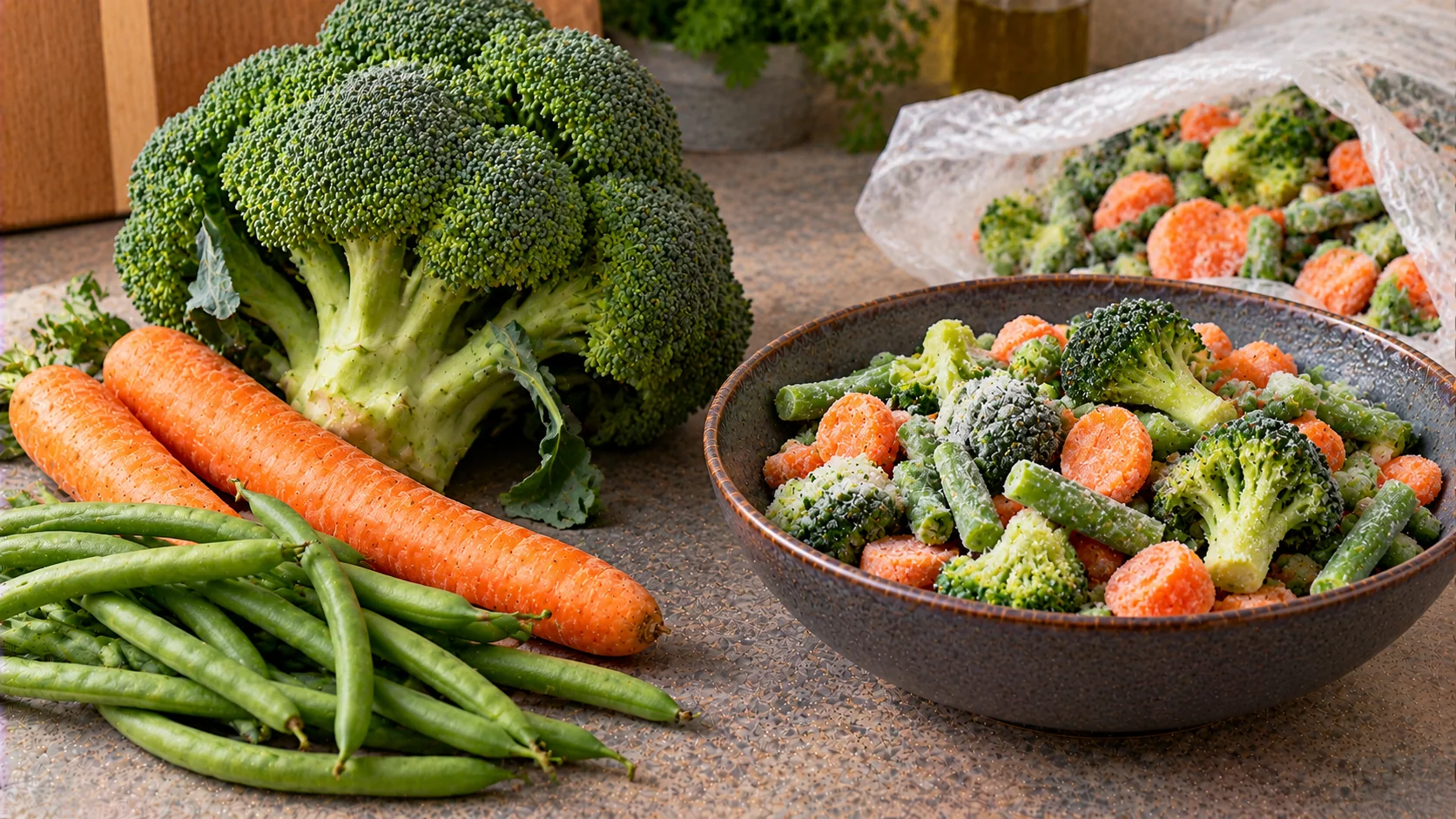
The right comparison is edible food, not the price tag
A one-kilogram fresh purchase and a one-kilogram frozen bag are not necessarily a kilogram of food on the plate. Stems, trimmings, spoilage, water in glazing and unused leftovers change the effective cost. This guide compares plain, unseasoned vegetables, not ready meals or vegetables in butter sauce. Frozen produce is convenient, but it is not automatically cheaper, healthier or waste-free. The useful decision depends on the vegetable, the shop, and how much you actually cook.
Compare the same food state and serving
Match broccoli with broccoli, not frozen broccoli with a prepared fresh salad. Read the net weight, ingredient list, drained or edible weight where relevant, and nutrition per 100 g. For frozen vegetables, confirm that the product is plain and check whether water, salt, oil or sauce has been added. Fresh vegetables may have stems or roots you do not eat; those are part of the amount purchased, not the edible yield. If the intended serving is 200 g cooked, measure your usual cooking losses or gains and use the same final edible serving basis for both options.
The edible-cost formula
For a fixed purchased quantity: cost per kilogram eaten = purchase price ÷ usable kilograms. If you buy a 1 kg fresh bag for €2.49 but use only 750 g, the usable cost is €2.49 ÷ 0.75 = €3.32/kg. A €1.99 frozen kilogram with 100% usable yield costs €1.99/kg, before energy. If a product loses 10% to unavoidable trimming, use a factor of 0.90. If you throw away additional food, reduce the usable fraction again rather than charging the same loss twice. A household may retain peels or stems for soup; count them as used only if they truly become food.
Four worked examples
| Vegetable | Fresh price per 1 kg bought | Fresh usable share | Fresh €/kg usable | Frozen price per 1 kg | Frozen €/kg usable |
|---|---|---|---|---|---|
| Broccoli | €2.49 | 75% | €3.32 | €1.99 | €1.99 |
| Spinach | €2.19 | 82% | €2.67 | €1.69 | €1.69 |
| Green beans | €3.20 | 90% | €3.56 | €2.49 | €2.49 |
| Carrots | €1.29 | 88% | €1.47 | €1.89 | €1.89 |
These are made-up, arithmetically consistent teaching prices and yields, not verified German retail offers or standard laboratory yield factors. They illustrate why frozen carrots can be more expensive even when frozen broccoli is cheaper. If a frozen bag contains unusable ice glaze, leakage or a sauce you do not want, do not assume 100% usable yield. For 200 g edible broccoli the model is €0.66 fresh versus €0.40 frozen (rounded). The corresponding carrot comparison is €0.29 fresh versus €0.38 frozen.
What research actually says about vitamins and minerals
A 2017 study comparing fresh, refrigerated for five days and frozen produce found that most selected vitamin comparisons showed no significant difference; in some comparisons frozen performed better than fresh-stored vegetables. Another study of fibre and minerals reported that most analysed commodities showed no significant fresh-versus-frozen difference for the assessed measures. These are specific foods and nutrients—not proof that every frozen bag equals every fresh vegetable. Blanching, storage duration, preparation and the vegetable itself can affect vitamin retention. Avoid universal claims such as “frozen has more vitamins”.
Add actual household waste to the calculation
Consider a household that purchases 1 kg fresh broccoli but trims 250 g: 750 g remain. If 150 g of that is spoiled before use, only 600 g is eaten, and the effective price becomes €2.49 ÷ 0.60 = €4.15/kg. A freezer bag used across four dinners could avoid some spoilage, but freezer burn and forgotten bags still cause waste. The European Commission’s food-waste overview explains why preventing avoidable waste matters. Do not apply national waste statistics as if they were your personal waste rate.
Cooking energy and serving sizes
Include cooking energy if the difference matters. Use kWh consumed × your electricity tariff; for instance, 0.20 kWh × €0.35/kWh = €0.07 for that cooking session, not €0.07 per portion if you cook four. Frozen vegetables may be cooked directly from frozen, while fresh vegetables may need washing, trimming or chopping. Neither preparation method always uses less energy. Compare portions on the plate: a 400 g bag cooked for two dinners costs half its package price per dinner only when both portions are used.
Reading ingredient lists and nutrition labels
A plain frozen product may contain only vegetables, while a “creamed spinach” product can contain milk, fat, salt or additives. Per-100-g nutrition on an EU label usually refers to the product as sold unless the packaging states otherwise. Compare like with like: raw fresh with plain frozen is not identical to comparing cooked servings. The calorie difference from a tablespoon of oil may exceed differences between plain vegetable products. Nutrition values and serving recommendations should not be inferred from the price per kilogram.
Storage, preparation and food safety
Keep vegetables frozen according to the pack instructions, normally in a freezer at about −18 °C; maintain refrigeration for fresh vegetables as appropriate. USDA guidance on freezing explains how quality can change during freezing and storage, including the role of blanching. Follow the producer’s cooking directions, especially where a product says it must be cooked; do not treat all frozen vegetables as ready-to-eat. Refrigerate cooked leftovers promptly and avoid long periods at room temperature. A thawed item should be handled according to its label and safe-food guidance.
When fresh wins and when frozen wins
Fresh can win when produce is in season, low priced and almost entirely eaten, or when raw crunch is important. Frozen can win when portions are small, shopping is infrequent, preparation time matters or fresh produce is often wasted. Buy fresh carrots if you routinely use them all and your local shop sells them cheaply. Frozen peas or chopped spinach can be practical when you want only one handful at a time. This is a decision by ingredient, not an endorsement of one aisle.
A five-minute shopping checklist
Check unit price per purchased kilogram; check plain versus sauced ingredients; estimate trim and expected spoilage; calculate price per edible kilogram; compare the portion you will actually use; account for a realistic cooking energy difference and freezer space. For a broader guide to low-cost meals with frozen vegetables, see quick dinners with frozen vegetables. Compare economical dinner options in budget meal planning.
Sources
- Li et al., selected nutrient analyses of fresh, fresh-stored and frozen produce (2017) — specific vitamin comparisons.
- Bouzari et al., mineral, fibre and phenolic retention (2015) — commodity-dependent results.
- European Commission: Food Waste — household waste context.
- USDA FSIS: Freezing and Food Safety — quality and storage practices.