
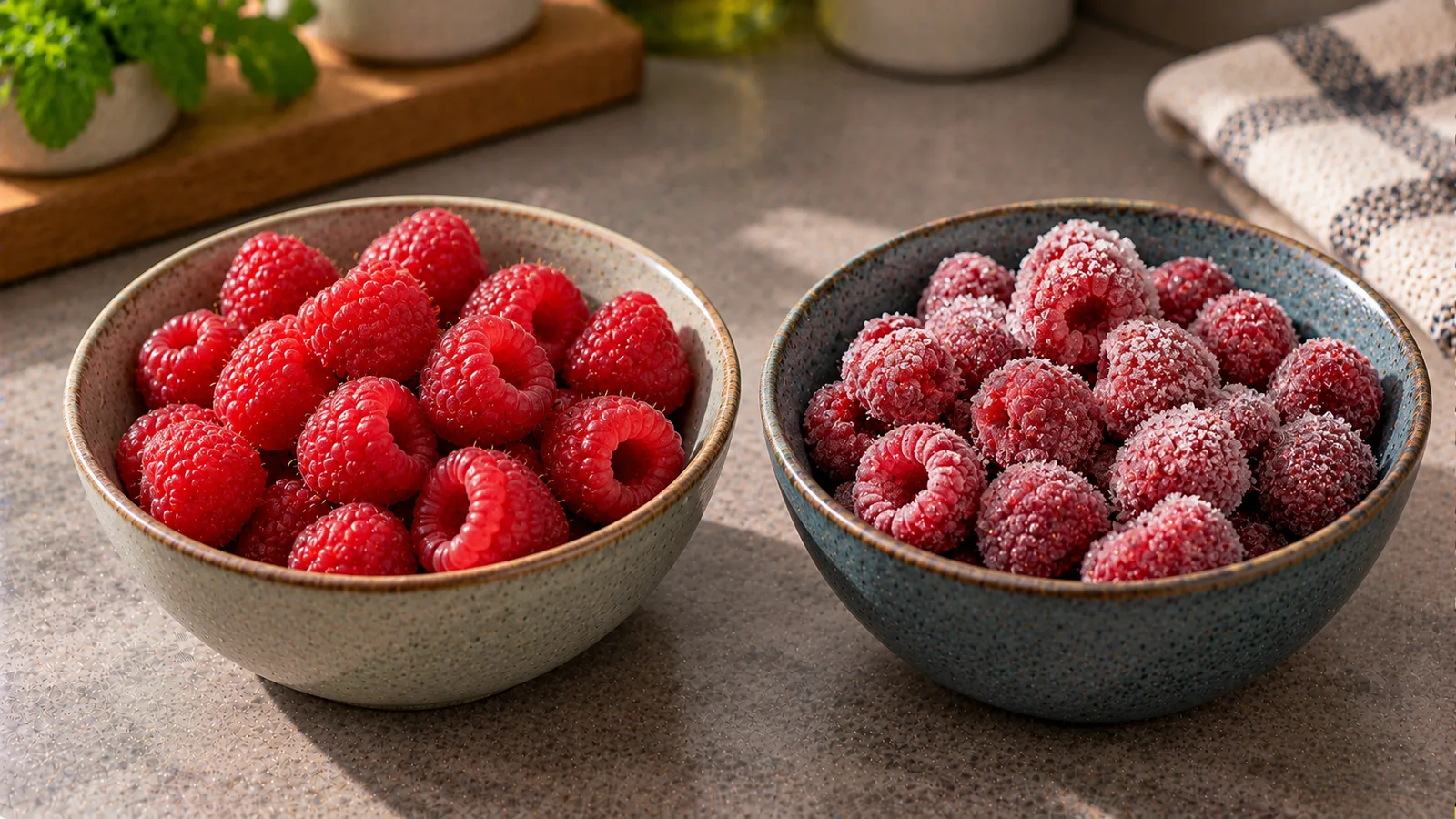
A punnet of fresh raspberries and a bag of frozen raspberries may contain essentially the same fruit, but they are not always interchangeable in your kitchen or budget. The meaningful comparison is the cost of berries you can actually eat, their fibre per measured portion, the ingredients on the label, and what happens during storage. Frozen berries need particular food-safety attention: the German Federal Institute for Risk Assessment (BfR) advises thoroughly heating them before consumption because freezing does not reliably inactivate noroviruses.
This guide uses a transparent German shopping example, not claimed store prices: a 125 g fresh punnet at €2.49 and a 300 g frozen bag at €3.29. It assumes 8% of purchased fresh berries is discarded or spoils before use and that the entire frozen bag is usable. Those are deliberately adjustable assumptions, not measured national waste rates. The example makes it possible to compare the same edible quantity while keeping nutrition data separate from hypothetical prices.
Fresh versus frozen berries: what exactly is being compared?
Plain fresh raspberries usually need only washing and careful handling. Plain frozen raspberries should list raspberries as their ingredient, without syrup or added sugar. A bag marketed as a berry dessert, fruit sauce or sweetened mix is a different product. Some frozen mixes contain strawberries, blueberries and blackberries in proportions that alter the fibre figure compared with 100% raspberries.
Two useful purchase weights can look deceptively similar. The net weight on a punnet describes what was packed; it does not guarantee you will eat every gram if some berries are mouldy. A frozen bag's labelled mass is not the drained fruit weight after thawing if you pour away juice. In both cases the relevant quantity for price comparisons is edible grams actually used. If you heat frozen fruit into a sauce and eat the liquid, do not subtract liquid merely because the fruit softened.
Our comparison of fresh and frozen vegetables discusses texture and cooking uses for a different food group. Here the main task is berries, edible cost, fibre and safe storage—not a universal verdict on all fresh or frozen produce.
Fibre and calories: use a matched berry and serving weight
A USDA dietary-guidelines reference for raspberries reports 52 kcal and 6.5 g dietary fibre per 100 g. It is a reference for the edible fruit, not a promise about the exact composition of every variety or packaged frozen mixture. A research comparison of eight fruits and vegetables found that for most analysed fibre and mineral outcomes, fresh and frozen samples were not significantly different; it did not prove identical fibre amounts in all brands or varieties. See the USDA dietary-guidelines food table and the peer-reviewed fibre-retention study.
| Edible raspberry portion | Calories from reference | Fibre from reference |
|---|---|---|
| 50 g | 26 kcal | 3.3 g |
| 80 g | 42 kcal | 5.2 g |
| 100 g | 52 kcal | 6.5 g |
| 125 g | 65 kcal | 8.1 g |
| 150 g | 78 kcal | 9.8 g |
| 200 g | 104 kcal | 13.0 g |
These figures come from 52 × grams ÷ 100 and 6.5 × grams ÷ 100, rounded at the end. They are illustrative raspberry-reference portions, not separate laboratory tests on fresh and frozen products. For the composition of an individual brand, use its nutrition label and ingredient list. Also, the calorie calculation is for the fruit alone: sugar added during cooking, syrup, cream and granola change the finished dish.
Other berry species are not nutritional synonyms. A 100 g strawberry serving does not have to match raspberry fibre, and a mixed-berry bag's ingredients may change its values. See the Mealisa guides to raspberries, strawberries and blueberries for their own food-specific entries; this page compares purchasing and storage choices instead of duplicating those calorie tables.
The real cost question: price per 100 g you eat
In the example a fresh 125 g punnet costs €2.49. If 8% is lost, 115 g remain edible. The frozen pack costs €3.29 for 300 g, assuming no purchased fruit is lost. Compare pack price ÷ usable grams × 100, not simply €2.49 against €3.29.
| Price model, Germany — illustrative | Fresh raspberries | Frozen raspberries |
|---|---|---|
| Bought package | 125 g | 300 g |
| Assumed checkout price | €2.49 | €3.29 |
| Assumed uneaten / discarded | 10 g (8%) | 0 g (0%) |
| Edible weight available | 115 g | 300 g |
| Cost per 100 g edible | €2.17 | €1.10 |
| Cost of 200 g edible, proportional allocation | €4.33 | €2.19 |
The last row is a recipe-cost allocation, not necessarily the amount charged at checkout. If you need 200 g edible raspberries, you would buy two 125 g fresh punnets for €4.98 and have about 30 g edible fruit left under these assumptions. With the frozen option, you would buy one 300 g bag for €3.29 and keep about 100 g frozen for another dish. Heating energy, transport and any additional ingredients are omitted. Both product prices are example numbers, not an observed REWE, Lidl, Aldi or dm offer.
A common budgeting error is calling the unused half of a freezer bag 'waste'. If it remains properly frozen and is later eaten, its value is still in your food inventory. Conversely, if a large frozen pack repeatedly spoils after thawing, the assumed zero-loss rate will be too optimistic.
What if fresh berries are cheaper or do not spoil?
The cost advantage is sensitive to your prices, quality, storage and household size. Keep the same illustrative €2.49/125 g fresh price but change the discarded fraction:
| Fresh berries not eaten | Edible grams per 125 g pack | Effective € per 100 g edible |
|---|---|---|
| 0% | 125 g | €1.99 |
| 8% | 115 g | €2.17 |
| 12% | 110 g | €2.26 |
| 20% | 100 g | €2.49 |
These are scenarios, not forecasts of actual loss. If fresh berries are on a genuine seasonal promotion, replace the assumed price and recalculate. If frozen berries lose 5% of purchased weight through discarded juice or spoiled portions, the same €3.29/300 g bag yields 285 g edible and approximately €1.15/100 g. Always compare the same variety, edible basis and amount you expect to use.
For households with limited freezer space, the cheaper cost per edible 100 g may not be the only decision. A small punnet used today may be preferable to a large pack that will not fit or that tempts repeated thawing. Time and convenience have value even when no euro amount is attached to them.
Does freezing destroy fibre or vitamins?
Freezing does not remove the bulk of the fruit's dietary fibre just by turning its water to ice. A study of fibre, minerals and total phenolics found no statistically significant difference for the majority of tested comparisons across fresh and frozen fruit and vegetables. This is more precise than claiming freezing improves every berry or makes all frozen fruit nutritionally identical to fresh.
A separate vitamin-retention study found comparable levels for several vitamins across many of the analysed foods, with differences depending on vitamin and commodity. Another study comparing fresh, frozen and five-day refrigerated fresh produce found no consistent nutritional superiority for the latter. Study overview. These studies examined specific samples, measured nutrients and storage periods; the findings cannot supply an exact vitamin C number for a new bag you purchase.
Texture often changes more obviously than total fibre. Ice crystals damage cell structure, so thawed berries release juice and tend to be softer. Fresh berries hold their shape better for a fruit salad or cake decoration. Frozen berries suit a cooked compote, porridge topping or sauce once appropriately heated. The taste and texture decision is different from the nutritional question.
Why frozen berries require heating before eating
The most consequential difference is not protein or calories but food safety. Germany's BfR guidance on noroviruses says frozen berries should be heated evenly and thoroughly before consumption, because contaminated frozen berries have been linked to outbreaks and freezing does not inactivate the viruses. Its meal-preparation advice refers to heating frozen berries to around 90 °C throughout to inactivate comparatively heat-resistant viruses. Brief warming, a splash of boiling water, or simply blending frozen berries into a cold smoothie is not an equivalent safety step.
That advice is particularly important for children, older adults, pregnant people and those with weakened immune systems. The German consumer centre's 2026 guidance on frozen-berry recalls also highlights the problem of recipe photographs and instructions that show unheated frozen berries. Check the current product's handling instructions and recalls; 'organic' or 'no added sugar' does not mean virus-free.
Wash fresh berries carefully just before eating, remove visibly damaged fruit, use clean equipment and refrigerate promptly. Washing can reduce some surface contamination but is not a guarantee of eliminating pathogens. Heat frozen berries thoroughly first, then cool quickly if you plan to use the cooked fruit cold in yogurt or overnight oats. Avoid cross-contaminating the cooled compote with utensils used for unheated fruit.
A practical shopping and storage routine
Choose fresh berries when they look sound, will be eaten soon and holding their shape matters. Inspect the underside of the punnet for crushed or mouldy fruit, avoid leaving it warm on the way home and follow the package's storage advice. Do not wash several days' worth in advance and leave them wet in a sealed tub unless the product's instructions support that handling; excess moisture can accelerate deterioration.
Choose plain unsweetened frozen berries when your meal is cooked, you need out-of-season fruit or want to use measured amounts over several occasions. Take out what is needed and keep the rest frozen. If the dish calls for cold berry sauce, heat the frozen berries thoroughly first, then refrigerate the cooked portion promptly. Once thawed, follow the label: avoid leaving it at room temperature and do not assume that thawed berries can be safely refrozen without appropriate handling.
For a 150 g berry topping, for example, the raspberry reference contributes about 78 kcal and 9.8 g fibre before additions. The meal total changes when you add yogurt or oats. A meaningful food diary uses the weight of berries eaten, plus other ingredients, rather than the total pack size or a guess based on the number of berries.
A decision that fits the actual meal
For a berry garnish served immediately, good-quality fresh berries can justify a higher price. For heated compote, a plain frozen bag often offers better portion control and can lower food waste. But the result hinges on usable weight, local checkout price, expected leftovers and the need for safe heating. It does not follow that frozen fruit is always cheaper, more nutritious or safe to eat raw.
Recalculate with your own two shelf prices and usable grams, then choose what you will actually consume. If you swap raspberries for mixed berries, check the label rather than copying raspberry fibre values. Keeping those variables separate makes the comparison useful even when prices change next week.
Sources
USDA dietary-guidelines food sources of fibre; fibre and mineral retention research; vitamin-retention research; fresh, fresh-stored and frozen produce study; BfR: norovirus and frozen berries; BfR: safe pre-cooking; Verbraucherzentrale: frozen berries and recalls, 2026. All prices, pack sizes and waste fractions are labelled editorial assumptions rather than live retail observations.