
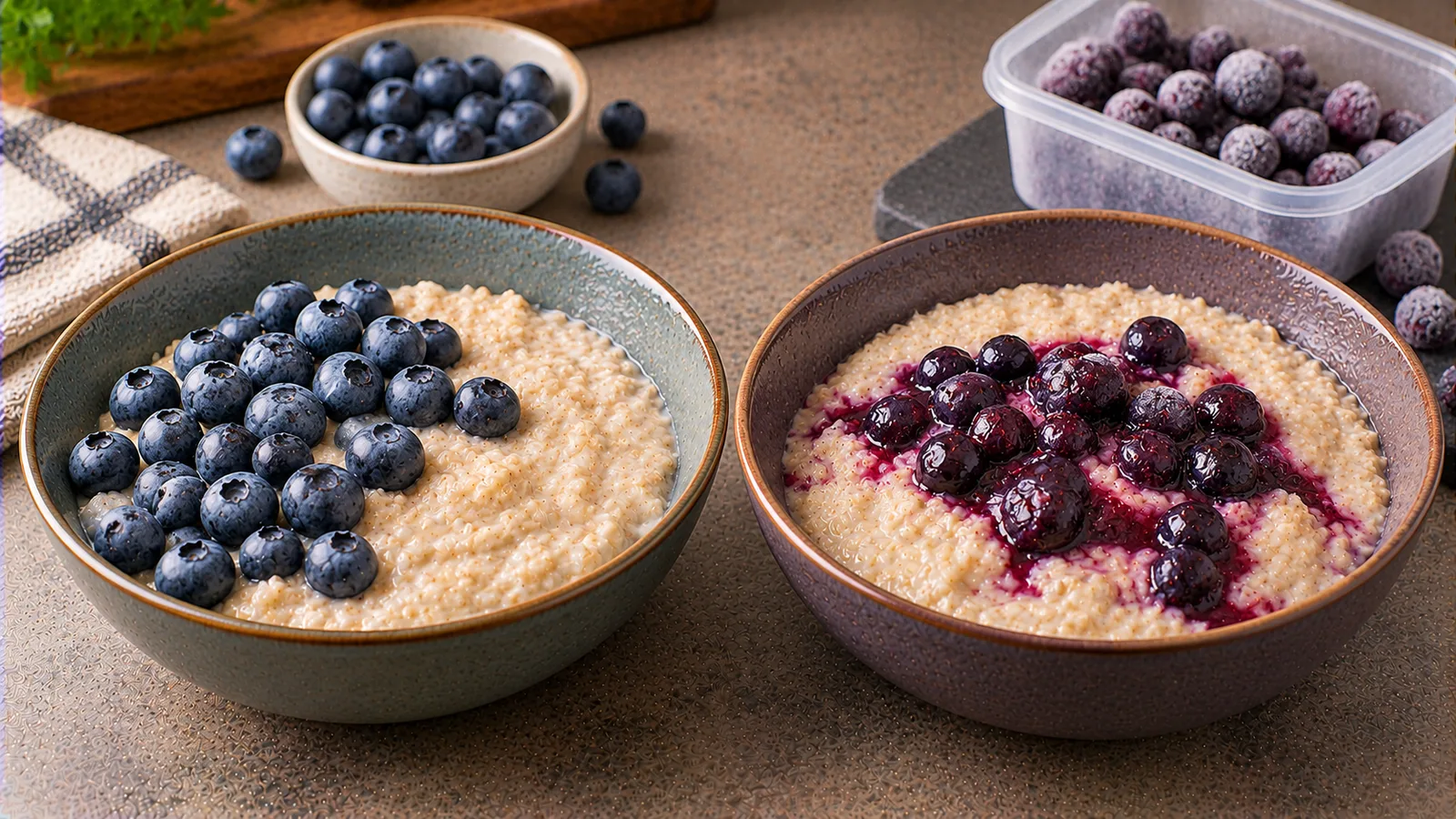
Fresh blueberries can be a beautiful topping for porridge, but a punnet and a freezer bag cannot be compared by looking only at the sticker price. You are buying different package sizes, and a little fruit may be rejected when you sort it. For one bowl, the useful question is simple: what does 100 g of blueberries that you can actually eat cost? This guide follows that single breakfast decision. It does not claim that every frozen bag is cheaper, or that a kilogram comparison automatically tells you the amount you will pay at checkout.
The result for one porridge bowl
In the deliberately illustrative German-price scenario below, a 125 g punnet of fresh blueberries costs €2.49 and provides an assumed 115 g of usable fruit. A 300 g bag of plain frozen blueberries costs €2.79 and provides an assumed 294 g after sorting. Neither the prices nor the yields are measured market averages. They are editable shopping assumptions, not current offers.
| Purchase and calculation | Fresh blueberries | Frozen blueberries |
|---|---|---|
| Package weight | 125 g | 300 g |
| Example checkout price | €2.49 | €2.79 |
| Assumed usable fraction | 92% | 98% |
| Usable fruit from package | 115 g | 294 g |
| Cost per usable 100 g | €2.17 | €0.95 |
| Cost of a 40 g topping | €0.87 | €0.38 |
Under these assumptions, frozen saves €1.22 per usable 100 g or about €0.49 for a smaller 40 g topping. A punnet is cheaper at checkout than the freezer bag in this example, yet it costs more per portion. That distinction is the central point of the comparison.
What counts as usable blueberries?
The edible quantity is the fruit you genuinely plan to serve. For fresh blueberries, remove any spoiled, visibly mouldy or crushed pieces you would not eat, along with stray leaves and stems. Sort the fruit before weighing the portion. Do not assume 8% waste is normal everywhere: a sound punnet may yield almost its entire stated weight, while an old or damaged one may yield less. Record actual waste on the day if you want precision.
For a plain unsweetened frozen bag, the model assumes 2% is discarded after checking quality. That is just a cautious illustration; an unopened good-quality bag could have practically no trimming loss. Ice crystals in the bag are not necessarily ruined fruit, and liquid released during safe heating is not automatically waste. If you pour the whole warmed topping and juices into porridge, the berry solids remain part of the meal. If you strain and discard liquid, you have changed the calculation and should measure what remains.
The label's net weight is the starting quantity for both versions. Never treat a 300 g frozen bag as though it were a 300 g cooked and drained topping: the two bases are not identical. We compare the fruit measured before heating after actual sorting, and retain all juices in the finished bowl.
Calculate cost per usable 100 g
Start with the shelf price divided by usable weight in grams, then multiply by 100. For the fresh punnet: €2.49 ÷ 115 g × 100 g = €2.165, rounded to €2.17. For the frozen bag: €2.79 ÷ 294 g × 100 g = €0.949, rounded to €0.95. Calculations use unrounded results until the final display.
The formula is checkout price ÷ (net weight × usable fraction) × 100. It is not a nutrition formula. Use the same basis for both packages. If you want to compare exactly what goes on a serving, weigh out 100 g of usable blueberries, not 100 g of porridge plus berries. Oats, milk and toppings other than blueberries are excluded, because they are identical in the two breakfast versions.
Suppose you need only 40 g of berries today. Multiply each unrounded cost-per-gram figure by 40: the fresh topping is about €0.87 and the frozen one about €0.38. You have not saved €1.22 on that smaller bowl; the difference is closer to €0.49. A cost-per-100-g headline and an actual serving bill answer related but different questions.
Checkout money is not the cost of the berries used
Buying the fresh punnet costs €2.49 now, even though only €2.17 of its calculated usable value goes into a 100 g bowl; 15 g of edible fresh fruit is left. Buying the frozen bag costs €2.79 now, even though just €0.95 of the bag's allocated cost goes into that bowl; 194 g of usable fruit is left, assuming the same yield. The remainder has value only if it can be used later without being spoiled or discarded.
| After making one 100 g blueberry topping | Fresh | Frozen |
|---|---|---|
| Cash spent at checkout | €2.49 | €2.79 |
| Allocated cost used in bowl | €2.17 | €0.95 |
| Usable fruit remaining | 15 g | 194 g |
This is why buying frozen is not necessarily an immediate cash saving for someone who needs just one breakfast and has no freezer. The value calculation favours the frozen version under our assumptions, but its bag initially costs €0.30 more. If the remainder is discarded, the real cost of that one bowl may be close to the entire purchase price rather than the ideal allocated portion cost.
How to make one comparable porridge
Use the same porridge base for both tests: 50 g dry oats, 150 ml milk or fortified plant drink, 100 ml water, and 100 g sorted blueberries. These are recipe quantities, not a prescribed dietary target. Add cinnamon if wanted, without changing the fruit-cost comparison. Cook the oats according to the package instructions, adjusting liquid to your preferred texture.
For fresh blueberries, sort and wash under running drinking-quality water, drain, then add the measured 100 g to the cooked porridge. Heating the fresh fruit is optional for texture; check food-handling advice and any individual health needs. Never rinse fresh blueberries with soap or detergent. For the frozen option, heat the measured berries thoroughly and evenly before adding them, following the pack instructions and German BfR safety guidance. Frozen berries should not simply be left to thaw in warm porridge: BfR warns that freezing does not reliably eliminate viruses. Keep the juices in the sauce and spoon them over the oats. For very small quantities, check that the centre has been heated, not just the surrounding liquid.
When timing is tight, heat the frozen topping while the oats cook rather than pretending that a cold bag can be safely thawed by stirring it into breakfast at the end. The porridge recipe has the same blueberry quantity in both versions; it does not attempt to compare frozen fruit at a cooled, drained weight with fresh fruit at an unheated weight.
What if the fresh punnet is better than average?
At 100% usable yield, the same €2.49 / 125 g fresh punnet costs €1.99 per usable 100 g. At an assumed 85% yield, it costs about €2.34. This changes the size of the price gap but not the underlying method. If fresh berries are on promotion, the outcome can reverse. With the frozen example fixed at €2.79 for 300 g and 98% usable yield, the break-even fresh punnet price is about €1.09 for 125 g at 92% usable yield. Below that, fresh becomes cheaper per usable gram in this particular model.
The opposite question is also useful: how expensive could the frozen bag be before the two reach parity? At 300 g and 98% usable yield, approximately €6.37 would give the same cost per usable 100 g as the €2.49 fresh punnet at 92% yield. Neither threshold is a price forecast. Both are arithmetic outputs of the stated assumptions. Enter your own shelf prices instead of relying on those example numbers.
Storage can change the real outcome
Fresh berries need timely handling. Check the pack for storage instructions, keep them chilled as indicated, and sort carefully before use. If you buy a large fresh punnet but only eat 40 g each week, discarding the remainder can erase a promotional advantage. If you share the berries with family or plan several breakfasts, a good fresh offer can make sense.
Frozen berries can help you take small amounts from one bag across multiple breakfasts, provided the freezer works and you return the unopened remainder promptly. Avoid repeated warming and refreezing. The bag needs freezer space and energy, which are not itemised in the narrow ingredient-price calculation. For a more realistic family budget, add any meaningful waste and storage costs you can actually measure rather than inventing an exact universal freezer cost.
Safety: the most important difference for frozen toppings
The German Federal Institute for Risk Assessment (BfR) recommends heating frozen berries thoroughly and evenly before eating, because noroviruses and other hazards have been associated with frozen berries. BfR notes that temperatures around 90 °C in the berry food can be relevant to inactivating heat-resistant viruses; briefly stirring cold berries into hot porridge is not an equivalent safety step. Follow manufacturer instructions and ensure complete heating, without relying on an arbitrary number of seconds. See the BfR guidance on noroviruses and its meal-prep guidance.
Fresh berries can also be contaminated; wash them carefully before serving and follow recalls. The FDA's berry-safety overview explains why both fresh and frozen supply chains need controls. Do not interpret 'frozen' as automatically sterile, or 'fresh' as completely risk-free.
Does freezing change the nutritional comparison?
Both are blueberries. This article does not claim that frozen berries are inherently more nutritious or that all fresh varieties are identical. Ripeness, cultivar, storage and cooking affect particular nutrients; labels and food databases cannot justify exact claims about a specific punnet and bag. A 100 g berry topping is not the same as a 100 g ready-made blueberry syrup, sweetened pie filling or fruit purée with added sugar. For a separate food-level explanation rather than a shopping calculation, see the blueberry nutrition and serving-size guide. For broader shopping trade-offs across different berry varieties, see the wider comparison of fresh and frozen berries.
If a frozen blend includes sweetened syrup or other fruit, it is not the same product: read the ingredients and net weight. The comparison here is 100 g usable, plain blueberries on the same oat porridge. That tight definition prevents an apparent bargain caused by comparing unlike products.
A repeatable five-step shelf check
First, note each pack's weight and total price on the same shopping date and in the same store or area. Second, check whether the frozen bag is plain blueberries. Third, inspect fresh fruit and estimate or, later, measure the discarded weight. Fourth, compute both cost-per-usable-100-g figures before deciding how much you need for breakfast. Fifth, look at the amount you must pay today and whether you will use the leftovers. This prevents a 300 g freezer bag from being called 'cheaper' solely because its portion price is lower.
For one breakfast, choose fresh when you value its texture and the full pack will be used promptly or discounted enough to beat the break-even price. Choose frozen when portion flexibility and lower calculated unit cost outweigh the need for thorough heating and freezer storage. Neither option is universally best; the relevant comparison is always one genuinely usable blueberry topping on the same porridge, not total fruit purchases for the month.
Sources
- BfR: Noroviruses, prevention and thorough heating of frozen berries
- BfR: Pre-cooking and safe handling of frozen berries
- FDA: Safety of fresh and frozen berries
Price and usable-yield figures in this article are invented calculation inputs, not observed retail prices, nationally representative averages or measured trimming losses.