
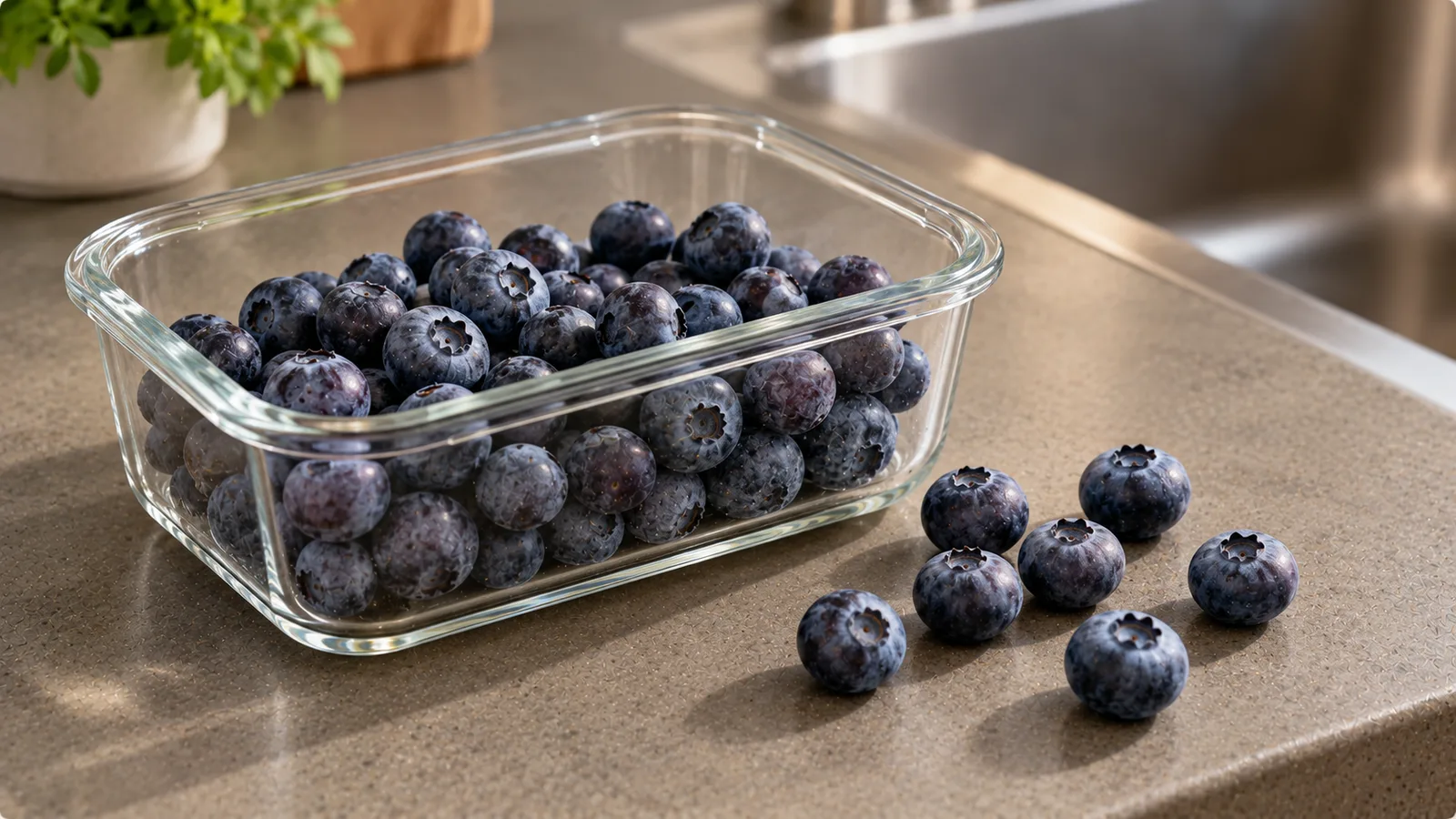
Blueberries provide approximately 57 calories per 100 g when eaten fresh and raw. A 150 g bowl contains about 86 calories, while a 250 g portion provides approximately 143 calories.
These values apply to plain blueberries without added sugar, yogurt, syrup or other ingredients.
The amount you eat matters more than the number of berries. Blueberries vary in size, and a small handful can weigh considerably less than a large bowl.
Blueberry calories by serving size
The following calculations use 57 kcal per 100 g, rounded to the nearest whole calorie.
| Blueberries | Approximate calories |
|---|---|
| 25 g | 14 kcal |
| 50 g | 29 kcal |
| 75 g | 43 kcal |
| 100 g | 57 kcal |
| 125 g | 71 kcal |
| 150 g | 86 kcal |
| 200 g | 114 kcal |
| 250 g | 143 kcal |
| 300 g | 171 kcal |
| 400 g | 228 kcal |
| 500 g | 285 kcal |
These are reference estimates based on raw cultivated blueberries. Natural variation in ripeness, variety and growing conditions can change the actual nutrient composition.
For calorie tracking, weighing the edible portion is more reliable than estimating from a container's appearance.
Source: USDA FoodData Central.
How many calories are in a cup of blueberries?
A commonly used US food-composition reference for one cup of raw blueberries is approximately 148 g.
At 57 kcal per 100 g, that equals about 84 calories.
| Volume-based serving | Approximate weight | Calories |
|---|---|---|
| ¼ cup | 37 g | 21 kcal |
| ½ cup | 74 g | 42 kcal |
| ¾ cup | 111 g | 63 kcal |
| 1 cup | 148 g | 84 kcal |
| 1½ cups | 222 g | 127 kcal |
| 2 cups | 296 g | 169 kcal |
These weights are reference conversions, not guarantees.
Cup size, berry size and how tightly the fruit is packed can affect the amount.
A metric measuring cup and a US customary cup also have different capacities. For accurate tracking, grams are preferable.
Source: USDA FoodData Central.
Calories in a handful or bowl of blueberries
A handful is not a standardized serving. Hand size and the way the berries are held make a difference.
For a practical estimate:
| Portion description | Illustrative weight | Calories |
|---|---|---|
| Small handful | 40 g | 23 kcal |
| Medium handful | 60 g | 34 kcal |
| Large handful | 80 g | 46 kcal |
| Small bowl | 125 g | 71 kcal |
| Medium bowl | 150 g | 86 kcal |
| Large bowl | 250 g | 143 kcal |
The weights are illustrative rather than official portion definitions.
A 250 g supermarket pack contains approximately 143 calories if the entire edible quantity is eaten.
A 500 g pack contains approximately 285 calories.
If some berries are discarded, calculate from the amount actually consumed.
Blueberry nutrition per 100 g
The following figures are approximate reference values for raw cultivated blueberries.
| Nutrient | Per 100 g |
|---|---|
| Energy | 57 kcal |
| Water | 84.2 g |
| Carbohydrates | 14.5 g |
| Total sugars | 10.0 g |
| Dietary fibre | 2.4 g |
| Protein | 0.7 g |
| Fat | 0.3 g |
| Potassium | 77 mg |
| Vitamin C | 9.7 mg |
| Vitamin K | 19.3 µg |
Blueberries contain very little fat or protein. Most of their calories come from carbohydrates, including naturally occurring sugars.
They also provide fibre and small amounts of various vitamins and minerals.
The numbers may differ slightly between nutrient databases and individual products.
Source: USDA FoodData Central.
Nutrition in a 150 g serving
A 150 g bowl of raw blueberries contains approximately:
| Nutrient | Amount |
|---|---|
| Calories | 86 kcal |
| Carbohydrates | 21.7 g |
| Total sugars | 15.0 g |
| Fibre | 3.6 g |
| Protein | 1.1 g |
| Fat | 0.5 g |
| Vitamin C | 14.6 mg |
These are calculated estimates using the per-100-g values.
The distinction between carbohydrates and fibre is important when comparing nutrition labels from different regions.
In US nutrient data, total carbohydrates generally include fibre. In EU nutrition declarations, carbohydrates and fibre are reported separately.
Do not subtract fibre from an EU carbohydrate figure as though it were a US total-carbohydrate value.
Sources: USDA FoodData Central and Regulation (EU) No 1169/2011.
How much sugar is in blueberries?
Raw blueberries contain approximately 10 g of naturally occurring sugars per 100 g.
| Blueberry portion | Approximate sugars |
|---|---|
| 50 g | 5 g |
| 100 g | 10 g |
| 150 g | 15 g |
| 200 g | 20 g |
| 250 g | 25 g |
| 300 g | 30 g |
These are sugars naturally present in the fruit, not sugar added during preparation.
Whole blueberries also contain water, fibre and other nutrients.
This makes them different from blueberry-flavoured sweets, syrups or sweetened fruit products.
If a product contains added sugar, calculate the additional amount from its nutrition label or ingredient quantities.
Source: USDA FoodData Central.
Blueberries compared with other berries
Different berries have different nutrient profiles.
Approximate raw-fruit reference values per 100 g are:
| Fruit | Calories per 100 g |
|---|---|
| Strawberries | 32 kcal |
| Blackberries | 43 kcal |
| Raspberries | 52 kcal |
| Blueberries | 57 kcal |
Blueberries contain more calories per 100 g than strawberries, blackberries and raspberries in these reference datasets.
That does not make blueberries an unsuitable food choice.
All these fruits can contribute variety to a balanced diet.
A meaningful comparison should consider the portion eaten, fibre, other nutrients and the foods served alongside the fruit.
Source: USDA FoodData Central.
Fresh versus frozen blueberries
Plain frozen blueberries generally have a similar calorie content to fresh blueberries.
Freezing does not itself add calories.
However, nutrient values per 100 g can vary because of differences in fruit varieties, water content, processing and the composition of individual products.
| Product | Calorie-tracking approach |
|---|---|
| Fresh raw blueberries | Approximately 57 kcal per 100 g |
| Plain frozen blueberries | Use the package label or a frozen-blueberry database entry |
| Frozen blueberries with added sugar | Include the added sugar |
| Blueberries in syrup | Use the prepared-product nutrition information |
For frozen berries, check the ingredient list.
A package containing only blueberries is different from a sweetened blueberry dessert mixture.
Should you weigh frozen berries before or after thawing?
For packaged frozen blueberries, follow the nutrition label's stated basis and weigh the amount you use.
If thawing causes juice to separate and you discard that juice, the nutrients actually consumed may differ slightly from the original portion.
For ordinary tracking, using the packaged weight and the appropriate product entry is usually a practical approach.
Are dried blueberries higher in calories?
Dried blueberries usually provide substantially more calories per 100 g than fresh blueberries because much of the water has been removed.
Some commercially dried blueberries also contain added sugar or oil.
There is no single reliable calorie value for every dried-blueberry product.
Use the package label rather than applying the fresh-blueberry figure of 57 kcal per 100 g.
The same principle applies to blueberry jam, fruit spreads and sweetened blueberry toppings.
They are separate foods with different recipes and nutritional values.
Calories in blueberries with yogurt
Plain blueberries are often eaten with yogurt or quark.
The total calories depend on both the fruit and the dairy product.
For example:
| Ingredient | Quantity | Approximate calories |
|---|---|---|
| Fresh blueberries | 100 g | 57 kcal |
| Plain yogurt, 1.5% fat | 150 g | 75 kcal |
| Total | 132 kcal |
The yogurt value is illustrative. Actual calories depend on the brand and formulation.
If you add 20 g of granola, honey or nuts, include those ingredients separately.
A blueberry yogurt sold as a ready-made product may contain added sugar and a different proportion of fruit.
It should not be calculated as plain blueberries plus unsweetened yogurt unless the actual ingredient quantities are known.
Calories in a blueberry smoothie
Blending blueberries does not create additional calories.
However, smoothie ingredients can change the energy total substantially.
Consider this example:
| Ingredient | Quantity | Approximate calories |
|---|---|---|
| Blueberries | 150 g | 86 kcal |
| Banana | 100 g | 89 kcal |
| Milk, 1.5% fat | 200 ml | 94 kcal |
| Total | 269 kcal |
The calculation uses representative food-composition values.
The finished smoothie contains approximately 269 kcal before any added honey, nut butter or other ingredients.
For accurate nutrition tracking, record each ingredient by weight or measured volume.
Source for reference composition: USDA FoodData Central.
Can blueberries fit into a weight-loss diet?
Yes. Blueberries can be included in an eating pattern designed for weight management.
A 150 g portion provides approximately 86 calories, making it a practical fruit option for a snack, breakfast or dessert.
Their water and fibre contribute to the overall composition of the food.
However, blueberries do not independently cause weight loss.
Changes in body weight depend on longer-term energy balance and other individual factors.
Choosing a portion that fits your meal and daily energy requirements is more useful than treating a particular fruit as a weight-loss solution.
For general dietary guidance, see the World Health Organization's healthy diet guidance.
How to calculate blueberry calories accurately
Use the edible weight and a suitable nutrition database entry.
Formula:
Calories = blueberry weight in grams × 57 ÷ 100.
For example:
- 85 g: 85 × 57 ÷ 100 = approximately 48 kcal.
- 175 g: 175 × 57 ÷ 100 = approximately 100 kcal.
- 225 g: 225 × 57 ÷ 100 = approximately 128 kcal.
If the blueberries are part of a recipe, calculate the other ingredients separately.
For mixed fruit, weigh or estimate each fruit rather than assigning the blueberry calorie value to the entire bowl.
Common calorie-tracking mistakes
Using the number of berries instead of their weight. Berry size varies.
Treating every cup as 148 g. This is a reference conversion, not a precise measurement for every cup.
Using fresh-blueberry values for dried blueberries. Removing water changes calories per 100 g.
Ignoring sweeteners and toppings. Sugar, syrups, chocolate and granola can increase the total.
Using the wrong product entry. Fresh, frozen sweetened, dried and preserved blueberries should not automatically share the same nutrition values.
Quick answers
How many calories are in 100 g of blueberries?
Approximately 57 kcal.
How many calories are in 150 g?
Approximately 86 kcal.
How many calories are in 200 g?
Approximately 114 kcal.
How many calories are in 250 g?
Approximately 143 kcal.
How many calories are in one cup?
Approximately 84 kcal for a reference cup weighing 148 g.
Are blueberries high in sugar?
They contain approximately 10 g of naturally occurring sugars per 100 g.
Do frozen blueberries have more calories?
Plain frozen blueberries generally have a similar energy content, but the product label is the best source for a specific package.
Sources
- USDA FoodData Central — nutrient composition and common serving references.
- World Health Organization: Healthy diet — general dietary guidance.
- Regulation (EU) No 1169/2011 — European nutrition-labelling rules.
All values are approximate. Portion calculations use 57 kcal per 100 g of fresh raw blueberries.