
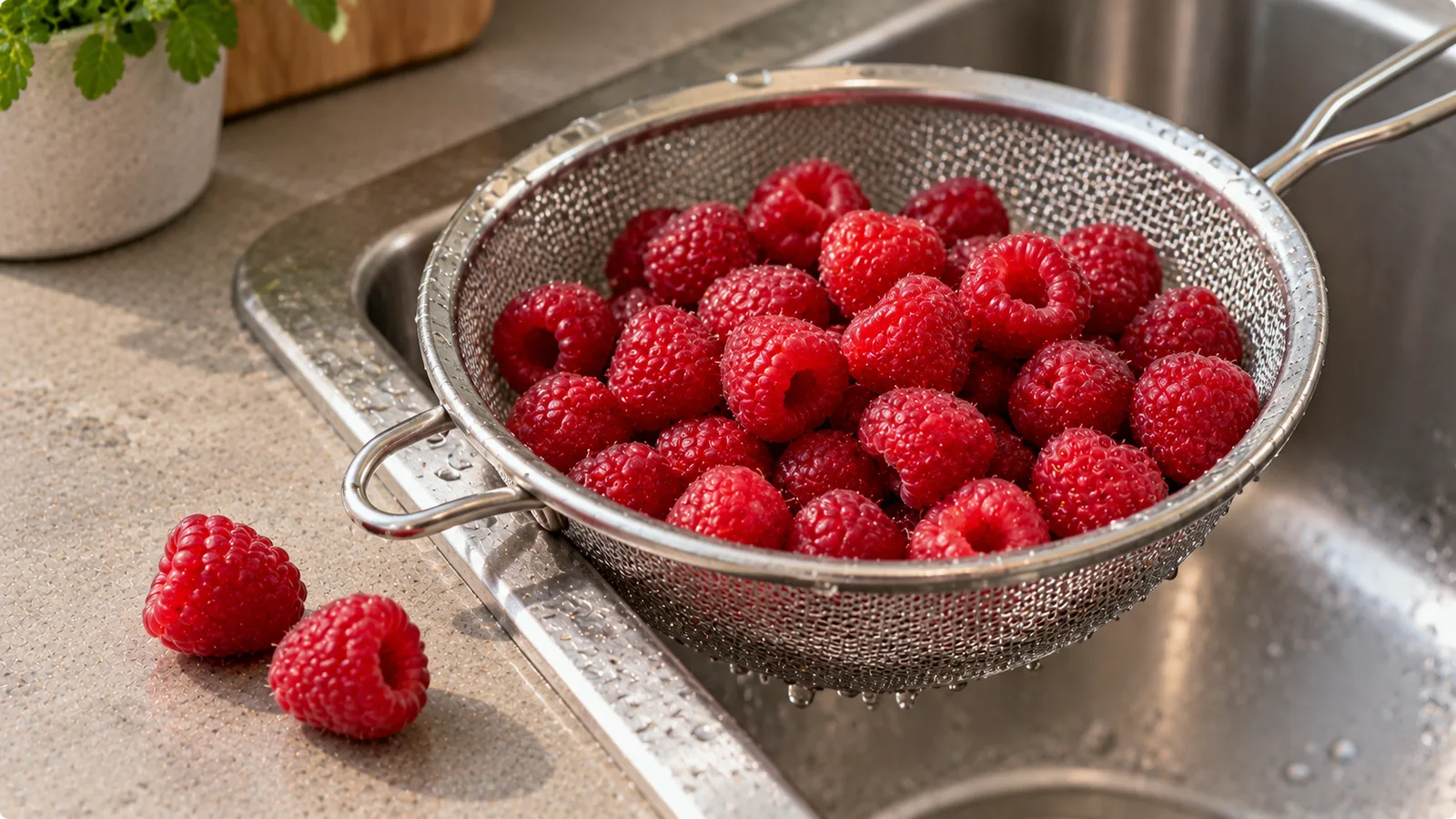
Fresh raw raspberries contain approximately 52 calories per 100 g. A 150 g bowl provides about 78 calories, while a 250 g portion contains approximately 130 calories.
These figures apply to plain raspberries without added sugar, cream, chocolate, syrup or other ingredients.
Raspberries are particularly notable for their fibre content. However, the calorie content of a serving still depends mainly on how much fruit is eaten.
Raspberry calories by weight
The following values use a reference of 52 kcal per 100 g of raw red raspberries.
| Raspberry portion | Approximate calories |
|---|---|
| 25 g | 13 kcal |
| 50 g | 26 kcal |
| 75 g | 39 kcal |
| 100 g | 52 kcal |
| 125 g | 65 kcal |
| 150 g | 78 kcal |
| 175 g | 91 kcal |
| 200 g | 104 kcal |
| 250 g | 130 kcal |
| 300 g | 156 kcal |
| 400 g | 208 kcal |
| 500 g | 260 kcal |
The calculations are rounded and based on reference food-composition data.
Actual nutrient values vary with raspberry variety, ripeness, growing conditions and product preparation.
A kitchen scale is more accurate than estimating the number of berries.
Source: USDA FoodData Central.
How many calories are in a cup of raspberries?
A commonly used US reference portion for one cup of raw raspberries weighs approximately 123 g.
At 52 kcal per 100 g, that equals approximately 64 calories.
| Portion | Reference weight | Approximate calories |
|---|---|---|
| ¼ cup | 31 g | 16 kcal |
| ½ cup | 62 g | 32 kcal |
| ¾ cup | 92 g | 48 kcal |
| 1 cup | 123 g | 64 kcal |
| 1½ cups | 185 g | 96 kcal |
| 2 cups | 246 g | 128 kcal |
These are reference conversions, not exact weights for every measuring cup.
Raspberries are delicate, and the amount that fits into a cup depends on their size and how they are arranged.
Do not compress the berries simply to match a reference weight.
US customary cups and metric measuring cups also differ in capacity.
For precise calorie tracking, weigh the actual edible portion.
Source: USDA FoodData Central.
Calories in a handful or bowl
A handful is a convenient description but not a standardized measurement.
| Serving description | Illustrative weight | Approximate calories |
|---|---|---|
| Small handful | 35 g | 18 kcal |
| Medium handful | 50 g | 26 kcal |
| Large handful | 75 g | 39 kcal |
| Small bowl | 100 g | 52 kcal |
| Medium bowl | 150 g | 78 kcal |
| Large bowl | 250 g | 130 kcal |
The weights are illustrative rather than official serving definitions.
A 125 g package contains approximately 65 calories if the entire edible quantity is consumed.
A 250 g package contains approximately 130 calories.
If some berries are discarded because they are damaged or spoiled, use the amount actually eaten.
Raspberry nutrition per 100 g
Approximate reference values for raw red raspberries are:
| Nutrient | Per 100 g |
|---|---|
| Energy | 52 kcal |
| Water | 85.8 g |
| Total carbohydrates, US definition | 11.9 g |
| Total sugars | 4.4 g |
| Dietary fibre | 6.5 g |
| Protein | 1.2 g |
| Fat | 0.7 g |
| Vitamin C | 26.2 mg |
| Potassium | 151 mg |
| Manganese | 0.67 mg |
Raspberries provide relatively little fat and protein.
They contain naturally occurring sugars, fibre and water, along with several vitamins and minerals.
Their fibre content is particularly notable compared with many other commonly eaten fruits.
These values are approximate and may differ between food databases.
Source: USDA FoodData Central.
Nutrition in a 150 g portion
A bowl containing 150 g of raw raspberries provides approximately:
| Nutrient | Amount |
|---|---|
| Calories | 78 kcal |
| Total carbohydrates, US definition | 17.9 g |
| Sugars | 6.6 g |
| Fibre | 9.8 g |
| Protein | 1.8 g |
| Fat | 1.1 g |
| Vitamin C | 39.3 mg |
These amounts are calculated from reference values per 100 g.
One important detail concerns carbohydrate labelling.
US food-composition tables commonly report total carbohydrates including dietary fibre.
EU nutrition declarations report carbohydrates and fibre separately, with carbohydrates generally referring to available carbohydrates.
Therefore, a US total-carbohydrate figure should not be presented as though it were directly equivalent to an EU carbohydrate-label figure.
For a specific packaged product, use the relevant local nutrition declaration.
Sources: USDA FoodData Central and Regulation (EU) No 1169/2011.
How much sugar is in raspberries?
Fresh raspberries contain approximately 4.4 g of naturally occurring sugars per 100 g.
| Raspberry portion | Approximate sugars |
|---|---|
| 50 g | 2.2 g |
| 100 g | 4.4 g |
| 125 g | 5.5 g |
| 150 g | 6.6 g |
| 200 g | 8.8 g |
| 250 g | 11.0 g |
The sugar is naturally present in the fruit.
Whole raspberries also contain water and fibre.
They are not nutritionally equivalent to raspberry syrup, confectionery or sweetened fruit fillings.
Added sugar in prepared raspberry products must be included separately.
Source: USDA FoodData Central.
Why raspberries are notable for fibre
Raspberries contain approximately 6.5 g of dietary fibre per 100 g.
That means a 150 g portion provides about 9.8 g.
Fibre contributes to normal digestive function and is an important component of a balanced diet.
However, a large amount of fibre consumed suddenly may cause bloating or digestive discomfort in some people.
Someone who is not accustomed to high-fibre foods may prefer smaller portions and a gradual increase.
Adequate fluid intake is also important when increasing dietary fibre.
The nutritional contribution of raspberries should be considered as part of the entire diet rather than as a treatment for digestive problems.
Reference: USDA FoodData Central.
Raspberries compared with other berries
Approximate calorie values for 100 g of raw fruit are:
| Berry | Calories per 100 g |
|---|---|
| Strawberries | 32 kcal |
| Blackberries | 43 kcal |
| Raspberries | 52 kcal |
| Blueberries | 57 kcal |
Raspberries fall between blackberries and blueberries in these reference data.
But calorie content alone does not determine whether one fruit is preferable.
For example, raspberries provide substantial fibre, while other berries have different combinations of nutrients.
Portion size, flavour, availability and overall dietary variety are all relevant.
Source: USDA FoodData Central.
Fresh versus frozen raspberries
Plain frozen raspberries generally have a calorie content similar to fresh raspberries.
Freezing itself does not add calories.
However, nutrition per 100 g may vary with fruit variety, water content and processing.
| Product | Recommended tracking method |
|---|---|
| Fresh raw raspberries | Approximately 52 kcal per 100 g |
| Plain frozen raspberries | Use the package label or suitable database entry |
| Frozen raspberries with added sugar | Include the added sugar |
| Raspberries in syrup | Use the prepared-product nutrition values |
| Raspberry purée without additions | Calculate from the actual fruit quantity |
Read the ingredient list before assuming a frozen product contains only fruit.
For frozen berries, also follow the manufacturer's food-safety instructions.
In some countries, public-health authorities recommend heating certain frozen berries before eating because freezing does not reliably eliminate all pathogens.
For example, the UK Food Standards Agency advises boiling imported frozen berries for one minute before consumption.
Source: UK Food Standards Agency.
Are dried raspberries more calorie-dense?
Usually, yes.
Removing water concentrates the remaining nutrients and calories per 100 g.
Freeze-dried raspberries can therefore have a much higher calorie value per 100 g than fresh raspberries.
A small amount of freeze-dried fruit may nevertheless contain fewer total calories than a large bowl of fresh fruit because the serving weighs much less.
There is no single value for all dried raspberry products.
Some contain added sugar or other ingredients.
Always use the specific product label.
Calories in raspberries with yogurt
Raspberries are often served with plain yogurt, Skyr or quark.
The total calories depend on both the fruit and the dairy product.
For example:
| Ingredient | Amount | Approximate calories |
|---|---|---|
| Fresh raspberries | 100 g | 52 kcal |
| Plain yogurt, 1.5% fat | 150 g | 75 kcal |
| Total | 127 kcal |
The yogurt value is illustrative.
Different brands may have different calorie and protein contents.
If you add honey, granola, nuts or chocolate, count those ingredients separately.
A ready-made raspberry yogurt may contain added sugar and a smaller proportion of actual raspberries.
Its package label is a better source than calculating it as plain yogurt plus fresh berries.
Calories in a raspberry smoothie
Blending raspberries does not create calories.
Additional ingredients determine the final energy content.
Example:
| Ingredient | Amount | Approximate calories |
|---|---|---|
| Raspberries | 150 g | 78 kcal |
| Banana | 100 g | 89 kcal |
| Milk, 1.5% fat | 200 ml | 94 kcal |
| Total | 261 kcal |
This illustrative smoothie contains approximately 261 calories before any extra sweeteners or toppings.
The banana and milk values are representative estimates.
Use actual product labels and weighed quantities when accuracy matters.
Source for reference nutrient data: USDA FoodData Central.
Raspberry jam versus fresh raspberries
Raspberry jam is not nutritionally equivalent to fresh raspberries.
Many traditional jams contain substantial added sugar.
They also have a different water content.
A spoonful of jam may be a small portion, but its calories cannot be estimated using the 52 kcal per 100 g value for raw fruit.
The same applies to raspberry syrup, sweetened sauces, pastry fillings and raspberry-flavoured desserts.
Use the nutrition label or the actual recipe.
Can raspberries fit into a weight-loss diet?
Yes. Raspberries can be included in an eating pattern designed for weight management.
A 150 g portion contains approximately 78 calories and provides fibre and water.
They can be eaten alone, mixed with yogurt or added to breakfast.
However, raspberries do not independently cause weight loss.
Long-term changes in body weight depend on overall energy balance and other individual factors.
A practical approach is to choose portions that fit your preferences, appetite and daily nutritional needs.
For general dietary guidance, see the World Health Organization's healthy diet guidance.
How to calculate raspberry calories
Use the edible weight and a suitable reference value.
Formula:
Calories = weight in grams × 52 ÷ 100.
Examples:
- 85 g × 52 ÷ 100 = approximately 44 kcal.
- 175 g × 52 ÷ 100 = approximately 91 kcal.
- 225 g × 52 ÷ 100 = approximately 117 kcal.
For mixed berries, calculate each type separately.
If the raspberries are part of a dessert, include the remaining ingredients.
Common tracking mistakes
Counting individual berries. Their size varies too much for accurate tracking.
Using a cup conversion as an exact measurement. A reference cup does not always contain 123 g.
Using fresh-fruit values for dried raspberries. Water removal changes calories per 100 g.
Ignoring toppings. Cream, sugar, chocolate and granola may substantially change the total.
Confusing natural sugars with added sugars. Fresh raspberries contain naturally occurring sugar, while prepared products may contain additional sweeteners.
Quick answers
How many calories are in 100 g of raspberries?
Approximately 52 kcal.
How many calories are in 150 g?
Approximately 78 kcal.
How many calories are in 200 g?
Approximately 104 kcal.
How many calories are in 250 g?
Approximately 130 kcal.
How many calories are in one cup?
Approximately 64 kcal for a reference cup weighing 123 g.
How much fibre do raspberries contain?
Approximately 6.5 g per 100 g.
Are frozen raspberries higher in calories?
Plain frozen raspberries generally have similar calorie content. Check the specific product label and follow food-safety preparation guidance.
Sources
- USDA FoodData Central — reference nutrient composition and serving weights.
- Regulation (EU) No 1169/2011 — European nutrition-labelling definitions.
- World Health Organization: Healthy diet — general dietary guidance.
- UK Food Standards Agency — food-safety guidance for frozen berries.
All nutritional values are approximate. Calorie calculations use 52 kcal per 100 g of fresh raw raspberries.