
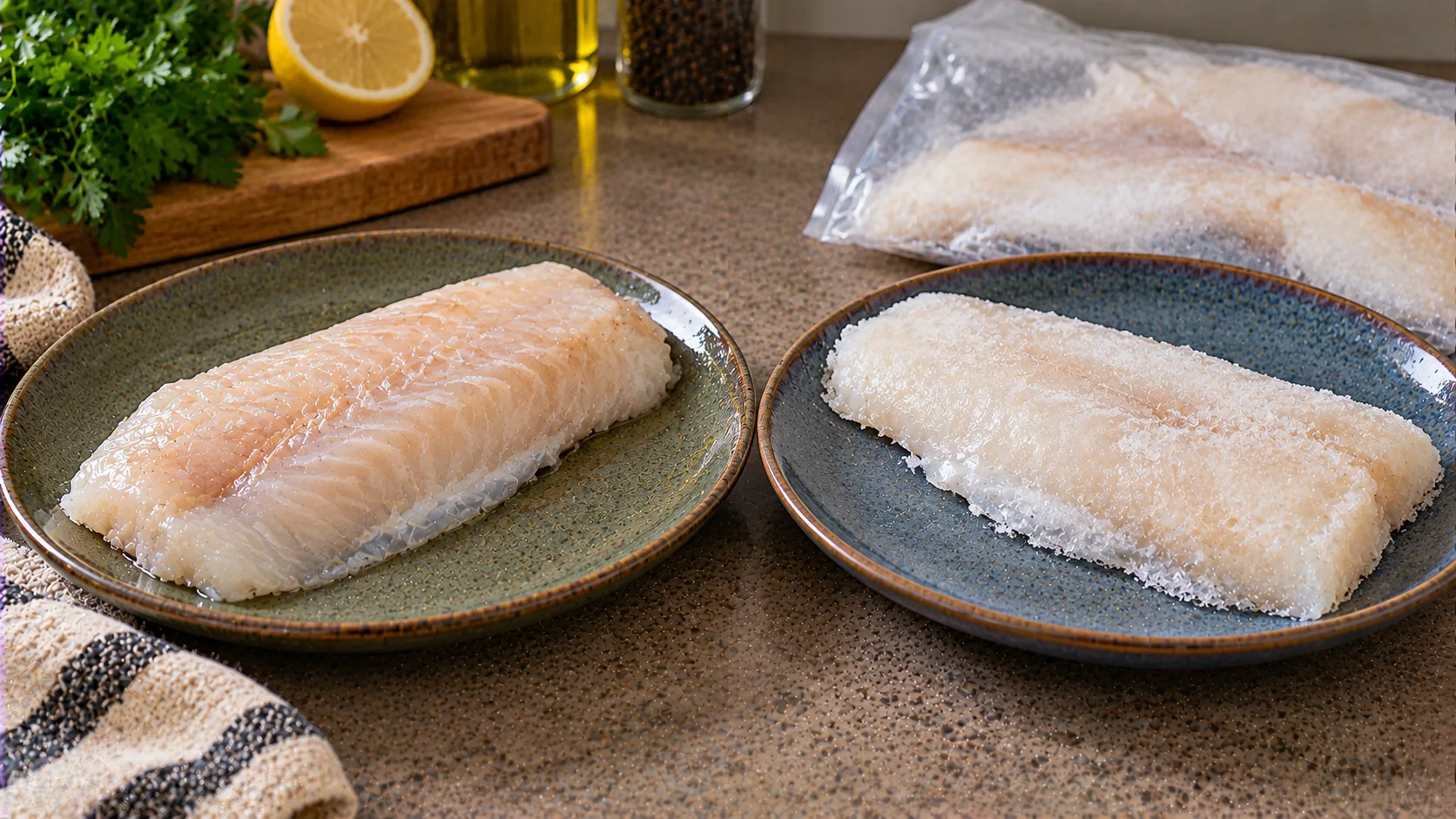
Is Frozen Fish Cheaper Than Fresh? Cost per Edible Fillet
A lower price on a frozen fish bag does not necessarily mean a cheaper dinner. The useful comparison is what you pay for the same mass of edible fish, not what the shelf ticket says per pack. This guide compares plain, boneless fish of the same species and similar cut; a breaded product or a whole fish is a different purchase. All euro prices below are illustrative assumptions, not current supermarket offers.
Quick answer
Frozen fish can cost less per edible serving, particularly when individually portioned fillets reduce unused leftovers. But the answer depends on the labelled net quantity excluding protective ice glaze, thawing drip, trimming, and how much you actually cook. Fresh fillets also lose some moisture and may need trimming. Freeze and fresh are storage descriptions, not guarantees of nutritional superiority.
A fair basis: 150 g of usable raw fish
Choose a 150 g portion of ready-to-cook, skinless boneless fillet, before heat shrinkage. Compare identical species and quality categories. Cooking changes both weights; if you compare cooked fish, weigh both after cooking instead and keep methods the same.
| Variable | Frozen illustrative example | Fresh illustrative example |
|---|---|---|
| Checkout pack price | €5.40 | €7.20 |
| Labelled fish net mass | 600 g | 600 g |
| Further usable yield after thaw / trim | 90% | 95% |
| Raw edible fish | 540 g | 570 g |
| Cost per 150 g edible fish | €1.50 | €1.89 |
Calculation: frozen €5.40 ÷ (600 × 0.90) × 150 = €1.50. Fresh €7.20 ÷ (600 × 0.95) × 150 = €1.89 when rounded to cents. These percentages demonstrate the method; they are not typical loss rates established by a study. If all 600 g is usable, do not invent a 10% loss.
Do not deduct ice glaze twice
An icy protective coating on some frozen fish is called glaze. FAO guidance explains that net weight for glazed seafood should be determined excluding the glaze, and that manufacturing records need to support the amount of coating. FAO guidance on glazing. If a 600 g retail label is the lawful net mass of fish, you must not reduce 600 g again by an assumed 15% glaze. Only use a separate glaze deduction when the price/weight basis actually includes it, and document the distinction.
For example, a hypothetical 720 g gross frozen block with 120 g of glaze contains 600 g fish before any subsequent thaw drip. But a pack already labelled 600 g net requires no extra 120 g deduction. Packaging weight should never enter the edible calculation.
Your own fish price calculator
Use this simple formula with the units kept consistent:
Price per 150 g edible = price paid × 150 ÷ (labelled edible fish net grams × post-net usable fraction).
For a 90% usable fraction enter 0.90. If there are bones, skin or inedible offcuts, measure them rather than guessing. For a whole fish the final fillet yield may be very different, so do not compare its per-kilogram sticker with fillet prices. Optional marinade, sauce, or batter needs its own cost and mass accounting.
Sensitivity: when does the winner change?
With the assumed €5.40 frozen 600 g pack, edible portion cost would be €1.35 at 100% yield, €1.50 at 90% and €1.69 at 80%. Fresh fish at €7.20, 600 g and 95% yield costs €1.89 for 150 g. With different products, promotion prices or lower frozen yield, rankings can reverse. The price difference in the main example is €0.39 per 150 g, not a universal saving.
Where thaw losses come from
Protective ice, water lost during defrosting, natural moisture and non-edible trimming are different measurements. Put a clean bowl on the scale, weigh the fish net before thawing where possible, thaw safely, drain briefly and reweigh before cooking. Use the same draining method on both packages. Avoid pressing one product dry while leaving the other wet. Record skin or pin bones separately; the exact yield will depend on species, processing and handling.
Fresh, frozen and nutrition
Plain frozen fish is still fish; freezing by itself is not evidence of a meaningful protein loss per equivalent edible fish portion. Added sauces, breading, sodium solutions or phosphate treatments change label values and price comparisons. Compare calories, protein and salt from the exact packs at the same edible portion size. Do not treat “fresh” as proof the fish was never frozen earlier in the supply chain.
Food safety and planning
Thaw fish in the refrigerator at 4 °C or colder; for faster thawing, use leakproof packaging submerged in cold water changed every 30 minutes, and cook immediately. Fish thawed in the microwave should also be cooked immediately. Do not thaw on the countertop. USDA FSIS provides the underlying safe-defrosting methods here. For raw fish the USDA minimum safe internal temperature is 63 °C (145 °F); use a clean thermometer. FSIS temperature chart. Follow any more specific local guidance and the product instructions.
Which product should you buy?
Choose frozen when the portion count matches how often you cook fish, the actual net fish quantity is clear and you can keep the cold chain. Choose fresh when the cut is already clean, you can cook it promptly and its edible price compares well. In both cases, cost per edible portion plus waste prevention matters more than a marketing label.
For a broader food-waste comparison see an edible-cost comparison of fresh and frozen foods. For a practical portion-budget method see cost-per-portion calculations.
Sources
- FAO: glazing and net-weight guidance — excludes glaze from fish net weight.
- USDA FSIS: safe defrosting methods — cold thawing and handling.
- USDA FSIS: minimum cooking temperatures — safe fish cooking temperature.
All pack prices and yield rates are illustrative worked examples, not measured retailer data.