
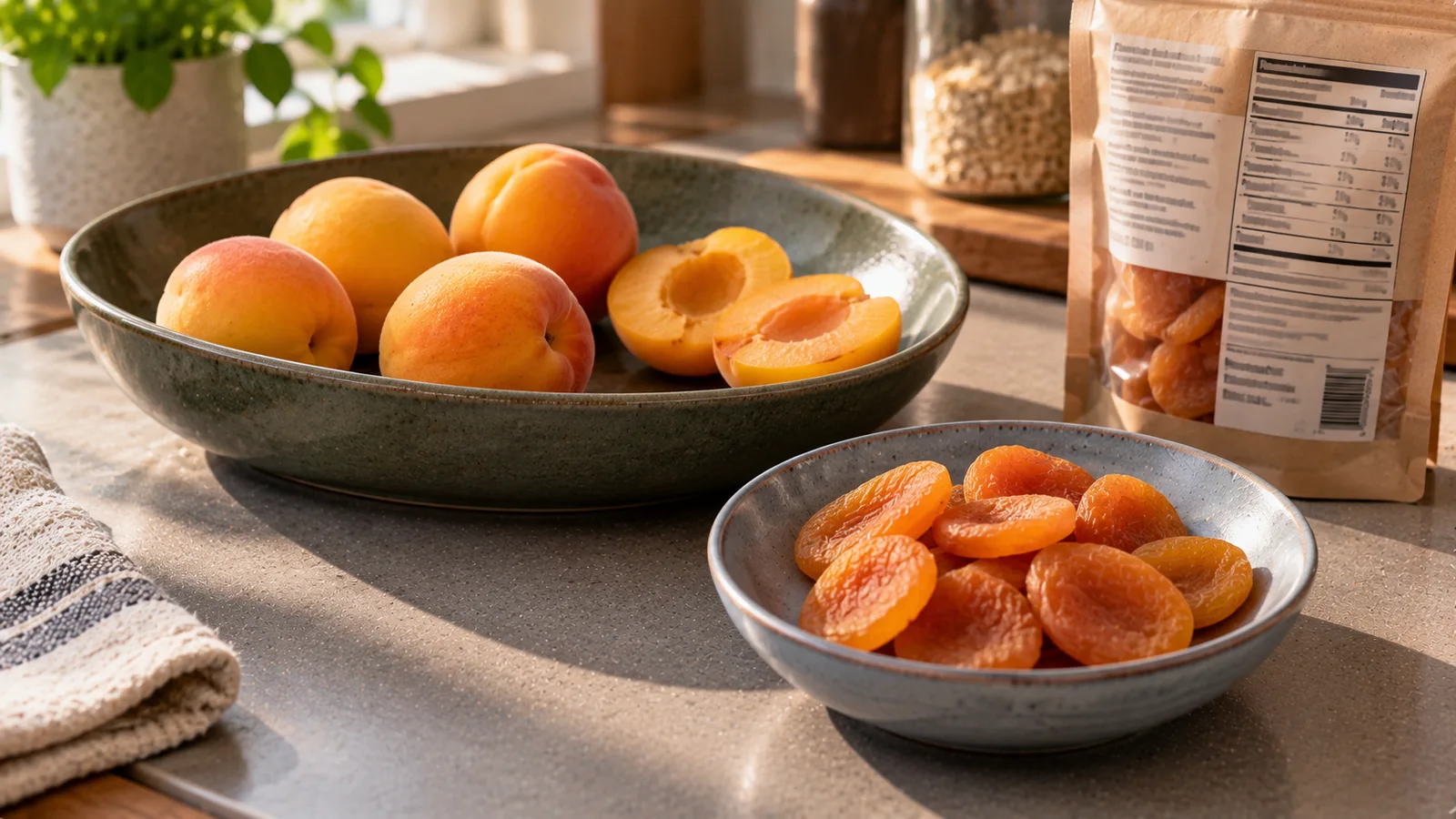
Fresh and dried fruit can come from the same starting ingredient, yet a handful of each can represent very different amounts of fruit.
The main reason is simple:
drying removes much of the water.
Once water is removed, the fruit becomes smaller and lighter while much of its carbohydrate, naturally occurring sugar, fiber and energy remain concentrated in a smaller amount of food.
That changes how portions and calories should be compared.
Fresh vs dried fruit at a glance
| Feature | Fresh fruit | Dried fruit |
|---|---|---|
| Water content | High | Much lower |
| Volume per 100 kcal | Usually larger | Usually smaller |
| Calories per 100 g | Usually lower | Usually higher |
| Natural sugars per 100 g | Less concentrated | More concentrated |
| Fiber per 100 g | Usually lower concentration | Usually higher concentration |
| Added sugar | Usually none | Depends on product |
| Storage life | Shorter | Usually longer |
| Portability | Moderate | High |
Neither format is automatically better.
They are simply not equivalent gram for gram.
Why dried fruit has more calories per 100 g
Imagine fruit before drying as a combination of:
- water;
- carbohydrate;
- fiber;
- small amounts of protein and fat;
- vitamins and minerals.
Drying removes a large part of the water.
It does not remove an equivalent proportion of the fruit's calories.
As a result, 100 g of dried fruit generally represents substantially more original fruit than 100 g of the fresh version.
That is why comparing the two only by weight can be misleading.
A simple example
Suppose a fresh fruit contains approximately 50 kcal per 100 g.
After drying, its energy value might be around 250 kcal per 100 g.
That does not mean drying mysteriously created calories.
Instead, 100 g of dried fruit may contain the solids that originally came from several hundred grams of fresh fruit.
The water is gone, so the calories are concentrated into a smaller weight.
Portion size matters more than the visual volume
Consider a bowl containing 150 g of fresh grapes.
Now compare it with a small handful of raisins.
The raisins occupy much less space, but they are concentrated grapes.
A relatively small portion can therefore provide a similar amount of energy to a much larger-looking portion of fresh fruit.
This is one reason dried fruit is easy to eat quickly.
Illustrative calorie comparison
Exact values vary by variety and product, but the pattern can look like this:
| Fruit | Fresh, approx. kcal/100 g | Dried, approx. kcal/100 g |
|---|---|---|
| Grapes / raisins | 69 | 299 |
| Apricots | 48 | 241 |
| Plums / prunes | 46 | 240 |
| Figs | 74 | 249 |
These figures are illustrative reference values rather than universal numbers for every product.
Variety, moisture content and processing can change the result.
For tracking, use the nutrition information for the actual food whenever possible.
Natural sugar becomes concentrated too
Fruit naturally contains sugars.
When water is removed, those naturally occurring sugars become concentrated in a smaller weight and volume.
That is why dried fruit can list substantially more sugars per 100 g than fresh fruit even when no sugar was added during processing.
For example, if several fresh apricots are needed to produce a small quantity of dried apricots, the sugars from those fruits are now present in the smaller dried portion.
This distinction matters:
high sugar per 100 g does not automatically mean sugar was added.
Check the ingredient list.
Natural sugar and added sugar are different questions
A dried fruit product can contain:
- only fruit;
- fruit plus added sugar;
- fruit plus other ingredients such as oil or preservatives.
For example:
Ingredients: apricots, sulfur dioxide
contains no listed added sugar.
But:
Ingredients: cranberries, sugar, sunflower oil
does contain added sugar.
Do not assume all dried fruit is unsweetened.
Do not assume all dried fruit is sweetened either.
Read the ingredients.
Some dried fruits are more commonly sweetened than others
Products such as raisins, dates, prunes and dried apricots are commonly available without added sugar.
Other products, particularly some dried cranberries, mangoes, pineapples and fruit snacks, may contain added sugar.
The exact formulation depends on the product.
If added sugar matters to you, compare:
- ingredient lists;
- nutrition labels;
- similar products from different manufacturers.
How to compare labels correctly
For two dried-fruit products, comparing per 100 g is useful.
For example:
| Per 100 g | Product A | Product B |
|---|---|---|
| Calories | 280 kcal | 340 kcal |
| Sugars | 55 g | 68 g |
| Fiber | 8 g | 6 g |
Then check the ingredients.
If Product B contains added sugar while Product A contains only fruit, that explains part of the difference.
But when comparing dried fruit with fresh fruit, remember that the per-100-g comparison also reflects the large difference in water content.
Compare the portion you will actually eat
Suppose dried apricots contain 240 kcal per 100 g.
A 30 g portion provides:
240 × 0.30 = 72 kcal
If fresh apricots contain 48 kcal per 100 g, a 150 g portion provides:
48 × 1.50 = 72 kcal
The calorie amount is the same in this simplified example.
But the physical portions are very different:
- 30 g dried fruit;
- 150 g fresh fruit.
This is a more useful comparison than simply stating that dried fruit has five times as many calories per 100 g.
Why dried fruit can be easy to over-portion
Several characteristics make dried fruit easy to eat in larger calorie amounts:
- it is compact;
- it requires little preparation;
- it is easy to eat directly from a large bag;
- several pieces can be consumed quickly;
- its small volume can make the portion look modest.
That does not make dried fruit a bad food.
It simply makes portion awareness more useful.
Portioning from a large bag
If you regularly eat dried fruit directly from the package, it can be difficult to estimate the amount consumed.
A simple approach is to:
- check calories per 100 g;
- decide on a portion;
- place that amount in a bowl or container;
- put the package away.
For example, if a product contains 300 kcal per 100 g:
- 20 g = 60 kcal;
- 30 g = 90 kcal;
- 40 g = 120 kcal;
- 50 g = 150 kcal.
The arithmetic is:
calories per 100 g × portion in grams ÷ 100
Fresh fruit usually provides more volume for the same calories
Because fresh fruit contains substantial water, an equivalent calorie amount generally occupies more physical volume.
For someone who prefers larger food portions, this may be useful.
For example, a fresh apple can take longer to eat and occupy more space than a calorie-equivalent small portion of dried fruit.
This does not prove that fresh fruit will always produce greater satiety for every person.
Satiety is influenced by the complete meal, eating speed, individual appetite and many other factors.
Dried fruit has practical advantages
Fresh fruit is not always the most convenient option.
Dried fruit can be useful because it:
- stores for longer;
- travels easily;
- does not bruise as readily;
- requires no refrigeration in many cases;
- is easy to add to oats or yogurt;
- can provide compact carbohydrate during long outdoor activities.
Its higher calorie density can even be an advantage when compact food is useful.
Context matters.
Fiber does not disappear simply because fruit is dried
Drying removes water, not all of the fiber.
Because the fruit solids become concentrated, dried fruit can contain more fiber per 100 g than its fresh equivalent.
But again, people may eat very different weights.
Compare the fiber in the portion rather than assuming that the per-100-g value represents a normal serving.
For example:
- fresh fruit: 2 g fiber per 100 g;
- dried fruit: 7 g fiber per 100 g.
If you eat 150 g fresh versus 30 g dried:
Fresh:
2 × 1.5 = 3 g fiber
Dried:
7 × 0.3 = 2.1 g fiber
The higher concentration per 100 g does not necessarily mean the smaller dried portion provides more fiber.
Micronutrients can change during processing
Drying can affect some vitamins more than others.
Heat, oxygen, light, storage and the drying process can reduce certain heat- or oxidation-sensitive nutrients.
Other nutrients and minerals remain present and become more concentrated per gram as water is removed.
The exact result varies by:
- fruit;
- drying method;
- temperature;
- storage time;
- processing.
It is therefore too simplistic to say that dried fruit is either "more nutritious" or "less nutritious" overall.
Sulfites and other preservatives
Some dried fruits are treated with sulfites to help preserve color and quality.
The ingredient list should identify relevant additives according to applicable labeling rules.
People with a known sensitivity to sulfites should follow appropriate medical advice and check labels carefully.
A darker color in an unsulfured dried fruit does not automatically indicate poor quality; it can simply reflect oxidation and processing differences.
Freeze-dried fruit is another category
Freeze-dried fruit also has much of its water removed, but its texture and production method differ from conventional dried fruit.
Because it is extremely light, a small weight can represent a substantial amount of original fruit.
The same basic rule applies:
use the nutrition information and portion weight rather than judging the amount by volume alone.
Some freeze-dried products contain only fruit, while others may be incorporated into sweetened snacks or coatings.
Check the actual product.
Fruit chips deserve a closer look
The word "fruit" on a package does not guarantee that the product is simply dried fruit.
Some banana chips, for example, may be fried or processed with added oil and sugar.
That can substantially change:
- calories;
- fat;
- added sugar;
- texture.
Compare the ingredient list with plain dried fruit.
"Banana chips" and "dried banana" are not necessarily nutritionally equivalent products.
Dried fruit in granola or trail mix
Once dried fruit is part of another product, evaluate the entire mixture.
Trail mix may also contain:
- nuts;
- seeds;
- chocolate;
- sweetened pieces;
- oils.
Granola can contain grains, nuts, oils and sweeteners.
Do not use the nutrition values for plain dried fruit to estimate a mixed product if the package provides its own nutrition label.
What about dates?
Dates are naturally very sweet and calorie-dense because of their low water content compared with many fresh fruits.
Plain dates do not require added sugar to taste intensely sweet.
Check the ingredient list.
If it simply lists dates, the sugars are naturally present in the fruit.
Portion size still matters because several dates can provide considerably more energy than their small visual volume suggests.
What about raisins?
Raisins are dried grapes.
A handful of raisins can represent many grapes in concentrated form.
This explains why raisins contain substantially more calories and sugars per 100 g than fresh grapes.
The comparison becomes more intuitive when you compare calorie-equivalent portions rather than equal weights.
What about dried cranberries?
Dried cranberries are a particularly useful example of why ingredient lists matter.
Many commercially available dried cranberry products contain added sugar because fresh cranberries are naturally very tart.
Unsweetened products may also exist.
Therefore, do not assume that the sugars shown on the label come entirely from the fruit.
Read the ingredients for the specific package.
Which is better for weight management?
There is no universal answer.
Fresh fruit may be convenient for weight management because its water content usually gives it lower calorie density and a larger physical portion.
Dried fruit can also fit a calorie-controlled diet when portions are appropriate.
For example:
- fresh fruit may work well as a larger snack;
- a measured amount of dried fruit may work well with yogurt;
- dried fruit may be useful when portability matters;
- either can fit within the day's overall calorie intake.
The important distinction is not "allowed" versus "forbidden."
It is portion and context.
Which is better before exercise?
That depends on the activity, timing and individual tolerance.
Dried fruit provides compact carbohydrate and is portable, which can be practical around some longer activities.
Fresh fruit provides more water and volume.
Neither should be presented as universally superior.
For individualized sports-nutrition advice, especially for prolonged or competitive exercise, a qualified sports dietitian can provide more specific guidance.
Which is better for everyday snacks?
Choose according to the situation.
Fresh fruit may make sense when you want:
- more volume;
- hydration;
- a larger snack;
- minimal processing.
Dried fruit may make sense when you want:
- portability;
- long shelf life;
- compact energy;
- an ingredient for cereal, oats or yogurt.
You can also combine them with other foods rather than treating them as competing choices.
A practical way to choose dried fruit
When buying dried fruit, check four things.
1. Ingredient list
Is it only fruit, or are sugar, oil or other ingredients included?
2. Calories per 100 g
This helps compare similar dried-fruit products.
3. Your realistic portion
Do you normally eat 20 g, 30 g or half the package?
4. How you will use it
A small amount mixed into breakfast is different from eating continuously from a large bag.
This context is more useful than labeling dried fruit as simply healthy or unhealthy.
A practical comparison
Imagine you are choosing a snack.
Option A
200 g fresh fruit at 50 kcal per 100 g:
50 × 2 = 100 kcal
Option B
33 g dried fruit at 300 kcal per 100 g:
300 × 0.33 = 99 kcal
The calorie amounts are almost identical.
But the portions differ greatly in:
- weight;
- volume;
- water;
- eating experience.
That is the central difference to understand.
Tracking fresh and dried fruit
If you use a food diary, choose the correct food state.
Do not log:
- 30 g raisins as 30 g fresh grapes;
- dried apricots as fresh apricots;
- banana chips as plain fresh banana.
The nutrition values are different because the water content and sometimes the ingredients differ.
Use the entry that matches the food you actually ate.
For packaged dried fruit, the package label is usually the most relevant source.
The main takeaway
Fresh and dried fruit can both contribute to a balanced diet.
The important difference is that drying removes water and concentrates the remaining fruit into a smaller weight and volume.
As a result, dried fruit generally has:
- more calories per 100 g;
- more naturally occurring sugar per 100 g;
- more concentrated nutrients and fiber per 100 g;
- a much smaller physical portion for a similar calorie amount.
Added sugar is a separate issue.
Some dried fruits contain it and others do not.
To compare products accurately:
- check the ingredient list;
- distinguish natural sugars from added ingredients;
- compare nutrition values;
- calculate the portion you actually eat;
- log fresh and dried forms separately.
The most useful comparison is rarely 100 g of fresh fruit versus 100 g of dried fruit.
It is the portion of each that you would realistically eat.
Sources
- USDA FoodData Central, nutrient data for fresh and dried fruits.
- European Commission, Regulation (EU) No 1169/2011 on food information to consumers.
- European Food Safety Authority (EFSA), dietary reference and nutrition information.
- World Health Organization (WHO), healthy diet guidance.
- Deutsche Gesellschaft für Ernährung (DGE), guidance on fruit as part of a balanced diet.