
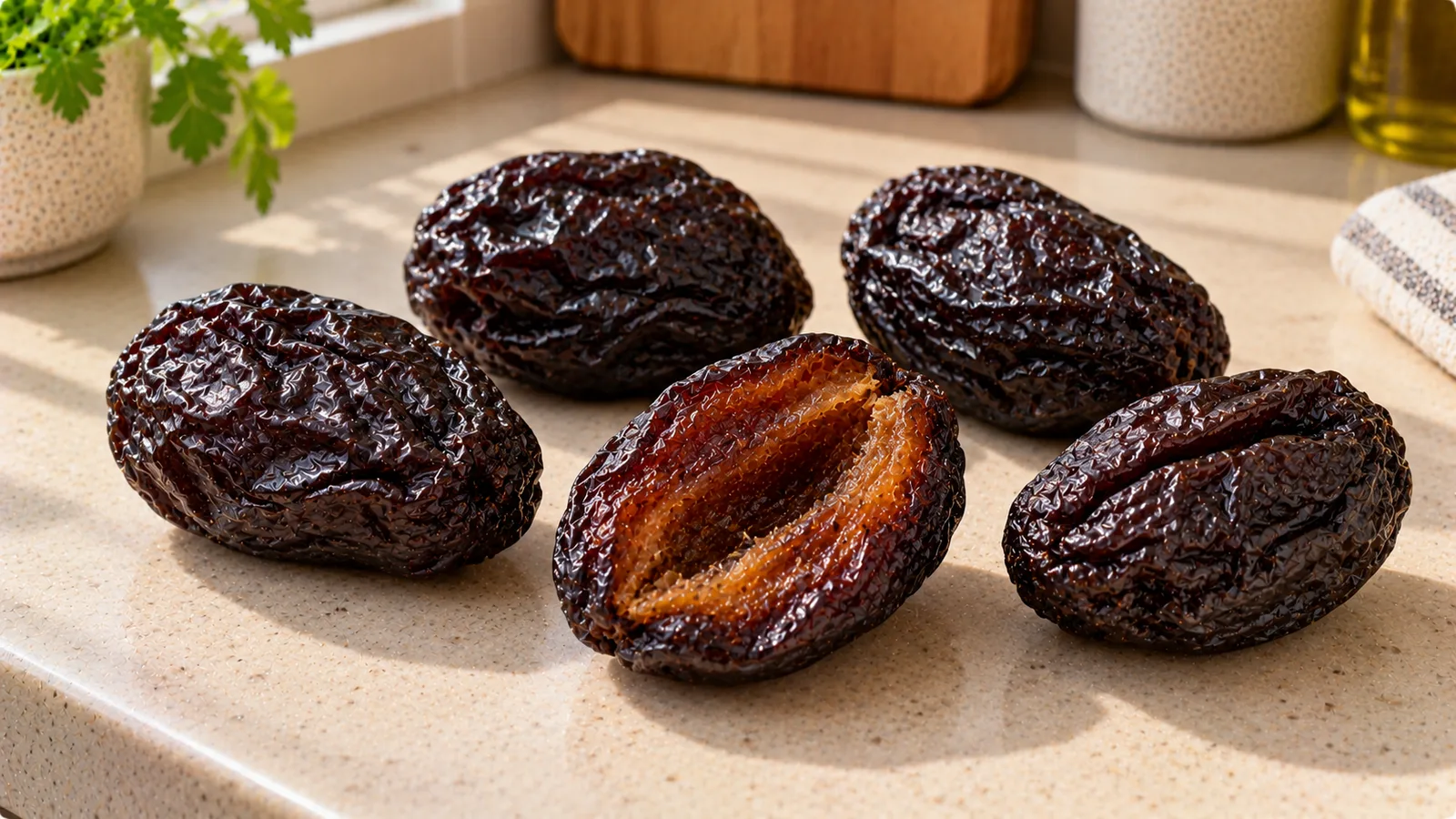
Prunes are dried plums. They are eaten as a snack, added to breakfast dishes and used in both sweet and savory recipes.
Because drying removes much of the water from fresh plums, prunes contain substantially more calories per 100 g than fresh fruit.
A useful reference value for ordinary dried prunes is approximately 240 calories per 100 g.
That means:
- 20 g of prunes provides approximately 48 calories.
- 30 g provides approximately 72 calories.
- 40 g provides approximately 96 calories.
- 50 g provides approximately 120 calories.
- 100 g provides approximately 240 calories.
These figures refer to the edible dried fruit, without stones.
Individual products vary in moisture content, size and ingredients. When available, use the nutrition label on the package for the most accurate calculation.
Prune calories by weight
The following table uses 240 kcal per 100 g, equivalent to 2.4 kcal per gram.
| Edible prune weight | Approximate calories |
|---|---|
| 5 g | 12 kcal |
| 10 g | 24 kcal |
| 15 g | 36 kcal |
| 20 g | 48 kcal |
| 25 g | 60 kcal |
| 30 g | 72 kcal |
| 40 g | 96 kcal |
| 50 g | 120 kcal |
| 60 g | 144 kcal |
| 75 g | 180 kcal |
| 100 g | 240 kcal |
| 125 g | 300 kcal |
| 150 g | 360 kcal |
| 200 g | 480 kcal |
The calculations are rounded estimates, not guaranteed values for every brand.
Source for representative nutrient composition: USDA FoodData Central.
The simplest way to calculate calories is to weigh the portion you actually eat.
For products with stones, exclude the stones from the edible weight.
How many calories are in one prune?
Prunes vary considerably in size.
A small prune may contain only a few grams of edible fruit, while a larger one may weigh considerably more.
For illustration:
| Edible weight of one prune | Approximate calories |
|---|---|
| 5 g | 12 kcal |
| 7 g | 17 kcal |
| 8 g | 19 kcal |
| 10 g | 24 kcal |
| 12 g | 29 kcal |
| 15 g | 36 kcal |
A commonly used estimate is approximately 20–25 calories per medium prune, depending on its actual weight.
However, counting pieces without weighing them can introduce substantial error.
Five small prunes weighing 5 g each provide approximately 60 calories.
Five larger prunes weighing 12 g each provide approximately 144 calories.
The number of pieces is identical, but the edible weight differs considerably.
If you regularly eat the same product, weigh several prunes and calculate the average weight per piece.
Calories in 3, 4, 5 and 6 prunes
If one prune weighs approximately 10 g, the estimated calories are:
| Number of prunes | Estimated edible weight | Calories |
|---|---|---|
| 1 | 10 g | 24 kcal |
| 2 | 20 g | 48 kcal |
| 3 | 30 g | 72 kcal |
| 4 | 40 g | 96 kcal |
| 5 | 50 g | 120 kcal |
| 6 | 60 g | 144 kcal |
| 8 | 80 g | 192 kcal |
| 10 | 100 g | 240 kcal |
These figures assume every prune weighs 10 g.
They are examples, not standard serving sizes.
For smaller or larger prunes, calculate using the actual edible weight.
Prune nutrition facts per 100 g
Prunes are predominantly a carbohydrate-rich food.
Representative USDA values for dried prunes include:
| Nutrient | Per 100 g | Per 30 g |
|---|---|---|
| Calories | 240 kcal | 72 kcal |
| Protein | 2.18 g | 0.65 g |
| Total fat | 0.38 g | 0.11 g |
| Total carbohydrate, US definition | 63.88 g | 19.16 g |
| Dietary fiber | 7.1 g | 2.13 g |
| Total sugars | 38.13 g | 11.44 g |
| Potassium | 732 mg | 220 mg |
| Calcium | 43 mg | 13 mg |
| Iron | 0.93 mg | 0.28 mg |
Source: USDA FoodData Central.
Prunes contain relatively little protein and fat.
Most of their energy comes from carbohydrates.
They also contain fiber, naturally occurring sugars and several minerals.
The values in a typical 30 g serving are much lower than those for 100 g.
Understanding carbohydrate labels
US nutrition databases generally include dietary fiber within total carbohydrates.
European food labels list available carbohydrates and fiber separately.
Using the representative USDA values:
63.88 g total carbohydrate − 7.1 g fiber = approximately 56.78 g available carbohydrate per 100 g.
This calculation illustrates the labeling distinction.
It does not replace the product's own nutrition information.
Reference: Regulation (EU) No 1169/2011.
Prunes versus fresh plums
Prunes are made from plums, but equal weights have very different calorie values.
Fresh plums contain considerably more water.
Drying concentrates the fruit's energy into a smaller weight.
Representative values:
| Food | Calories per 100 g |
|---|---|
| Fresh plums | Approximately 46 kcal |
| Dried prunes | Approximately 240 kcal |
Source: USDA FoodData Central.
This does not mean that drying creates calories.
Removing water decreases the weight without adding an equivalent amount of energy.
Comparing equal weights
100 g of fresh plums provides approximately 46 kcal.
100 g of prunes provides approximately 240 kcal.
The dried fruit is more energy-dense because it contains less water.
Comparing the same original fruit
Suppose a batch of fresh plums contains 250 calories before drying.
If only water is removed, the dried fruit will retain approximately the same total energy, excluding processing losses.
The finished prunes will weigh much less.
This distinction matters when comparing fresh and dried fruit.
How much sugar is in prunes?
Ordinary dried prunes contain approximately 38.1 g of naturally occurring sugars per 100 g.
| Portion | Approximate sugars |
|---|---|
| 10 g | 3.8 g |
| 20 g | 7.6 g |
| 30 g | 11.4 g |
| 40 g | 15.3 g |
| 50 g | 19.1 g |
| 75 g | 28.6 g |
| 100 g | 38.1 g |
The sugars are naturally present in the dried fruit.
They still contribute carbohydrates and calories.
Prunes are therefore not a low-sugar food simply because they may contain no added sugar.
Check the ingredients when buying flavored or sweetened products.
Prunes coated in chocolate or combined with syrup should be tracked as the complete product.
Carbohydrates in prunes
Prunes contain approximately 63.9 g total carbohydrate per 100 g under the US definition, including fiber.
A 30 g serving provides approximately 19.2 g total carbohydrate.
A 50 g serving provides approximately 31.9 g.
A 100 g serving provides approximately 63.9 g.
If you track available carbohydrates using European labeling, use the corresponding product value.
People who need to manage carbohydrate intake for diabetes or another medical reason should consider the actual portion and individualized advice.
Fiber in prunes
Prunes provide approximately 7.1 g dietary fiber per 100 g.
| Portion | Approximate fiber |
|---|---|
| 10 g | 0.7 g |
| 20 g | 1.4 g |
| 30 g | 2.1 g |
| 40 g | 2.8 g |
| 50 g | 3.6 g |
| 75 g | 5.3 g |
| 100 g | 7.1 g |
The European Food Safety Authority considers 25 g of dietary fiber per day an adequate intake for normal laxation in adults.
Source: EFSA — Dietary Reference Values.
Prunes can contribute to fiber intake, but a varied diet should also include vegetables, legumes, whole grains and other fiber-containing foods.
Prunes, sorbitol and digestion
Prunes naturally contain sorbitol, a sugar alcohol.
They also contain dietary fiber.
These components help explain why prunes are commonly associated with bowel function.
However, the effects depend on portion size and individual digestive tolerance.
Eating a large quantity may cause gas, bloating or loose stools in some people.
Prunes should not be treated as a guaranteed remedy for constipation.
If you rarely eat dried fruit or other fiber-rich foods, a modest portion may be more comfortable than a large one.
Persistent constipation, significant abdominal pain, blood in the stool or other concerning symptoms require medical evaluation.
People following a medically recommended low-FODMAP diet may need to limit prunes because of their sorbitol content.
Are prunes high in potassium?
Prunes provide approximately 732 mg potassium per 100 g.
A 30 g serving provides approximately 220 mg.
A 50 g serving provides approximately 366 mg.
Potassium is an essential mineral, but the presence of potassium does not mean that prunes prevent or treat disease.
People with kidney disease or medical advice to restrict potassium may need to consider their prune portions carefully.
For individualized restrictions, consult an appropriate healthcare professional.
Calories in pitted versus unpitted prunes
This distinction is especially important for accurate tracking.
The nutrition values in this article refer to edible prune flesh.
If the package contains stones, the total weight includes a part that is not normally eaten.
Example: prunes with stones
Suppose five prunes weigh 65 g before the stones are removed.
After removing the stones, the edible fruit weighs 52 g.
The correct calculation is:
52 g × 2.4 kcal/g = approximately 125 kcal.
Using the full 65 g would give 156 kcal and overestimate the edible portion.
Example: pitted prunes
If a package contains ready-to-eat pitted prunes and you weigh out 40 g, the edible weight is approximately 40 g.
The estimated energy is:
40 g × 2.4 kcal/g = 96 kcal.
Some products contain added moisture or other ingredients, so the package label remains the preferred source.
What about prunes in syrup or prune purée?
Not all prune products have the same calorie density.
Plain dried prunes
These are the reference food used throughout the main tables.
Their typical energy value is approximately 240 kcal per 100 g.
Prunes packed in syrup
Syrup adds liquid and may add sugar.
The final calories per 100 g depend on the product and whether the syrup is included in the portion.
Use the nutrition label.
Prune purée
A purée may contain prunes, water or other ingredients.
Adding water changes the calories per 100 g.
Adding sweeteners may change the total energy.
Do not automatically apply the values for dried prunes to a diluted purée.
Prune juice
Prune juice is a different product with a different water and fiber content.
Its calories must be calculated using the juice's own nutrition information.
Calories in prunes added to breakfast
Prunes are commonly added to oatmeal, yogurt and breakfast cereals.
Their calories should be included alongside those of the other ingredients.
Oatmeal with prunes
Suppose you prepare:
- Dry oats: 60 g.
- Milk: 200 ml.
- Pitted prunes: 30 g.
- Cinnamon.
The prunes contribute approximately 72 kcal.
The oats and milk contribute additional energy.
The total depends on their quantities and nutrition information.
Yogurt with prunes
A bowl might contain:
- Plain yogurt: 200 g.
- Pitted prunes: 40 g.
- Walnuts: 15 g.
The prunes contribute approximately 96 kcal.
The yogurt and walnuts must also be counted.
Breakfast cereal
If a packaged cereal already contains dried plums, use the nutrition values of the complete cereal.
Do not count the included fruit twice.
If you add extra prunes, record the additional amount separately.
Calories in prunes used for baking
Prunes can add sweetness and moisture to baked goods.
They are sometimes used whole, chopped or puréed.
Example: homemade prune muffins
Suppose a recipe contains 120 g pitted prunes.
The prunes contribute:
120 × 2.4 = 288 kcal to the entire recipe.
If the recipe produces 12 equal muffins, the prunes account for approximately 24 kcal per muffin.
Flour, eggs, oil, sugar and other ingredients contribute additional calories.
Example: prune and nut mixture
Suppose a snack contains:
- Pitted prunes: 40 g.
- Almonds: 20 g.
The prunes contribute approximately 96 kcal.
The almonds add their own calories and nutrients.
Calculate each ingredient separately for an accurate total.
How to calculate prune calories
Using the reference value of 240 kcal per 100 g:
Calories = edible weight in grams × 2.4
Examples:
- 8 g × 2.4 = 19 kcal.
- 12 g × 2.4 = 29 kcal.
- 18 g × 2.4 = 43 kcal.
- 28 g × 2.4 = 67 kcal.
- 35 g × 2.4 = 84 kcal.
- 45 g × 2.4 = 108 kcal.
- 65 g × 2.4 = 156 kcal.
- 90 g × 2.4 = 216 kcal.
If your package states 250 kcal per 100 g, multiply the edible weight by 2.5 instead.
The package-specific value is more accurate than a general reference.
How to weigh prunes accurately
A digital kitchen scale makes the process straightforward.
- Place a bowl on the scale.
- Reset the scale to zero.
- Remove any stones if necessary.
- Add the edible prunes.
- Record their weight.
- Calculate calories using the product label.
For a recipe, weigh the prunes before mixing them with other ingredients.
If you regularly use the same product, you can also weigh several pieces to establish an approximate average weight.
Remember that this average may not apply to a different brand or size.
Are prunes suitable for weight management?
Prunes can fit into a diet intended to manage body weight.
They provide sweetness, fiber and other nutrients.
However, they are more energy-dense than fresh plums.
A 30 g serving contains approximately 72 kcal.
A 100 g serving contains approximately 240 kcal.
Both portions may fit into different eating patterns, but they are not equivalent.
Prunes do not independently cause weight loss or weight gain.
Overall energy intake, dietary patterns and other factors influence body weight.
A practical strategy is to choose a portion before eating and include it in the total for the meal or snack.
Do prunes contain much protein or fat?
No.
Ordinary prunes provide approximately 2.2 g protein and 0.4 g fat per 100 g.
A 30 g portion contains less than 1 g protein and very little fat.
Prunes are primarily a carbohydrate-rich food.
They should not be relied upon as a main source of protein.
If you combine them with yogurt, nuts or other foods, the nutritional profile of the complete snack will change.
How to store prunes
Follow the storage instructions on the package.
Keep prunes in a clean, sealed container and protect them from excess moisture and contamination.
Some products may require refrigeration after opening.
Check the best-before date and product-specific instructions.
Discard prunes showing mold or other clear signs of spoilage.
Changes in softness or moisture do not automatically establish whether a product is safe.
When in doubt, follow food-safety guidance and the manufacturer's instructions.
Common questions
How many calories are in 100 g of prunes?
Approximately 240 kcal for ordinary dried prunes.
How many calories are in 30 g of prunes?
Approximately 72 kcal.
How many calories are in 50 g of prunes?
Approximately 120 kcal.
How many calories are in one prune?
Approximately 24 kcal if the edible fruit weighs 10 g. Smaller and larger prunes have different values.
How many calories are in five prunes?
Approximately 120 kcal if the five prunes together weigh 50 g.
Do prunes have more calories than fresh plums?
Per 100 g, yes. Drying removes water and concentrates the energy in a smaller weight.
Do prunes contain sugar?
Yes. Ordinary prunes contain approximately 38 g naturally occurring sugars per 100 g.
Are prunes a source of fiber?
Yes. They provide approximately 7.1 g fiber per 100 g.
Should prune stones be included when calculating calories?
No. Use the weight of the edible fruit.
Are prunes and prune juice nutritionally identical?
No. Their water content, fiber content and calorie density differ.
Sources and calculation method
- USDA FoodData Central — representative nutrient values for dried prunes and fresh plums.
- Regulation (EU) No 1169/2011 — European nutrition-labeling conventions.
- EFSA — Dietary Reference Values — dietary fiber reference information.
All calorie calculations use 240 kcal per 100 g of edible dried prunes. Individual prune weights are illustrative estimates. For the most accurate result, use the edible weight and the nutrition label of the specific product.