
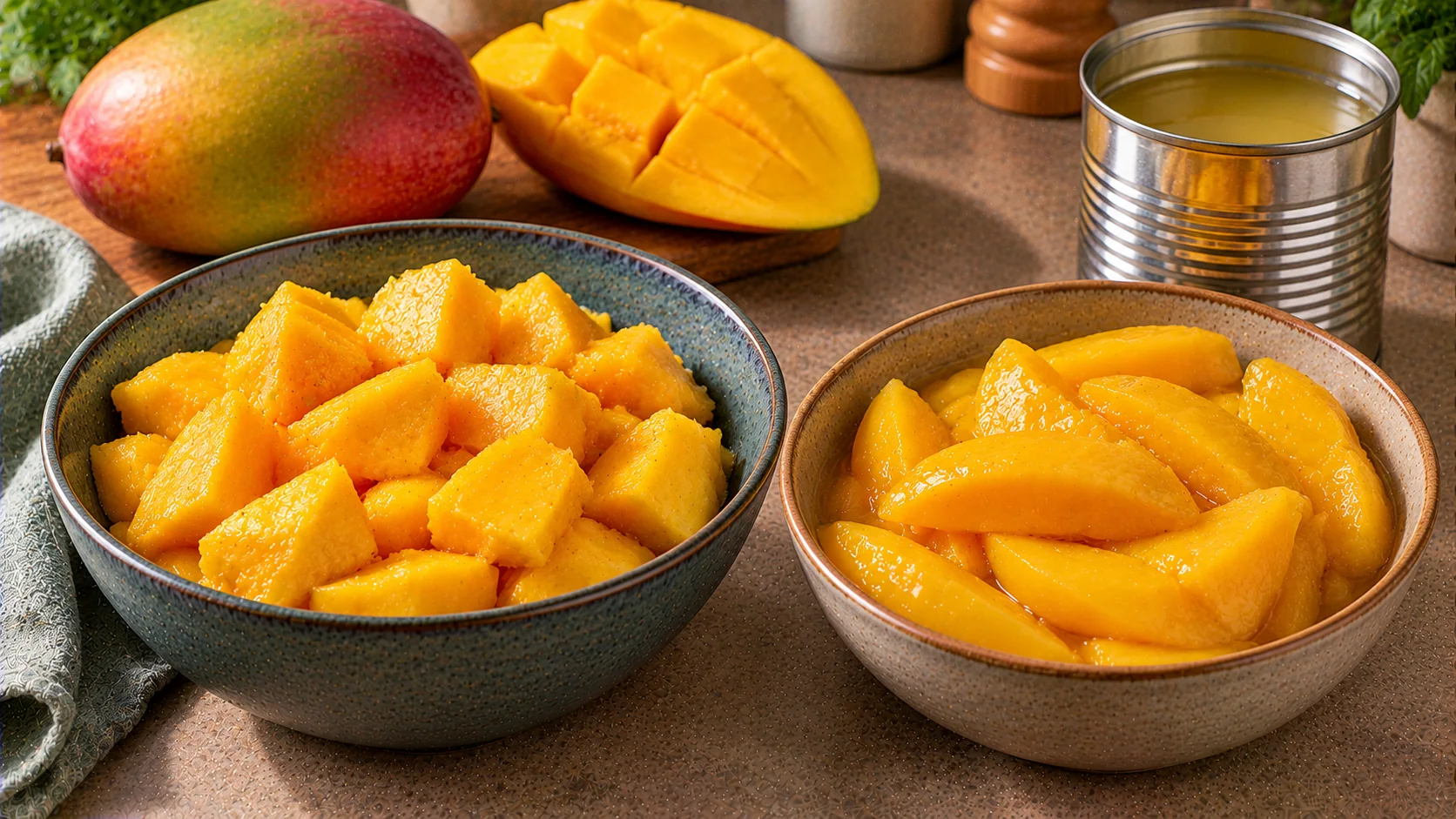
Fresh Mango vs Canned Mango in Juice: Sugar and Cost
Compare fruit with fruit, not a whole fruit with a whole can
Fresh mango and mango pieces packed in juice can both work in breakfast bowls, desserts and snacks. Their headline prices are hard to compare because a whole mango has skin and a large stone, whereas a can contains fruit plus packing liquid. The sensible comparison is price per 100 g of edible mango, followed by the sugar value for the portion you actually eat. This is a narrow mango comparison, not a general argument that fresh produce is always better than canned fruit. For a wider discussion of fruit forms, see our guide to fresh and dried fruit.
What counts as edible weight?
With a fresh mango, weigh the whole fruit, prepare it and weigh the edible flesh. With a can, find the drained weight on the label, drain the packing liquid using a sieve and weigh the fruit if precise accounting matters. Do not assume the 425 g printed as net weight is all mango. If you drink the juice as well, record it separately; the drained-fruit comparison does not include the liquid consumed.
| Label or kitchen measurement | Fresh mango | Mango canned in juice |
|---|---|---|
| Weight before preparation | Whole fruit, including peel and stone | Net weight, including packing juice |
| Weight used for fruit-only comparison | Flesh after trimming | Drained mango pieces |
| Sugar comparison | Flesh per 100 g | Drained product per 100 g, if specified |
| Often overlooked | Peel and stone waste | Juice remaining in the can |
A worked example with illustrative prices
Suppose a mango costs €1.79, weighs 350 g whole, and yields 225 g flesh. The edible yield is 225 ÷ 350 × 100 = 64.3%. The cost per 100 g of edible flesh is €1.79 ÷ 225 × 100 = €0.80 (rounded). If a can costs €2.09, has 425 g net weight and 250 g drained fruit, its fruit-only cost is €2.09 ÷ 250 × 100 = €0.84 per 100 g. Here fresh is slightly cheaper per edible 100 g even though the can offers convenience. These are hypothetical shelf prices and measured yields, not verified retailer offers.
| Item | Fresh mango | Canned mango in juice |
|---|---|---|
| Purchased item price | €1.79 | €2.09 |
| Whole or net mass | 350 g | 425 g |
| Edible or drained mango | 225 g | 250 g |
| Fruit-only price per 100 g | €0.80 | €0.84 |
| Fruit available for 150 g serving | 1 serving, 75 g left | 1 serving, 100 g left |
Do not interpret the leftover 75 g or 100 g as waste: both can be refrigerated appropriately and used in the next meal. A very ripe fresh mango may be cheaper on promotion, but a badly bruised mango may yield less edible flesh. Conversely, a large can may be economical when the entire drained quantity is used.
Sugar: naturally present, packing juice and added ingredients
Mango naturally contains sugars. A European nutrition declaration normally provides total sugars, not a dedicated added-sugars figure. A can labelled “in juice” may contain mango juice, another fruit juice, or juice from concentrate. Read the full ingredients list and the nutrition table rather than inferring “zero sugar” from the absence of granulated sugar. Fruit juice contains free sugars under UK public-health definitions, although intact fruit sugars are treated differently. The NHS suggests choosing canned fruit in juice rather than syrup; that is a useful shopping default, not proof that all canned mango has lower sugar than fresh mango. NHS guidance on sugar.
The EU mandatory nutrition table lists sugars under carbohydrate; fibre is optional in that declaration. European Commission nutrition-labelling overview.
Sugar calculation for a 150 g fruit serving
Imagine a fresh mango reference with 13.7 g sugars per 100 g edible flesh and a particular drained canned product labelled 12.0 g per 100 g. Those are illustrative example values, not universal measurements or an assertion about every brand. For 150 g fresh flesh: 13.7 × 1.5 = 20.55 g total sugars. For 150 g drained canned fruit: 12.0 × 1.5 = 18.0 g total sugars. A different can might have more sugars, and a label may describe the fruit with juice instead of the drained fruit. Only compare equivalent states.
| Example measure | Fresh flesh | Drained canned mango |
|---|---|---|
| Hypothetical sugars per 100 g | 13.7 g | 12.0 g |
| Fruit eaten | 150 g | 150 g |
| Calculated total sugars | 20.6 g | 18.0 g |
| Added sugars from this number alone | Cannot determine | Cannot determine |
The numbers above are for practicing label mathematics. For nutrient data, use the exact food description and preparation state in USDA FoodData Central, and prefer the actual can's label when available. Neither the price nor the example sugar values should be promoted as a market average.
Juice changes the calculation
If a can has 250 g drained mango and 175 g packing juice, the juice is not a free extra in the nutritional sense. Drinking 100 g juice with a 150 g portion of fruit increases the amount of total sugars and energy consumed. Record the fruit and juice separately using label information where possible. If the nutrition declaration covers the total packed contents, do not apply it blindly to just the drained flesh. Some packaging gives both as-sold and drained values; others do not. When the information is ambiguous, describe the estimate as uncertain rather than inventing a drained nutrient value.
A three-step supermarket comparison
- Read ingredients. Look for mango and the named packing liquid; distinguish juice from syrup and added sweeteners.
- Find the drained weight. Calculate package price ÷ drained grams × 100. For fresh mango, use a realistic edible yield or weigh the flesh at home.
- Compare matched portions. Use grams of total sugars per 100 g of mango in the same state, then multiply by your serving weight ÷ 100.
The NHS regards an 80 g portion of fresh or canned fruit as a portion in its 5 A Day guidance and recommends canned fruit in natural juice or water without added sugar. Portion guidance does not remove the need to check actual food labels. NHS 5 A Day guidance.
Texture, nutrients and practical uses
Fresh mango can have a firmer bite, more aroma or more variation in ripeness. Canned pieces tend to be softer and more predictable, which may suit a quick yogurt bowl or blended dessert. Vitamin C and other nutrients depend on variety, ripeness, processing and storage; do not assume canned mango has the same micronutrient profile as fresh fruit. A cup of canned mango with juice is not equivalent to a cup of drained mango on a scale. For tracking, gram measurements are preferable to loosely filled cups.
Storage and reducing waste
Wash and cut fresh mango using clean utensils; refrigerate cut fruit promptly in a closed container. Refrigerate drained canned fruit and unused juice after opening in suitable food containers according to package instructions. Never store an opened tin indefinitely on the counter. If you will eat only 100–150 g, buying a ripe single mango or a small can can reduce leftovers even when the unit price is higher. For general advice on interpreting fruit portions, our guide to drained weights offers related context.
Which should you buy?
Choose the option that fits the edible price, label and usage. Fresh mango can win on texture and sometimes price; canned mango in juice can win on convenience, availability and predictable usable quantity. “In juice” is generally a better starting point than “in syrup” for limiting added sweeteners, but total sugars are not the same as added sugars. The best answer comes from the package in front of you and the amount you will actually eat.
Sources
- European Commission — Nutrition labelling: mandatory total-sugars information in EU declarations.
- NHS — Sugar: the facts: fruit, juice and ingredients interpretation.
- NHS — 5 A Day: what counts?: fresh and canned fruit portions.
- USDA FoodData Central: food-description-specific reference data; not a substitute for brand labels.