
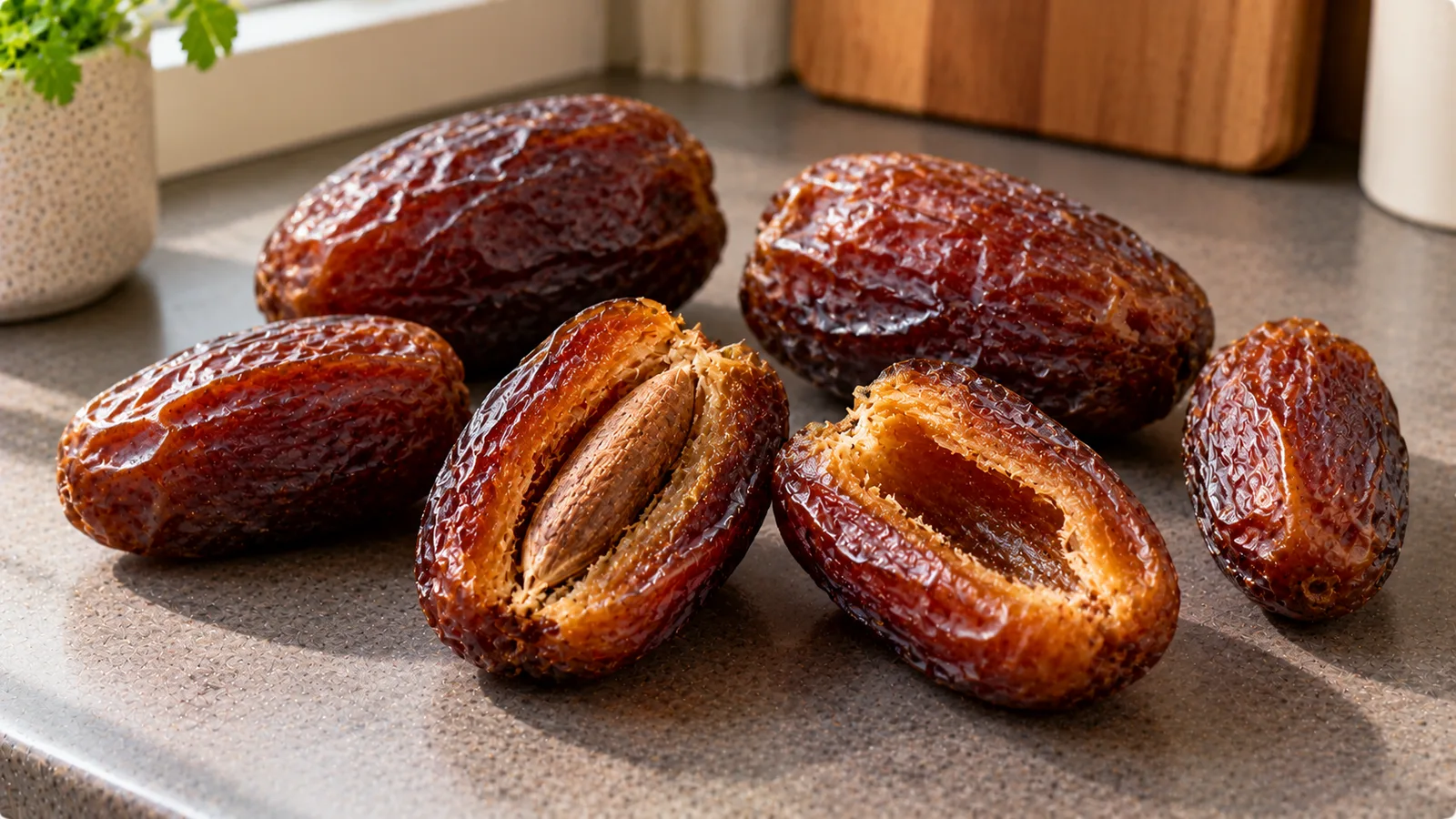
Dates are sweet fruits commonly eaten as snacks, used in desserts or added to breakfast dishes. They are often sold with most of their moisture already lost, which makes them relatively concentrated sources of energy and carbohydrates.
A useful starting estimate is approximately 277 calories per 100 g of Medjool dates or 282 calories per 100 g of Deglet Noor dates.
The number of calories in one date depends mainly on its variety, size and edible weight.
A large Medjool date can contain several times as many calories as a small Deglet Noor date, even though both are sold simply as dates.
For accurate food tracking, it is best to distinguish between the weight of the edible fruit and the weight of any pit that is discarded.
Calories in dates by weight
The following table uses approximately 280 kcal per 100 g as a practical rounded estimate for dates.
| Edible date flesh | Approximate calories |
|---|---|
| 10 g | 28 kcal |
| 15 g | 42 kcal |
| 20 g | 56 kcal |
| 25 g | 70 kcal |
| 30 g | 84 kcal |
| 40 g | 112 kcal |
| 50 g | 140 kcal |
| 75 g | 210 kcal |
| 100 g | 280 kcal |
| 125 g | 350 kcal |
| 150 g | 420 kcal |
| 200 g | 560 kcal |
These values are estimates for the edible portion.
The exact calorie content varies between varieties, products and moisture levels.
For example, representative USDA data give approximately 277 kcal per 100 g for Medjool dates and 282 kcal per 100 g for Deglet Noor dates.
Source: USDA FoodData Central.
How many calories are in one date?
There is no single standard weight for a date.
Medjool dates are generally larger than Deglet Noor dates, and individual fruits vary considerably.
Representative serving weights commonly used in food databases are approximately 24 g for one pitted Medjool date and 7.1 g for one pitted Deglet Noor date.
Using the respective nutrient values:
| Type of date | Approximate edible weight | Calories |
|---|---|---|
| One Deglet Noor date | 7.1 g | 20 kcal |
| Two Deglet Noor dates | 14.2 g | 40 kcal |
| Three Deglet Noor dates | 21.3 g | 60 kcal |
| Five Deglet Noor dates | 35.5 g | 100 kcal |
| One Medjool date | 24 g | 66 kcal |
| Two Medjool dates | 48 g | 133 kcal |
| Three Medjool dates | 72 g | 199 kcal |
| Four Medjool dates | 96 g | 266 kcal |
These are reference portion weights, not guarantees for every fruit.
If your dates are particularly small or large, weighing them will produce a more reliable result than counting pieces.
Medjool dates versus Deglet Noor dates
Medjool and Deglet Noor are two widely available varieties.
Both provide carbohydrates, naturally occurring sugars and dietary fiber.
Their calorie content per 100 g is broadly similar, but their typical individual weights differ.
| Nutrient | Medjool dates, 100 g | Deglet Noor dates, 100 g |
|---|---|---|
| Energy | Approximately 277 kcal | Approximately 282 kcal |
| Protein | 1.81 g | 2.45 g |
| Fat | 0.15 g | 0.39 g |
| Total carbohydrate, US definition | 75.03 g | 75.03 g |
| Dietary fiber | 6.7 g | 8.0 g |
| Total sugars | 66.47 g | 63.35 g |
| Potassium | 696 mg | 656 mg |
These are representative rounded nutrient values, not fixed specifications for every date sold.
Source: USDA FoodData Central.
The important practical difference is often the portion size.
A single large Medjool date may weigh more than three small Deglet Noor dates.
Therefore, comparing one fruit with one fruit can be misleading.
For a more meaningful comparison, use equal edible weights.
How many calories are in Medjool dates?
Medjool dates are usually relatively large and soft.
A representative pitted Medjool date weighs approximately 24 g.
At about 277 kcal per 100 g, one such date provides roughly 66 kcal.
| Medjool dates | Approximate edible weight | Calories |
|---|---|---|
| 1 date | 24 g | 66 kcal |
| 2 dates | 48 g | 133 kcal |
| 3 dates | 72 g | 199 kcal |
| 4 dates | 96 g | 266 kcal |
| 5 dates | 120 g | 332 kcal |
| 6 dates | 144 g | 399 kcal |
If a package provides a specific serving weight or nutrition label, use those values instead of the generic estimates.
For example, a smaller Medjool date weighing 18 g would contain approximately 50 kcal, not 66 kcal.
A larger one weighing 30 g would provide approximately 83 kcal.
How many calories are in Deglet Noor dates?
Deglet Noor dates are often smaller than Medjool dates.
A representative pitted Deglet Noor date weighs approximately 7.1 g.
At approximately 282 kcal per 100 g, one date provides about 20 kcal.
| Deglet Noor dates | Approximate edible weight | Calories |
|---|---|---|
| 1 date | 7.1 g | 20 kcal |
| 3 dates | 21.3 g | 60 kcal |
| 5 dates | 35.5 g | 100 kcal |
| 7 dates | 49.7 g | 140 kcal |
| 10 dates | 71 g | 200 kcal |
| 15 dates | 106.5 g | 300 kcal |
These values demonstrate why the variety and weight matter.
A snack of three Medjool dates and a snack of three small Deglet Noor dates can have very different calorie totals.
Nutrition facts for dates per 100 g
Dates are primarily a carbohydrate-rich food.
Representative values for Medjool dates include:
| Nutrient | Per 100 g | Per 50 g |
|---|---|---|
| Calories | 277 kcal | 139 kcal |
| Protein | 1.81 g | 0.91 g |
| Fat | 0.15 g | 0.08 g |
| Total carbohydrate, US definition | 75.03 g | 37.52 g |
| Dietary fiber | 6.7 g | 3.35 g |
| Total sugars | 66.47 g | 33.24 g |
| Potassium | 696 mg | 348 mg |
| Magnesium | 54 mg | 27 mg |
Source: USDA FoodData Central.
Dates contain little fat and relatively little protein.
Most of their energy comes from carbohydrates.
They also provide fiber and minerals, but they should not be treated as a substitute for a varied diet.
Why carbohydrate figures may differ between databases
American nutrient databases commonly include dietary fiber in total carbohydrate.
European food labels generally list available carbohydrate and fiber separately.
For Medjool dates, the representative values above give:
75.03 g total carbohydrate − 6.7 g fiber = approximately 68.33 g available carbohydrate per 100 g.
This is a difference in reporting conventions, not evidence that dates sold in Europe necessarily contain fewer carbohydrates.
Reference: Regulation (EU) No 1169/2011.
Are dates fresh or dried?
Dates are sometimes marketed as fresh, soft, semi-dry or dried.
These descriptions can be confusing.
Unlike many fresh fruits, commercially sold dates may already have relatively low moisture content even when their texture is soft.
A soft Medjool date is not necessarily nutritionally equivalent to a high-water-content fresh fruit such as an apple or grape.
Moisture content affects calories per 100 g.
When water is removed, the remaining sugars and other nutrients become more concentrated by weight.
This does not mean that drying creates calories.
It changes how much edible material is contained in a given weight.
Fresh dates
Dates harvested at earlier ripeness stages can have a higher moisture content and a different composition from fully ripe, concentrated dates.
Their calorie content may therefore differ substantially.
Do not automatically apply the standard dried-date value to every product labeled fresh dates.
If the package provides nutrition information, use it.
Dried dates
Dried or fully ripened dates commonly provide approximately 280 kcal per 100 g, depending on variety and product.
Some products are additionally dehydrated and may have a different energy concentration.
Again, the product label is the best reference when available.
Dates with added sugar
Plain dates are naturally sweet.
However, date-based products may include sugar syrup, coatings, fillings or other added ingredients.
For such products, use the complete nutrition label rather than the values for plain dates.
How much sugar is in dates?
Medjool dates contain approximately 66.5 g of naturally occurring sugars per 100 g.
The quantity increases with the portion size.
| Medjool date flesh | Approximate sugars |
|---|---|
| 10 g | 6.6 g |
| 20 g | 13.3 g |
| 24 g | 16.0 g |
| 30 g | 19.9 g |
| 50 g | 33.2 g |
| 75 g | 49.9 g |
| 100 g | 66.5 g |
These sugars occur naturally in the fruit.
However, naturally occurring sugar still contributes carbohydrates and calories.
Public-health guidance distinguishes sugars in whole fruit from free sugars, including added sugars and sugars in fruit juices.
Source: World Health Organization — Healthy diet.
That distinction does not make dates a low-sugar food.
Their concentrated carbohydrate content is relevant when choosing portion sizes.
Are dates high in carbohydrates?
Yes.
Dates contain approximately 75 g total carbohydrate per 100 g under the US reporting convention.
For Medjool dates:
- 24 g, approximately one reference date: 18 g total carbohydrate.
- 48 g, approximately two dates: 36 g.
- 72 g, approximately three dates: 54 g.
- 100 g: 75 g.
These figures include dietary fiber under the US definition.
If you are tracking available carbohydrates using European labeling conventions, use the corresponding product values.
People who monitor carbohydrate intake for diabetes or another medical reason should consider the actual portion and their individualized dietary guidance.
Fiber in dates
Medjool dates contain approximately 6.7 g dietary fiber per 100 g.
Deglet Noor dates contain approximately 8 g per 100 g in representative USDA data.
For Medjool dates:
| Portion | Approximate fiber |
|---|---|
| 24 g | 1.6 g |
| 48 g | 3.2 g |
| 72 g | 4.8 g |
| 100 g | 6.7 g |
Dates can contribute to fiber intake.
However, the fiber comes alongside a substantial amount of carbohydrate and energy.
The European Food Safety Authority considers 25 g of dietary fiber per day an adequate intake for normal laxation in adults.
Source: EFSA — Dietary Reference Values.
A varied diet containing vegetables, legumes, whole grains, fruit, nuts and seeds can help provide fiber from multiple sources.
Vitamins and minerals in dates
Dates contain several minerals, including potassium and magnesium.
Representative Medjool values per 100 g include:
- Potassium: approximately 696 mg.
- Magnesium: approximately 54 mg.
- Calcium: approximately 64 mg.
- Iron: approximately 0.90 mg.
Source: USDA FoodData Central.
These nutrients have established roles in normal body functions.
However, the presence of minerals does not establish that dates prevent or treat a specific disease.
The amount obtained depends on the portion eaten.
For example, one 24 g Medjool date provides approximately 167 mg potassium, rather than the 696 mg found in 100 g.
How to weigh dates correctly
For accurate calorie tracking, weigh only the edible portion.
Method 1: Pitted dates
If the dates are sold without pits, weigh the amount you plan to eat.
For example:
- Pitted dates: 45 g.
- Estimated energy using 280 kcal per 100 g: 126 kcal.
This is the simplest method.
Method 2: Dates with pits
If the dates contain pits:
- Weigh the dates before eating.
- Remove the pits.
- Weigh the discarded pits.
- Subtract the pit weight from the original weight.
- Calculate calories from the edible flesh.
Example:
- Dates with pits: 110 g.
- Discarded pits: 12 g.
- Edible date flesh: 98 g.
98 × 2.8 = approximately 274 kcal.
The pit weight in this example is hypothetical.
Actual pits differ in size.
Method 3: Weigh the edible flesh directly
Remove the pits before eating.
Place the flesh on a kitchen scale and record the exact weight.
This method avoids having to estimate the pit percentage.
How to calculate date calories
For a general estimate using 280 kcal per 100 g:
Calories = edible weight in grams × 2.8
Examples:
- 8 g = 22 kcal.
- 15 g = 42 kcal.
- 25 g = 70 kcal.
- 35 g = 98 kcal.
- 60 g = 168 kcal.
- 90 g = 252 kcal.
- 120 g = 336 kcal.
For a more precise calculation, use the value for the specific variety or packaged product.
For Medjool dates with 277 kcal per 100 g, multiply edible grams by 2.77.
For Deglet Noor dates with 282 kcal per 100 g, multiply edible grams by 2.82.
Dates versus other dried fruits
Dried fruits differ in energy density, sugar composition, fiber and portion size.
Dates, raisins, dried figs and dried apricots can all provide substantial calories in relatively small portions.
However, the exact values vary by product and preparation.
It is not reliable to assume that all dried fruits contain the same number of calories per 100 g.
When comparing products, use the nutrition values for equal edible weights.
Also check whether the product contains added sugar, oil or other ingredients.
Calories in stuffed dates
Dates are sometimes filled with nuts, nut butter, chocolate or cheese.
The filling can substantially change the calories.
Example: Medjool date with peanut butter
Suppose you use:
- One Medjool date, 24 g edible flesh.
- Peanut butter, 10 g.
The date contributes approximately 66 kcal.
If the peanut butter contains 600 kcal per 100 g, the 10 g filling adds 60 kcal.
Total: approximately 126 kcal.
The peanut butter value is illustrative. Use the label of the actual product.
Example: Dates with almonds
Suppose you use:
- Two Medjool dates, 48 g edible flesh.
- Almonds, 15 g.
The dates contribute approximately 133 kcal.
The almonds add further calories.
Calculate them using the actual weight and nutrition data.
Example: Chocolate-covered dates
Chocolate-covered dates require a calculation of both the fruit and the coating.
A packaged product may also contain additional fillings.
Use its nutrition label whenever possible.
Do not log chocolate-covered dates as plain dates.
Date paste, date syrup and date sugar
Dates are also sold as paste, syrup and granulated products.
These forms are not nutritionally identical.
Date paste
Date paste is usually made by processing dates, sometimes with added water.
Its calorie content per 100 g depends on the amount of water and any additional ingredients.
Homemade paste made from 200 g dates and 100 g water will have a lower calorie concentration per 100 g than the original dates, but the entire batch still contains the calories from the dates.
Date syrup
Date syrup is a concentrated sweetener.
Its composition depends on manufacturing methods and water content.
Use the product label.
Do not assume it contains the same fiber as whole dates.
Date sugar
Products labeled date sugar may be made from dried, ground dates.
Their calorie content depends on the specific formulation and moisture level.
Use the packaging information rather than applying a generic value automatically.
Are dates suitable for weight management?
Dates can fit into a weight-management diet.
They provide sweetness, carbohydrates and some fiber.
However, they are relatively energy-dense.
A portion of three large Medjool dates may provide approximately 199 kcal.
That can be appropriate in some eating patterns, but it is substantially different from eating three small dates.
Dates do not independently cause weight loss or weight gain.
Overall energy intake, dietary patterns and other factors influence body weight.
A practical strategy is to decide on a portion, weigh it if necessary and include it in the total meal or snack.
Dates before or after exercise
Dates provide readily available carbohydrates.
They can be a convenient snack around physical activity, depending on individual preferences and tolerance.
However, they are not required for exercise performance.
The appropriate amount depends on the duration and intensity of activity, other food consumed and individual needs.
For example, two reference Medjool dates provide approximately 36 g total carbohydrate.
Someone planning carbohydrate intake around training should consider that quantity rather than relying only on the number of fruits.
Practical calorie-tracking examples
Example 1: Two Medjool dates with coffee
You eat two Medjool dates weighing 48 g without pits.
48 × 2.77 = approximately 133 kcal.
Coffee, milk or sugar must be recorded separately.
Example 2: Five small dates
You eat five Deglet Noor dates weighing approximately 35.5 g in total.
35.5 × 2.82 = approximately 100 kcal.
Example 3: Dates added to oatmeal
Your oatmeal contains:
- Oats: 60 g dry.
- Milk: 200 ml.
- Chopped dates: 30 g.
- Cinnamon.
The dates contribute approximately 84 kcal.
Calculate oats and milk separately.
Example 4: Homemade date snack
You combine:
- Dates: 100 g.
- Almonds: 40 g.
- Cocoa powder: 10 g.
The dates contribute approximately 280 kcal.
The almonds and cocoa contribute additional energy.
If the finished mixture is divided into ten equal pieces, divide the complete ingredient calorie total by ten.
Example 5: A mixed bag of dates
You eat 80 g of pitted dates from a package.
The label states 290 kcal per 100 g.
80 × 2.9 = 232 kcal.
In this situation, the product-specific value is preferable to the general 280 kcal estimate.
Storing dates
Storage requirements depend on whether dates are fresh, soft, dried or processed.
Follow the package instructions.
Keep dates in a clean, suitable container and protect them from excessive moisture and contamination.
Some varieties benefit from refrigeration, particularly after opening.
Discard dates with visible mold, unusual spoilage or other signs that they are unsafe to eat.
Do not assume that all products have identical shelf lives.
Frequently asked questions
How many calories are in 100 g of dates?
Approximately 280 kcal for many commonly sold dates. Medjool and Deglet Noor reference values are about 277 and 282 kcal per 100 g respectively.
How many calories are in one Medjool date?
Approximately 66 kcal if the edible flesh weighs 24 g.
How many calories are in one small date?
A small Deglet Noor date weighing approximately 7.1 g provides about 20 kcal.
How many calories are in three Medjool dates?
Approximately 199 kcal if each date contains 24 g edible flesh.
How many calories are in five small dates?
Approximately 100 kcal for five reference-size Deglet Noor dates.
Are dates high in sugar?
Dates contain a substantial amount of naturally occurring sugar by weight. Medjool dates provide approximately 66.5 g sugars per 100 g.
Do you count date pits?
Not if you discard them. Calculate calories using only the edible portion.
Are Medjool dates more caloric than other dates?
Per 100 g, Medjool and Deglet Noor dates have similar calorie values. A single Medjool date often contains more calories because it is larger.
Sources and calculation methodology
- USDA FoodData Central — representative nutrient composition of Medjool and Deglet Noor dates.
- Regulation (EU) No 1169/2011 — European nutrition-labeling definitions.
- World Health Organization — Healthy diet — guidance on dietary sugars.
- EFSA — Dietary Reference Values — dietary fiber reference values.
The general calorie tables use approximately 280 kcal per 100 g edible dates. Variety-specific calculations use approximately 277 kcal per 100 g for Medjool and 282 kcal per 100 g for Deglet Noor. All portions are estimates, and product-specific nutrition labels should take precedence.