
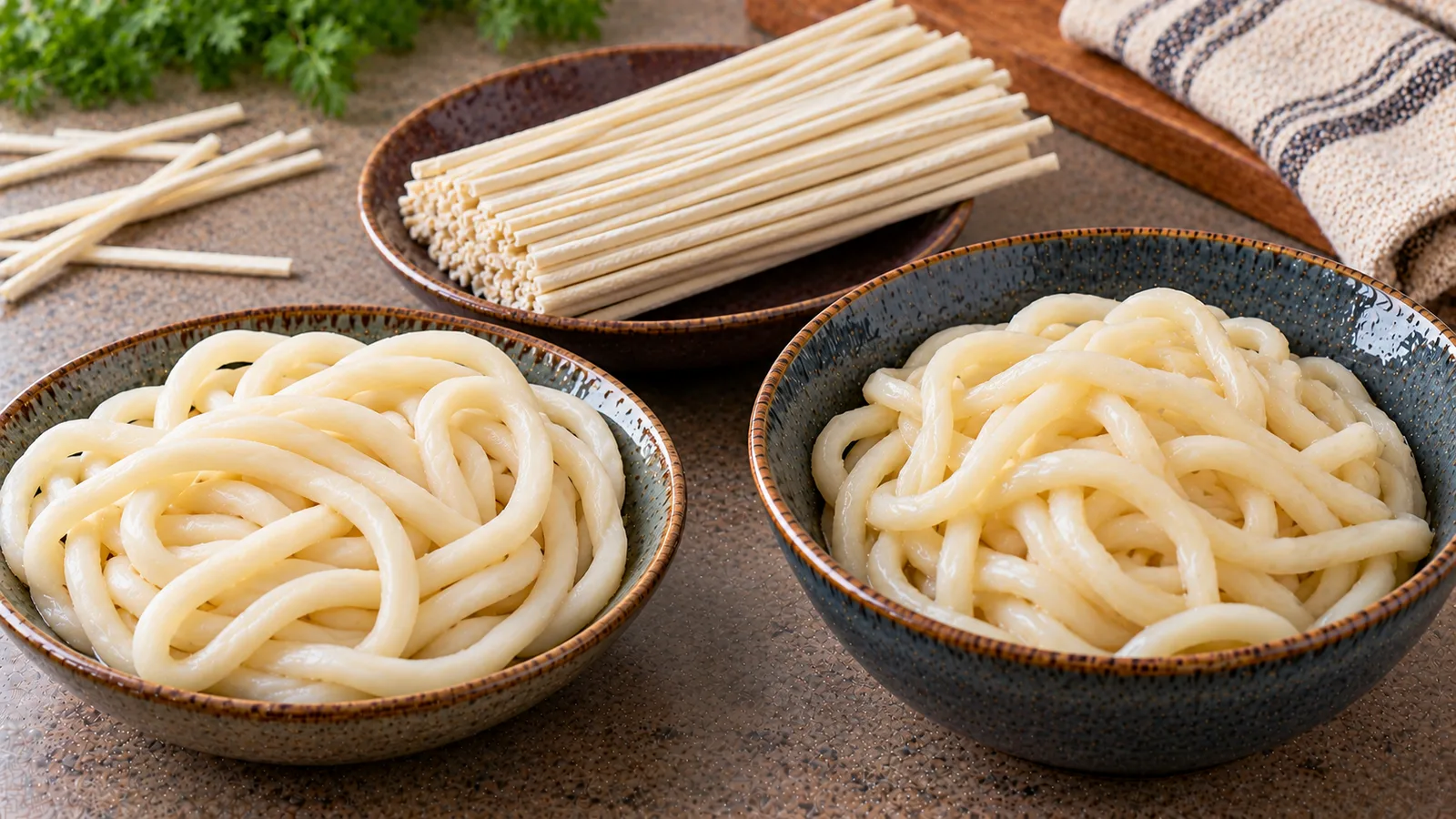
Udon are thick wheat noodles, but the same word on a package can describe fresh uncooked dough, a dry shelf-stable product or moist noodles that are already cooked. Those products contain very different amounts of water. Comparing their calories by weight without reading the preparation state can produce a large tracking error. This guide uses identified entries in Japan's official food composition database rather than treating every packet as equivalent. All reference values apply to plain noodles, not a finished bowl with broth, oil or toppings.
Four separate udon calorie values
The Japanese Standard Tables of Food Composition (2023 supplement to the eighth edition) list 249 kcal per 100 g of fresh uncooked udon (01038), 95 kcal per 100 g of fresh udon after boiling (01039), 333 kcal per 100 g of dried uncooked udon (01041), and 117 kcal per 100 g of cooked noodles made from dried udon (01042). These are four separate reference foods, not a controlled before-and-after experiment on one batch. In particular, 95 and 117 kcal are not competing answers to one identically defined product.
| State of noodles | Calories per 100 g |
|---|---|
| Fresh, uncooked | 249 kcal |
| Fresh, boiled | 95 kcal |
| Dried, uncooked | 333 kcal |
| Made from dried, boiled | 117 kcal |
A ready-to-heat vacuum pack often contains substantial water before you open it. Never enter its 200 g pack weight into a dry-udon entry unless the label specifically says the weight is dry. Similarly, uncooked fresh dough is not the same thing as a shelf-stable pouch of preboiled noodles. The front label's word fresh can be less useful than the ingredients, storage instructions and nutrition declaration.
How many calories are in a serving?
For dried udon, use 333 kcal per 100 g as this article's reference. That gives 200 kcal for 60 g dry, 266 kcal for 80 g dry and 333 kcal for 100 g dry before any dressing. For fresh uncooked udon, the 249 kcal reference gives about 374 kcal for 150 g of uncooked dough. For plain boiled fresh udon, 200 g of the separate cooked reference provides about 190 kcal; 200 g of cooked dried-type udon provides about 234 kcal. The numbers answer different weighing questions and should not be added together.
| Example portion | Estimated kcal |
|---|---|
| Fresh raw udon (150 g) | 374 |
| Fresh boiled udon (200 g) | 190 |
| Dried udon (60 g) | 200 |
| Dried udon (80 g) | 266 |
| Boiled from dried udon (200 g) | 234 |
Use a kitchen scale when possible. A bowl size does not define a serving, because a loosely filled bowl, a tightly packed bowl and a bowl containing broth can all have the same apparent volume while containing different amounts of noodles. Record the grams of noodles independently of the soup and toppings. If you divide a cooked batch between two people, divide the total noodles by the portions actually served, not by a guessed restaurant serving size.
What changes when you boil dried udon?
Much of the increase in weight is absorbed water. A Japanese manufacturer, Yakult Foods, says 100 g of its dry udon becomes approximately 230 g after boiling. Its particular dry product declares 342 kcal per 100 g dry; using its own figures as a simplified no-loss accounting example gives about 149 kcal per 100 g of the 230 g cooked batch. That is a calculation for this manufacturer and yield, not a replacement for the 117-kcal national database entry for a separately characterized cooked food. Some dissolved starch may leave the pot; the simple division is an estimate, not a chemical assay.
If your own 80 g dry portion is labeled 342 kcal per 100 g, it begins with about 274 kcal. Weigh the drained cooked noodles; if the cooked batch weighs 184 g, that same starting energy is roughly 149 kcal per 100 g of your batch before any unmeasured losses. A different final weight changes the per-100-g density but not the fact that you started with 80 g of noodles. A recipe app should use either your weighed dry amount or your measured cooked amount with a compatible database entry, not both.
Shelf-stable moist udon and packaged labels
Many packaged udon servings are already hydrated. A 200 g pouch might be one or two servings, depending on its label and your meal. The energy printed per 100 g can differ from all four government values because ingredients, formulation, salt and water content differ. Check whether the nutrition panel describes the product as sold or after preparation; if the latter, follow the manufacturer's directions, including any sauces counted in the figures. When information is ambiguous, use the package's calories for the entire stated pack rather than borrowing a dry-noodle value from a search result.
Udon are ordinarily wheat-based and may contain gluten. Anyone avoiding wheat or gluten needs to read the ingredient and allergen declaration, rather than assuming that Japanese-style noodles are made from rice or buckwheat. A brown color or a gluten-free-looking broth tells you nothing conclusive about the noodle flour. The same caution applies to restaurant meals, where noodles, broth and garnishes may introduce different ingredients.
Calories from broth, sauce and toppings
Plain-noodle calories are only a subtotal. Soup broth can contribute calories and substantial sodium; sauce, sugar, fried tofu, tempura, meat and added sesame oil can change the meal significantly. For transparent arithmetic, start with 200 g of the reference plain boiled fresh udon (190 kcal) and add 10 g of oil (about 90 kcal). The subtotal becomes approximately 280 kcal, even before broth and other ingredients. The oil value is a conventional energy estimate, not a laboratory measurement of a particular brand.
If a package includes a concentrated sauce sachet, check whether the nutritional declaration already includes it. Do not count that sachet twice. Conversely, do not set the sauce to zero just because the database entry says "udon noodles, boiled." A practical diary entry records noodles, stock, vegetables, protein, condiments and any oil separately when the recipe is assembled at home.
A repeatable kitchen method
Before cooking, photograph or note the label and weigh the amount you put into the pan. Cook according to the package, drain as instructed and weigh the final noodles if you need a cooked serving reference. If you used half the dry package, use half its labeled noodle calories; boiling does not make the other half of those calories vanish. For an already cooked pouch, weigh the portion taken directly from the pouch and use the as-sold data unless the label instructs otherwise.
Avoid comparing a nutrition panel expressed per 100 g prepared with one expressed per 100 g dry as though both described the same starting material. If a brand switches to a different recipe, its label is the best brand-specific number. These steps usually matter more for accuracy than debating a few calories between national food composition tables.
What this means for meal planning
Udon can fit into a balanced dinner, but the noodle subtotal by itself does not show the meal's protein, vegetable content or total energy. Consider a portion of weighed noodles with vegetables and a protein source; log the actual amounts of sauce and oil rather than relying on a generic "udon bowl" entry. When preparing multiple servings, calculate the whole batch from its ingredients first and divide by the measured servings. That approach works for dry, fresh and ready-to-heat udon without switching units halfway through the calculation.
Sources
- Japanese food composition table — fresh uncooked udon (01038)
- Japanese food composition table — fresh boiled udon (01039)
- Japanese food composition table — dried uncooked udon (01041)
- Japanese food composition table — boiled udon made from dried noodles (01042)
- Yakult Foods — dry udon product, label and prepared yield