
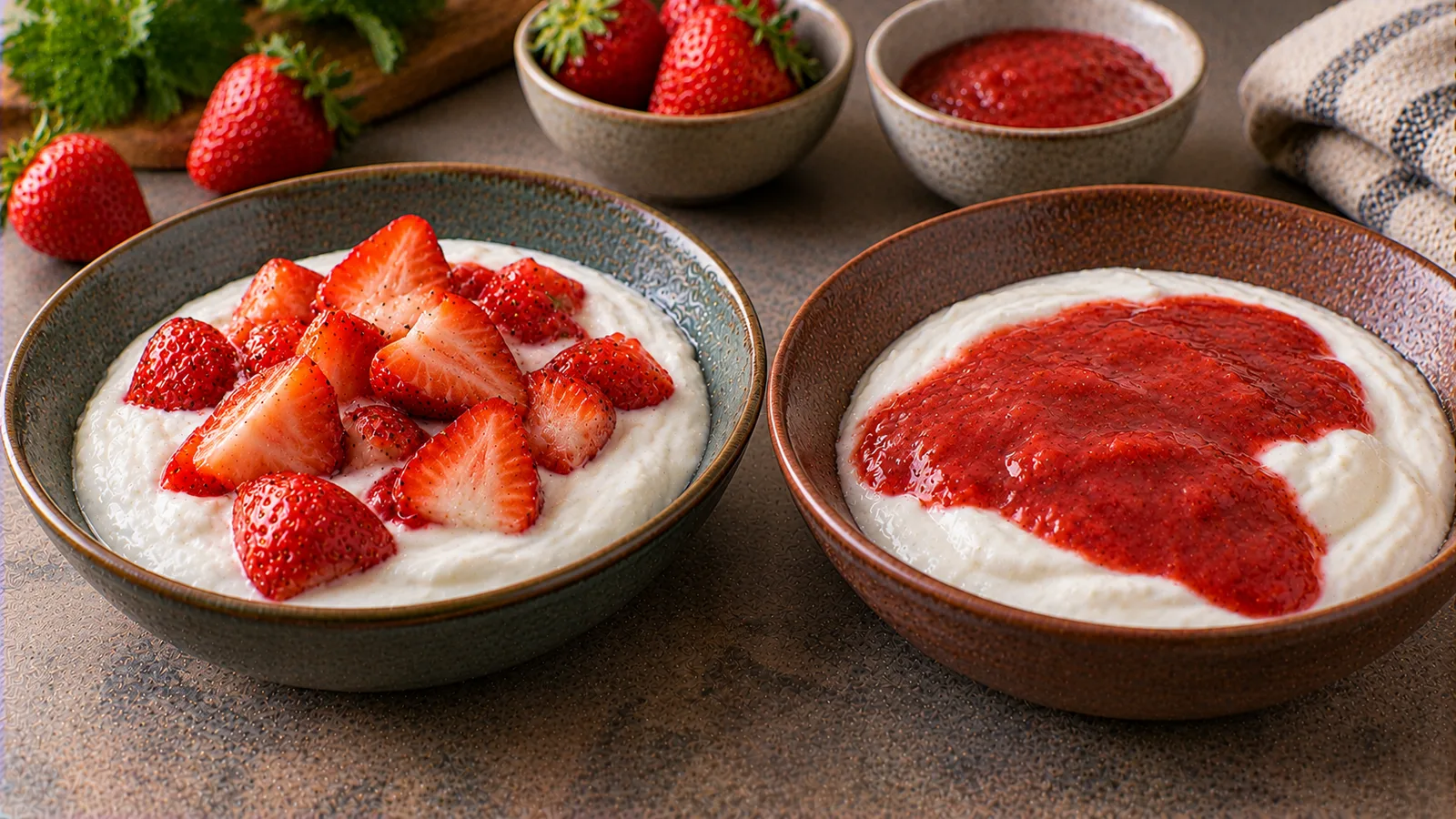
A tub of plain yogurt and one piece of fruit can become two very different-looking breakfasts: a bowl with distinct apple pieces or a creamy swirl of blended apple. Does the smooth version automatically contain less fiber or more sugar? No—if the same 100 g of edible fruit goes into each bowl, the fruit is blended without straining, and nothing is added, the starting quantities of fiber and total sugars are the same. The texture changes; the ingredient arithmetic does not. A purchased fruit topping, however, may contain less fruit, added sweeteners, concentrated juice or removed solids. Those are different comparisons.
The useful question is not whether a blender “creates sugar”. It is what went into the blender, what came out, what was discarded, and how much fruit and yogurt ended up in the bowl. This is a comparison of an assembled bowl, not a comparison of flavored yogurt brands. For interpreting added-sugar wording on packaged yogurt rather than fruit preparation, see added-sugar claims on European yogurt labels. For the rules behind carbohydrate and sugar rows on a label, see how to read a nutrition label.
Define three kinds of fruit topping before comparing
Whole fruit here means chopped, washed raw apple with skin, with core and inedible material removed before weighing. Unstrained purée means exactly that same edible fruit processed briefly into a smooth or coarse mash, with peel, flesh and released liquid retained. Strained purée or fruit sauce may have solids, peel or liquid removed and therefore cannot automatically inherit the whole-fruit values per 100 g. A fourth case, sweetened fruit topping, adds another ingredient and requires its own calculation.
An unsweetened product is not the same thing as a low-sugar product. Fruit contains naturally occurring sugars, and plain milk yogurt contains lactose. Under EU nutrition labeling, “of which sugars” is total sugars, not a separate declaration of added sugars. The EU nutrition-declaration guide explains which nutrients are mandatory and that fibre can be declared voluntarily. The European Commission's rules for “with no added sugars” specify that sweetening ingredients matter; naturally present sugars may still be present.
Compare two bowls using the same edible apple weight
Both bowls use 170 g of the same unflavoured natural yogurt plus 100 g raw edible apple with skin. The yogurt is a clearly labeled illustrative assumption of 4.0 g total sugars and 0 g fiber per 100 g, not a verified universal nutritional value or a label for a particular brand. A yogurt with 3.6 or 5.2 g sugars per 100 g gives a different total. The apple estimate uses the USDA FoodData Central reference for apples with skin, also reproduced in a USDA document: about 10.39 g total sugars and 2.4 g fiber per 100 g edible apple.
| Per finished bowl, before any extra sweetener | Apple chunks | Same apple blended, not strained |
|---|---|---|
| Plain yogurt | 170 g | 170 g |
| Edible raw apple with skin | 100 g | 100 g |
| Sugar from yogurt, assumed | 6.8 g | 6.8 g |
| Sugar from apple, USDA estimate | 10.39 g | 10.39 g |
| Estimated total sugars | 17.19 g | 17.19 g |
| Estimated fruit fiber | 2.4 g | 2.4 g |
| Added table sugar | 0 g | 0 g |
The yogurt contributes 170 × 4.0 ÷ 100 = 6.8 g sugars. The apple contributes 100 × 10.39 ÷ 100 = 10.39 g. Together they give 17.19 g total sugars. The 2.4 g fiber shown is the apple's reference amount, assuming no skin, pulp or other solids are thrown away. This is an ingredient-led estimate, not a laboratory test of the blended final product. Blending may change particle size, texture and how quickly a person eats the bowl; it does not justify subtracting the existing fiber or adding fictitious grams of sugar to a mass-balance calculation.
The numbers do not demonstrate identical blood-sugar responses or satiety. Physiological outcomes depend on food structure, processing, individual response, the rest of the meal and actual eating rate. A nutrient table is not a clinical comparison. Chewing apple pieces usually takes different effort from swallowing a smooth topping, but we make no quantitative promise about appetite or glycemic effects.
What changes when purée is strained or diluted?
If you pass the 100 g blended apple through a fine sieve, the retained part and discarded part have unknown nutrient distributions unless measured. The strainer may trap peel and fibrous solids. Neither the weight of the retained purée nor its fiber per 100 g can be reliably calculated from the USDA whole-apple line. Some soluble fiber and sugars can remain in the liquid, so it is also wrong to declare that all fiber is lost. Weigh the finished purée and use its product-specific nutrition information or laboratory analysis if precise numbers are essential.
Adding 30 g water to 100 g purée does not create or remove the apple's total sugars; it makes a 130 g diluted topping. Per 100 g topping, sugars appear lower because water increases the denominator; per bowl, if all 130 g is eaten, the original apple sugars remain. Conversely, cooking down a sauce by evaporating water can increase grams of sugar per 100 g sauce without adding any sugar to the batch. Always note whether a figure refers to the starting fruit, a reduced sauce or the whole assembled yogurt bowl.
| Comparison trap | Why the number can change | Better question |
|---|---|---|
| Smooth unstrained apple versus chopped apple | Same ingredients but different texture | Did you discard anything? |
| Strained apple purée | Some solids and liquid are separated | What is the yield and actual tested composition? |
| Purée diluted with water | Total fruit mass stays, concentration falls | How many grams of original fruit per bowl? |
| Concentrated cooked sauce | Water loss increases concentration per 100 g | Was sugar added, or only water removed? |
| Packaged dessert fruit layer | Recipe may include sugar, syrup or juice concentrate | What ingredients and quantity of real fruit are used? |
The sweetened topping is a different bowl
Start again with 170 g yogurt and 100 g edible apple, but mix 10 g ordinary table sugar into the apple purée. The bowl then holds 280 g of ingredients instead of 270 g. The fruit still supplies the USDA estimate of 10.39 g sugars and 2.4 g fiber, while yogurt contributes the assumed 6.8 g sugars. Table sugar adds 10 g sugar and 0 g fiber, bringing the estimated bowl to 27.19 g total sugars, with 10 g deliberately added sugar. Compared with the otherwise identical unsweetened apple bowl, that is exactly 10 g more total sugar; it is not the effect of the blender.
| Bowl construction | Total sugars, estimate | Fruit fiber | Table sugar added |
|---|---|---|---|
| 170 g yogurt + 100 g whole apple | 17.19 g | 2.4 g | 0 g |
| 170 g yogurt + 100 g unstrained apple purée | 17.19 g | 2.4 g | 0 g |
| Same apple purée + 10 g added sugar | 27.19 g | 2.4 g | 10 g |
These total-sugar figures include yogurt lactose and fruit's natural sugar. They are not synonymous with “free sugars” under every public-health classification. For example, the UK NHS discussion of free sugars treats sugars in puréed fruit differently from those in intact whole fruit for its guidance, even when no table sugar was added. European Commission/EFSA terminology defines added, total and free sugars in its own policy context. Do not convert these category differences into a claim that physical blending manufactures new sugar molecules, or that an EU nutrition label includes a mandatory stand-alone “free sugars” number.
Change fruit without confusing sugar and fiber
Apple is not the only fruit that works in a bowl. Using the USDA entry for raw strawberries (a reference summary reports 4.89 g sugar and 2.0 g fiber per 100 g), a 170 g yogurt + 100 g strawberry bowl gives approximately 11.69 g total sugars (6.8 + 4.89) and 2.0 g fruit fiber. It is not correct to assume every fruit purée has the same sugar and fiber as apple. The measured value depends on fruit type and cultivar, whether peel and seeds are retained, and how the topping was prepared.
| Yogurt basis: 170 g at assumed 4 g sugars/100 g | Total sugars per bowl | Fruit fiber |
|---|---|---|
| 100 g apple, raw with skin | 17.19 g | 2.4 g |
| 100 g strawberries, raw | 11.69 g | 2.0 g |
| Apple topping with 10 g table sugar | 27.19 g | 2.4 g |
A strawberry mixture with seeds retained preserves more identifiable solids than strained clear strawberry sauce. In any blended version, the fruit quantities in this table refer to 100 g before blending, not a presumed 100 g of commercial finished purée. If a packaged fruit cup lists 60% strawberries and 40% other ingredients, 100 g of that product is not 100 g strawberries.
How to read a store-bought fruit purée jar
Read the ingredient list before the nutrition panel. An ingredient list stating “apple 100%” describes a very different product from “apple, glucose-fructose syrup, concentrated apple juice.” A statement “no added sugar” is subject to EU claim rules, but it does not mean zero naturally occurring sugar and does not provide a guarantee of high fiber. On EU packages the mandatory sugar line reports total sugar; fiber may be absent because its declaration is not generally mandatory. Never treat a missing fiber row as an analytical result of 0 g.
Next compare products using the same basis: nutrition figures per 100 g of product, number of grams you actually spoon into the yogurt, and how much edible fruit those grams represent. If one jar gives nutrition only for a prepared portion, check whether water or milk is meant to be added. For a fruit-only unstrained ingredient, the whole-apple USDA comparison is a reasonable illustrative starting point, not a substitute for the declared product value.
A repeatable kitchen test for one breakfast
Wash raw fruit under running water, trim it safely and weigh 100 g of the edible part after removing the core. The FDA guidance on selecting and serving fresh produce recommends cleaning fresh produce even when the skin will not be eaten. Divide one preparation between two independent test bowls only if you have enough fruit; for a true equal-fruit comparison each bowl needs its own 100 g portion. Add 170 g plain yogurt to each. Leave one fruit portion chopped and blend the other until smooth without sieving it or adding water. Eat or refrigerate promptly and follow the yogurt's storage label.
Record whether the entire purée, including the skin and any liquid on the blender wall, was transferred. A visibly large residue breaks the exact-mass assumption. For a more controlled comparison, weigh the blender jar before and after emptying it; account for leftovers rather than declaring 100 g transferred automatically. If you want to know your brand's total sugar, substitute its declared yogurt sugar value into the formula: yogurt grams × labeled sugar per 100 g ÷ 100 + fruit grams × fruit sugar per 100 g ÷ 100 + any added sugar grams. Dietary fiber is calculated separately from an appropriate fruit or product data source; it is not directly derived from the sugars line.
Who should choose which topping?
If chewing, fruit texture and recognisable pieces matter, use chopped whole fruit. If a smooth texture is necessary for a recipe or personal preference, blend the whole edible portion without straining, and keep the fruit amount measured. If a purchased jar is convenient, choose it using actual ingredients, per-100-g composition and portion size. For anyone adjusting sugar intake on medical advice, discuss individual food choices with a qualified clinician instead of treating a generic bowl calculation as personalized guidance. Neither whole fruit nor purée is automatically a “bad” food; the important differences are ingredient composition, processing, texture and serving size.
Sources
- USDA FoodData Central, raw apple with skin (FDC 171688); USDA composition table.
- USDA FoodData Central, raw strawberries (FDC 167762).
- European Commission: nutrition declaration and optional fibre; rules for no-added-sugars claims.
- European Commission: sugar terminology and NHS: sugars in puréed fruit.
- FDA: wash and handle fresh produce safely.