
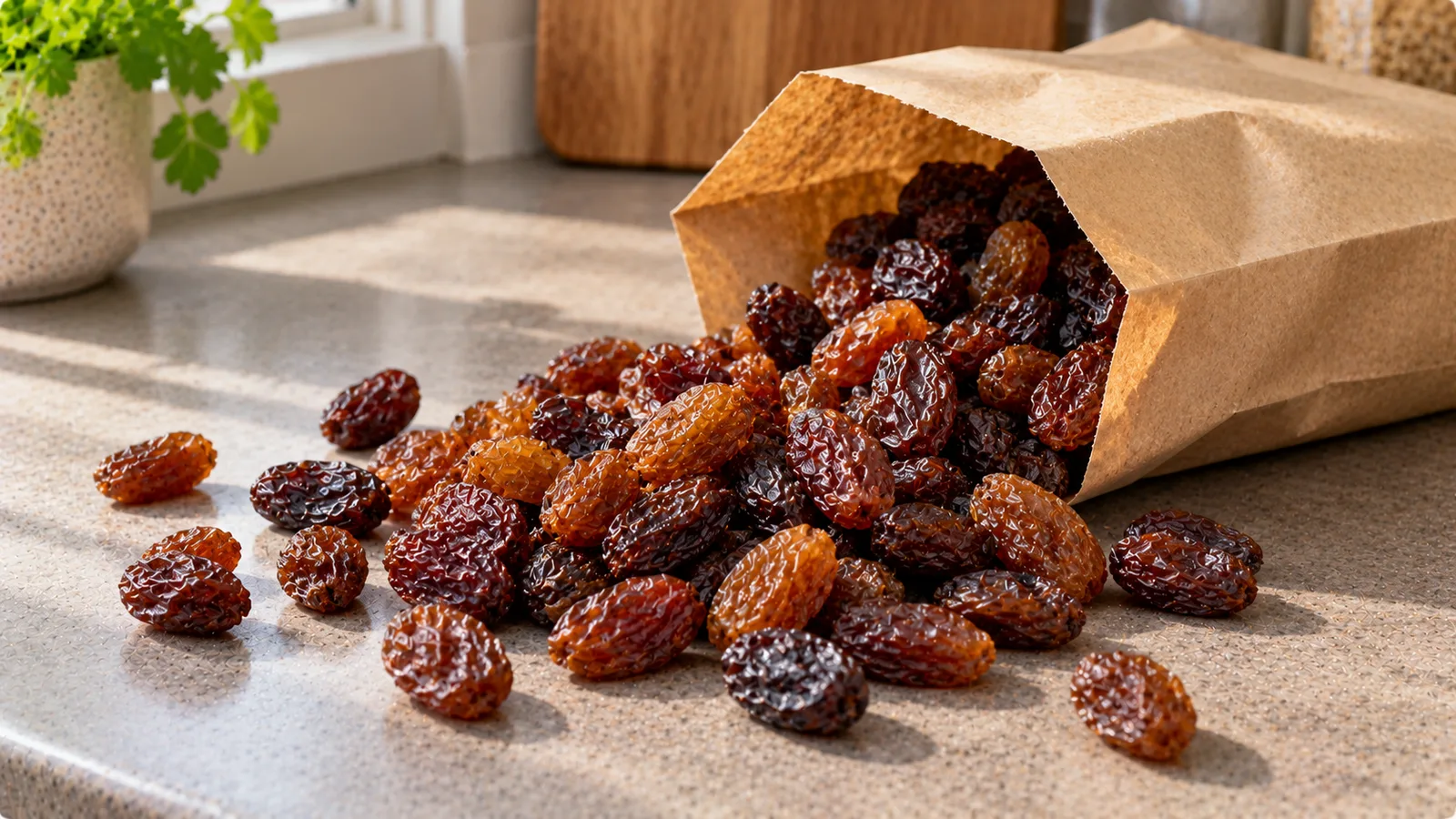
Raisins are dried grapes. They are commonly eaten as a snack, mixed into breakfast cereals, added to baked goods or used in savory dishes.
Because much of the water has been removed, raisins contain more calories per 100 g than fresh grapes.
A practical reference value for ordinary seedless raisins is approximately 299 calories per 100 g.
That means a 30 g portion provides about 90 calories, while a 50 g portion provides approximately 150 calories.
The exact value depends on the variety, moisture content and any additional ingredients.
For accurate food tracking, the most useful approach is to measure the actual weight of raisins rather than estimate the number of individual pieces.
Raisin calories by portion size
The following calculations use 299 kcal per 100 g, a representative value for seedless raisins.
| Raisin portion | Approximate calories |
|---|---|
| 5 g | 15 kcal |
| 10 g | 30 kcal |
| 15 g | 45 kcal |
| 20 g | 60 kcal |
| 25 g | 75 kcal |
| 30 g | 90 kcal |
| 40 g | 120 kcal |
| 50 g | 150 kcal |
| 60 g | 179 kcal |
| 75 g | 224 kcal |
| 100 g | 299 kcal |
| 150 g | 449 kcal |
| 200 g | 598 kcal |
These values are rounded estimates.
A particular brand may have slightly different nutrition information.
If the package provides calories per 100 g, use that value when calculating your portion.
Source for representative composition: USDA FoodData Central.
How many calories are in one tablespoon of raisins?
A tablespoon is a volume measurement, not a fixed weight.
The amount of raisins it holds depends on their size, how tightly they are packed and whether the spoon is level or heaped.
For practical estimates, a level tablespoon may contain approximately 9–10 g of raisins.
Using 10 g as an illustrative weight:
| Amount | Estimated weight | Calories |
|---|---|---|
| 1 tablespoon | 10 g | 30 kcal |
| 2 tablespoons | 20 g | 60 kcal |
| 3 tablespoons | 30 g | 90 kcal |
| 4 tablespoons | 40 g | 120 kcal |
| 5 tablespoons | 50 g | 150 kcal |
These are not universal conversion factors.
A heaped tablespoon can weigh more than a level one.
If you regularly add raisins to oatmeal or yogurt, weigh your usual spoonful once. You can then use that measured amount as a personal reference.
How many calories are in a handful of raisins?
Handfuls are particularly variable.
A small handful might weigh approximately 20–30 g, while a larger handful could weigh 40–50 g or more.
| Raisin portion | Weight | Calories |
|---|---|---|
| Small handful | 20 g | 60 kcal |
| Small handful | 30 g | 90 kcal |
| Larger handful | 40 g | 120 kcal |
| Larger handful | 50 g | 150 kcal |
These weights are examples rather than standardized serving sizes.
Two people can pick up very different quantities with one hand.
When precise calorie tracking matters, weighing raisins is more reliable than logging one handful.
Raisin nutrition facts per 100 g
Raisins are primarily a carbohydrate-rich food.
Representative USDA values for ordinary seedless raisins include:
| Nutrient | Per 100 g | Per 30 g |
|---|---|---|
| Calories | 299 kcal | 90 kcal |
| Protein | 3.07 g | 0.92 g |
| Fat | 0.46 g | 0.14 g |
| Total carbohydrate, US definition | 79.18 g | 23.75 g |
| Dietary fiber | 3.7 g | 1.11 g |
| Total sugars | 59.19 g | 17.76 g |
| Potassium | 749 mg | 225 mg |
| Iron | 1.88 mg | 0.56 mg |
Source: USDA FoodData Central.
Raisins contain very little fat and relatively little protein.
Most of their calories come from carbohydrates, particularly naturally occurring sugars.
They also contribute some fiber and minerals.
The nutrient amounts in a typical 30 g portion are considerably smaller than the values listed for 100 g.
Why European and US carbohydrate labels differ
American nutrition databases generally include fiber in total carbohydrate.
European nutrition labels list available carbohydrate and fiber separately.
Using the representative figures above:
79.18 g total carbohydrate − 3.7 g fiber = approximately 75.48 g available carbohydrate per 100 g.
This is a difference in labeling conventions.
It does not mean that raisins sold in different countries necessarily have different compositions.
Reference: Regulation (EU) No 1169/2011.
Raisins versus fresh grapes: calories
Raisins are produced by drying grapes.
During drying, much of the water is removed.
The sugars and other nutrients remain concentrated in a smaller mass.
That is why raisins have substantially more calories per 100 g than fresh grapes.
Representative values are:
| Food | Calories per 100 g |
|---|---|
| Fresh grapes | Approximately 69 kcal |
| Raisins | Approximately 299 kcal |
Source: USDA FoodData Central.
This does not mean drying creates calories.
If grapes are dried without adding or removing energy-containing ingredients, their total energy is largely retained while their weight decreases.
Example: equal weights
A 100 g portion of fresh grapes provides approximately 69 kcal.
A 100 g portion of raisins provides approximately 299 kcal.
The raisins contain more concentrated grape solids because they contain much less water.
Example: equal starting fruit
Suppose a batch of fresh grapes contains 300 kcal before drying.
If drying removes only water, the finished raisins will still contain approximately the same total energy, excluding processing losses.
However, the finished raisins will weigh much less.
The important distinction is between comparing equal weights and comparing the same original quantity of grapes.
How much sugar is in raisins?
Ordinary seedless raisins contain approximately 59.2 g of naturally occurring sugars per 100 g.
| Raisin portion | Approximate sugars |
|---|---|
| 10 g | 5.9 g |
| 15 g | 8.9 g |
| 20 g | 11.8 g |
| 30 g | 17.8 g |
| 40 g | 23.7 g |
| 50 g | 29.6 g |
| 100 g | 59.2 g |
These sugars are naturally present in the dried fruit.
However, naturally occurring sugars still contribute carbohydrates and calories.
Public-health recommendations distinguish sugars within whole fruit from free sugars, such as added sugars and those in fruit juices.
Source: World Health Organization — Healthy diet.
This distinction does not make raisins low in sugar.
Their concentrated carbohydrate content is important when selecting a portion.
Are raisins high in carbohydrates?
Yes.
Ordinary raisins contain approximately 79 g total carbohydrate per 100 g under the US definition, including dietary fiber.
A 30 g portion provides approximately 24 g total carbohydrate.
A 50 g portion provides approximately 40 g.
A 100 g portion provides approximately 79 g.
If you track available carbohydrates according to European nutrition labeling, use the appropriate figure from your product's packaging.
People who manage carbohydrate intake for diabetes or another medical reason should consider the actual portion and their individualized dietary advice.
How much fiber do raisins contain?
Representative seedless raisins provide approximately 3.7 g dietary fiber per 100 g.
| Portion | Approximate fiber |
|---|---|
| 15 g | 0.6 g |
| 20 g | 0.7 g |
| 30 g | 1.1 g |
| 40 g | 1.5 g |
| 50 g | 1.9 g |
| 100 g | 3.7 g |
Raisins can contribute to fiber intake.
However, they should not be the only source of fiber in a diet.
The European Food Safety Authority considers 25 g dietary fiber per day an adequate intake for normal laxation in adults.
Source: EFSA — Dietary Reference Values.
Vegetables, legumes, whole grains, fresh fruit, nuts and seeds can provide fiber alongside other nutrients.
Minerals in raisins
Raisins provide several minerals.
Representative values per 100 g include:
- Potassium: approximately 749 mg.
- Iron: approximately 1.88 mg.
- Calcium: approximately 50 mg.
- Magnesium: approximately 32 mg.
Source: USDA FoodData Central.
The amount obtained depends on the portion.
For example, a 30 g serving provides approximately 225 mg potassium.
The presence of minerals does not establish that raisins prevent or treat a particular medical condition.
A varied diet remains important.
Are all raisins nutritionally identical?
No.
Raisins differ by grape variety, drying method, moisture level and additional ingredients.
Common products include dark raisins, golden raisins and sultanas.
Dark raisins
Dark raisins are commonly produced from grapes dried without the processing used to create some golden varieties.
Their precise composition depends on the grapes and processing conditions.
Golden raisins
Golden raisins often undergo a different drying or preservation process.
Some products contain sulfur dioxide or sulfites to help maintain their color.
Sulfites must be declared according to applicable labeling rules when present at relevant levels.
People sensitive to sulfites should read the ingredient list.
Sultanas
The term sultanas is used differently across markets.
It commonly refers to raisins made from particular seedless grape varieties.
Calorie values are generally comparable to other raisins, but individual products can differ.
Raisins with added ingredients
Some raisin products contain added sugar, oil, coatings or flavorings.
Chocolate-covered raisins are a different food from plain raisins.
Use the complete product's nutrition label.
Do not assume all packaged raisin snacks have 299 kcal per 100 g.
Calories in raisins added to breakfast
Raisins are often added to foods that already contain carbohydrates and calories.
Their contribution should be calculated separately.
Oatmeal with raisins
Suppose you prepare oatmeal using:
- Dry oats: 60 g.
- Milk: 200 ml.
- Raisins: 20 g.
- Cinnamon.
The raisins contribute approximately 60 kcal.
Oats and milk contribute additional energy.
The total depends on their exact quantities and nutrition values.
Yogurt with raisins
Suppose a bowl contains:
- Plain yogurt: 200 g.
- Raisins: 30 g.
- Walnuts: 15 g.
The raisins contribute approximately 90 kcal.
The yogurt and walnuts must also be included in the meal total.
Breakfast cereal with raisins
If a cereal already contains raisins, use the packaged cereal's nutrition information.
Adding more raisins increases the total calories.
Do not count the raisins already included in a packaged cereal twice.
Calories in raisins used for baking
Raisins are common in bread, muffins, cakes, cookies and other baked goods.
For homemade recipes, the correct approach is to calculate the calories of all ingredients.
Example: homemade raisin bread
Suppose a bread recipe contains 100 g raisins.
The raisins contribute approximately 299 kcal to the entire loaf.
If the loaf is cut into ten equal portions, the raisins account for approximately 30 kcal per portion.
The flour, oil, butter, sugar and other ingredients contribute additional calories.
Example: oatmeal cookies
Suppose a cookie recipe contains 80 g raisins.
The raisins contribute:
80 × 2.99 = approximately 239 kcal.
If the finished recipe produces 12 equal cookies, the raisins account for approximately 20 kcal per cookie.
This is only the contribution from the raisins, not the calorie content of a complete cookie.
How to calculate raisin calories
Using the reference value of 299 kcal per 100 g:
Calories = weight in grams × 2.99
Examples:
- 8 g × 2.99 = 24 kcal.
- 12 g × 2.99 = 36 kcal.
- 18 g × 2.99 = 54 kcal.
- 28 g × 2.99 = 84 kcal.
- 35 g × 2.99 = 105 kcal.
- 45 g × 2.99 = 135 kcal.
- 65 g × 2.99 = 194 kcal.
- 90 g × 2.99 = 269 kcal.
For a product with 310 kcal per 100 g, multiply the portion weight by 3.10 instead.
The product-specific value should take precedence over the general estimate.
Weighing raisins accurately
A digital kitchen scale is the simplest tool.
- Place a bowl on the scale.
- Reset the display to zero.
- Add the raisins.
- Record their weight.
- Calculate calories using the nutrition label.
If you are adding raisins to another food, you can weigh them separately before mixing.
For small quantities, a scale that measures in 1 g increments is generally more useful than relying on tablespoons.
What if you do not have a scale?
Use the serving size printed on the package if available.
A tablespoon or handful can be used as an estimate, but the uncertainty should be understood.
For example, treating every handful as 30 g may underestimate calories if your actual handful weighs 50 g.
The difference is approximately 60 kcal.
Are raisins suitable for weight management?
Raisins can fit into a diet intended to manage body weight.
They provide sweetness, carbohydrates and some fiber.
However, they are relatively energy-dense.
A small 30 g portion provides approximately 90 kcal.
A 100 g portion provides approximately 299 kcal.
Both can fit into different eating patterns, but they are not interchangeable portions.
Raisins do not independently cause weight loss or weight gain.
Overall energy intake, dietary patterns and other factors influence body weight.
A practical approach is to decide on a portion before eating and include it in the meal or snack total.
Raisins before or after exercise
Raisins provide carbohydrates and are easy to carry.
They may be convenient around physical activity depending on the duration of exercise, personal preferences and digestive tolerance.
A 30 g serving contains approximately 24 g total carbohydrate under the US definition.
A 50 g serving contains approximately 40 g.
They are not required for exercise performance.
The appropriate carbohydrate intake depends on the activity and individual circumstances.
Raisins and dental health
Raisins contain concentrated sugars and have a sticky texture.
Oral-health considerations depend on the overall diet, eating frequency, oral hygiene and individual risk.
It is not appropriate to claim that raisins automatically cause tooth decay or that they are harmless to teeth.
The World Health Organization recommends limiting free sugars as part of oral and general health guidance.
Source: WHO — Healthy diet.
For personalized dental advice, consult a dental professional.
How to store raisins
Store raisins according to the package instructions.
Keep them in a clean, sealed container, protected from moisture and contamination.
Some products benefit from refrigeration after opening.
Check the best-before date and storage directions.
Discard raisins showing mold or other clear signs of spoilage.
If raisins become dry or hard, this does not automatically mean they are unsafe, but their quality may have changed.
Common questions
How many calories are in 100 g of raisins?
Approximately 299 kcal for ordinary seedless raisins.
How many calories are in 30 g of raisins?
Approximately 90 kcal.
How many calories are in 50 g of raisins?
Approximately 150 kcal.
How many calories are in one tablespoon of raisins?
Approximately 30 kcal if the tablespoon contains 10 g. Actual spoonfuls vary.
How many calories are in a handful of raisins?
A 20–30 g handful provides approximately 60–90 kcal. Larger handfuls contain more.
Are raisins higher in calories than grapes?
Per 100 g, yes. Raisins contain much less water and therefore have a higher energy concentration.
Are raisins high in sugar?
Yes. Ordinary raisins contain approximately 59 g naturally occurring sugars per 100 g.
Do golden raisins have different calories?
They can differ slightly by product, but the values are generally comparable. Check the package label.
Are raisins a good source of protein?
No. Raisins contain relatively little protein, approximately 3 g per 100 g.
Sources and calculation method
- USDA FoodData Central — representative nutrient values for raisins and fresh grapes.
- Regulation (EU) No 1169/2011 — European nutrition-labeling conventions.
- WHO — Healthy diet — dietary sugar guidance.
- EFSA — Dietary Reference Values — dietary fiber reference information.
Calorie calculations use 299 kcal per 100 g of ordinary seedless raisins. Spoon and handful weights are illustrative estimates rather than standardized measures. Product-specific nutrition labels should be used whenever available.