
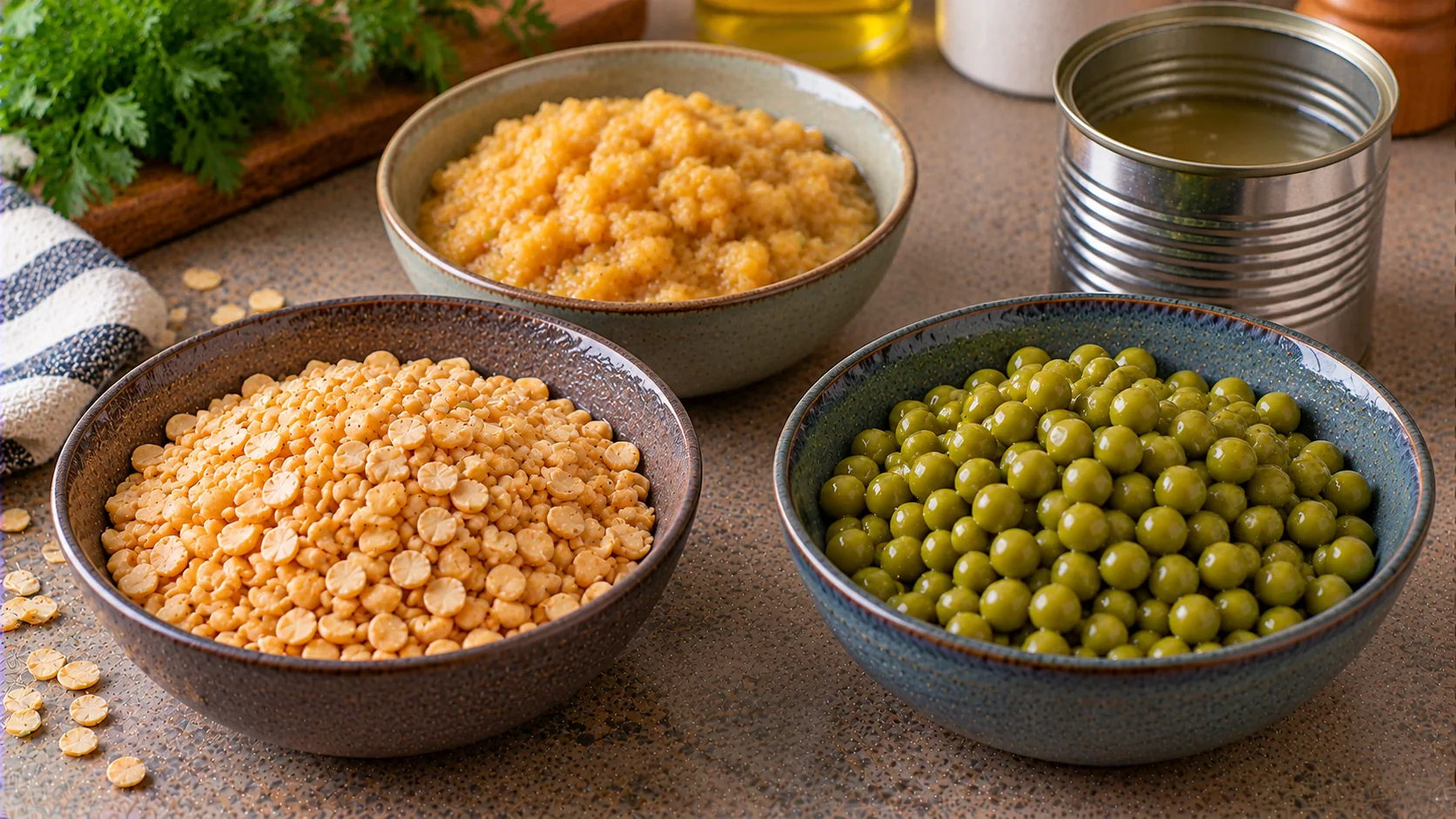
Dried Split Peas vs Canned Peas: Nutrition and Cost
What exactly is being compared?
Dried split peas and canned green peas both come from peas, but they are not interchangeable versions of one identical product. Split peas are mature dried seeds with the seed coat removed and the seed split; canned green peas are generally harvested tender, then heated in a can. Their moisture, texture, taste, cooking needs and nutrient concentrations differ. Compare edible cooked or drained weight rather than dry peas against a wet can. A cheap-looking package is not necessarily the cheapest finished portion.
Nutrition at the same cooked weight
For an illustrative USDA-style reference comparison, cooked split peas boiled without salt supply about 118 kcal, 8.3 g protein and 8.3 g fibre per 100 g. Plain canned green peas vary by brand; the example below uses a hypothetical label of 73 kcal, 4.5 g protein and 4.5 g fibre per 100 g drained. Do not treat the canned row as a universal USDA measurement. For a real purchase, take all three values from the actual can and compare the same edible state. The cooked split-pea reference can be checked in USDA FoodData Central.
| Nutrient / Nährwert / Nutriment | Cooked split peas / Schälerbsen / Pois cassés | Canned green peas / Dosenerbsen / Petits pois |
|---|---|---|
| kcal / 100 g | 118 | 73 (model) |
| protein / Eiweiß / protéines / 100 g | 8.3 g | 4.5 g (model) |
| fibre / Ballaststoffe / fibres / 100 g | 8.3 g | 4.5 g (model) |
What a 200 g serving means
At 200 g ready to eat, the cooked split-pea reference gives 236 kcal, 16.6 g protein and 16.6 g fibre. The model canned peas give 146 kcal, 9.0 g protein and 9.0 g fibre. These differences partly reflect maturity and water content; they do not demonstrate that canned peas are an unhealthy choice. The serving itself is larger than a common vegetable side portion; adjust it to the actual meal and do not present the numbers as a recommended serving for everyone.
| Comparison / Vergleich / Comparaison | Cooked split peas | Canned peas (model) |
|---|---|---|
| 200 g kcal | 236 | 146 |
| 200 g protein | 16.6 g | 9.0 g |
| 200 g fibre | 16.6 g | 9.0 g |
Why dry weight is not a fair shortcut
Suppose 100 g of dry split peas becomes 250 g cooked, with water absorption and some evaporation. The yield factor is 2.5; 200 g cooked requires 80 g dry. Real cooked yield depends on simmer duration, draining and texture. Weigh a representative cooked batch if you need accurate cost. With canned peas, use the drained weight stated on the can or weigh the drained contents; a 400 g can may contain 240 g peas and 160 g packing liquid. Never compare 400 g can weight to 400 g cooked peas.
A transparent shopping-cost model
Model prices, not checked current store offers: 500 g dried split peas for €1.50; a can of green peas with 240 g drained weight for €0.95. The dry peas cost €0.30 per 100 g dry; using a yield of 2.5, 200 g cooked costs 80/500 × €1.50 = €0.24 before energy. Drained canned peas cost 200/240 × €0.95 = €0.79 for the same weight. This comparison excludes seasonings, transport, water and packaging deposits. The full can costs €0.95 at checkout even if you eat only 200 g.
Accounting for stove energy and time
Cooking energy can narrow the gap. Illustrative saucepan electricity of 0.6 kWh at €0.35/kWh costs €0.21 per batch. If that batch makes 500 g cooked split peas, the allocated energy for 200 g is €0.21 × 200/500 = €0.084; total split-pea cost becomes about €0.32 per 200 g. Using a pressure cooker, larger batch or residual heat changes the result. Canned peas typically need only heating, whose energy is excluded in this simple baseline; add it if comparing two hot meals. Neither kWh number nor shelf price is a measured supermarket study.
Sodium and the can label
Canned peas may contain added salt, while split peas cooked without salt do not. Convert label salt to sodium only when needed: salt (g) = sodium (g) × 2.5 under EU labelling conventions. For example, 0.65 g salt per 100 g drained yields 1.30 g salt in 200 g; a no-added-salt can could be far lower. Draining and rinsing may reduce some surface brine, but do not apply an invented fixed percentage reduction. Read the actual label, including whether values refer to drained contents.
Two practical ways to prepare them
Split peas: sort and rinse 160 g dry peas, cover with abundant fresh water, bring to a boil and simmer gently according to the packet until soft, commonly around 30–50 minutes; add water as needed. Weigh the resulting cooked batch instead of assuming a fixed yield. Salt to taste only after deciding the desired sodium level. Canned green peas: check the can, open, drain, optionally rinse, then heat in a saucepan with a spoonful of water until piping hot, usually a few minutes; do not boil them long enough to turn mushy. Follow the producer’s heating instructions.
Texture, uses and substitutions
Soft cooked split peas tend to break down and thicken soup, dhal and mash. Canned green peas retain small whole spheres and work as a quick side, in rice or in salads if the label allows ready-to-eat use. Do not substitute one for the other at a 1:1 dry weight. For a protein-rich thick soup, split peas usually fit the texture; for a five-minute vegetable addition, canned peas offer convenience. A decision should weigh preparation time and the dish, not protein per euro alone.
Safe storage and leftovers
Dry peas should be stored sealed in a cool, dry cupboard according to the packet. An unopened can follows its best-before date and storage instructions. Transfer leftovers from an opened can to a clean covered container and refrigerate promptly. Cool cooked split peas quickly in shallow containers; follow USDA safe food handling and use most cooked leftovers within 3–4 days. Reheat thoroughly; freeze additional portions promptly if not eating them in that period.
Which is the better buy?
Choose dried split peas for a cooked bulk batch and thick soups when you have time and the yield supports the price advantage. Choose canned peas for intact texture, quick service and low effort. To check another dried-versus-canned legume comparison, see the dried-versus-canned bean cost comparison. For a similar cost calculation focused on lentils, read the cooked-portion lentil cost comparison. Recalculate with your own receipts, drained weights and batch yield before deciding which is cheapest for your kitchen.
| Cost model / Kostenmodell / Modèle | Split peas | Canned peas |
|---|---|---|
| Edible 200 g before energy | €0.24 | €0.79 |
| Edible 200 g with modeled batch energy | €0.32 | €0.79 (heating excluded) |
Sources
- USDA FoodData Central — split peas cooked without salt; values for canned peas are expressly hypothetical.
- USDA Food Safety Basics — refrigeration and leftovers.