
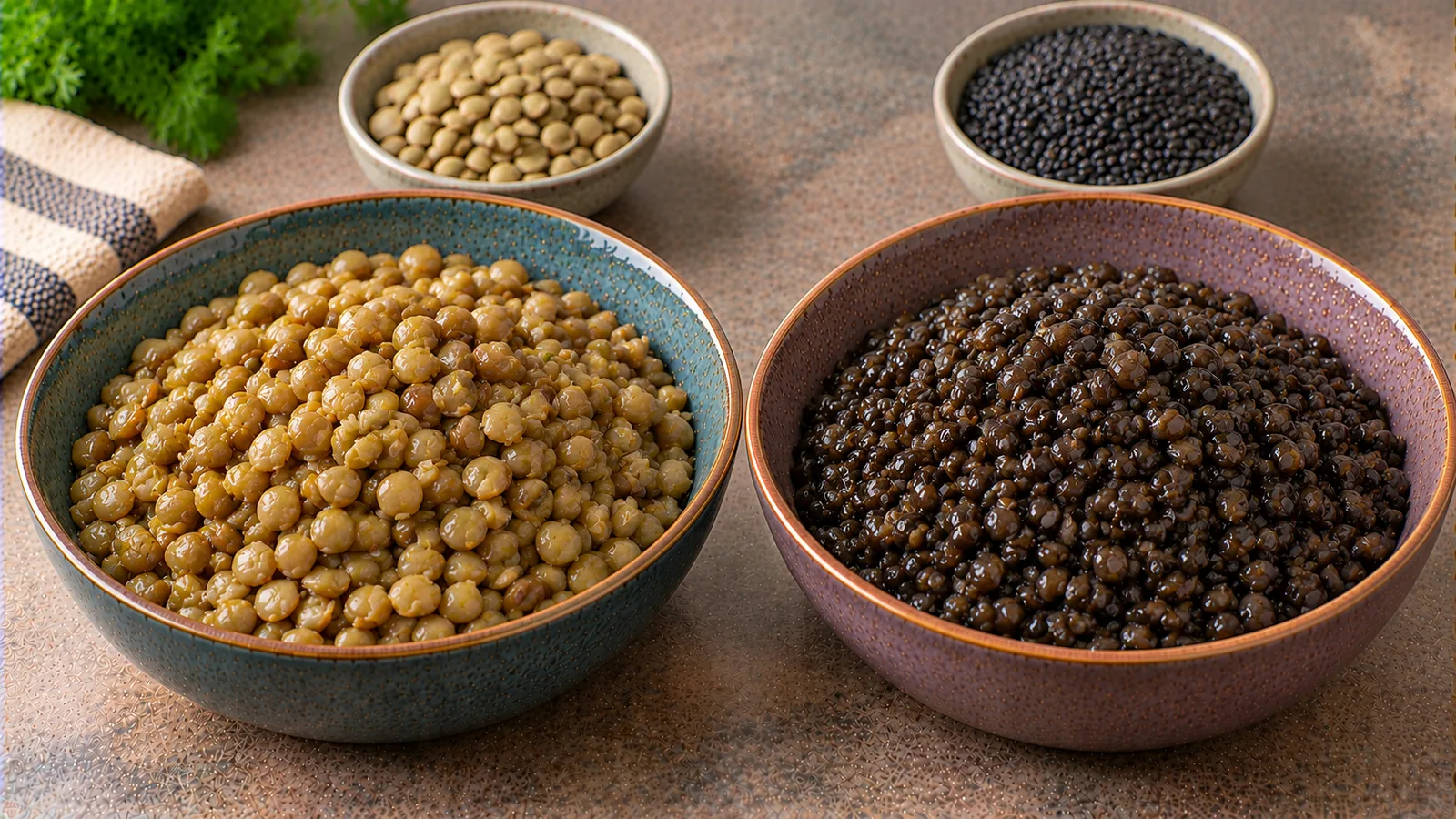
Green lentils and black Beluga lentils are both small dried legumes that can work in soups, grain bowls and salads. But the practical choice depends on the precise variety and brand: cooking time, how firmly each lentil holds its shape, the food-label basis and the shelf price. The word black here means Beluga lentils, not black beans or black gram. The green comparison product is labelled simply dmBio Grüne Linsen, not peeled green split peas.
This comparison uses two specified organic 500 g dry packs sold by dm in Germany, with product information checked on 22 October 2026. The same retailer and package weight help make the price and instructions comparable. The article deliberately does not imply that every green lentil cooks faster or that every black lentil costs less.
Green versus black lentils: the numbers
| Item | dmBio green lentils | dmBio black Beluga lentils |
|---|---|---|
| Pack size, dry | 500 g | 500 g |
| Published pack price | €2.85 | €2.45 |
| Price per 100 g dry | €0.57 | €0.49 |
| Manufacturer cooking instruction | 10–15 minutes | 30–35 minutes |
| Soaking in product instructions | Not required | Not required |
| Fiber per 100 g dry | 17 g | 17 g |
| Protein per 100 g dry | 23 g | 23 g |
| Energy per 100 g dry | 304 kcal | 305 kcal |
The green-lentil product page gives 10–15 minutes at low heat after bringing rinsed lentils to a boil in three times their volume of water. The Beluga-lentil product page gives 30–35 minutes, using twice the volume of water. These are instructions for those specific products, not a universal scientific ranking of green and black lentils. Package directions can change, so check the packet in your kitchen.
The displayed fiber and protein are also strikingly similar: 17 g fiber and 23 g protein per 100 g of dry lentils for both dmBio products. Their declared energy differs by just 1 kcal per 100 g dry. This is not evidence that all brands are identical; it is the exact pair of labels chosen for this comparison.
Why the cooking times differ
It can be tempting to assume that dark Beluga lentils are automatically quicker because they are small. These particular labels demonstrate why size alone is a poor shortcut. dmBio tells buyers to simmer its green lentils for 10–15 minutes, but its black Beluga lentils for 30–35 minutes. Even when both packs are unsoaked, the written instructions are substantially different.
Start the clock at the gentle simmer, not when the dry lentils first go into cold water. Test several lentils at the lower end of the range. A lentil that has softened at its centre but still keeps its outline is usually suitable for a salad. For a soup where the lentils are intended to thicken the broth, continue cooking until the texture fits the dish. Water hardness, age of the dry pulse, pot size and heat level can all change the actual result.
Neither of these packs instructs soaking. That agrees with general Iowa State University Extension lentil guidance: lentils ordinarily do not need a presoak. Sort out any debris, rinse with water, and follow the specific manufacturer's water and time instructions. Do not extend cooking solely because a recipe for another variety says to boil lentils for 40 minutes.
The reverse is also important: 10–15 minutes is not a food-safety guarantee or a universal endpoint. If the green lentils remain hard, continue simmering and test again. If the Beluga lentils soften earlier than 30 minutes in your pan, stop at the texture you need rather than automatically overcooking them.
Which one holds its shape?
Beluga lentils are named for their small, dark appearance. The dmBio description specifically says they remain pleasantly firm after cooking. In a dish where individual grains should be visible, their dark colour provides contrast with roast vegetables, carrots, parsley and light-coloured grains. They can make a salad look more defined without requiring a separate topping.
The green product is a useful alternative for quick vegetable soups, simple warm bowls and a side dish. However, the name green lentils does not identify a single universal texture. French Puy-style lentils, generic green lentils, mountain lentils and various brands can differ. The product page for this green dmBio pack does not prove that every green lentil will soften in 10 minutes.
If you want firm, separate lentils, taste the beans frequently as the packet's lower cooking limit approaches, then drain promptly. If you want a creamy soup, either variety can be cooked a little further and some of the lentils mashed. The additional liquid from a soup recipe means its final texture may differ from a sample cooked only in water.
For cold salads, cook the lentils, drain thoroughly and allow them to cool safely before mixing with vegetables and dressing. Do not compare a strained salad portion to a bowl of soup by equal total weight: water and broth can dilute the measured lentil quantity.
Fiber: compare dry weights before cooked portions
Both selected packages state 17 g fiber per 100 g dry. This yields 10.2 g of label-estimated fiber in 60 g dry lentils for either pack, using 17 × 0.60 = 10.2. It is a straightforward dry-input calculation; it is not a laboratory measurement of a 150 g cooked portion.
Cooking adds water and changes weight, and some soluble compounds can move into the cooking liquid. If one pot yields 240 g cooked from 100 g dry while another yields 280 g, equal 150 g cooked portions do not represent equal dry input. Therefore, claiming that both types contain precisely 10.2 g fiber per 150 g cooked would overstate what the labels establish.
For a repeatable home test, weigh 60 g dry of each, prepare them separately as directed, drain in the same way and weigh the cooked yields. If each batch happened to finish at 150 g, that would be a 2.5× illustrative yield, not a manufacturer-verified result. Only then would each whole batch represent the same 60 g dry starting quantity. Use the dry labels as an estimate of the starting nutrients, without implying that every gram is necessarily retained through boiling and draining.
Similarly, each dry 60 g batch starts with 13.8 g label-estimated protein (23 × 0.60) and approximately 182 kcal from the green pack versus 183 kcal from the black pack (304 × 0.60 and 305 × 0.60, rounded). These are ingredient-input numbers—not validated nutrient values for the drained cooked serving.
Price: a pack, a dry portion and a cooked yield
On the checked German dm product pages, the green lentils cost €2.85 per 500 g, or €5.70/kg. Black Beluga lentils cost €2.45 per 500 g, or €4.90/kg. Both are ordinary listed prices, not promotional coupons or loyalty discounts. These specific products are the basis for the budget calculation; shelf prices and local availability can change. Shop links: green lentils and black lentils.
For a 60 g dry serving, the calculated ingredient cost is €0.342 ≈ €0.34 for green and €0.294 ≈ €0.29 for Beluga. The exact unrounded difference is €0.048, approximately €0.05 per dry-input portion. These prices exclude water, heat, seasoning, other ingredients, delivery and unused product.
If you assume, rather than measure, that each 60 g dry serving becomes 150 g cooked and drained, the cost allocation would still be €0.34 versus €0.29 per assumed 150 g cooked. But the yield assumption must be stated. If actual yields differ, the cost per 150 g cooked changes: pack price ÷ 500 × dry grams used calculates the cost of a batch, while batch cost ÷ actual cooked grams × 150 calculates the cost of a real 150 g cooked serving.
For example, cook 120 g dry of either variety for two portions. The dry ingredient cost is €0.684 ≈ €0.68 for green or €0.588 ≈ €0.59 for Beluga. If—and only if—the cooked drained yield is 300 g, each 150 g serving would represent 60 g dry. Check the actual result with a kitchen scale. A pack is still purchased for €2.85 or €2.45 at checkout; the serving cost is a calculation, not the till price.
A different green lentil may cost less at another supermarket. Mountain lentils (Berglinsen), red split lentils and canned lentils are not necessarily identical substitutes for these exact green and Beluga products. This page compares clearly identified, same-brand, same-weight dry packets rather than claiming an exhaustive lowest price throughout Germany.
The two-pot kitchen test
A simple side-by-side test helps reveal whether the manufacturer's instructions are realistic for your stove. Prepare both types separately, using 60 g dry lentils per pan. Keep seasoning, heat level and draining method comparable, but use each label's own recommended water ratio.
- Spread the dry lentils briefly on a plate to check for stones or foreign material, then rinse under running water.
- Put green lentils in one pot with approximately three parts water per part lentils and black Beluga in another with approximately two parts, following their respective dmBio labels. Add water if needed to prevent drying out.
- Bring to a boil, lower to a gentle simmer and start a timer. Check green lentils at 10 minutes and Beluga at 30 minutes, or earlier if a pot visibly needs attention.
- Taste a few lentils, confirm the centre is tender, and drain. Record the actual cooking time and cooked weight for each batch.
- Taste both plain, then with the same light seasoning. Note whether the lentils stay separate, split or feel creamy.
Do not mix the two varieties in one small pot and assume they will finish simultaneously. According to these two labels, their target cooking windows are different. If combining them in a stew, add each at a point that allows it to reach the texture you want. Avoid using raw dry weight as though it were already the cooked quantity in a meal diary.
What changes in soup, salad and meal prep?
Quick weekday soup: The cited green dmBio pack has the shorter stated cooking interval. That makes it a convenient choice if you have only a brief simmering window. Vegetables, stock and any acidic ingredients may still affect the overall recipe's duration.
A salad with distinct grains: The Beluga product is described as remaining firm. Its dark colour contrasts well with pale vegetables or a light dressing. Cook to tenderness, drain and refrigerate promptly if not eaten hot.
A grain or rice bowl: Either works. Weigh the dry portion when planning protein, fiber and cost; then weigh the cooked portion if you want to record the actual batch yield. Add vegetables and a suitable dressing separately so their nutrients are not attributed to the lentils.
Batch cooking: Make a large batch, divide it into shallow containers and refrigerate promptly. According to USDA leftovers guidance, refrigerate within 2 hours and generally use cooked leftovers within 3–4 days. Reheat leftovers to 74 °C (165 °F). Avoid leaving a large warm pot on the counter for hours.
What about other lentil comparisons?
The page our guide to soaking and cooking red lentils specifically addresses whether red lentils need soaking, plus their own cooking time and yield. Red split lentils often soften differently, so their instructions cannot be substituted for the green-versus-Beluga package comparison here. Our our comparison of dried and canned pulses guide instead compares dry pulses with canned alternatives, where draining liquid and ready-to-eat weights become a separate issue.
If the product you bought is labelled Berglinsen, Puy, Pardina, green split peas or simply black lentils without naming Beluga, identify what is actually in the bag before applying these two particular manufacturer time ranges. Use the pack's directions as the first check, and judge doneness by texture.
Which should you buy?
Choose the dmBio green lentils if the shorter 10–15 minute manufacturer instruction fits your cooking schedule. Choose the dmBio black Beluga lentils if you want the described firm texture and the lower observed shelf price in this specific pair: €2.45 instead of €2.85 per 500 g.
Neither product wins on declared dry fiber or protein, because both selected packs list 17 g fiber and 23 g protein per 100 g dry. The useful shopping decision is therefore about your recipe, verified cooking instructions, texture and today's actual price—not a claim that one colour of lentil is inherently more nutritious.
Sources
- dmBio Grüne Linsen, 500 g — price, nutrition label and cooking instructions.
- dmBio Beluga Linsen, 500 g — price, nutrition label and cooking instructions.
- Iowa State University Extension — preparing lentils without a presoak.
- USDA Food Safety and Inspection Service — leftover cooling, storage and reheating.
Prices were checked 22 October 2026 for the named products in Germany. The 2.5× cooking yield is an explicitly hypothetical illustration, not an observed product yield or a basis for claiming laboratory-verified cooked nutrients.