
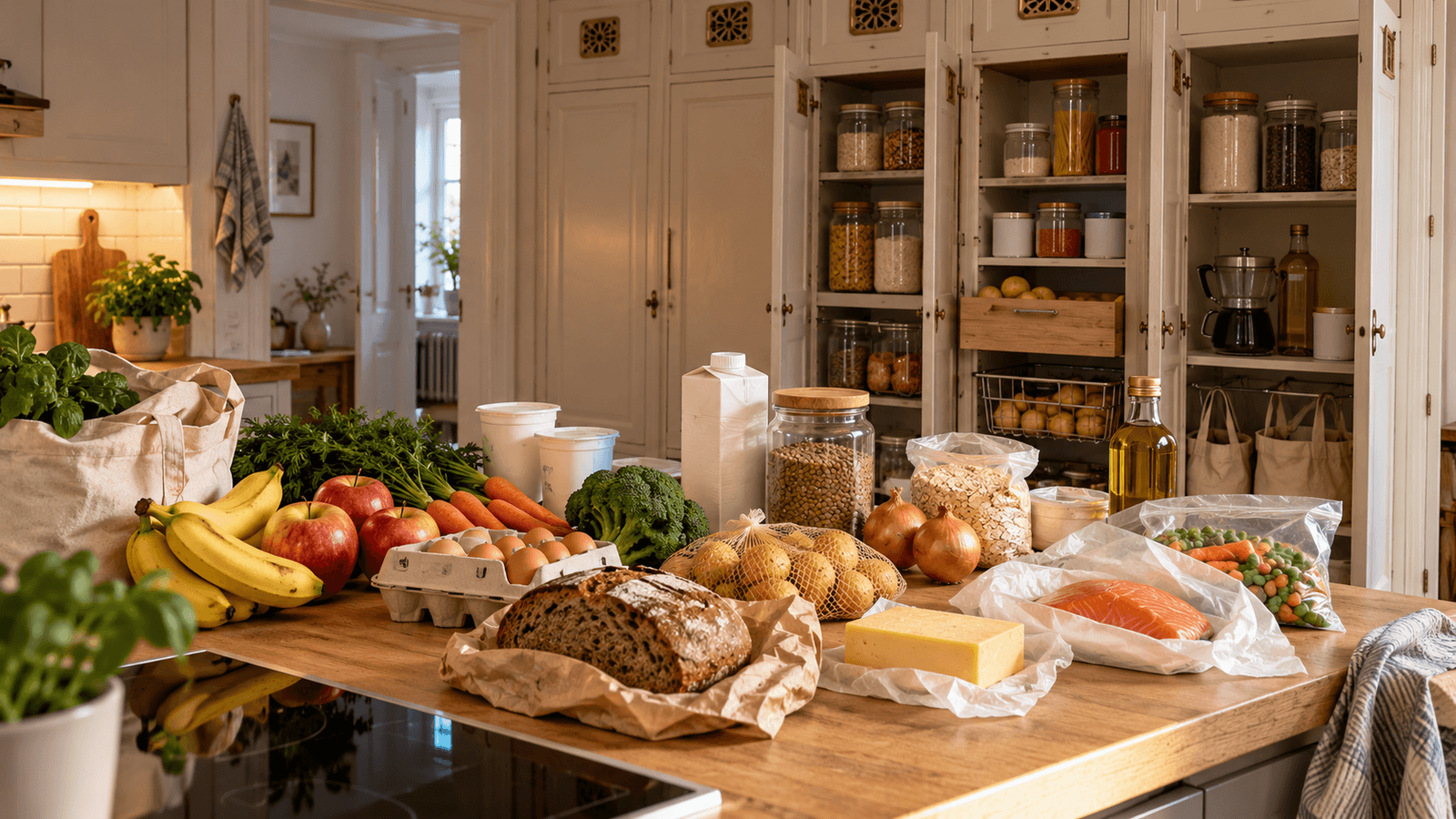
There is no single grocery budget that is right for every household.
Two households with the same number of people can spend very different amounts because of location, food preferences, dietary needs, shopping habits, restaurant use and food waste.
A useful grocery budget is therefore not a universal number. It is a realistic spending range based on what your household actually eats and buys.
What should a grocery budget include?
Before choosing a number, decide what you are counting as groceries.
A grocery budget may include:
- food for meals at home
- snacks
- drinks
- cooking ingredients
- pantry staples
- frozen foods
- convenience foods
Some households also buy toiletries, cleaning products and household supplies during the same supermarket trip.
If you want to understand food spending specifically, separate those non-food purchases from your grocery total.
Start with your actual spending
The most practical starting point is usually your recent spending.
Review several normal weeks rather than one unusual shopping trip.
Look at:
- supermarket purchases
- smaller grocery shops
- bakery purchases if they are part of your normal food routine
- food markets
- grocery delivery
- frequent top-up purchases
The objective is to understand your current baseline before deciding whether it should change.
Why one week is not enough
Grocery spending naturally fluctuates.
One week you may buy:
- olive oil
- rice
- coffee
- frozen foods
- spices
- other long-lasting staples
The following week you may need mostly fresh food.
A monthly view or several-week average gives a more useful picture than a single receipt.
Household size matters
A household of four generally needs more food than a household of one.
However, grocery spending does not always increase perfectly in proportion to household size.
Larger households may benefit from:
- larger package sizes
- shared ingredients
- fewer partially used packages
- batch cooking
- better use of bulk purchases
A person living alone may sometimes pay more per serving for smaller packages or experience more waste if ingredients are difficult to use before they spoil.
Age and appetite matter too
The number of people alone does not tell you how much food the household needs.
Food requirements can differ between:
- adults
- children
- teenagers
- highly active people
- people with smaller appetites
That is another reason why a universal “budget per person” can be misleading.
Your location affects grocery costs
Food prices vary by:
- country
- city
- neighborhood
- supermarket
- season
- availability
A grocery budget copied from someone living somewhere else may not reflect the prices available to you.
Use local prices and your own receipts whenever possible.
What you eat has a major effect
Different eating patterns can produce very different grocery bills.
Regular purchases of:
- premium cuts of meat
- fresh seafood
- specialty products
- imported foods
- prepared meals
- premium convenience products
may increase spending.
Lower-cost staples such as:
- oats
- potatoes
- rice
- pasta
- lentils
- beans
- seasonal vegetables
- frozen vegetables
- eggs
can often reduce average meal cost.
A lower grocery budget does not require eating the same cheap foods every day. The useful question is where expensive choices matter most to you.
Dietary restrictions can affect cost
Some people need specific foods because of:
- allergies
- intolerances
- medical dietary requirements
- ethical preferences
- cultural or religious food choices
Specialized replacement products can sometimes cost more than standard alternatives.
A realistic budget should account for these needs rather than comparing the household with a generic benchmark.
Eating out changes the picture
A household that eats at restaurants frequently may have a relatively low grocery bill while spending much more on food overall.
Another household may buy nearly all of its food from supermarkets and cook almost every meal at home.
Comparing only grocery spending can therefore be misleading.
If your goal is to understand total food cost, consider both groceries and food purchased outside the home.
Convenience has a price — and a value
Pre-cut vegetables, prepared sauces, frozen meals and other convenience foods may cost more than preparing everything from basic ingredients.
But convenience can also reduce:
- cooking time
- planning effort
- food waste
- dependence on takeaway meals
The cheapest ingredient is not always the cheapest practical choice for your household.
Food waste is part of your grocery budget
Food that is purchased but never eaten still costs money.
Common sources of waste include:
- buying more fresh food than you can use
- purchasing ingredients without a plan
- forgetting leftovers
- duplicate purchases
- buying large packages only because the unit price is lower
- cooking more than the household will eat
Reducing waste can lower spending without reducing the amount of food you actually consume.
See How to Plan Meals With Leftovers.
Calculate your current baseline
A simple approach is:
- collect several weeks of grocery spending
- remove non-food purchases if you want a food-only budget
- calculate your typical weekly spending
- look at the monthly pattern
- identify unusually expensive weeks
- identify categories where spending changes most
You do not need perfect accounting.
The goal is to understand the pattern well enough to make useful decisions.
Separate fixed staples from flexible purchases
Some grocery purchases are relatively predictable.
Examples:
- milk
- eggs
- bread
- oats
- rice
- potatoes
- yogurt
- common vegetables
Other purchases are more flexible:
- premium snacks
- specialty drinks
- expensive cuts of meat
- convenience meals
- impulse purchases
- specialty ingredients
If you want to reduce spending, flexible categories are often easier to adjust than essential staples.
Calculate cost per meal
Looking only at the price of a package can be misleading.
A more useful question is:
How many meals or portions does this purchase help create?
For example, a more expensive ingredient that contributes to several meals may be more economical than a cheaper product that is used once and partly wasted.
See How to Calculate Cost per Meal.
Use a range instead of one rigid number
A grocery budget can work better as a range.
For example, you might have:
- a normal target range
- some flexibility for restocking pantry staples
- occasional higher-cost weeks
This can be more realistic than treating every small variation as a budgeting failure.
Build a buffer for irregular purchases
Not every grocery item is purchased weekly.
You may occasionally need:
- cooking oil
- spices
- coffee
- flour
- rice
- frozen staples
- condiments
A small buffer prevents these purchases from making an otherwise normal week look like a major overspend.
Seasonal prices can change your budget
Fresh-food prices can change throughout the year.
Instead of expecting identical spending every month, adapt purchases when useful.
You might:
- choose seasonal produce
- use frozen alternatives
- switch between similar vegetables
- adjust recipes around current prices
Flexibility can make a budget easier to maintain.
Compare unit prices carefully
A larger package is not automatically better value.
It may have a lower price per unit, but only if you actually use it.
Before buying a larger package, consider:
- storage space
- shelf life
- freezer capacity
- how often you eat the food
- whether part of it is likely to be wasted
The lowest unit price and the lowest real household cost are not always the same.
Plan around foods you already have
Before shopping, check:
- refrigerator
- freezer
- pantry
- leftovers
This can prevent duplicate purchases and help you use food before it expires.
See How to Plan Meals Around What You Already Have.
Meal planning can stabilize grocery spending
Planning does not require deciding every meal weeks in advance.
Even a flexible plan can help answer:
- which meals you expect to cook
- which ingredients are already available
- which ingredients can be shared between meals
- which foods should be used first
- how many meals you realistically need to buy for
This reduces random purchases.
Do not plan more meals than you need
A common budgeting mistake is buying ingredients for every theoretical meal while forgetting:
- leftovers
- restaurant plans
- work lunches
- social events
- nights when you will not cook
If you regularly have leftovers, deliberately leave space for them in your plan.
Use overlapping ingredients
Ingredients that work in several meals can reduce waste.
For example:
- spinach can be used in eggs, pasta and soup
- yogurt can be used for breakfast and sauces
- roasted vegetables can become dinner, lunch or a side
- cooked potatoes can be reused in another meal
- beans can work in soups, wraps and salads
The goal is not repetition. It is flexibility.
Keep a few low-cost fallback meals
A grocery budget becomes easier when you have simple meals that do not require a new shopping trip.
Examples might include:
- lentil soup
- eggs with potatoes and vegetables
- pasta with tomato sauce and beans
- rice with frozen vegetables and eggs
- chickpea curry
- soup with bread
These meals can reduce last-minute takeaway or expensive convenience purchases.
Decide where quality matters most to you
Budgeting does not mean choosing the cheapest version of everything.
You may prefer to spend more on:
- coffee
- fish
- bread
- cheese
- organic products
- specific brands
- specialty ingredients
That can be completely compatible with a budget.
The important step is choosing intentionally where higher spending provides value to you.
Reduce spending without sacrificing nutrition
If you want to lower your grocery budget, useful strategies can include:
- reducing food waste
- using more legumes
- choosing seasonal produce
- using frozen vegetables
- comparing unit prices
- planning around existing food
- replacing some expensive ingredients with lower-cost alternatives
- cooking enough for useful leftovers
- reducing impulse purchases
See How to Save Money on Groceries Without Sacrificing Nutrition.
Avoid cutting the budget too aggressively
An unrealistically low budget can create other problems.
It may lead to:
- repeated extra shopping trips
- insufficient food at home
- reliance on takeaway
- a very restrictive food selection
- abandoning the budget completely
A sustainable budget is usually more useful than the lowest theoretically possible number.
Review your budget periodically
Food prices, household size and routines change.
Review your grocery budget when:
- prices change substantially
- someone joins or leaves the household
- your work schedule changes
- your eating habits change
- you begin cooking more or less at home
- your dietary needs change
A budget is a working tool, not a permanent number.
A practical grocery-budget workflow
Step 1: Track normal spending
Use several weeks rather than one receipt.
Step 2: Separate food from household products
Do this if you want a food-specific number.
Step 3: Find your normal range
Identify typical rather than exceptional spending.
Step 4: Identify waste and unnecessary purchases
Look for food that repeatedly goes unused.
Step 5: Decide what you want to change
Choose specific categories instead of trying to reduce everything.
Step 6: Plan upcoming meals
Account for food already at home and realistic leftovers.
Step 7: Shop with flexibility
Substitute similar ingredients when prices make sense.
Step 8: Review the result
If the target repeatedly fails despite reasonable shopping, the budget may simply be too low.
How Mealisa can help with grocery budgeting
A useful food-planning system can connect meal decisions with grocery spending.
Mealisa can help you think about:
- what you already have
- what meals you plan to make
- which ingredients can be reused
- approximate meal cost
- food that should be used before buying more
- how spending changes over time
The purpose is not to force the cheapest possible diet.
It is to make food planning and spending easier to understand together.
Common grocery-budget mistakes
Copying someone else’s budget
Their household, prices and eating habits may be completely different.
Using one expensive week as your baseline
Look at several weeks.
Ignoring food eaten outside the home
A low grocery bill does not necessarily mean low total food spending.
Buying bulk food that gets wasted
Lower unit price only helps if you use the food.
Cutting all enjoyable foods
A budget that feels overly restrictive may be difficult to maintain.
Forgetting irregular staples
Oil, spices and pantry restocking can make some weeks more expensive.
Planning too many meals
Leftovers and schedule changes need space.
Focusing only on price
Nutrition, convenience, time and waste also matter.
Frequently asked questions
How much should I spend on groceries per month?
There is no universal amount. A realistic figure depends on household size, local prices, eating habits, dietary needs, how often you cook and how much food is wasted.
Should I use a weekly or monthly grocery budget?
Both can be useful. Weekly tracking gives faster feedback, while a monthly view handles irregular purchases more realistically.
Does a larger household always spend more per person?
Not necessarily. Larger households may benefit from shared ingredients, larger package sizes and less waste per person.
Should restaurants be included in a grocery budget?
Usually they are better tracked separately. If your goal is total food spending, combine grocery and restaurant spending at a higher level.
How can I lower my grocery budget?
Start with waste, meal planning, impulse purchases, expensive flexible categories and ingredient substitutions rather than simply buying less food.
Is buying in bulk always cheaper?
No. It only saves money when the unit price is lower and you use the full quantity.
Should a grocery budget be the same every week?
Not necessarily. Pantry restocking, seasonal prices and household schedules can create normal variation.
Can healthy eating fit a limited grocery budget?
Often yes. Foods such as legumes, oats, potatoes, eggs, frozen vegetables and seasonal produce can provide useful nutrition at relatively modest cost, although actual prices vary by location.
The bottom line
A useful grocery budget is not a universal number copied from someone else.
Build it from:
- your actual recent spending
- household size and appetite
- local food prices
- dietary needs
- how often you eat at home
- food waste
- convenience needs
- the foods you value most
Then use a realistic spending range rather than expecting every week to be identical.
The best grocery budget is one that helps you buy enough useful food, reduce unnecessary waste and maintain an eating pattern that works for your household.
This article provides general educational information and is not individualized financial, medical or dietary advice.