
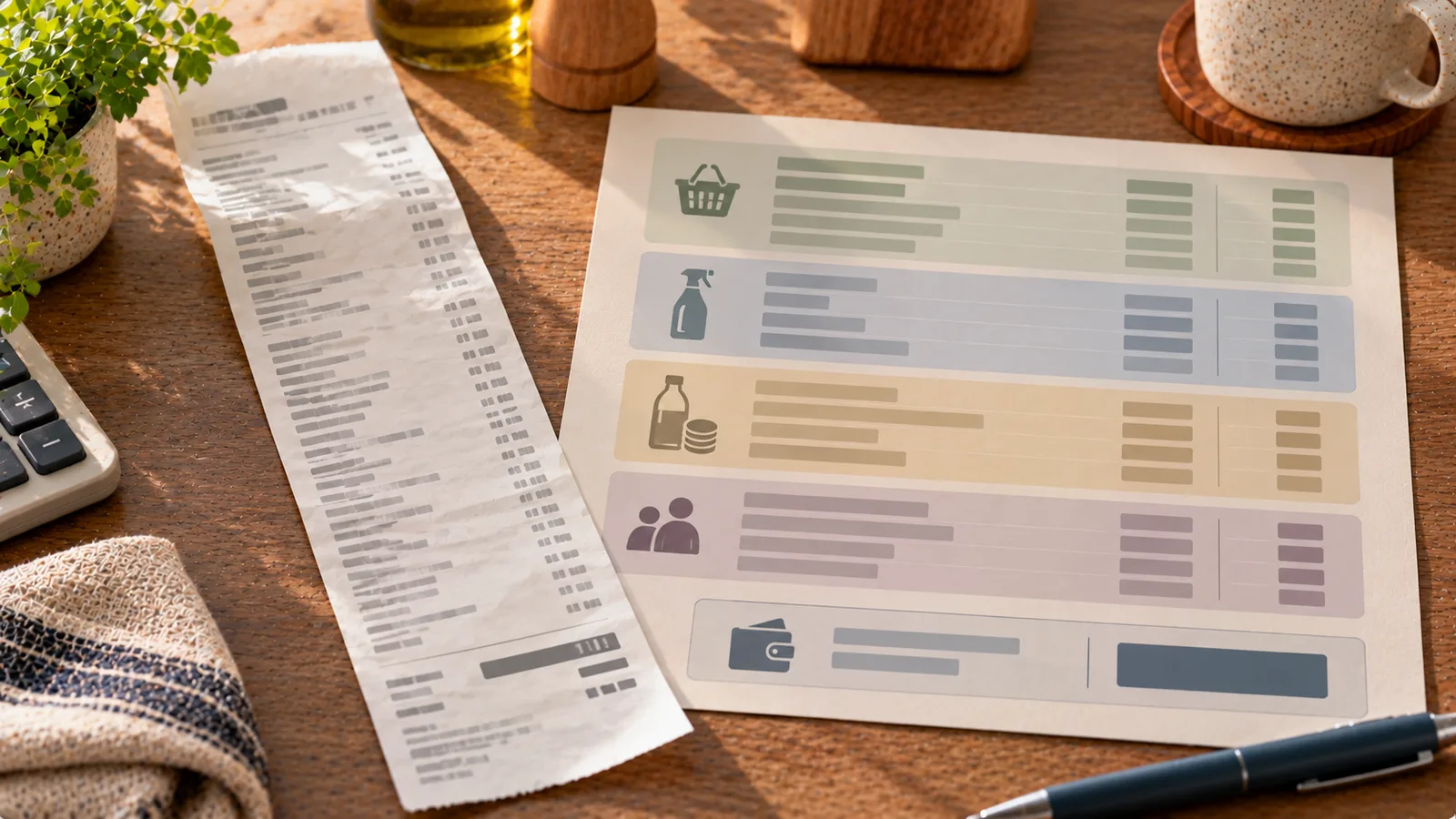
A supermarket receipt rarely represents food spending perfectly.
The total at the bottom may include groceries, cleaning products, toiletries, bottle deposits, discounts, refunds and items bought for someone else. If you copy that total directly into your food budget, your grocery spending can gradually become distorted.
Receipt reconciliation solves that problem.
Instead of asking only, “How much did I pay at the store?”, you identify the part of the transaction that actually belongs to your food budget.
What it means to reconcile a grocery receipt
Reconciling a receipt means matching the transaction with the spending category you want to track.
For a food budget, the basic calculation is:
food spending = eligible food purchases − food discounts − food refunds + relevant food-related charges
The exact categories depend on how you define your budget.
The important part is consistency.
If household cleaning products are excluded this month, they should normally be excluded next month as well.
Why the checkout total can be misleading
Imagine a supermarket receipt with this total:
€78.40
It includes:
| Item group | Amount |
|---|---|
| Food and drinks | €61.20 |
| Dishwashing tablets | €7.80 |
| Shampoo | €4.50 |
| Bottle deposits | €2.40 |
| Food discount | −€1.50 |
| Purchase for a friend | €4.00 |
The amount charged to your payment method may be €78.40, but that does not mean your personal food budget increased by €78.40.
You need to classify the components first.
Step 1: decide what your food budget includes
Before processing receipts, define the boundary of the budget.
A food-only budget might include:
- groceries used for meals;
- snacks;
- non-alcoholic drinks;
- ingredients for cooking;
- food bought for household members included in the budget.
It might exclude:
- toiletries;
- cleaning products;
- kitchen equipment;
- pet food;
- cosmetics;
- medicines;
- purchases made for other people.
There is no single mandatory definition.
A household may intentionally track “supermarket spending” instead of “food spending.” That is also valid, but it is a different metric.
Write down your rule once and apply it consistently.
Step 2: separate food and non-food items
Go through the receipt and assign each line to a category.
For example:
| Receipt item | Price | Category |
|---|---|---|
| Bread | €2.40 | Food |
| Eggs | €3.20 | Food |
| Chicken | €8.50 | Food |
| Apples | €3.10 | Food |
| Laundry detergent | €6.90 | Non-food |
| Toothpaste | €2.30 | Non-food |
Food subtotal:
2.40 + 3.20 + 8.50 + 3.10 = €17.20
The €9.20 spent on detergent and toothpaste does not enter a food-only budget.
This simple separation is the foundation of receipt reconciliation.
Step 3: handle discounts correctly
Discounts should normally reduce the category to which they belong.
Suppose the receipt contains:
- vegetables: €8.00;
- dairy: €6.00;
- household cleaner: €5.00;
- vegetable promotion: −€2.00.
Food spending is:
8 + 6 − 2 = €12.00
The €2 discount reduces food spending because it applies to food.
What about a discount on the whole basket?
A basket-wide discount is less straightforward.
Suppose:
- food: €60;
- non-food: €20;
- total before discount: €80;
- basket discount: €8.
One practical method is to allocate the discount proportionally.
Food represents:
60 ÷ 80 = 75% of the basket
Food share of the discount:
8 × 0.75 = €6
Adjusted food spending:
60 − 6 = €54
Non-food spending becomes €18.
You do not always need this level of precision. For a small occasional discount, a simpler consistent rule may be sufficient.
Step 4: separate bottle and container deposits
Deposit systems can make grocery receipts confusing.
In Germany, for example, a beverage purchase may include a refundable container deposit.
If your goal is to track the cost of food and drinks consumed, you may want to keep refundable deposits separate from food spending.
Example:
- drinks: €12.00;
- refundable deposits: €3.00;
- checkout amount: €15.00.
Your ledger could record:
- food/drinks: €12.00;
- deposits: €3.00.
When containers are returned and €3.00 is refunded, the refund can be matched against the deposit category rather than treated as negative food consumption.
The key is not to count the original deposit as food spending and then count the refund as a reduction in food spending unless that is intentionally how your system works.
Step 5: account for refunds and returns
Refunds should generally reverse the category of the original purchase.
Suppose you previously recorded:
- spoiled packaged food: €4.50.
The store later refunds the full €4.50.
Your food budget adjustment is:
−€4.50
If the refund appears on a later receipt, do not ignore it simply because the original purchase happened during a previous shopping trip.
For monthly budgeting, decide whether you want the refund to adjust:
- the month in which the refund occurred; or
- the original month's spending.
The first method is easier for routine tracking.
The second can provide cleaner historical accounting but requires editing previous records.
Step 6: remove purchases made for someone else
A shared checkout does not necessarily mean shared consumption.
Imagine you buy €72 of groceries but €14 belongs to a friend who immediately reimburses you.
If the €14 purchase is not part of your household food consumption, your food budget should normally reflect:
72 − 14 = €58
The reimbursement itself should not then reduce the €58 again.
Otherwise you would subtract the same amount twice.
Step 7: divide genuinely shared groceries
Shared households can use a different approach.
Suppose two roommates share:
- milk: €2;
- rice: €4;
- vegetables: €6.
Shared total:
€12
If expenses are divided equally:
12 ÷ 2 = €6 per person
If one person paid the entire receipt, the payment account shows €12, but that person's personal food cost is €6 once the shared expense is settled.
For a household budget covering both people together, however, the full €12 belongs in the household food budget.
Always match the accounting method to the unit you are measuring: individual or household.
A complete worked example
Consider this receipt:
| Line | Amount |
|---|---|
| Vegetables | €11.80 |
| Chicken | €9.40 |
| Pasta | €2.60 |
| Yogurt | €4.20 |
| Coffee | €7.50 |
| Cleaning spray | €3.90 |
| Shampoo | €4.80 |
| Drinks | €6.00 |
| Bottle deposits | €1.50 |
| Food promotion | −€2.00 |
| Food bought for friend | €5.00 |
First calculate food before adjustments:
11.80 + 9.40 + 2.60 + 4.20 + 7.50 + 6.00 + 5.00 = €46.50
Subtract the food promotion:
46.50 − 2.00 = €44.50
Remove the food bought for the friend:
44.50 − 5.00 = €39.50
If refundable deposits are tracked separately, do not add the €1.50 deposit.
Final amount entered into the personal food budget:
€39.50
The actual checkout total can be much higher because it also contains non-food purchases and deposits.
A simple receipt ledger
You do not need to reproduce every receipt line in a spreadsheet.
A compact ledger can be enough:
| Date | Store | Receipt total | Food | Non-food | Deposits | Reimbursements | Food budget amount |
|---|---|---|---|---|---|---|---|
| 4 May | Store A | €54.80 | €43.30 | €8.50 | €3.00 | €0 | €43.30 |
| 8 May | Store B | €31.20 | €27.20 | €0 | €0 | €4.00 | €23.20 |
| 12 May | Store A | €68.50 | €59.00 | €7.00 | €2.50 | €0 | €59.00 |
Food-budget total:
43.30 + 23.20 + 59.00 = €125.50
This preserves enough information to understand why the food total differs from the amount charged at checkout.
What to do with loyalty points
Loyalty programs can create several types of benefits.
If points create an immediate discount on the current purchase, treat that discount similarly to other discounts.
If points are earned today but redeemed later, there is usually no need to reduce today's food spending.
When the points are eventually redeemed, record the actual reduction at that time.
This keeps your ledger aligned with what you actually paid.
What about coupons?
An item-specific food coupon should normally reduce the cost of that food.
Example:
- cheese: €4.50;
- coupon: −€1.00.
Food-budget cost:
€3.50
For a coupon applying to both food and non-food products, either allocate it proportionally or use another consistent household rule.
Precision is useful, but a budgeting system that takes too long to maintain is unlikely to survive.
Delivery fees and service charges
Online grocery orders introduce another decision.
Suppose:
- food: €55;
- delivery: €4;
- service fee: €2.
You can:
- include €6 in the grocery budget;
- track it separately as delivery/service spending.
Neither method is universally correct.
If the goal is to understand the total cost of obtaining groceries, including delivery can be useful.
If the goal is specifically to compare food prices, keeping service costs separate may be more informative.
Should alcohol be included?
That depends on the purpose of your budget.
Some households include all supermarket food and drink purchases in one category.
Others separate:
- groceries;
- alcohol;
- restaurants;
- household products.
The important point is to define the rule before comparing one month with another.
Changing the category boundary repeatedly makes trends difficult to interpret.
Receipts with missing or unclear descriptions
Receipt abbreviations are not always obvious.
If you cannot identify a small item, you have several options:
- check the product price against what you bought;
- look at the receipt shortly after shopping while the purchase is still fresh;
- place uncertain items in a temporary “unclassified” category;
- avoid spending several minutes investigating a tiny amount that will not materially affect the budget.
Budget tracking should be accurate enough to support decisions, not unnecessarily perfect.
When the card transaction differs from the receipt
Normally the receipt total and payment transaction should match.
If they do not, check for:
- split payments;
- cash plus card;
- refunds;
- deposits;
- separate card authorizations;
- tips or service charges where applicable;
- pending versus finalized bank transactions.
Do not change the food ledger simply to force it to match the bank transaction.
First determine why the totals differ.
How often should you reconcile receipts?
For many households, reconciling shortly after shopping is easiest.
You might process receipts:
- after every grocery trip;
- once or twice per week;
- during a weekly budget review.
Waiting until the end of the month can make ambiguous receipt lines harder to remember.
A five-minute routine after shopping is often easier than reconstructing dozens of transactions later.
A practical weekly workflow
A simple system can look like this:
- Keep each grocery receipt.
- Record the checkout total.
- Separate food from non-food.
- Remove refundable deposits if tracked separately.
- Apply relevant discounts and refunds.
- Remove purchases made for other people.
- Allocate genuinely shared purchases according to your household rule.
- Record the resulting food-budget amount.
- Compare the running total with the remaining weekly or monthly budget.
This turns receipts into usable spending data without requiring full bookkeeping.
Receipt total vs food budget: the key distinction
Your payment history answers:
How much money left my account?
Your reconciled food ledger answers:
How much of that money was actually food spending under my budget rules?
Those numbers can legitimately differ.
For example:
- card transaction: €92;
- food: €71;
- household supplies: €12;
- toiletries: €6;
- refundable deposits: €3.
Nothing is wrong when the food budget shows €71 while the bank shows a €92 supermarket transaction.
They are measuring different things.
Keep the system consistent
The most useful grocery budget is not necessarily the one with the most categories.
It is the one whose categories remain consistent enough to compare over time.
Choose clear rules for:
- food;
- non-food;
- deposits;
- discounts;
- refunds;
- shared purchases;
- delivery charges.
Then apply those rules to each receipt.
That makes weekly and monthly grocery totals far more meaningful than simply adding every supermarket checkout total together.