
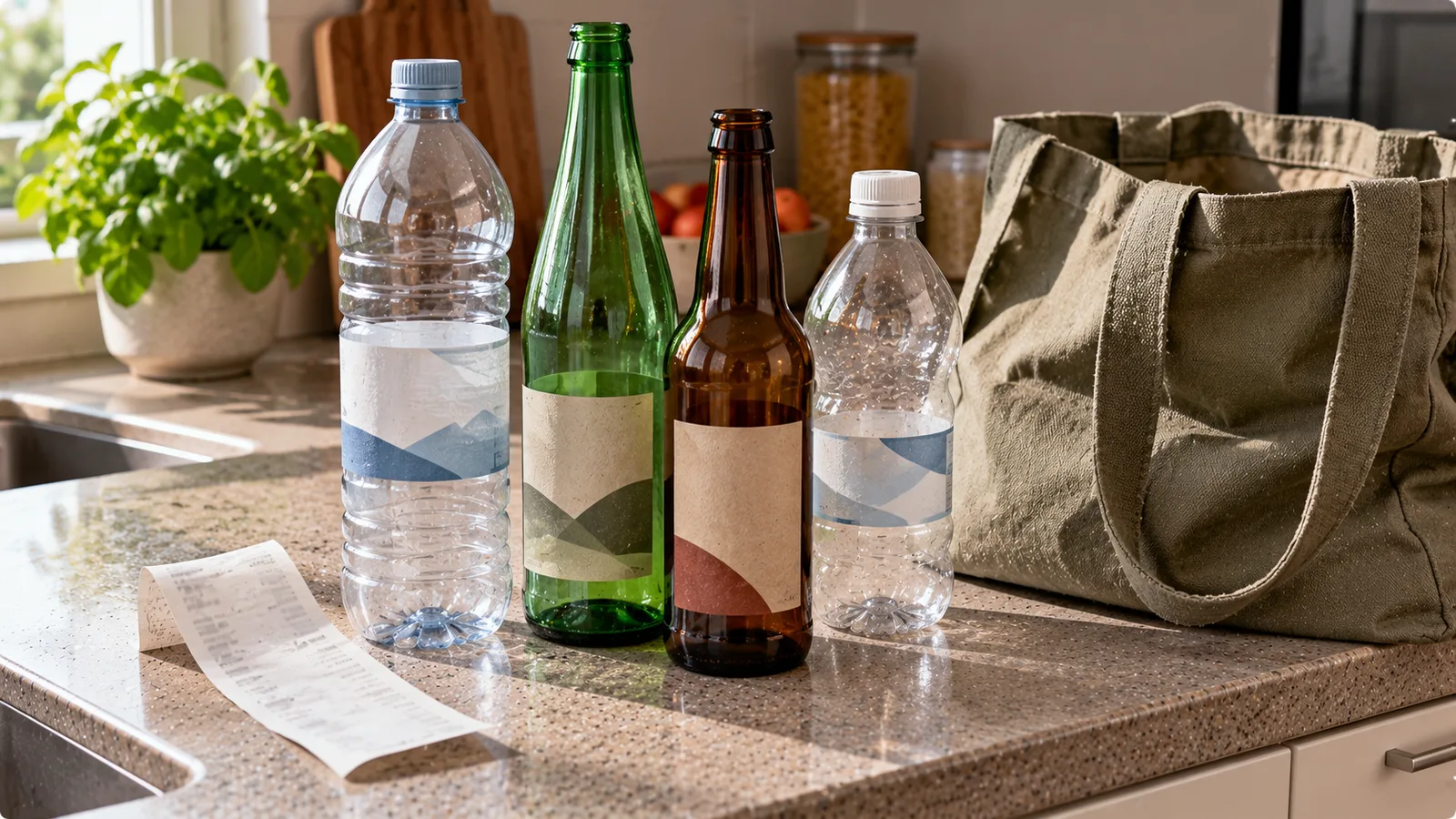
A German supermarket receipt can include more than the cost of food and drinks.
When you buy certain beverages, you also pay Pfand: a refundable deposit on eligible bottles or cans.
That deposit increases the amount you pay at checkout, but it is not necessarily a permanent expense.
If you record every supermarket payment as food spending and later treat every bottle-return voucher as a discount, your budget can become difficult to interpret.
The simplest solution is to distinguish three things:
- The cost of groceries and beverages.
- Refundable deposits paid.
- Deposits returned.
This distinction makes your monthly food budget more accurate without requiring complicated accounting.
What is Pfand?
Pfand is the German deposit system used for certain beverage containers.
When you purchase an eligible drink, the checkout price includes the beverage and an additional deposit.
You can usually reclaim the deposit by returning the eligible empty container through the appropriate return system.
Germany has different deposit arrangements for single-use and reusable containers.
The German Packaging Act (Verpackungsgesetz) provides the legal framework, while DPG Deutsche Pfandsystem GmbH explains the single-use deposit system.
For consumers, the important point is that the deposit and the beverage price represent different types of spending.
Common deposit amounts in Germany
Deposit amounts depend on the packaging system and container type.
| Container category | Common deposit | Important qualification |
|---|---|---|
| Eligible single-use beverage bottle | €0.25 | Applies to containers within the statutory deposit system |
| Eligible single-use beverage can | €0.25 | Applies to containers within the statutory deposit system |
| Many reusable beer bottles | €0.08 | Common, but not universal |
| Many reusable water or soft-drink bottles | €0.15 | Common, but not universal |
| Some reusable or specialty containers | Varies | Check the receipt or product information |
| Beverage crate | Additional deposit may apply | Depends on crate and bottle system |
The familiar €0.08 and €0.15 reusable-bottle amounts are customary examples, not a universal legal tariff for all Mehrweg packaging.
Single-use deposit rules are defined by the applicable legislation.
The Verbraucherzentrale guidance on bottle and can deposits and DPG provide further information.
Why Pfand complicates a food budget
Suppose you buy:
- Groceries: €42.00.
- Drinks excluding deposits: €8.00.
- Refundable deposits: €2.50.
Your checkout payment is:
€42.00 + €8.00 + €2.50 = €52.50.
But the food-and-drink purchase itself costs €50.00.
The other €2.50 is a deposit you may recover later.
Both figures are useful.
Cash paid: €52.50.
Groceries and drinks consumed or purchased: €50.00.
A budget that tracks only one of these figures may answer the wrong question.
The recommended method: keep Pfand separate
For a practical household budget, use three categories.
| Category | What belongs here? |
|---|---|
| Food and drinks | Purchase prices excluding refundable deposits |
| Pfand paid | Deposits added at checkout |
| Pfand returned | Deposits refunded after containers are returned |
This structure allows you to see both the cost of food and the cash temporarily tied up in containers.
It also prevents a return voucher from making a future grocery trip appear artificially cheap.
You do not need professional accounting software to use this method.
A spreadsheet, notes app or budgeting app with separate categories is enough.
Example: a normal supermarket trip
Imagine the following receipt:
| Item | Amount |
|---|---|
| Food | €38.40 |
| Drinks excluding Pfand | €7.60 |
| Pfand charged | €2.00 |
| Total paid | €48.00 |
Record:
Food and drinks: €46.00.
Pfand paid: €2.00.
Cash paid: €48.00.
The three amounts are not contradictory.
They describe different aspects of the same transaction.
If you later return the containers and receive €2.00, record that amount as Pfand returned rather than as negative food consumption.
How to record a bottle return
German supermarkets often use reverse vending machines, sometimes called Pfandautomaten.
After returning containers, you receive a voucher, commonly called a Pfandbon.
That voucher can generally be redeemed according to the retailer's applicable conditions.
From a budgeting perspective, the deposit is being refunded.
It is not new income from food sales.
For example:
You return containers worth €3.25.
Record:
Pfand returned: €3.25.
If the voucher is applied to a shopping bill, do not automatically treat it as a €3.25 reduction in the cost of the groceries.
The groceries still have their normal purchase value.
The voucher is simply used as a payment credit.
Example: shopping with a Pfand voucher
Suppose your new purchase consists of:
- Groceries and drinks: €35.00.
- New deposits: €1.50.
Total before voucher: €36.50.
You use a €4.00 Pfandbon.
Amount paid from your bank account or cash: €32.50.
The correct breakdown is:
| Budget entry | Amount |
|---|---|
| Food and drinks | €35.00 |
| New Pfand paid | €1.50 |
| Old Pfand returned | €4.00 |
| Net cash paid | €32.50 |
The calculation is:
€35.00 + €1.50 − €4.00 = €32.50.
If you recorded only €32.50 as groceries, you would understate the actual food-and-drink purchase by €2.50.
That difference comes from mixing the new deposit with the refund of an earlier deposit.
A simple monthly Pfand formula
For a monthly household overview, calculate:
Net deposit cash flow = Pfand paid − Pfand returned.
For example:
Pfand paid during the month: €14.75.
Pfand returned during the month: €11.25.
Net deposit cash flow:
€14.75 − €11.25 = €3.50.
Your household has paid €3.50 more in deposits than it received back during that month.
That does not automatically mean you lost €3.50.
Some containers may still be at home and refundable later.
The difference reflects the timing of purchases and returns.
Monthly example: food spending versus bank spending
Imagine this illustrative monthly summary:
| Category | Amount |
|---|---|
| Food and drinks | €420.00 |
| Pfand paid | €18.00 |
| Pfand returned | €12.50 |
| Net supermarket cash outflow | €425.50 |
Calculation:
€420.00 + €18.00 − €12.50 = €425.50.
Your food-and-drink spending is €420.00.
Your net cash outflow is €425.50.
The €5.50 difference is the net deposit cash movement for that period.
Both metrics are legitimate, provided they are clearly labelled.
Why bottle returns should not count as grocery savings
A refund is not the same as a lower product price.
Suppose you paid a €0.25 deposit when buying a drink.
Returning the container gives you that €0.25 back.
The beverage itself did not become cheaper.
If you classify the refund as a discount on a later shopping trip, you may conclude that your groceries cost less than they actually did.
That can distort comparisons between weeks.
It may also make one supermarket appear cheaper simply because you redeemed a large Pfand voucher there.
For price comparisons, separate refundable deposits from product prices.
What if you do not return every container?
Not all deposits are necessarily recovered.
Containers may be lost, damaged or discarded.
If a deposit is no longer recoverable, it becomes a real household cost.
For simple personal budgeting, you can record an adjustment when you decide the deposit will not be recovered.
Example:
You paid €2.50 in deposits for ten eligible containers.
Two containers are lost.
Assuming €0.25 per container, the unrecoverable amount is:
2 × €0.25 = €0.50.
You can record €0.50 as an unrecovered deposit expense.
Do not assume that every container can always be returned under every condition.
Acceptance rules depend on the packaging system and applicable legal requirements.
Consult the Verbraucherzentrale information on Pfand returns for practical consumer guidance.
What about bottles already at home?
When starting a budget, you may already have refundable containers.
If you want detailed tracking, you can estimate the outstanding deposit value.
For example:
- 12 eligible single-use containers at €0.25 = €3.00.
- 6 reusable bottles at €0.15 = €0.90.
Estimated outstanding deposits: €3.90.
This is a simplified inventory, not a guarantee that every container will be accepted or refunded.
For most households, it is not necessary to count every bottle.
Tracking deposits paid and returned is often sufficient.
A detailed container balance is useful only if you want to reconcile outstanding deposits more precisely.
Do not confuse Einweg and Mehrweg
Germany distinguishes between single-use packaging, often labelled Einweg, and reusable packaging, known as Mehrweg.
The deposit amount is not the only difference.
The systems also differ in how containers are collected and reused or recycled.
A €0.25 deposit is commonly associated with eligible single-use beverage packaging.
Reusable packaging frequently has other deposit amounts.
However, the presence of a deposit does not by itself tell you everything about the packaging's environmental characteristics.
For background, see the German Federal Environment Ministry's packaging information and the German Packaging Act.
Grocery price comparisons and Pfand
Suppose two supermarkets sell the same drink.
Store A:
Beverage price: €1.19.
Pfand: €0.25.
Checkout amount: €1.44.
Store B:
Beverage price: €1.09.
Pfand: €0.25.
Checkout amount: €1.34.
The beverage price difference is €0.10.
The deposit is the same in both examples and should not be treated as a product-price difference.
If the packaging systems differ, compare the beverage price separately from the refundable deposit.
This keeps price comparisons meaningful.
How to handle mixed receipts
A German grocery receipt may contain food, beverages, household goods and deposits.
For a useful food budget, split the transaction into the relevant categories.
For example:
| Receipt component | Amount | Category |
|---|---|---|
| Vegetables, bread and dairy | €24.00 | Food |
| Drinks excluding deposits | €6.00 | Drinks |
| Cleaning products | €5.00 | Household |
| Pfand | €1.50 | Deposits |
| Total | €36.50 | Cash paid |
The food-and-drink total is €30.00.
The overall checkout payment is €36.50.
If you want to monitor food costs separately from household spending, this distinction matters even without Pfand.
Should Pfand be included in a weekly food budget limit?
That depends on what the limit is intended to measure.
If your weekly target is food consumption and purchasing cost, exclude refundable deposits from the food category.
If your target is maximum cash you can spend at checkout, include deposits in the cash requirement.
For example, a household may plan:
Food budget: €100 per week.
Additional cash allowance for deposits: €5.
The €5 is not necessarily a permanent expense, but it affects how much money must be available during shopping.
For households with tight cash flow, tracking both amounts is especially useful.
What if you use cash instead of a bank card?
The accounting principle stays the same.
Cash paid at checkout includes new deposits and is reduced by redeemed vouchers.
Food cost should still be recorded separately.
A cash-only household may find it helpful to keep a simple weekly note:
Food and drinks: €92.40.
Pfand paid: €4.00.
Pfand returned: €2.75.
Net cash outflow: €93.65.
Calculation:
€92.40 + €4.00 − €2.75 = €93.65.
This gives a more accurate picture than recording only the money left in the wallet.
A simple spreadsheet structure
A spreadsheet can use the following columns:
| Date | Food and drinks | Pfand paid | Pfand returned | Cash outflow |
|---|---|---|---|---|
| Monday | €42.00 | €2.00 | €0.00 | €44.00 |
| Thursday | €31.00 | €1.50 | €3.00 | €29.50 |
| Saturday | €25.00 | €0.75 | €1.25 | €24.50 |
| Total | €98.00 | €4.25 | €4.25 | €98.00 |
The cash-outflow formula is:
Food and drinks + Pfand paid − Pfand returned.
In this example, the deposits paid and returned happen to balance over the week.
That will not always be the case.
What if you cannot separate Pfand on an old receipt?
If you still have the receipt, look for separate deposit lines.
If the receipt is unavailable, do not invent exact deposit amounts.
You can either:
- Record the full checkout payment as an estimated grocery transaction.
- Mark the transaction as containing an unknown deposit amount.
- Use known package quantities to make a clearly labelled estimate.
Avoid silently presenting estimated deposits as exact figures.
For future shopping, separate the deposit when entering the receipt.
A five-minute monthly reconciliation
At the end of each month:
- Add up food-and-drink purchases excluding Pfand.
- Add up deposits paid.
- Add up deposits returned.
- Calculate net cash outflow.
- Check whether a large difference is explained by containers still at home.
You do not need to make every month's deposits balance exactly.
The purchase and return dates often differ.
A positive deposit balance may simply mean that more containers are waiting to be returned.
The practical rule
For a German grocery budget, Pfand is best tracked as a separate refundable deposit, not automatically as food spending.
Record the full amount paid for cash-flow purposes.
Record food and drink prices without refundable deposits for grocery-cost analysis.
When you return containers, record the refund against the deposit category rather than treating it as a new food discount.
This small distinction makes weekly budgets, supermarket comparisons and monthly spending reports considerably easier to interpret.