
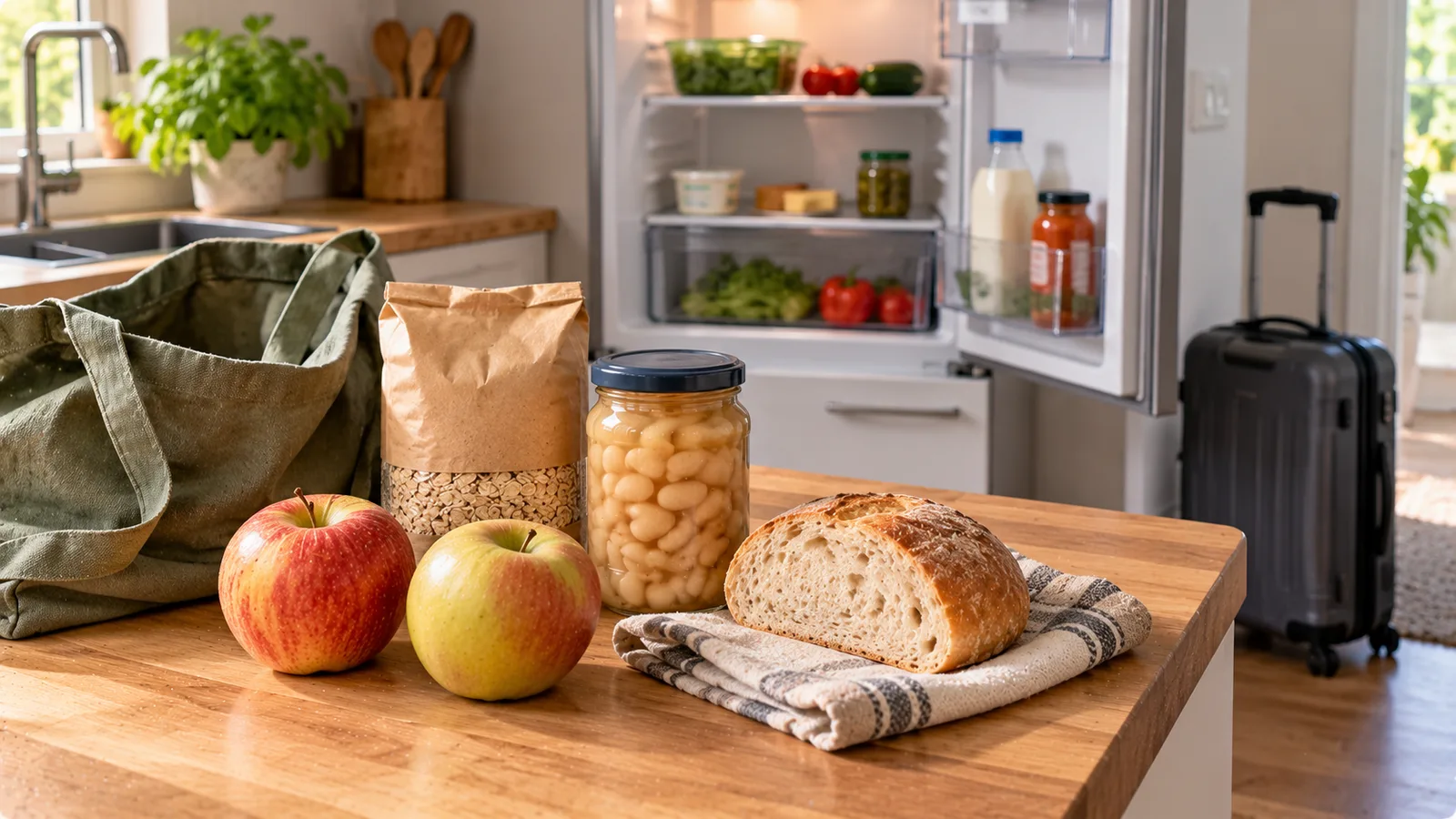
A vacation, business trip or extended stay with family can change your grocery spending considerably.
If you normally spend €400 per month on groceries but will be away for ten days, you probably do not need the same amount of food at home.
However, simply dividing the budget by the number of days away can produce an unrealistic result.
Some food costs disappear while you travel. Others remain, and your spending at the destination may be higher than usual.
The most useful approach is to separate groceries consumed at home from food purchased while away, then adjust only the costs that actually change.
Why your grocery budget changes when you travel
A normal grocery budget covers several types of purchases:
- Fresh ingredients for meals at home.
- Milk, bread, fruit and other frequently replenished foods.
- Pantry staples such as rice, pasta and oil.
- Frozen products and long-lasting groceries.
- Snacks, drinks and convenience foods.
- Occasional household items bought during grocery shopping.
When you leave home, these categories behave differently.
Fresh food purchases may fall sharply because nobody is eating at home.
Pantry purchases may be postponed rather than permanently eliminated.
Meanwhile, food bought at your destination may be more expensive.
The difference between postponed spending and genuine savings is important.
Start with your normal monthly budget
Before adjusting anything, estimate your usual grocery spending.
For example:
| Category | Monthly spending |
|---|---|
| Fresh produce | €100 |
| Meat, fish, eggs and dairy | €125 |
| Bread, grains and legumes | €70 |
| Snacks and drinks | €55 |
| Pantry restocking | €50 |
| Total | €400 |
This is an illustrative budget, not an average household benchmark.
Your own spending may be higher or lower depending on household size, dietary needs and local prices.
Ideally, use the last two or three months of transactions to estimate a representative amount.
If one month included a large pantry purchase, account for that separately.
The simplest calculation: adjust for days at home
A basic starting formula is:
Adjusted home grocery budget = Monthly grocery budget × Days at home ÷ Days in month
Suppose:
- Normal grocery budget: €400.
- Month length: 30 days.
- Days away: 10.
- Days at home: 20.
Then:
€400 × 20 ÷ 30 = €266.67.
The simple calculation suggests a home grocery allowance of approximately €267.
The apparent reduction is:
€400 − €266.67 = €133.33.
This method is useful for a quick estimate.
But it assumes all grocery spending changes proportionally with days at home, which is rarely true.
A more accurate method: separate fixed and variable costs
A better model divides grocery spending into two groups.
Variable costs change with the number of meals eaten at home.
Examples include fresh vegetables, dairy, meat and bread.
Less flexible costs include pantry restocking, bulk purchases and items already bought before departure.
These expenses may remain unchanged in the current month.
Use this formula:
Adjusted home budget = Fixed grocery costs + Variable grocery costs × Home days ÷ Month days
Worked example
Assume a household normally spends:
- €80 on less flexible pantry and bulk purchases.
- €320 on groceries that vary with meals eaten at home.
The household will be away for 10 days in a 30-day month.
Adjusted variable spending:
€320 × 20 ÷ 30 = €213.33.
Add the less flexible spending:
€80 + €213.33 = €293.33.
Estimated reduction:
€400 − €293.33 = €106.67.
This is more conservative than the simple €133 reduction.
It recognizes that not every grocery expense disappears during a trip.
The classification is approximate: a pantry purchase can often be delayed, while a subscription or previously committed order may be unavoidable.
Compare different lengths of absence
Using the same example of €80 less flexible spending and €320 variable spending, the estimated home grocery budget changes as follows.
| Days away in a 30-day month | Days at home | Adjusted home budget | Reduction |
|---|---|---|---|
| 0 | 30 | €400.00 | €0.00 |
| 3 | 27 | €368.00 | €32.00 |
| 7 | 23 | €325.33 | €74.67 |
| 10 | 20 | €293.33 | €106.67 |
| 14 | 16 | €250.67 | €149.33 |
| 20 | 10 | €186.67 | €213.33 |
These numbers are estimates.
Actual spending depends on which household members travel, what remains in the refrigerator and whether purchases can be postponed.
Account for how many people are away
The number of people traveling matters as much as the number of days.
Imagine a household with two adults.
If both adults leave for ten days, grocery consumption at home may fall substantially.
If only one adult travels, the other still needs groceries.
It would be inaccurate to treat the home as completely unoccupied.
Use person-days for partial household absences
A person-day represents one person eating at home for one day.
For two adults over 30 days:
2 × 30 = 60 possible person-days.
If one adult is away for 10 days:
60 − 10 = 50 person-days at home.
The consumption ratio is:
50 ÷ 60 = 83.3%.
If €320 of spending is variable:
€320 × 50 ÷ 60 = €266.67.
Adding €80 in less flexible costs gives:
€346.67 adjusted home grocery spending.
The estimated reduction is only €53.33, rather than €106.67 when both adults travel.
This method is especially useful for families, shared households and frequent work travel.
However, household food spending is not always exactly proportional to the number of people.
Shared meals, package sizes and food waste can change the result.
Do not confuse grocery savings with total food savings
Reducing groceries at home does not automatically reduce your total food expenses.
You may spend money on:
- Restaurant meals.
- Airport or railway station food.
- Hotel breakfasts.
- Supermarket purchases at the destination.
- Takeaway meals.
- Snacks and drinks while traveling.
These costs should be tracked separately.
Example: a ten-day vacation
Suppose your estimated home grocery reduction is €107.
During the trip, you spend:
| Travel food category | Amount |
|---|---|
| Groceries at destination | €90 |
| Restaurants and cafés | €160 |
| Snacks and drinks | €35 |
| Total travel food spending | €285 |
Your combined food spending changes by:
€285 − €107 = €178 additional spending.
This does not mean the trip was poorly budgeted.
It means the grocery reduction offset only part of the travel food cost.
For a complete budget, compare home groceries, destination groceries and meals purchased outside the home.
Should travel groceries count as groceries or vacation spending?
There is no single correct accounting method.
Two approaches work well.
Method A: separate travel food category
Keep your usual grocery category for food purchased for home.
Record destination groceries, restaurants and snacks under a travel budget.
This makes it easier to see how much your regular household spending changed.
Method B: one combined food budget
Record all groceries in one category, including those purchased at your destination.
Track restaurant spending separately.
This works well if your main objective is monitoring total food expenditure.
The important rule is consistency.
Avoid counting destination groceries in both the household grocery budget and the travel budget.
How to adjust shopping before departure
Budget planning works best when it also prevents waste.
Seven days before leaving
Check your refrigerator, freezer and pantry.
Identify foods that should be consumed before departure.
Plan meals around those ingredients rather than buying new specialty products.
Three to four days before leaving
Reduce purchases of:
- Leafy greens.
- Fresh berries.
- Soft fruit.
- Fresh fish.
- Short-dated dairy products.
- Large packages of prepared food.
Buy only what you expect to use.
One day before leaving
Check open packages and perishable leftovers.
Freeze suitable foods promptly if they can be frozen safely.
Do not freeze food that has already been stored improperly.
For longer absences, consider whether someone will need to check the refrigerator or other household arrangements.
Which groceries can be postponed?
Some purchases can simply wait until you return.
Examples include:
- Extra pasta or rice.
- Unopened canned beans.
- Cooking oil when enough remains.
- Spare coffee or tea.
- Additional frozen food when the freezer is already stocked.
Postponing these purchases reduces current-month cash spending.
But it is not necessarily a permanent saving.
If you buy the same products next month, the expense has shifted rather than disappeared.
Distinguish a lower monthly bill from lower long-term consumption.
Food waste can erase your savings
Imagine you reduce grocery purchases by €80 before traveling but throw away €25 of spoiled food.
The effective benefit is smaller.
A simple calculation is:
Net avoided home food cost = Reduced purchases − Additional waste losses
In this example:
€80 − €25 = €55.
This is a simplified accounting illustration.
Food already purchased is a sunk cost, but preventing waste still matters because it can reduce future replacement purchases and improve resource use.
The best approach is to buy less before departure and use ingredients already available.
Returning home: avoid the expensive restocking trip
After a vacation, it is tempting to buy everything at once.
This can make the first grocery bill after returning unusually large.
Instead:
- Check the freezer and pantry.
- Plan three or four meals using existing ingredients.
- Buy fresh produce and proteins for the next few days.
- Replenish shelf-stable staples only when needed.
- Return to the normal weekly shopping rhythm.
This reduces the risk of overbuying.
A temporary increase in grocery spending after a trip does not necessarily mean your overall monthly plan failed.
Special case: frequent business travel
If you travel regularly for work, monthly budgeting can become unpredictable.
A better approach may be to calculate an average home-food cost per person-day.
For example:
Variable groceries: €320 per month.
Two adults over 30 days:
60 person-days.
Variable cost per person-day:
€320 ÷ 60 = €5.33.
If your household expects 48 person-days at home next month:
48 × €5.33 = €255.84.
Add €80 in less flexible spending:
€335.84 estimated grocery budget.
This model can be updated each month based on travel schedules.
It is an approximation, not a prediction of exact checkout totals.
Special case: long vacations or extended absences
For absences lasting several weeks, the usual monthly grocery budget may no longer be the best starting point.
Consider:
- Whether the home will be completely empty.
- Whether anyone will continue using the kitchen.
- Whether grocery deliveries or subscriptions need pausing.
- Which pantry items can safely remain stored.
- Whether the refrigerator should remain running.
- Whether destination accommodation includes cooking facilities.
A self-catering apartment may allow relatively inexpensive grocery shopping.
A hotel without kitchen access may lead to more restaurant spending.
Plan these scenarios separately.
Build a realistic travel-month food budget
A practical budget has three parts.
| Budget component | What it covers |
|---|---|
| Home groceries | Food consumed at home before and after travel |
| Destination groceries | Supermarket food purchased during the trip |
| Eating out | Restaurants, cafés, takeaway and travel snacks |
For example:
| Component | Planned amount |
|---|---|
| Home groceries | €293 |
| Destination groceries | €90 |
| Eating out | €195 |
| Total food budget | €578 |
This is a more useful travel-month target than keeping the ordinary €400 grocery budget unchanged.
If your travel accommodation includes meals, the destination amounts may be lower.
If you are traveling to an expensive location, they may be higher.
Frequently asked questions
Should I reduce my grocery budget when going on vacation?
Usually, yes, if fewer meals will be eaten at home. The reduction depends on trip length, household occupancy and spending that can actually be avoided.
Can I divide my grocery budget by 30 to find daily spending?
You can use that as a quick estimate, but it assumes every expense changes proportionally with time. Separating flexible and less flexible costs is more accurate.
What if only one family member travels?
Use person-days rather than treating the entire household as absent. Other household members still need food.
Do restaurant meals on vacation count as groceries?
For clear budgeting, it is often helpful to record restaurant meals separately from groceries. The same method should be used consistently.
Does buying fewer groceries before a trip always save money?
Not necessarily. Some purchases are merely postponed, and food bought while traveling can exceed the amount avoided at home.
How do I avoid wasting food before leaving?
Check perishables a week ahead, plan meals around existing ingredients, reduce last-minute shopping and freeze suitable foods safely.
Key takeaway
The most practical way to adjust a grocery budget when traveling is to estimate how many meals will no longer be eaten at home, separate flexible purchases from less flexible costs and track travel food spending independently.
This creates a realistic budget without mistaking postponed purchases for permanent savings.
It also helps prevent unnecessary food waste before departure.