
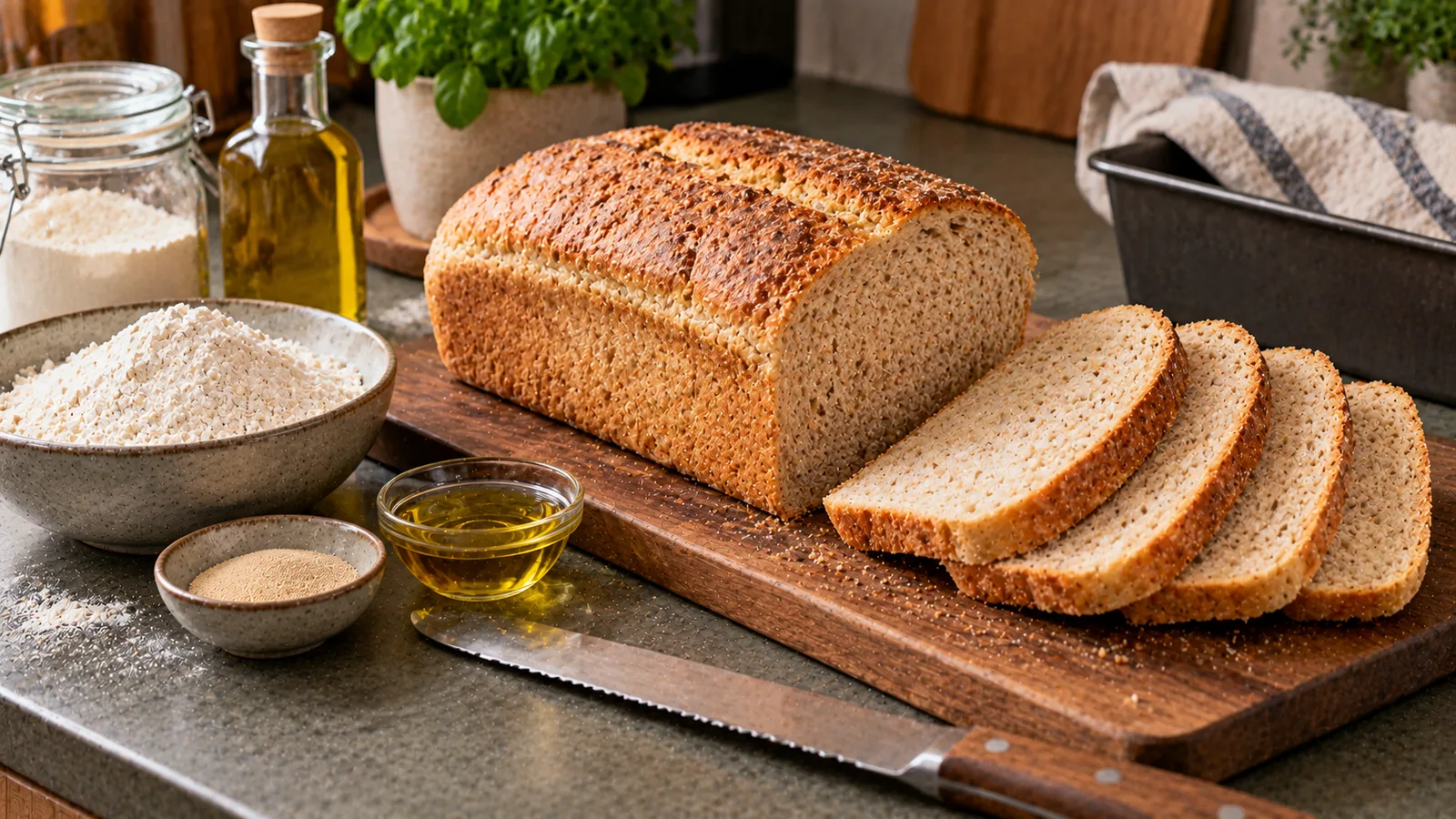
What does a slice of homemade bread really cost?
A homemade loaf has no shelf label telling you its price per slice. The useful answer comes from ingredients actually used, any baking energy you decide to include, and the number or weight of slices you obtain after cooling. These are three different measurements. Adding the price of every unopened package to one loaf inflates the cost; counting only flour ignores yeast, fat and electricity. Neither method makes a fair comparison with a shop-bought loaf.
This guide prices a specific illustrative wheat loaf, rather than claiming that homemade bread is always cheaper. All euro amounts, package sizes and electricity use below are worked-example assumptions, not verified offers from a German supermarket or a benchmark for every oven. Keep the method; replace the numbers with your receipts and energy tariff.
A measured loaf and its ingredient ledger
Our illustrative dough contains 500 g wheat flour, 320 ml water, 7 g dry yeast, 10 g salt, 20 g sugar and 20 ml oil. Tap-water cost is ignored as negligible in this household example. The quantities describe ingredients before baking, not the final mass of the loaf.
| Ingredient | Pack bought | Full pack price | Used | Cost in loaf |
|---|---|---|---|---|
| Wheat flour | 1,000 g | €1.20 | 500 g | €0.60 |
| Dry yeast | 7 g | €0.19 | 7 g | €0.19 |
| Salt | 1,000 g | €1.00 | 10 g | €0.01 |
| Sugar | 1,000 g | €1.00 | 20 g | €0.02 |
| Oil | 500 ml | €4.00 | 20 ml | €0.16 |
| Total | — | €7.39 | — | €0.98 |
The €7.39 column is what all five complete packs cost at checkout; it is not the recipe cost. The loaf consumes €0.98 of those ingredients. You still have flour, salt, sugar and oil worth €6.41 under the same unit-price assumptions, not €6.41 in cash returned to you. Water is listed for recipe clarity but excluded from this monetary table.
Calculate quantities used, not entire packs
For each ingredient, divide its purchase price by its pack quantity, then multiply by the quantity entering the dough. Flour illustrates the rule: €1.20 ÷ 1,000 g × 500 g = €0.60. Oil uses millilitres consistently: €4.00 ÷ 500 ml × 20 ml = €0.16. The single 7 g yeast sachet is used completely, so its whole €0.19 belongs to the loaf.
Do not multiply a litre price by grams unless you have a defensible density conversion. Likewise, flour weighed dry is not the same as the weight of bread after baking. Small rounding differences are possible; calculate with unrounded unit prices and round the final ledger to cents. For new ingredients, copy the quantity and price from the actual package rather than estimating from memory.
Add oven electricity without pretending it is universal
Whether to include utilities depends on the question. For a grocery-only estimate, the loaf costs €0.98 in ingredients. For a fuller at-home production cost, add baking energy. Suppose your entire bake, including preheating, used a measured or explicitly assumed 0.8 kWh at an electricity rate of €0.30/kWh. Then 0.8 × €0.30 = €0.24, making €1.22 for this loaf.
The oven's rated wattage multiplied by time is only an approximation: thermostats cycle, preheating matters, and two loaves baked together share the energy used by that baking session. A plug-in power meter suitable for your appliance or an energy reading is more informative when available. Never describe 0.8 kWh as a standard oven measurement. If you bake two identical loaves in the same measured cycle, allocate the session cost across both instead of charging €0.24 twice.
Weigh the cooled loaf before dividing it
Our worked loaf weighs 800 g after baking and cooling. The dough weighed more before it lost some water in the oven. Divide the total production cost by this finished, edible weight, not by the initial flour weight or dough mass. On this basis €1.22 ÷ 800 g × 100 g = €0.1525 per 100 g, approximately €0.15/100 g.
If the loaf produces 20 equal slices, each has a nominal weight of 40 g and costs €1.22 ÷ 20 = €0.061, or around €0.06 per slice. Keep the unrounded figure when calculating sandwiches or weekly totals. The end pieces will rarely weigh exactly the same as central slices; a kitchen scale gives a more reliable result for any particular portion.
Different thickness, different cost
A 'slice' is not a unit of mass. With the same 800 g loaf and the same €1.22 total, cutting 16 slices of 50 g gives approximately €0.08 each; cutting 25 slices of 32 g gives approximately €0.05 each. These are not cheaper bread recipes. They are different divisions of one loaf.
For an irregular 60 g slice, calculate 60 ÷ 800 × €1.22 = €0.0915, about €0.09. If you put two unequal slices in a sandwich, price their combined weight, then add fillings separately. For logging calories, use a nutrient source and the actual slice weight; euros per slice cannot be converted into kcal per slice.
Keep the cash bill and the recipe ledger apart
At checkout, the five packages cost €7.39. The ingredients actually consumed cost €0.98; unused inventory is €6.41. Separately, the illustrative energy input adds €0.24. The bookkeeping reconciliation is therefore €0.98 + €6.41 = €7.39, while the loaf-production total is €0.98 + €0.24 = €1.22. These equalities answer different questions.
Record pantry purchases once as cash expenses. Deduct ingredient quantities from their available stock as you bake. Do not add the €7.39 receipt to the €0.98 recipe cost when producing a single spending total: that double-counts the same products. If you run out of a component and open a new pack at a different price, record its own unit price before the next bake.
Waste, storage and repeat batches
A loaf divided into 20 pieces only provides 20 usable portions if you eat or preserve all of them. If four 40 g slices go stale and are discarded, the effective cost of the 16 eaten slices is €1.22 ÷ 16 ≈ €0.08 each, rather than the original roughly €0.06. This is a cost-allocation choice, not a change in the ingredient bill. Track losses honestly if the aim is to compare household value.
Let bread cool before packaging to limit trapped condensation; use suitable clean wrapping and freeze portions you will not eat promptly. Storage conditions and recipe ingredients change how long homemade bread keeps. Guidance on commercial breads cannot be copied mechanically to a homemade loaf with moist fillings or other perishable additions. For practical ideas on freezing individual slices, use the linked Mealisa guide if that language edition is already published. Related practical guidance: nutrition per slice of a homemade loaf.
Comparing homemade bread with a bought loaf
Compare like with like: the same weight of bread, the same definition of cost and similar ingredients if nutrition matters. A shop price per 500 g cannot be compared directly with your €1.22 for 800 g. The illustrative homemade cost equals about €0.76 per 500 g with the assumed electricity charge, but this is not a market price claim. Shop-bought bread involves packaging, convenience and different shelf life; homemade bread may involve equipment wear and preparation time not included here.
Save a new ledger for each changed recipe, bread size or electricity tariff. If you switch to seeds, butter, sourdough refreshments or a bread machine, update quantities and energy rather than reusing the headline result. The most useful conclusion is not 'homemade always wins': it is a transparent per-slice calculation you can audit with your own receipts and cooled loaf.
Sources
- USDA Food Buying Guide — purchase units, edible yield and portion costing. Used for the general principle of matching amounts purchased, amounts used and yielded portions; not as a source for our illustrative euro prices.
- Smart Energy GB — calculating appliance running costs. Source for the energy-consumption × unit-tariff method, not a claim that every bread bake uses 0.8 kWh.
- USDA FSIS — how long bread can be stored. General background on bread storage; check the exact recipe and perishable ingredients.