
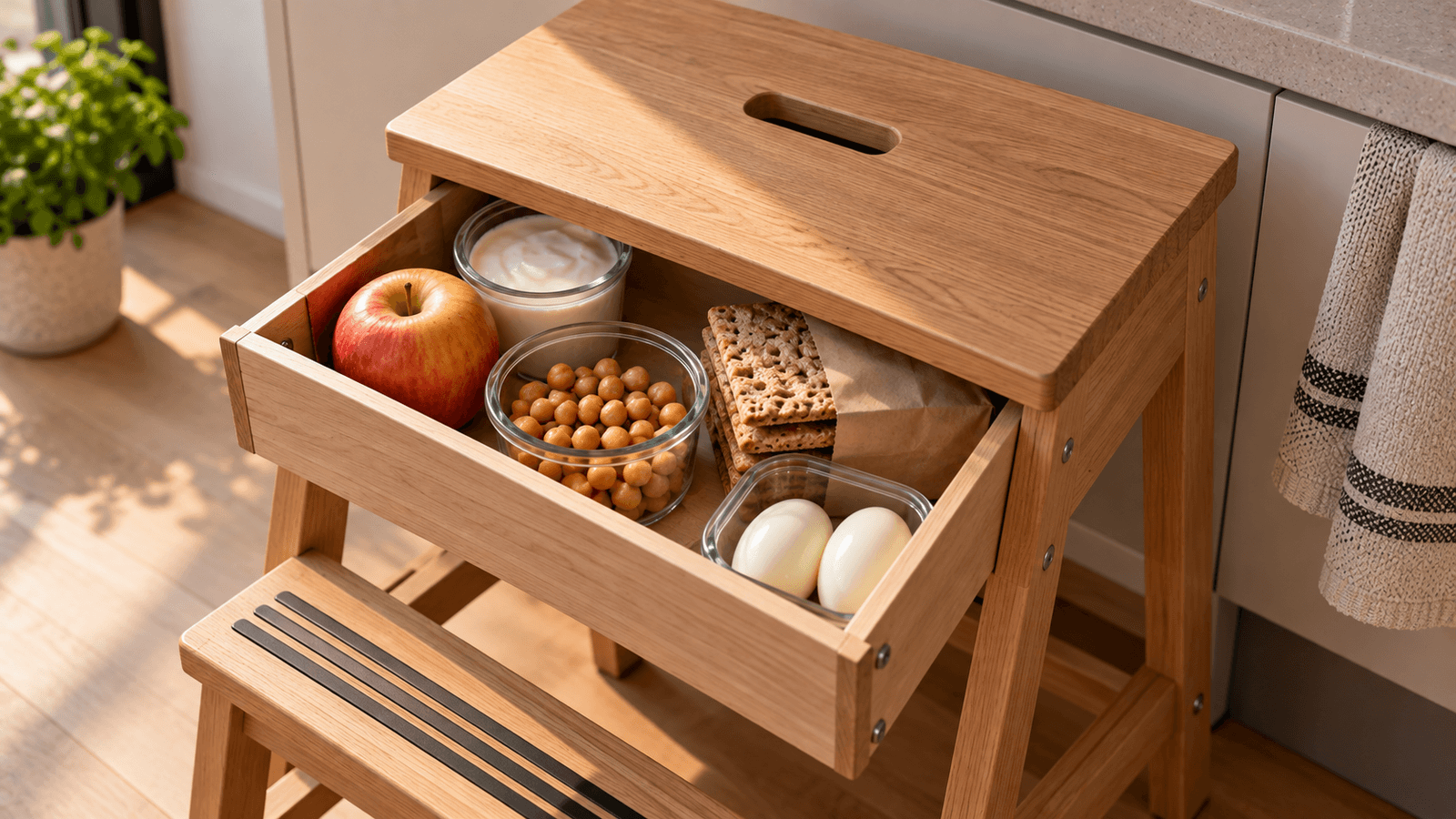
Healthy snacks do not need to rely on expensive protein bars, single-serving packs or specialty products.
Some of the cheapest options are ordinary supermarket foods that can be portioned at home: oats, fruit, yogurt, eggs, bread, carrots, beans and other basic ingredients.
This guide focuses specifically on keeping snack costs low. For the nutritional structure of a snack, see Healthy Snacks: How to Build a More Satisfying Snack.
What makes a snack budget-friendly?
The shelf price alone can be misleading.
A useful budget snack usually combines several characteristics:
- inexpensive ingredients
- little food waste
- sensible portion cost
- ingredients that can be used in other meals
- minimal preparation
- reasonable storage life
A €3 package that makes six snacks costs €0.50 per snack.
A €1.50 single-serving product costs €1.50 every time.
That difference becomes substantial when snacks are eaten regularly.
20 cheap healthy snack ideas
1. Apple with peanut butter
Slice an apple and add a small spoonful of peanut butter.
Why it works for a budget:
- apples are widely available
- peanut butter is used in small quantities
- a jar provides many portions
For the lowest cost, compare apples by price per kilogram rather than by package.
2. Banana with plain yogurt
A banana and a portion of plain yogurt require almost no preparation.
Buying yogurt in a larger tub is often cheaper per kilogram than buying multiple individual cups.
3. Oats with yogurt
Oats are inexpensive, store well and can be used in breakfast as well as snacks.
Mix a small portion with plain yogurt and allow it to soften for a few minutes.
Optional additions:
- banana
- apple
- cinnamon
- frozen berries
4. Hard-boiled eggs
Boil several eggs at once and refrigerate them.
They require more preparation than opening a packaged snack, but batch cooking keeps the effort low.
Eggs can also be reused for breakfast, salads and sandwiches.
5. Carrot sticks with yogurt dip
Cut carrots into sticks and serve them with plain yogurt mixed with herbs or seasoning.
Whole carrots are often cheaper than pre-cut snack packs.
6. Homemade popcorn
Plain popcorn kernels can produce many portions from one inexpensive package.
Preparing popcorn yourself also lets you control how much oil and seasoning you add.
Compare the cost with individual bags of ready-made popcorn to see the difference.
7. Banana and oats
For a very simple snack, combine sliced banana with a small amount of oats.
It uses two inexpensive ingredients that can also appear in multiple meals.
8. Toast with cottage cheese
Bread plus cottage cheese makes a simple savory snack.
If cottage cheese is expensive in your supermarket, compare:
- different package sizes
- store brands
- price per kilogram
9. Apple with plain yogurt
This works especially well when you already buy a large yogurt tub for breakfast.
Dice the apple and mix it directly into the yogurt.
10. Bread with peanut butter
Bread and peanut butter are shelf-stable staples compared with many prepared snacks.
The portion can be as simple as one slice of bread with a thin layer of peanut butter.
11. Carrots with hummus
Store-bought hummus can be convenient, but homemade hummus from chickpeas may reduce the cost further if you make enough to use across several meals.
12. Homemade bean spread on bread
Mash cooked beans with a little seasoning and use the mixture as a spread.
This is particularly useful when beans are already part of your lunch or dinner plan.
13. Plain yogurt with frozen fruit
Frozen fruit can be useful when fresh berries are expensive or likely to spoil before you use them.
Take only the amount you need and leave the rest frozen.
14. Seasonal fruit
The cheapest fruit changes throughout the year.
Instead of deciding that your snack must always contain a specific fruit, compare what is inexpensive that week.
Depending on location and season, that might be:
- apples
- bananas
- pears
- oranges
- plums
15. Homemade overnight oats in a small portion
Overnight oats do not need to be a full breakfast.
A smaller portion made from oats and milk or yogurt can work as a prepared snack.
Make several portions when convenient rather than buying individual snack pots.
16. Egg on toast
One boiled egg on a slice of bread uses inexpensive ingredients and can be prepared from foods already available for other meals.
This is a useful example of a snack that does not require a dedicated “snack product.”
17. Cucumber with yogurt-herb dip
Cucumber with a simple homemade dip can be inexpensive when cucumbers are in season or on promotion.
If they are expensive, carrots may offer a lower-cost alternative.
18. Leftover roasted chickpeas
If you are already using chickpeas in a meal, reserve some and roast them with seasoning.
Using an ingredient already in the meal plan can be cheaper than buying a separate snack.
19. Homemade mini sandwich
A snack can simply be a smaller version of familiar food.
Try:
- bread
- a small amount of cheese
- tomato or cucumber
There is no requirement for a snack to come in a dedicated snack package.
20. Leftover fruit-and-yogurt bowl
Use small amounts of fruit that need to be eaten soon and combine them with plain yogurt.
This turns food that might otherwise be wasted into another snack.
Cheap snack ingredients worth keeping around
Instead of buying 20 different products, build several snacks from a small group of flexible staples.
| Ingredient | Snack uses | Other uses |
|---|---|---|
| Oats | yogurt, overnight oats | breakfast, baking |
| Bananas | yogurt, oats, peanut butter | breakfast, smoothies |
| Apples | yogurt, peanut butter | breakfast, packed lunch |
| Eggs | boiled snack, toast | breakfast, salads, meals |
| Plain yogurt | fruit bowl, dip, oats | breakfast, sauces |
| Carrots | sticks, hummus | soups, dinners, salads |
| Bread | toast, mini sandwich | breakfast, lunch |
| Chickpeas/beans | hummus, spread, roasted snack | lunch, dinner |
| Peanut butter | fruit, toast | breakfast, sauces |
| Frozen fruit | yogurt, oats | breakfast, smoothies |
The budget advantage comes from overlap.
An ingredient used in several meals is less likely to sit unused until it spoils.
Example: packaged snacks vs basic ingredients
Imagine you need five snacks for the working week.
Option A: five individual snack products
If each costs €1.49:
5 × €1.49 = €7.45
Option B: ingredients used across several snacks
Suppose the portions you use during the week cost approximately:
- bananas: €1.20
- oats: €0.35
- yogurt: €1.40
- carrots: €0.70
- eggs: €1.20
Total used for snacks:
€4.85
The exact prices will vary by country, shop, brand and season, but the method is what matters: compare the cost of the amount actually used, not only the package price.
Calculate cost per snack
Use:
cost per snack = cost of ingredients used in the snack
If a 1 kg tub of yogurt costs €2.40 and you use 150 g:
€2.40 × 150 ÷ 1000 = €0.36
If a 500 g bag of oats costs €0.90 and you use 30 g:
€0.90 × 30 ÷ 500 = €0.054
Your yogurt-and-oats base costs approximately:
€0.36 + €0.05 = €0.41
Fruit or other additions would then be added to that amount.
For a broader method, see How to Calculate Cost per Meal.
Compare unit prices, not only package prices
A small package may have the lowest checkout price while costing more per kilogram.
Example:
Yogurt A:
500 g for €1.49
€2.98/kg
Yogurt B:
1,000 g for €2.49
€2.49/kg
The larger package has the lower unit price.
But it is only cheaper in practice if you can use it before it spoils.
Buying a cheaper-per-kilogram product and throwing half away does not save money.
Store brands can make simple snacks cheaper
For staple foods, compare store-brand versions of:
- oats
- plain yogurt
- canned beans
- chickpeas
- bread
- frozen fruit
- peanut butter
- basic dairy products
The cheapest option does not have to be the one you choose, but comparing the price per kilogram gives you useful information.
Whole foods can be cheaper than snack-sized versions
Convenience often adds cost.
Compare:
- whole carrots vs pre-cut carrot sticks
- large yogurt tub vs individual cups
- whole fruit vs prepared fruit cups
- popcorn kernels vs individual snack bags
- normal cheese block vs individually wrapped portions
Sometimes convenience is worth paying for.
The important point is to know what you are paying extra for.
Use seasonal flexibility
A rigid snack list can increase grocery costs.
If strawberries are expensive this week, you do not necessarily need strawberries.
Swap based on price:
- berries → apple
- apple → pear
- cucumber → carrot
- fresh berries → frozen fruit
- expensive nuts → another snack entirely
The nutritional role of a snack can often be maintained without buying the same ingredient every week.
Plan snacks from ingredients already on your grocery list
A separate snack shopping list often creates extra spending.
Instead, look at your existing meal plan.
If breakfast already uses:
- oats
- yogurt
- bananas
those ingredients can also make snacks.
If dinner already uses:
- carrots
- chickpeas
- eggs
some of those foods can become snack components.
This is one reason meal planning can help reduce grocery spending.
Reduce food waste with “use first” snacks
Before opening a new snack, check what needs to be eaten soon.
Examples:
- soft banana → yogurt and banana
- half cucumber → cucumber with dip
- open yogurt → yogurt with oats
- remaining bread → toast
- leftover chickpeas → roasted chickpeas or bean spread
A snack can act as a small food-waste buffer between planned meals.
When bulk buying does not save money
Buying the largest package is not automatically the cheapest strategy.
Avoid bulk buying when:
- you rarely eat the food
- storage space is limited
- the product spoils quickly
- you are trying a food for the first time
- a promotion encourages you to buy more than you need
Unit price matters, but usable quantity matters too.
Cheap snacks for work or school
Portable options can include:
- banana
- apple
- boiled egg in appropriate chilled storage
- homemade mini sandwich
- small container of oats and yogurt kept chilled
- carrot sticks
- homemade popcorn
Reusable containers can reduce dependence on individually packaged products.
For perishable foods, follow appropriate storage and food-safety practices.
Cheap snacks without cooking
When you do not want to cook:
- fruit + yogurt
- bread + peanut butter
- carrots + hummus
- apple + peanut butter
- yogurt + oats
- mini sandwich
- banana + yogurt
Convenience does not have to mean buying a dedicated packaged snack.
Cheap snacks with more protein
Budget-friendly protein sources vary by location and current prices, but useful candidates include:
- eggs
- plain yogurt
- skyr when competitively priced
- cottage cheese
- beans
- chickpeas
- peanut butter
Compare price per useful portion, not only which food has the highest protein number.
For a broader protein-focused list, see Cheap High-Protein Foods.
Build a one-week snack rotation without buying many foods
A simple example:
| Day | Snack |
|---|---|
| Monday | Yogurt + banana |
| Tuesday | Egg + toast |
| Wednesday | Apple + peanut butter |
| Thursday | Yogurt + oats |
| Friday | Carrots + hummus |
| Saturday | Homemade popcorn |
| Sunday | Fruit that needs using + yogurt |
Notice how the same ingredients repeat intentionally.
For budget planning, repetition can be useful because it reduces the number of packages you need to buy.
Three rules that keep snack spending under control
Buy ingredients, not a different snack product for every day
A few flexible staples can create many combinations.
Calculate the cost of the portion you eat
Package price alone does not tell you what each snack costs.
Use what is already open
The cheapest snack may be the food already in your refrigerator or pantry that needs to be used.
That approach keeps this strategy practical: lower snack spending without requiring a separate collection of expensive “healthy snack” products.