
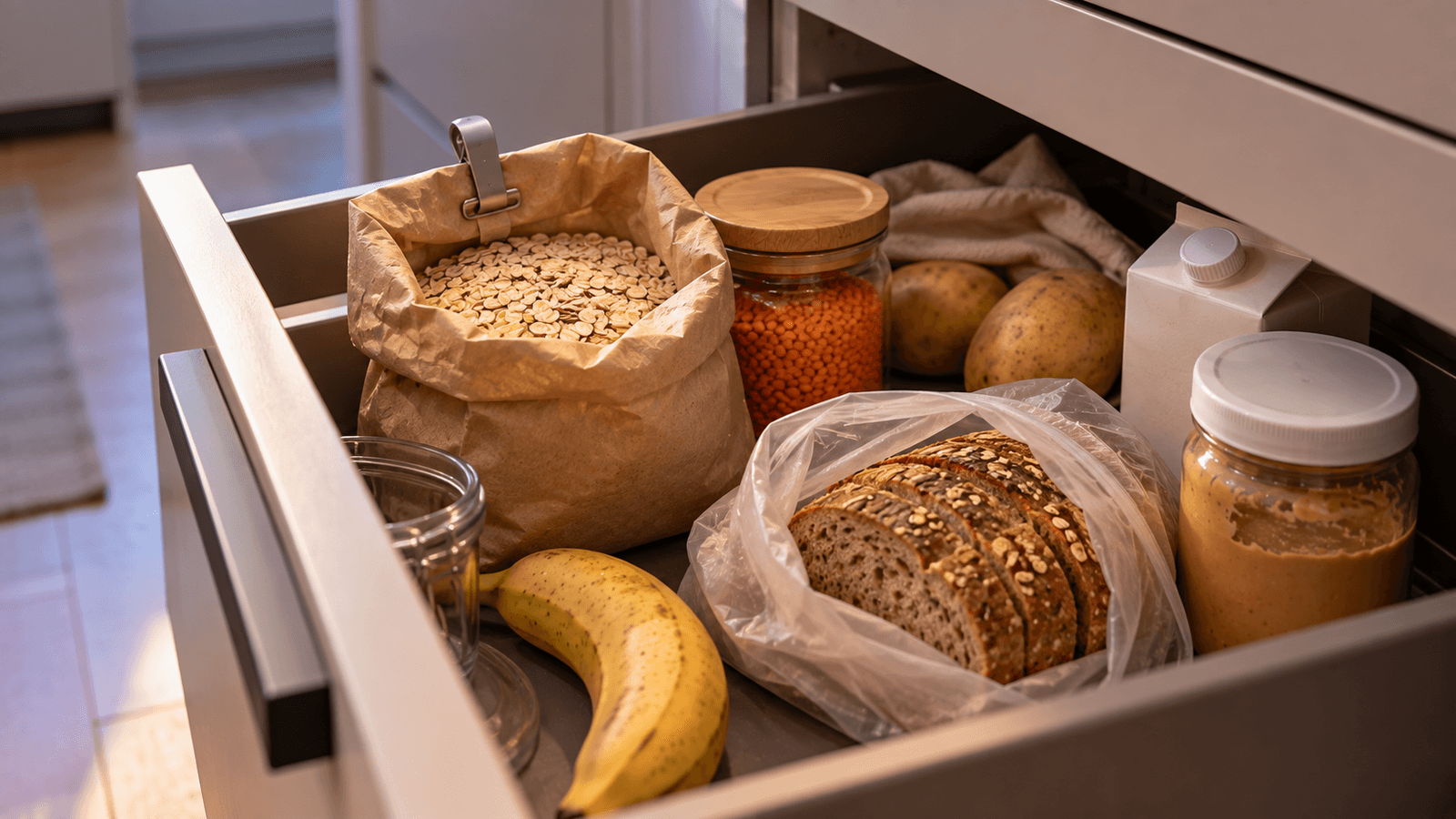
A healthy breakfast does not need specialty products, expensive protein snacks or a long ingredient list.
Some of the most useful breakfast staples are also relatively inexpensive: oats, eggs, bread, yogurt, seasonal fruit, milk, legumes and basic frozen produce.
The key is to build breakfast around a few affordable base ingredients and vary the additions rather than buying a completely different set of foods for every morning.
15 cheap healthy breakfast ideas
| Breakfast | Main affordable ingredients | Why it works |
|---|---|---|
| Oatmeal with banana | Oats, milk or water, banana | Low-cost staple with fruit and fibre |
| Overnight oats | Oats, milk, yogurt | Can be prepared ahead |
| Yogurt with oats and fruit | Plain yogurt, oats, seasonal fruit | Simple protein + carbohydrate combination |
| Eggs on whole-grain toast | Eggs, bread | Few ingredients and easy to scale |
| Scrambled eggs with frozen vegetables | Eggs, frozen vegetables | Uses inexpensive freezer staples |
| Banana oatmeal pancakes | Oats, banana, egg | Uses common ingredients |
| Apple-cinnamon oatmeal | Oats, apple, cinnamon | Useful when apples are inexpensive |
| Cottage cheese on toast | Cottage cheese, bread | Protein-rich and quick |
| Peanut butter and banana toast | Bread, peanut butter, banana | Shelf-stable staple plus fruit |
| Lentils with egg and toast | Cooked lentils, egg, bread | Affordable savoury breakfast |
| Yogurt with homemade oat topping | Yogurt, toasted oats, fruit | Alternative to packaged granola |
| Baked oatmeal | Oats, milk, egg, fruit | Good for several servings |
| Egg and potato breakfast | Potatoes, eggs | Uses two inexpensive staples |
| Bean and egg toast | Beans, egg, bread | Fibre and protein from basic ingredients |
| Leftover-based breakfast | Leftover grains or vegetables, egg | Reduces waste and extra purchases |
The exact price depends on your country, supermarket, season and package size. The useful comparison is therefore usually cost per serving, not simply the shelf price.
1. Oatmeal with banana
Oats are one of the easiest inexpensive breakfast bases because they are shelf-stable and sold in large packages.
A basic bowl can use:
- 50–60 g oats
- water or milk
- one banana
- cinnamon if desired
You can change the fruit depending on price and season.
Using water for part or all of the cooking liquid lowers the cost further, while milk can add protein and other nutrients.
The advantage of oatmeal is that the base remains inexpensive even when you change the toppings.
2. Overnight oats
Overnight oats use many of the same ingredients as hot oatmeal but require almost no work in the morning.
A simple version can contain:
- oats
- milk
- plain yogurt
- banana or apple
You do not need chia seeds, protein powder or expensive toppings for overnight oats to work.
If those ingredients fit your preferences and budget, they can be added, but they are optional rather than essential.
3. Plain yogurt with oats and seasonal fruit
Instead of buying individual flavoured yogurt cups, compare the unit price of a larger container of plain yogurt.
Combine it with:
- oats
- banana
- apple
- frozen berries
- whichever fruit is currently affordable
This gives you control over both portion size and additions.
When comparing yogurt products, check the price per kilogram rather than assuming the largest package is always cheapest.
4. Eggs on toast
Eggs and bread create a simple breakfast that needs very few additional ingredients.
Try:
- one or two eggs
- one or two slices of bread
- leftover vegetables if available
The cost can remain low because you are not buying a separate breakfast-specific product.
Bread can also be frozen in slices if you struggle to finish a loaf before it becomes stale.
5. Scrambled eggs with frozen vegetables
Frozen vegetables are useful when fresh vegetables repeatedly spoil before you use them.
Add a small amount directly to scrambled eggs.
Good options depend on what is inexpensive locally, but might include:
- spinach
- peas
- mixed vegetables
- peppers
There is no need to buy a special “breakfast vegetable mix.”
Use the same frozen vegetables you already use for lunch and dinner.
6. Banana oatmeal pancakes
A simple version can be made from:
- banana
- oats
- egg
The exact texture depends on how finely the oats are processed and how much banana is used.
The budget advantage is that the ingredients can all be used elsewhere during the week.
That matters because inexpensive meal planning is easier when ingredients have several uses.
7. Apple-cinnamon oatmeal
Apples are often relatively affordable and keep longer than many softer fruits.
Cook chopped or grated apple with oats and cinnamon.
If apples are inexpensive in your area, this can be a useful alternative to buying berries or more expensive breakfast fruit every week.
When another fruit is cheaper, switch.
A budget breakfast should adapt to prices rather than depend on one exact ingredient.
8. Cottage cheese on toast
Cottage cheese can provide substantial protein and can be used in both sweet and savoury breakfasts.
Combine it with toast and either:
- sliced fruit
- tomato
- cucumber
- pepper
- herbs
Check the price per kilogram because small single-serving packages may cost considerably more per unit than larger containers.
For nutrition and serving-size details, see Calories in Cottage Cheese.
9. Peanut butter and banana toast
Peanut butter is relatively energy-dense, so a modest amount can go a long way.
Combine:
- bread
- peanut butter
- banana
Because peanut butter stores well, it can be useful as a backup breakfast ingredient.
Compare products by unit price and choose according to your preferences rather than assuming specialty nut butters are nutritionally necessary.
10. Lentils with egg and toast
Breakfast does not have to be sweet.
If you already cook lentils for another meal, use some of them the next morning with an egg and bread.
This is especially useful because the lentils are not purchased exclusively for breakfast.
One batch can contribute to several meals.
That type of ingredient overlap is one of the easiest ways to keep a grocery budget under control.
11. Yogurt with homemade oat topping
Packaged granola can cost considerably more per kilogram than plain oats.
For a simpler alternative, lightly toast oats and combine them with plain yogurt and fruit.
You can add nuts or seeds if they fit your budget, but they do not need to dominate the mixture.
If you regularly buy both oats and granola, see Oats vs Granola: Nutrition and Calories Compared.
12. Baked oatmeal for several breakfasts
Baked oatmeal can turn one preparation session into several servings.
A basic version might use:
- oats
- milk
- eggs
- banana or apple
- cinnamon
Prepare only as much as you realistically expect to eat and store it appropriately.
Batch cooking saves money only when the food actually gets eaten.
13. Egg and potato breakfast
Potatoes are not limited to lunch or dinner.
Cooked potatoes left from another meal can be reheated and combined with eggs and vegetables.
This works particularly well when you intentionally cook a little extra potato for another meal.
The important distinction is between planned leftovers and forgotten leftovers.
The first can reduce both cooking time and food cost.
14. Bean and egg toast
Beans are another inexpensive ingredient that can work beyond lunch and dinner.
Use cooked or canned beans with egg and toast.
If using canned beans, compare drained weight and unit price rather than only comparing can prices.
A cheaper can is not necessarily cheaper per amount of food you actually receive.
15. Build breakfast from leftovers
A low-cost breakfast does not need to contain traditional breakfast foods.
Useful leftovers might include:
- potatoes
- cooked rice
- beans
- lentils
- roasted vegetables
- bread nearing the end of its freshness
Add an egg, yogurt, fruit or another ingredient where appropriate.
Using food already in your kitchen can be cheaper than buying something specifically labelled or marketed for breakfast.
What makes a cheap breakfast healthy?
Price alone does not determine nutritional quality.
A practical breakfast can combine several of these components:
- a carbohydrate-rich staple such as oats, bread or potatoes
- a protein source such as eggs, yogurt, cottage cheese, milk or legumes
- fruit or vegetables
- a source of fat when appropriate
Not every breakfast needs to contain every possible nutrient category.
Your overall eating pattern across the day matters more than making one breakfast nutritionally perfect.
For a broader framework, see What Makes a Breakfast Balanced?.
Use cost per serving, not package price
Suppose:
- a 1 kg package of oats costs €1.80
- you use 60 g per breakfast
The oat portion costs:
€1.80 ÷ 1000 × 60 = €0.11
Now suppose:
- a 400 g package of breakfast cereal costs €3.20
- you use 60 g
That portion costs:
€3.20 ÷ 400 × 60 = €0.48
The cereal may still fit your budget, but cost per serving reveals the difference more clearly than package price.
For the full method, see How to Calculate Cost per Meal.
Choose ingredients that work in several meals
One of the easiest ways to overspend is buying ingredients that serve only one recipe.
Instead, choose breakfast foods that also work elsewhere.
| Ingredient | Breakfast use | Other uses |
|---|---|---|
| Oats | Porridge, overnight oats | Baking, homemade toppings |
| Eggs | Toast, scrambled eggs | Lunches, dinners |
| Yogurt | Fruit bowl, oats | Sauces, snacks |
| Bread | Toast | Sandwiches, soups |
| Bananas | Oatmeal, toast | Snacks, baking |
| Potatoes | Egg breakfast | Lunch and dinner |
| Beans/lentils | Savoury breakfast | Soups, salads, main meals |
| Frozen vegetables | Eggs | Lunch and dinner |
The more ways you can realistically use an ingredient, the lower the chance that part of it will be wasted.
Compare unit prices
Shelf prices can be misleading when package sizes differ.
Compare:
- price per kilogram
- price per litre
- price per 100 g
This is especially useful for:
- oats and cereals
- yogurt
- nuts and seeds
- bread
- frozen fruit
- cheese
- milk
Do not automatically choose the largest package.
A large package is only economical if you will actually use it.
Store brands can reduce the cost
Basic products such as oats, milk, yogurt, frozen fruit and canned legumes are often available as supermarket own-brand versions.
The nutritional difference between a basic store-brand product and a premium version may be small or irrelevant for your needs, while the price difference can be substantial.
Compare the nutrition label and unit price rather than relying on branding.
Use expensive ingredients as additions rather than foundations
Some nutritious foods can be relatively expensive.
Examples may include:
- berries outside their season
- nuts
- seeds
- specialty granola
- premium protein products
You do not necessarily need to remove them.
Instead, use smaller amounts alongside cheaper base ingredients.
For example, a small quantity of berries can flavour a bowl based primarily on oats and banana.
A few nuts can add texture without becoming the largest ingredient.
Keep one emergency breakfast available
Convenience purchases become more likely when there is nothing easy to eat at home.
Keep at least one low-effort breakfast available.
Examples:
- oats + banana
- eggs + frozen bread
- yogurt + frozen fruit
- peanut butter + bread
These ingredients keep reasonably well and can prevent a busy morning from automatically becoming a more expensive purchase outside the home.
A simple low-cost breakfast rotation
You do not need seven completely different breakfasts.
A realistic rotation might be:
Monday: oatmeal with banana
Tuesday: eggs on toast
Wednesday: yogurt, oats and apple
Thursday: oatmeal with frozen fruit
Friday: eggs with leftover vegetables
Weekend: baked oatmeal or another breakfast using what remains
This provides variation while repeatedly using the same core groceries.
Build the shopping list from the breakfasts
If you want five breakfasts, decide what they are before shopping.
For example:
- oats × 3 breakfasts
- eggs and toast × 2 breakfasts
- bananas with oats
- apples with yogurt
- frozen vegetables with eggs
Your shopping list can then stay short:
- oats
- eggs
- bread
- plain yogurt
- bananas
- apples
- frozen vegetables
Check your kitchen first and remove anything you already have.
This is usually more economical than walking through the breakfast aisle and deciding what looks useful.
The cheapest breakfast is not always the smallest one
Reducing cost by making breakfast extremely small can backfire if it leaves you hungry and leads to another purchase shortly afterward.
Budgeting works better when the meal is both affordable and appropriate for your needs.
A slightly more substantial breakfast made from inexpensive staples may be more useful than the absolute cheapest possible combination.
Focus on repeatable breakfasts
A cheap healthy breakfast does not need to look impressive.
The most useful options usually share three characteristics:
- the ingredients are affordable where you shop
- you actually enjoy eating them
- the ingredients can be used before they spoil
Start with two or three breakfasts that meet those conditions.
Then vary fruit, vegetables, seasonings or preparation rather than rebuilding your breakfast routine from scratch every week.