
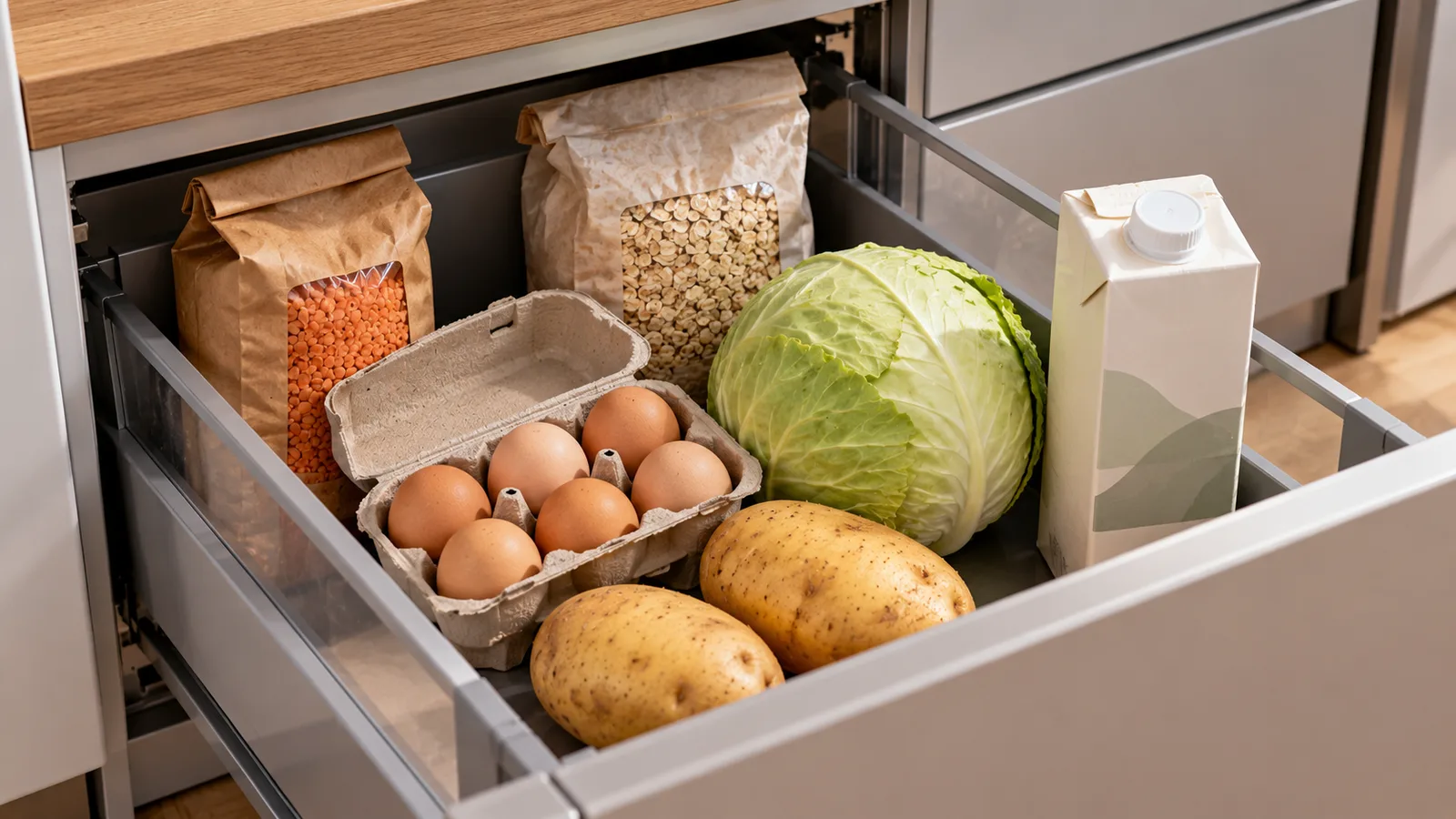
Eating a balanced diet on a budget does not require buying a special collection of "healthy" products.
A practical budget grocery basket is usually built from ordinary foods that are affordable in your area, store reasonably well and can be combined into many different meals.
Prices vary by country, season, supermarket and package size, so there is no universal list of the cheapest foods. Instead, it helps to know which categories often provide useful nutrition at a relatively low cost and then compare the actual prices where you shop.
What makes a food useful on a budget?
The lowest shelf price is not always the best value.
A useful budget food usually performs well in several areas:
- reasonable price for the amount you actually eat;
- useful nutritional contribution;
- low risk of waste;
- easy storage;
- flexibility across several meals;
- availability in ordinary supermarkets;
- preparation that fits your schedule.
For example, a large package may have a lower price per kilogram but still be poor value if half of it spoils.
Likewise, an inexpensive ingredient that works in breakfast, lunch and dinner may be more useful than a similarly priced product you only use occasionally.
1. Lentils
Dry lentils are a versatile pantry staple.
They can be used in:
- soups;
- stews;
- curries;
- salads;
- grain bowls;
- sauces;
- mixed dishes.
Lentils provide plant protein and fiber and can help make a meal more substantial without requiring meat at every meal.
Dry lentils often have a long shelf life when stored correctly. Canned or ready-cooked lentils can cost more per unit of food but save preparation time.
The better choice depends on whether your priority is lowest cost, convenience or both.
2. Beans
Beans are another flexible staple.
Common options include:
- kidney beans;
- black beans;
- white beans;
- pinto beans;
- chickpeas.
They work in soups, chili-style dishes, salads, wraps, rice dishes and vegetable meals.
Dry beans can be economical but require soaking or longer cooking depending on the variety.
Canned beans are convenient and can still be useful on a budget, particularly when time and energy costs matter.
Compare the usable amount rather than only the package price.
3. Chickpeas
Chickpeas can work as both a main ingredient and an addition to other foods.
Use them in:
- salads;
- curries;
- soups;
- grain bowls;
- roasted dishes;
- spreads.
They provide another way to vary plant-based meals without buying a completely different set of ingredients.
If canned chickpeas are expensive where you live, dried chickpeas may offer better value. If cooking time is limited, the convenience of canned chickpeas may justify the difference.
4. Eggs
Eggs are compact, versatile and easy to use in different meals.
They can become:
- breakfast;
- sandwich filling;
- omelet;
- addition to rice or potatoes;
- component of a salad;
- ingredient in cooked dishes.
Their price can fluctuate considerably, so compare them with other protein foods rather than assuming they are always the cheapest option.
A useful question is not simply "Are eggs cheap?" but:
What does a meal built around eggs cost compared with the alternatives available this week?
5. Oats
Plain rolled oats are useful beyond a single breakfast recipe.
They can be used for:
- porridge;
- overnight oats;
- yogurt mixtures;
- homemade muesli;
- baking;
- some savory dishes.
Plain oats often cost less than heavily flavored individual breakfast products.
They also store well, which can reduce waste.
When comparing oat products, check the unit price rather than assuming the largest-looking package is automatically cheapest.
6. Potatoes
Potatoes are a flexible starchy food that can form the base or side of many meals.
They can be:
- boiled;
- baked;
- roasted;
- mashed;
- added to soups and stews.
They also pair easily with vegetables, eggs, fish, meat or legumes.
The cheapest package is not necessarily the best purchase if it is too large for your household to use before quality deteriorates.
Buy an amount that matches your realistic cooking habits.
7. Rice
Rice is easy to combine with many inexpensive ingredients.
For example:
- rice + beans + vegetables;
- rice + lentils + vegetables;
- rice + egg + frozen vegetables;
- rice + tofu + cabbage.
Large bags can reduce the unit price, but only when the product will actually be used and can be stored properly.
Different rice varieties can also vary significantly in price. A basic everyday variety may fit a budget better than a specialty option.
8. Pasta
Dry pasta is inexpensive in many markets, stores well and is easy to portion.
A balanced pasta meal does not need to consist only of pasta.
You can combine it with:
- tomato-based sauce;
- lentils or beans;
- vegetables;
- tuna;
- a moderate amount of cheese;
- other protein foods.
This approach turns a basic staple into a more complete meal without requiring expensive ingredients.
9. Cabbage
Cabbage can be particularly useful because it is versatile and often keeps longer than more delicate vegetables.
It can be used:
- raw in salads or slaws;
- sautéed;
- in soups;
- in stews;
- with potatoes;
- with rice or noodles.
A vegetable that survives long enough to be eaten can offer better real-world value than a cheaper-looking product that regularly ends up in the bin.
10. Carrots
Carrots are another adaptable vegetable.
Use them:
- raw;
- roasted;
- in soup;
- in stews;
- grated into salads;
- in sauces;
- alongside grains and legumes.
They can also be bought in quantities that are relatively easy for many households to use.
As always, local and seasonal pricing matters.
11. Frozen vegetables
Frozen vegetables can be one of the most practical tools for reducing waste.
Advantages include:
- long freezer storage;
- no pressure to use the entire package immediately;
- easy portioning;
- minimal preparation;
- availability outside the fresh season.
Examples include:
- peas;
- spinach;
- broccoli;
- green beans;
- mixed vegetables.
Frozen vegetables are not automatically cheaper than fresh vegetables, so compare prices.
Their main budget advantage can be the amount you actually use rather than throw away.
12. Seasonal vegetables
The best-value vegetable can change during the year.
Instead of deciding that one vegetable must always be on your shopping list, compare what is currently inexpensive.
Depending on season and region, good-value options might include:
- cabbage;
- carrots;
- onions;
- zucchini;
- tomatoes;
- pumpkin;
- cauliflower.
Flexible meal planning makes it easier to substitute one vegetable for another when prices change.
13. Bananas and other affordable fruit
Bananas are often a practical fruit option, but they are not universally the cheapest fruit.
Apples, oranges, pears or seasonal local fruit may offer better value at different times.
A useful strategy is to compare:
- price per kilogram;
- edible amount;
- how quickly the fruit spoils;
- how much your household actually eats.
Buying inexpensive fruit is not economical if it regularly becomes food waste.
14. Plain yogurt
Plain yogurt can work in:
- breakfast;
- snacks;
- sauces;
- dressings;
- savory dishes.
Large tubs may cost less per kilogram than individual portions.
But the larger size only saves money if you finish it.
If a smaller container prevents waste, the higher unit price may still produce a lower real household cost.
15. Milk
Milk can contribute protein and several micronutrients and can be used in drinks, cereals, porridge, sauces and cooking.
Fresh and shelf-stable versions may have different prices and storage advantages.
Shelf-stable milk can be useful for households that want backup supplies without filling the refrigerator.
Choose the type that fits your diet, storage and actual use.
16. Cottage cheese, quark or similar local dairy
Depending on the country, simple high-protein dairy foods can provide good value.
Examples vary by market:
- cottage cheese;
- quark;
- fromage blanc;
- skyr;
- plain high-protein yogurt.
Do not assume the product marketed most heavily as "high protein" is the cheapest.
Compare the price per kilogram and the nutrition label.
Mealisa also has a dedicated guide to cheap high-protein foods when protein cost is the main goal.
17. Canned tomatoes
Canned tomatoes are useful because they can turn inexpensive staples into complete dishes.
Combine them with:
- lentils;
- beans;
- pasta;
- rice;
- vegetables;
- eggs.
They store for a long time and make it easier to keep ingredients for a simple meal available at home.
Compare plain canned tomatoes with prepared sauces, which may differ substantially in price.
18. Onions
Onions are rarely the main component of a meal, but they can make inexpensive ingredients more useful.
They work with:
- beans;
- lentils;
- potatoes;
- eggs;
- rice;
- pasta;
- soups;
- stews.
Budget shopping is not only about buying the cheapest calories. Ingredients that make simple foods enjoyable enough to eat repeatedly can also have practical value.
19. Peanut butter or other nut/seed spreads
Where reasonably priced, peanut butter can be a convenient, shelf-stable food.
It can be used with:
- oats;
- bread;
- fruit;
- yogurt;
- sauces.
However, nut and seed products vary enormously in price between markets.
They are also energy-dense, so the useful portion can be relatively small.
Treat them as one possible option rather than an essential budget food.
20. Canned fish when competitively priced
Canned tuna, sardines and similar products can sometimes provide a convenient protein option with long storage life.
But prices vary greatly.
Compare:
- price per can;
- drained weight;
- price per kilogram;
- how many portions you actually get.
A cheap-looking can with a small drained weight may be less economical than another package.
Build a budget basket by category
Instead of trying to buy every food on a "healthy budget foods" list, build a flexible basket.
A simple framework is:
| Category | Examples |
|---|---|
| Protein foods | Lentils, beans, eggs, tofu, canned fish, simple dairy |
| Starchy foods/grains | Potatoes, oats, rice, pasta |
| Vegetables | Cabbage, carrots, seasonal produce, frozen vegetables |
| Fruit | Bananas, apples, seasonal fruit |
| Flavor/base ingredients | Onions, canned tomatoes, herbs, spices |
| Optional additions | Yogurt, cheese, nut or seed spreads |
You do not need something from every row in every meal.
The purpose is to make sure a low-cost grocery basket still contains enough variety to build different meals.
Example: turning six staples into several meals
Suppose you have:
- lentils;
- eggs;
- potatoes;
- cabbage;
- oats;
- milk.
These are not a complete diet by themselves, but they demonstrate how a few ordinary staples can serve different roles.
You could use them as foundations for:
Breakfast
Oats cooked with milk.
Lunch
Lentil and cabbage soup with potatoes.
Dinner
Potatoes with eggs and cooked cabbage.
Then add other vegetables, fruit, seasonings and protein foods according to your budget and preferences.
The important principle is ingredient overlap.
A useful ingredient can appear in more than one meal without forcing you to eat the same finished dish repeatedly.
Compare cost per usable amount
Shelf price alone can be misleading.
Imagine:
Product A: €1.50 for 500 g
Product B: €2.40 for 1 kg
Product B costs more at checkout but less per kilogram.
However, if half of Product B spoils, its apparent saving disappears.
For foods with edible waste, drained liquid or rapid spoilage, the amount you actually consume matters.
Mealisa's guide to comparing grocery prices across package sizes explains this in more detail.
Cheap per kilogram does not always mean cheap per meal
A meal contains several ingredients.
The relevant question may be:
How much does the amount I actually use cost?
For example, an ingredient that costs €6 per kilogram but is used in 20 g portions contributes:
€6 × 0.020 = €0.12 per portion
Meanwhile, a cheaper ingredient used in a much larger quantity can contribute more to the meal cost.
This is why cost per meal can be more useful than looking at one package price in isolation.
Use expensive ingredients strategically
Budget eating does not require eliminating every expensive ingredient.
A more flexible strategy is to combine smaller quantities of higher-cost foods with inexpensive foundations.
For example:
- a smaller amount of salmon with potatoes and vegetables;
- a little cheese with beans and pasta;
- yogurt with oats rather than several individually packaged breakfast products.
This can preserve variety while keeping the total meal cost manageable.
Store brands can be worth comparing
For basic foods such as:
- oats;
- rice;
- pasta;
- canned tomatoes;
- beans;
- milk;
- frozen vegetables;
store-brand products may cost less than heavily marketed alternatives.
But compare the actual unit price rather than assuming the store brand always wins.
Promotions and package sizes can change the result.
Convenience has economic value too
The absolute cheapest ingredient is not always the best choice for your life.
Dry beans may cost less than canned beans.
But canned beans can be ready in seconds.
Whole vegetables may cost less than prepared frozen vegetables.
But frozen vegetables may prevent waste and make it more likely that you actually cook.
A realistic budget considers:
- money;
- preparation time;
- storage;
- cooking equipment;
- energy use;
- waste.
The best choice is the one that works in your household.
Avoid buying a bargain you will not eat
Discounts can encourage unnecessary purchases.
Before buying a large discounted package, ask:
- Do we normally eat this?
- Can we store it safely?
- Will we use it before quality deteriorates?
- Can part of it be frozen?
- Is the unit price actually lower?
- Does buying it replace something else, or simply add spending?
A low price is only useful when the food gets used.
Keep a few backup foods
Budget-friendly pantry and freezer staples can reduce the need for last-minute purchases.
Examples include:
- oats;
- rice;
- pasta;
- lentils;
- beans;
- canned tomatoes;
- frozen vegetables.
With a few compatible ingredients available, you can still build a meal when fresh plans change.
This can also support budget meal planning without requiring every meal to be planned rigidly.
Buy for meals, not for an idealized pantry
A beautiful pantry full of inexpensive staples can still waste money if those foods do not fit your actual cooking habits.
Start with meals you genuinely eat.
Then identify ingredients that repeat across them.
For example:
Meal 1: rice + beans + vegetables
Meal 2: lentil soup + potatoes
Meal 3: pasta + tomatoes + vegetables
Meal 4: eggs + potatoes + cabbage
The shopping list now has a reason behind it.
Variety does not require dozens of ingredients
You can create variety through different combinations and preparation methods.
Rice can appear with:
- beans;
- egg;
- vegetables;
- tofu;
- fish.
Potatoes can be:
- boiled;
- baked;
- mashed;
- added to soup.
Lentils can become:
- soup;
- curry;
- salad;
- sauce.
This reduces the need to buy a completely different ingredient set for every meal.
A practical budget-food checklist
Before adding a staple to your regular shopping list, ask:
- Is the unit price competitive?
- Will I actually use it?
- Does it work in more than one meal?
- Can I store it long enough?
- Does it add something useful to my overall diet?
- Is there a cheaper equivalent I enjoy just as much?
- Does the package size fit my household?
This is more reliable than following a universal list of supposedly cheap foods.
The practical takeaway
Good budget foods are not defined by one fixed shopping list.
Useful choices often include staples such as:
- lentils and beans;
- eggs;
- oats;
- potatoes;
- rice and pasta;
- cabbage and carrots;
- frozen or seasonal vegetables;
- affordable fruit;
- plain dairy products;
- canned tomatoes and other flexible pantry ingredients.
The best combination depends on local prices, household size, dietary needs, storage and cooking habits.
Build your basket around several food groups, compare unit prices, choose package sizes you can realistically use and favor ingredients that work across multiple meals.
That approach makes budget eating more flexible than simply chasing the lowest sticker price.