
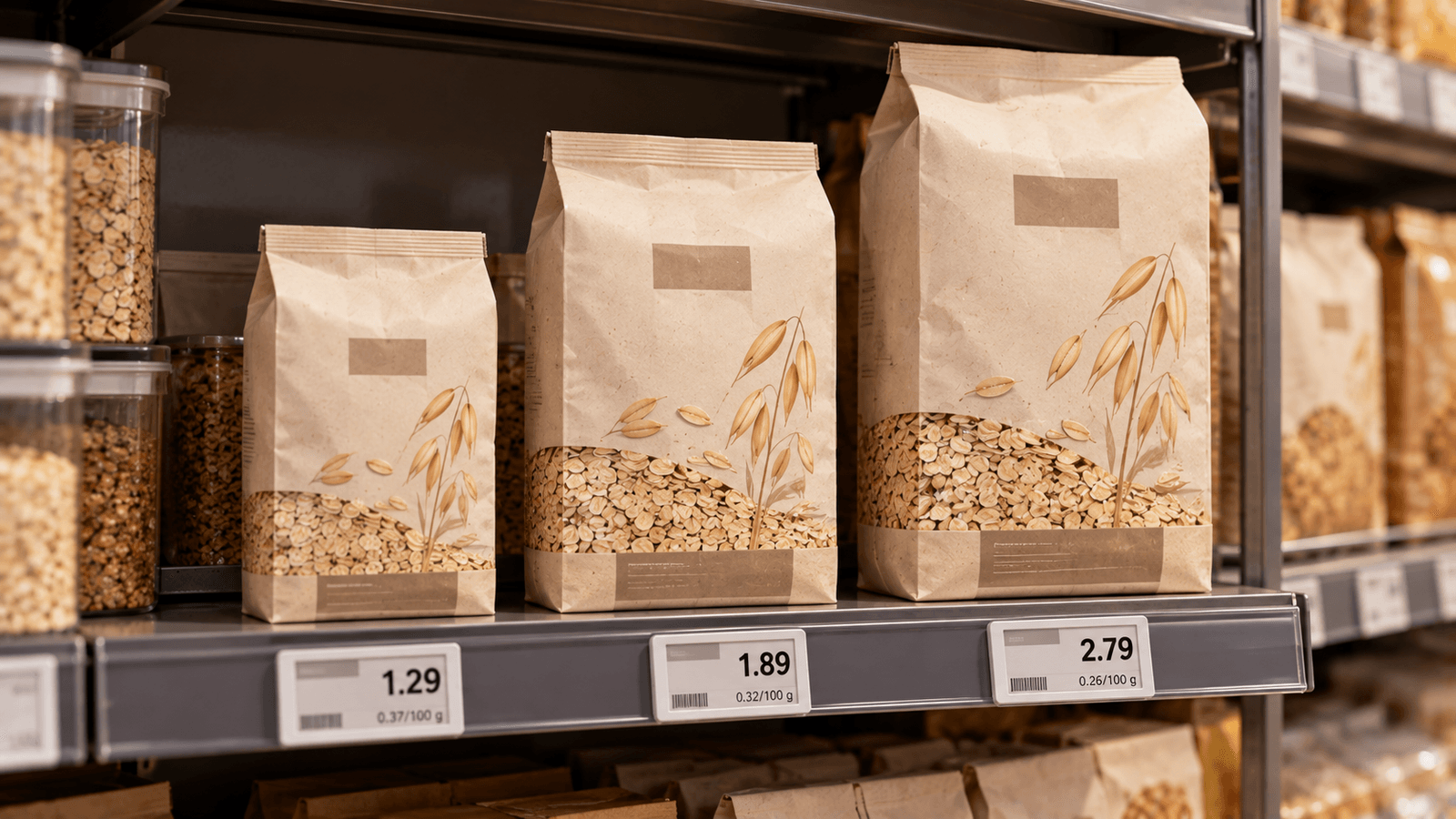
A larger package is not automatically cheaper.
A sale sticker does not automatically mean the best value either.
When two grocery products come in different package sizes, the shelf price alone is often the wrong number to compare.
The useful number is the unit price.
It converts both products to the same unit — such as price per kilogram, per 100 g or per litre — so you can compare them directly.
The basic unit-price formula
Use:
Unit price = package price ÷ package quantity
The quantity must be expressed in the unit you want to compare.
For example:
A 500 g package costs €2.40.
500 g = 0.5 kg.
€2.40 ÷ 0.5 = €4.80 per kg
A competing 750 g package costs €3.30.
750 g = 0.75 kg.
€3.30 ÷ 0.75 = €4.40 per kg
The second package costs more at checkout, but it is cheaper per kilogram.
Why shelf price can be misleading
Imagine:
Product A
500 g for €2.49
Product B
750 g for €3.29
Looking only at the price tag, Product A appears cheaper.
Now compare the same quantity.
Product A:
€2.49 ÷ 0.5 kg = €4.98/kg
Product B:
€3.29 ÷ 0.75 kg = €4.39/kg
Product B has the lower unit price.
That does not automatically mean you should buy it — waste, storage and your actual needs still matter — but now the price comparison itself is fair.
Price per kilogram
Price per kilogram is useful for many foods sold by weight:
- rice;
- pasta;
- oats;
- flour;
- meat;
- fish;
- cheese;
- vegetables;
- frozen foods;
- nuts.
Formula:
Price per kg = price ÷ weight in kg
Example:
900 g of oats costs €2.79.
900 g = 0.9 kg.
€2.79 ÷ 0.9 = €3.10/kg
Comparing grams without converting mentally
You can also calculate directly from grams:
Price per kg = price ÷ grams × 1000
Example:
€1.89 for 350 g:
1.89 ÷ 350 × 1000 = €5.40/kg
This is often faster when the package gives only grams.
Price per 100 g
Some shops display price per 100 g rather than per kilogram.
Formula:
Price per 100 g = price ÷ grams × 100
Example:
A 250 g package costs €1.75.
1.75 ÷ 250 × 100 = €0.70 per 100 g
Another 400 g package costs €2.60:
2.60 ÷ 400 × 100 = €0.65 per 100 g
The 400 g package is cheaper per 100 g.
Converting between price per 100 g and price per kg
There are ten 100 g portions in one kilogram.
So:
€0.65 per 100 g = €6.50 per kg
and:
€4.80 per kg = €0.48 per 100 g
Use whichever format makes the comparison easiest.
Price per litre
For milk, juice, oil and other products sold by volume:
Price per litre = price ÷ volume in litres
Example:
750 ml of a product costs €2.25.
750 ml = 0.75 L.
€2.25 ÷ 0.75 = €3.00/L
A 1 L package costs €2.85.
Its unit price is €2.85/L.
The 1 L package is cheaper per litre.
Calculating directly from millilitres
Use:
Price per litre = price ÷ ml × 1000
Example:
€1.69 for 500 ml:
1.69 ÷ 500 × 1000 = €3.38/L
Price per item
Weight is not always the most useful unit.
For products such as:
- eggs;
- wraps;
- bread rolls;
- yogurt cups;
- snack bars;
- individual portions,
you may want to compare price per item.
Example:
6 yogurt cups cost €2.70.
€2.70 ÷ 6 = €0.45 each
10 cups cost €4.10.
€4.10 ÷ 10 = €0.41 each
The larger multipack is cheaper per cup.
Make sure you compare the same unit
This is the most important rule.
Do not compare:
- €/kg with €/100 g without converting;
- €/L with price per 500 ml;
- price per pack with price per item;
- drained weight with total package weight without understanding the difference.
Convert both products to one common basis first.
Example: three rice packages
Suppose a store offers:
| Package | Price | Unit price |
|---|---|---|
| 500 g | €1.49 | €2.98/kg |
| 1 kg | €2.69 | €2.69/kg |
| 2 kg | €4.99 | €2.50/kg |
The 2 kg bag has the lowest price per kilogram.
But this answers only one question:
Which package has the lowest unit price?
It does not answer whether 2 kg is the right amount for your household.
Bigger is cheaper — until you waste it
Suppose:
Small package
500 g for €2.00 = €4.00/kg
Large package
1 kg for €3.50 = €3.50/kg
The large package looks better.
But if you use only 700 g before the rest spoils, your effective cost for the food actually eaten is:
€3.50 ÷ 0.7 kg = €5.00/kg consumed
In that situation, the nominally cheaper package became more expensive for you.
Unit price is useful, but only if you can actually use the quantity.
When a smaller package can be the better purchase
A smaller pack may make more sense when:
- the food spoils quickly;
- you are trying a product for the first time;
- freezer or storage space is limited;
- your household uses very little of it;
- the larger pack would tie up money you need for other groceries;
- you are unlikely to finish it.
The lowest unit price and the lowest total spending are not always the same thing.
Sale prices should also be converted to unit prices
Suppose:
Regular 500 g package: €2.20
Sale 750 g package: €3.10
Calculate:
500 g:
2.20 ÷ 500 × 1000 = €4.40/kg
750 g:
3.10 ÷ 750 × 1000 = €4.13/kg
The sale package is cheaper per kilogram.
But now imagine the regular product costs €1.95.
1.95 ÷ 500 × 1000 = €3.90/kg
In that case, the product without the sale label is cheaper per kilogram.
The word "sale" is not the comparison. The unit price is.
Percentage discounts
If a package normally costs €4.00 and is discounted by 25%:
25% of €4.00 = €1.00.
Sale price:
€4.00 − €1.00 = €3.00
If the package weighs 600 g:
3.00 ÷ 600 × 1000 = €5.00/kg
Now compare €5.00/kg with the alternatives.
Buy-one-get-one offers
A promotion can change the effective unit price dramatically — but only if you will use both packages.
Example:
One 400 g package costs €2.40.
Two normally cost €4.80.
If the second is free, you receive 800 g for €2.40.
2.40 ÷ 800 × 1000 = €3.00/kg
Without the promotion:
2.40 ÷ 400 × 1000 = €6.00/kg
But if the second package goes unused, the theoretical saving is not useful.
Compare store brands and branded products on the same basis
Package design can make products look difficult to compare.
Suppose:
Brand A
375 g for €3.20
Store brand
500 g for €3.75
Brand A:
3.20 ÷ 375 × 1000 = €8.53/kg
Store brand:
3.75 ÷ 500 × 1000 = €7.50/kg
The store brand has the lower unit price.
You can then compare other factors such as ingredients, nutrition, taste and whether the product actually meets your needs.
Watch for shrinkflation
Sometimes the package becomes smaller while the price stays similar.
For example:
Old package:
500 g for €2.49 = €4.98/kg
New package:
450 g for €2.49 = €5.53/kg
The shelf price did not change.
The unit price increased by about €0.55/kg.
Comparing unit prices makes changes like this easier to notice.
Net weight matters
Use the quantity of product the price actually covers.
For packaged foods, the net quantity is generally the relevant starting point.
Do not estimate package size by how large the box looks.
Two boxes can have similar dimensions while containing very different quantities.
Drained weight can change the comparison
Foods packed in liquid can be more complicated.
Examples include:
- canned beans;
- tuna in liquid;
- olives;
- vegetables in brine.
If you discard the liquid, the drained weight may be more relevant to what you actually eat.
Example:
Can A costs €1.20 and contains 400 g total, but 240 g drained.
Using total weight:
1.20 ÷ 400 × 1000 = €3.00/kg
Using drained food weight:
1.20 ÷ 240 × 1000 = €5.00/kg
Those numbers answer different questions.
When comparing two products that will both be drained, compare them on the same drained-weight basis where the relevant information is available.
Concentrated products require extra care
Some products are diluted before use.
Examples:
- drink concentrates;
- stock concentrates;
- powdered mixes.
A price per litre of concentrate may not reflect the cost per litre of prepared product.
If Product A makes 5 litres and Product B makes 8 litres, compare the cost of the prepared amount when that is the meaningful use case.
Example:
€3 concentrate makes 6 L:
€3 ÷ 6 = €0.50 per prepared litre
€4 concentrate makes 10 L:
€4 ÷ 10 = €0.40 per prepared litre
Tea bags, coffee capsules and similar products
For products used as individual units, price per kilogram may be technically correct but not always the most practical comparison.
Coffee capsules are often easier to compare per capsule.
Tea bags may be compared per bag if you normally use one bag per drink.
Example:
20 tea bags for €2.80:
2.80 ÷ 20 = €0.14 per bag
40 bags for €5.20:
5.20 ÷ 40 = €0.13 per bag
The difference is small: one cent per serving.
That helps you judge whether buying the larger pack is worthwhile.
Calculate the actual saving
A lower unit price can look important even when the real saving is tiny.
Example:
Product A = €3.80/kg
Product B = €3.60/kg
Difference = €0.20/kg
If you buy 500 g:
€0.20 × 0.5 = €0.10 saved
If you buy 10 kg over time:
€0.20 × 10 = €2.00 saved
Unit price identifies the cheaper product. Actual consumption tells you how much the difference matters.
Comparing different brands with different package sizes
Use this three-step process:
Step 1: choose a common unit
For example €/kg.
Step 2: calculate every package in that unit
Example:
| Product | Size | Price | Price/kg |
|---|---|---|---|
| A | 350 g | €1.99 | €5.69 |
| B | 500 g | €2.59 | €5.18 |
| C | 750 g | €3.69 | €4.92 |
Step 3: consider practical factors
Ask:
- Will I use the whole package?
- Can I store it?
- Is the product actually comparable in quality and composition?
- Does buying the larger package fit this week's budget?
The mathematical comparison is only one part of the purchase decision.
Unit price and grocery budgeting are different questions
Unit price asks:
How much does the product cost for the same amount?
A grocery budget asks:
How much can I spend overall?
These can point in different directions.
A 5 kg bag may have the lowest unit price but require €15 today.
A 1 kg bag might cost more per kilogram but require only €3.50 today.
If cash flow matters, the smaller pack may fit the budget better even though its unit price is higher.
Unit price and cost per meal are also different
A food can be cheap per kilogram but expensive per meal if you use a large quantity.
Conversely, a relatively expensive ingredient may contribute only a small amount to each meal.
For meal-level budgeting, calculate the amount actually used in the recipe.
Example:
A 1 kg ingredient costs €6.
A recipe uses 150 g.
Cost used:
€6 ÷ 1000 × 150 = €0.90
If the recipe makes three portions:
€0.90 ÷ 3 = €0.30 of that ingredient per portion
This is different from simply knowing the supermarket unit price.
A fast supermarket method
When standing in the aisle:
- Check whether the shelf already displays a unit price.
- Make sure both products use the same unit.
- If not, convert them to €/kg, €/L or another common unit.
- Compare the unit prices.
- Check whether you will realistically use the larger package.
- Consider the checkout price and your total budget.
This takes only a few seconds once the method becomes familiar.
Common comparison mistakes
Comparing package prices only
€2.50 is not automatically cheaper than €3.00 if the package sizes differ.
Comparing different units
€0.60/100 g and €5.50/kg need conversion before comparison.
Ignoring drained weight
This can distort comparisons for foods packed in liquid.
Assuming bulk always wins
Waste can eliminate the saving.
Ignoring the amount you actually need
A low unit price is not useful if the extra product is unnecessary.
Letting promotional labels replace calculation
A promotion can still have a higher unit price than another option.
Quick conversion table
| If the label gives | To get |
|---|---|
| price per 100 g | multiply by 10 for price/kg |
| price/kg | divide by 10 for price/100 g |
| price per 100 ml | multiply by 10 for price/L |
| price/L | divide by 10 for price/100 ml |
For package calculations:
| Package quantity | Calculation |
|---|---|
| grams | price ÷ grams × 1000 = price/kg |
| grams | price ÷ grams × 100 = price/100 g |
| millilitres | price ÷ ml × 1000 = price/L |
| number of items | price ÷ items = price/item |
The practical rule
When package sizes differ, do not ask only:
"Which package costs less?"
Ask:
"What does the same amount of each product cost?"
Then check whether the cheaper unit price still makes sense for your storage, consumption and weekly budget.
That separates the mathematical comparison from the practical buying decision.