
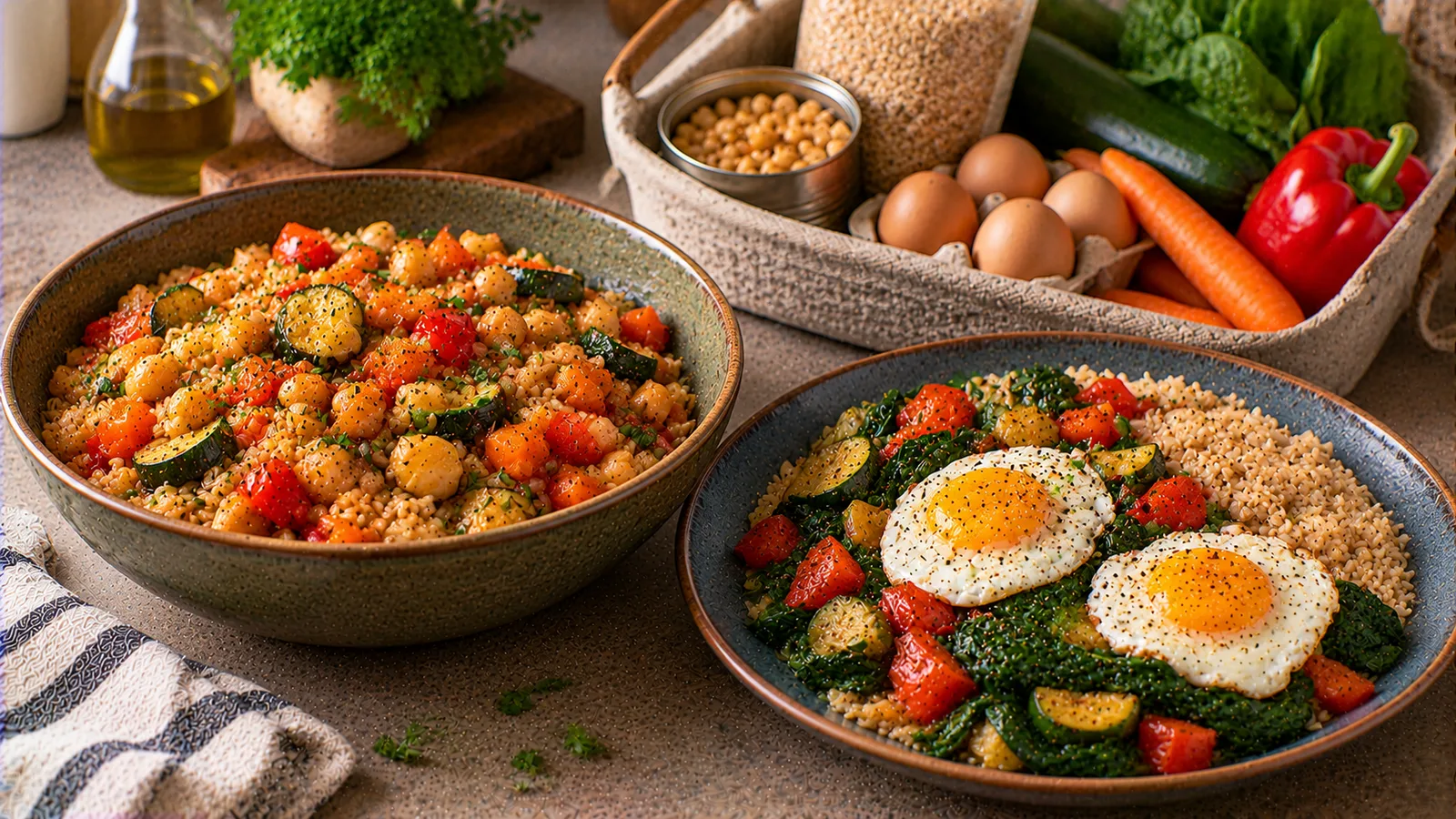
Could a €20 grocery budget cover three real vegetarian dinners for one person? Yes, in this worked German example: the entire basket costs €14.75, while only €6.51 of the purchased ingredients is allocated to the three cooked dinners. Those are two different numbers, and neither one is the price of a complete three-day diet. You buy entire packages at the till; you consume fractions of most of them.
This is a dated illustrative ALDI SÜD price basket, assembled from public product listings checked between 20 and 22 October 2026. It is not a receipt from one physical branch, a guaranteed present-day offer or a claim that every product will be stocked together. Fresh-produce and promotional prices vary by location and date. Recheck local shelf labels. A €20 ceiling leaves €5.25 headroom against the listed prices, not a guarantee about your checkout.
The recipes are three separate single-person dinners, not meal prep for a household. They deliberately share carrots, onions, rice, oil and tomatoes while changing the main protein source from red lentils to kidney beans to eggs. The third dinner uses creamed frozen spinach containing dairy, not plain spinach; this matters for allergies, salt and taste.
Source transparency (22 October 2026): ALDI SÜD has retired its original individual product pages for the 1 kg organic carrots and 1.5 kg yellow onions (HTTP 410). The carrot link below now points to the live ALDI brand page confirming the 1 kg organic carrot product; the onion link leads to ALDI’s fresh-produce category, not a product-price confirmation. Their €1.79 and €1.49 prices are dated examples from earlier public listings and have not been independently reverified as current prices. Do not use them as guaranteed checkout prices. The recipe calculations are unchanged.
The exact basket: what you pay versus what you use
The table gives the full checkout price of each retail pack and the proportional ingredient cost of the amount used in the three recipes. For canned kidney beans, the whole tin is costed even though its purchase weight includes liquid; the recipe uses the 255 g drained stated on the label. Eggs are counted individually. Vegetable quantities are raw purchase weight before peeling and trimming, so actual edible weight is slightly lower. No unrealistic zero-price pantry oil is assumed.
| Whole package to buy | Pack size | Checkout price | Used for three dinners | Allocated cost | Evidence |
|---|---|---|---|---|---|
| Red lentils | 500 g | €1.45 | 100 g | €0.29 | ALDI SÜD |
| Parboiled rice | 1 kg | €1.39 | 160 g | €0.22 | ALDI SÜD |
| Canned kidney beans (255 g drained) | 400 g can / 255 g drained | €0.69 | 255 g drained | €0.69 | ALDI SÜD |
| Free-range eggs | 6 eggs | €2.29 | 3 eggs | €1.15 | ALDI SÜD |
| Organic firm-cooking potatoes | 1.5 kg | €1.79 | 500 g | €0.60 | ALDI SÜD |
| Carrots | 1 kg | €1.79 | 600 g | €1.07 | ALDI SÜD |
| Creamed frozen spinach (contains dairy) | 450 g | €0.89 | 450 g | €0.89 | ALDI SÜD |
| Tomato passata | 500 g | €0.69 | 500 g | €0.69 | ALDI SÜD |
| Yellow onions | 1.5 kg | €1.49 | 300 g | €0.30 | ALDI SÜD |
| Plain natural yogurt | 500 g | €0.89 | 300 g | €0.53 | ALDI SÜD |
| Rapeseed oil | 500 ml | €1.39 | 30 ml | €0.08 | ALDI SÜD |
| Total | 11 packs | €14.75 | — | €6.51 | — |
The row-level figures are rounded to two decimals for readability. The €6.51 total comes from summing all unrounded pack-price × used-quantity ÷ pack-quantity calculations and rounding once; adding individually rounded rows may differ by a cent. The calculator rule also works for a different shop: a €1.39 pack of 1,000 g rice, with 160 g used, contributes €1.39 × 160 ÷ 1,000 = €0.2224 (about €0.22). The 500 ml rapeseed oil bottle costs €1.39; 30 ml used costs €0.0834 (about €0.08).
This basket has 11 purchased line items, including the cooking oil. Tap the product-evidence links in the table to review the named pack sizes and example listed prices. A quoted price is not an independently checked local till receipt. The €8.24 difference between checkout and used cost remains in partly full packages and unused ingredients; it is not cash refunded after dinner. Plain tap water costs are excluded and seasonings such as salt or pepper are optional, not hidden requirements.
The three dinner plates
| Dinner for one | Ingredient-use cost | What it contains |
|---|---|---|
| Tomato-red-lentil rice with carrots | €1.23 | Dry lentils and rice, vegetables, rapeseed oil |
| Potato–kidney-bean pan with yogurt | €2.47 | Drained beans, potatoes, carrots, tomato and dairy yogurt |
| Creamed-spinach egg rice with carrots | €2.81 | Three eggs, rice, entire frozen-spinach pack, vegetables and yogurt |
| Three dinners | €6.51 | One person; not an entire three-day diet |
Each meal combines a substantial starch source with vegetables, a protein-containing ingredient and some fat, rather than pretending that one cheap food supplies every nutrient. The German Nutrition Society’s food-group guidance emphasizes vegetables, legumes, grain foods and plant oils. The three dinners do not guarantee your entire day's protein, energy, calcium, iron or vitamin intake. Portion needs vary by person.
Dinner 1 — Tomato and red-lentil rice, with carrots
One generous dinner; approximately 30–35 minutes. Ingredient-use cost: €1.23. The red lentils thicken the tomato sauce around the rice; this is a spoonable pilaf, not three separate sides.
| Ingredients for one | Raw or packaged amount |
|---|---|
| Red lentils | 100 g dry |
| Parboiled rice | 80 g dry |
| Tomato passata | 250 g |
| Carrots | 200 g raw purchase weight, then trim and dice |
| Onion | 100 g raw purchase weight, then peel and dice |
| Rapeseed oil | 10 ml |
| Water | Start with 450 ml; top up as needed |
- Wash and dice the carrots and onion, keeping the specified amounts as the weight before trimming. Heat 10 ml oil in a saucepan, soften the onion for 3–4 minutes and add the carrots for another 2 minutes.
- Rinse lentils as the packet advises. Add 100 g dry lentils, 80 g dry parboiled rice, 250 g passata and approximately 450 ml water. Stir, bring to a boil and reduce to a gentle simmer.
- Cook covered for about 20–30 minutes, stirring frequently. Different lentils and rice brands have different cooking times: follow both packet instructions, add water in 50 ml increments when necessary, and continue until both rice and lentils are fully cooked. If the rice needs longer, it is fine for the lentils to become soft.
- Remove the lid and reduce the sauce to your preferred thickness. Serve the whole batch as one dinner. Optional pepper or dried herbs may enhance the flavour but are not counted as purchases.
Why it works: dried lentils supply protein and fibre while rice makes the meal more filling. The vegetables and tomato sauce provide volume. DGE describes legumes as useful plant protein sources and recommends eating them regularly. Do not serve lentils raw or undercooked.
Dinner 2 — Warm potato and kidney-bean skillet with yogurt
One dinner; approximately 30–40 minutes. Ingredient-use cost: €2.47. Beans take centre stage rather than functioning as a garnish.
| Ingredients for one | Raw or packaged amount |
|---|---|
| Small potatoes | 500 g raw purchase weight |
| Kidney beans | One can, 255 g drained |
| Carrots | 250 g raw purchase weight |
| Onion | 100 g raw purchase weight |
| Tomato passata | 250 g |
| Plain yogurt, 3.5% fat | 150 g |
| Rapeseed oil | 10 ml |
| Water | A small splash as needed |
- Wash the potatoes and dice into roughly 2 cm pieces, removing any unsuitable parts. Simmer in water until fully tender, usually around 12–20 minutes depending on size; drain. Using 500 g before trimming means the actual edible serving may weigh slightly less.
- Dice the carrots and onion. Warm 10 ml oil in a large pan, cook the onion and carrots for 7–10 minutes with a splash of water, then add 250 g passata. Cover and cook until the carrots are tender.
- Drain and rinse the kidney beans. Add all 255 g drained beans plus the potatoes; simmer until everything is steaming hot and the liquid has reduced. Taste before adding any optional salt.
- Spoon 150 g chilled plain yogurt over the hot panful after portioning so that it stays pleasantly cool. The yogurt is included in both the ingredients and the proportional cost.
The beans, vegetables and potatoes make this a substantial plate. Kidney beans must be properly cooked: this recipe uses commercially canned, ready-to-eat beans. Do not substitute dry, uncooked kidney beans without a separate safe cooking procedure.
Dinner 3 — Creamed-spinach egg rice with carrots
One dinner; approximately 25–35 minutes. Ingredient-use cost: €2.81. This is a soft, creamy skillet, not a crisp fried-rice restaurant dish.
| Ingredients for one | Raw or packaged amount |
|---|---|
| Parboiled rice | 80 g dry |
| Eggs | 3 whole eggs from the six-pack |
| Frozen creamed spinach | 450 g (the whole pack), still frozen |
| Carrots | 150 g raw purchase weight |
| Onion | 100 g raw purchase weight |
| Plain yogurt | 150 g |
| Rapeseed oil | 10 ml |
| Water | As required for rice and spinach |
- Cook 80 g dry parboiled rice in fresh water according to its pack until tender. Prepare it for this dinner, rather than leaving cooked rice at room temperature for a later day.
- Dice the onion and carrots. Heat 10 ml oil in a deep skillet and soften the vegetables with a splash of water for about 7–10 minutes.
- Add the whole 450 g frozen creamed spinach and cook according to its package instructions until fully hot throughout. The product is already creamy and salted; do not replace it with plain chopped spinach without changing the sauce.
- Stir the cooked rice into the vegetables. Beat 3 eggs, pour them in and cook while stirring gently until the eggs are completely set, without uncooked liquid remaining.
- Serve immediately with 150 g plain yogurt on the side. The dairy in both yogurt and creamed spinach makes this meal vegetarian, not vegan, and unsuitable for a milk allergy without substitutions.
Reconcile the packages before putting the food away
The three recipes use 100 g of 500 g dry lentils, 160 g of 1,000 g dry rice, one entire 255 g drained can of beans, 3 of 6 eggs, 500 g of 1,000 g potatoes, 600 g of 1,000 g carrots, all 450 g of frozen creamed spinach, all 500 g passata, 300 g of 1,500 g onions, 300 g of 500 g yogurt, and 30 ml of 500 ml rapeseed oil. No second can or third-party side is silently required.
What remains: 400 g lentils, 840 g rice, 3 eggs, approximately 500 g potatoes, 400 g carrots, 1,200 g onions, 200 g yogurt and 470 ml oil before peel losses. The beans, spinach and passata are fully used. Store each remainder as its label directs. Keeping these leftovers is why the used cost is much lower than the checkout total, but they are not three additional ready-made dinners.
Storage and safety: chill cooked leftovers promptly, within 2 hours; a fridge at 4 °C or below is a conservative target. FoodSafety.gov recommends eating refrigerated leftovers within 3–4 days when handled correctly (guidance). Rice deserves extra attention: the German Federal Institute for Risk Assessment explains that Bacillus cereus can form heat-resistant spores and grow when cooked starchy foods are held improperly (BfR background). The simplest option is to cook each single serving fresh rather than hold a cooked rice pot for days. Follow the frozen-spinach pack instructions.
What this budget does—and does not—prove
With the listed, dated prices, the entire till bill of €14.75 fits within a €20 cap; the three plates allocate €1.23 + €2.47 + €2.81 = €6.51 in ingredients. Those are transparent worked costs, not a promise that a German shop can always supply the same basket for exactly that price. A different region, different egg pack or smaller potato bag changes the checkout arithmetic. If a product costs more, subtract the new total from €20; do not call the cost per serving your checkout spending. A larger household basket and a general €30 shopping strategy are separate questions; see the larger €30 grocery-basket guide. For a method you can reuse with any receipt, see how to calculate cost per meal.
Sources
- DGE: food-group model and overall balance
- DGE: legumes and nuts as protein sources
- FoodSafety.gov: storing and cooling leftovers
- BfR: Bacillus cereus and starchy cooked food
- ALDI SÜD: 11 individual example retail pack pages (individual sources linked in the basket table; snapshot checked 20 October 2026).