
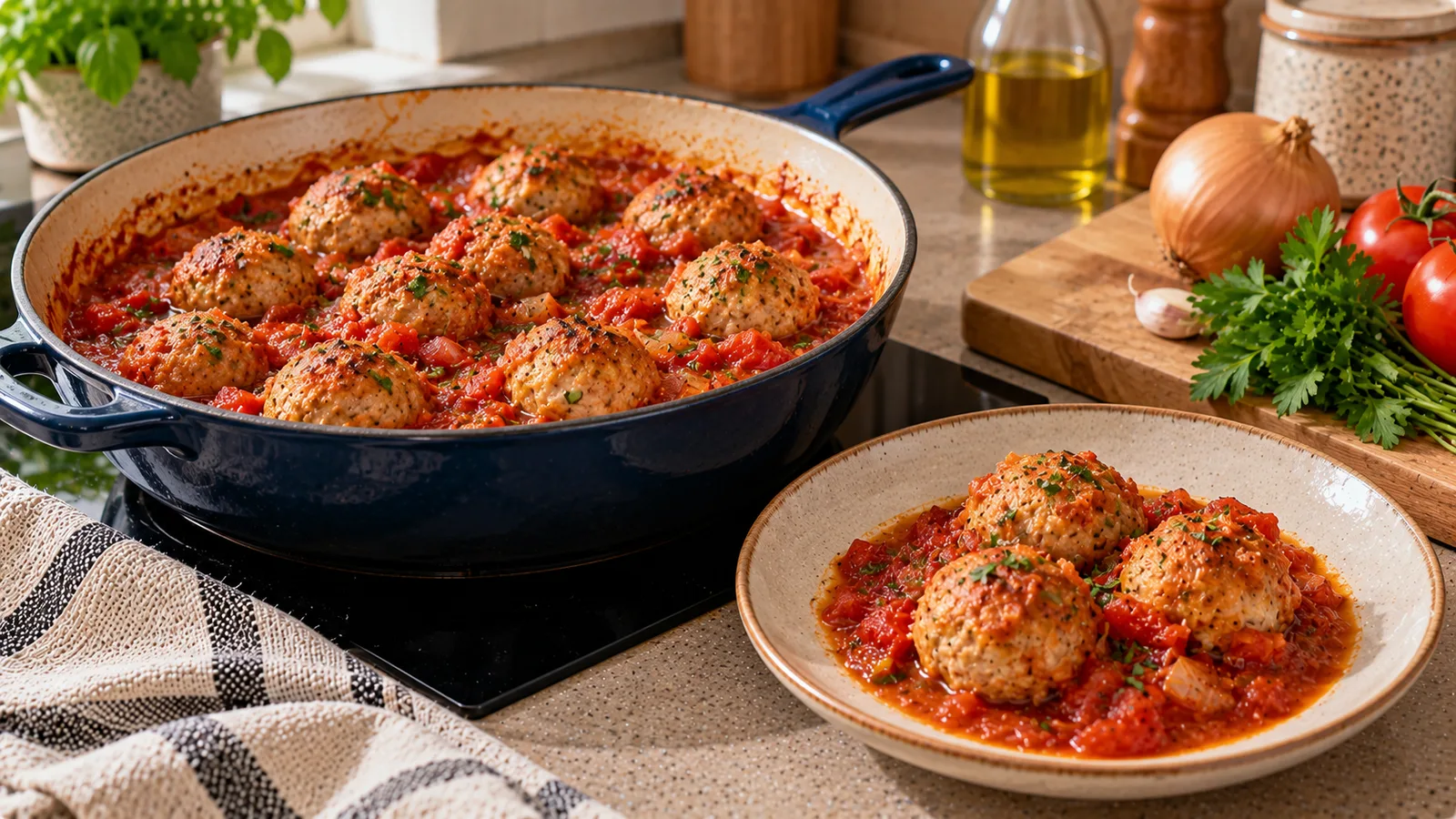
Turkey meatballs in tomato sauce are a practical dinner when you want something comforting without a complicated cooking process. Ground turkey cooks relatively quickly, the tomato sauce uses familiar pantry ingredients, and the finished dish works with pasta, rice, potatoes or bread.
The main challenge is keeping turkey meatballs tender. Ground turkey is often leaner than ground beef, so overmixing or cooking for too long can make the texture firm or dry.
This recipe uses grated onion, an egg and breadcrumbs to help retain moisture. The meatballs are briefly browned, then finished gently in tomato sauce.
The result is a straightforward meal that can be cooked in approximately 35–40 minutes.
Recipe overview
| Detail | Amount |
|---|---|
| Servings | 4 |
| Preparation | 15 minutes |
| Cooking | 20–25 minutes |
| Total time | Approximately 35–40 minutes |
| Main protein | Ground turkey |
| Cooking method | Pan-browned, then simmered |
| Equipment | Large frying pan with lid, bowl, knife, grater |
Cooking times are approximate. The size of the meatballs, pan temperature and type of ground turkey can change the result.
For food safety, ground turkey must reach an internal temperature of at least 74°C (165°F), measured in the center of a meatball.
Ingredients for four servings
For the turkey meatballs
- 500 g ground turkey.
- 1 medium egg.
- 50 g plain breadcrumbs.
- 1 small onion, finely grated, approximately 80 g.
- 2 garlic cloves, minced.
- 1 teaspoon dried oregano.
- 1/2 teaspoon sweet paprika.
- 1/2 teaspoon salt, or to taste.
- Freshly ground black pepper.
- 1 tablespoon olive oil for browning.
For the tomato sauce
- 500 g tomato passata or crushed tomatoes.
- 1 small onion, finely chopped, approximately 80 g.
- 2 garlic cloves, minced.
- 1 tablespoon olive oil.
- 1 teaspoon dried basil or oregano.
- 100 ml water, as needed.
- Salt and black pepper to taste.
- Optional fresh basil for serving.
Choose plain ground turkey rather than a pre-seasoned mixture if you want direct control over salt and seasoning.
The fat content of ground turkey varies. Very lean turkey may require especially gentle mixing and cooking to maintain a tender texture.
Step 1: Prepare the meatball mixture
Place the ground turkey in a large bowl.
Add the egg, breadcrumbs, grated onion, garlic, oregano, paprika, salt and pepper.
Mix gently with a spoon or clean hands until the ingredients are evenly distributed.
Stop mixing once the mixture holds together.
Overworking ground meat can create a dense texture, which is particularly noticeable with lean turkey.
If the mixture is too soft to shape, let it rest for five minutes so the breadcrumbs absorb moisture.
Avoid adding large amounts of extra breadcrumbs immediately. Too much can make the finished meatballs dry.
Step 2: Shape the meatballs
Divide the mixture into approximately 16 equal portions.
With 500 g of turkey and the additional ingredients, the raw meatballs will each weigh roughly 40–45 g, depending on the exact quantities.
Shape them gently into balls without compressing them tightly.
Keeping the meatballs similar in size helps them cook evenly.
If the mixture sticks to your hands, lightly moisten them with cold water.
Place the shaped meatballs on a clean plate.
Keep raw turkey away from ready-to-eat foods, and wash utensils and surfaces that have touched it.
Step 3: Brown the meatballs
Heat one tablespoon of olive oil in a large frying pan over medium heat.
Add the meatballs in a single layer, leaving space between them.
Brown for approximately five to seven minutes, turning carefully to color several sides.
They do not need to be fully cooked at this stage.
The purpose is to develop flavor and help the meatballs hold their shape before they simmer in sauce.
If your pan is small, brown them in two batches rather than overcrowding the surface.
Transfer the browned meatballs to a clean plate.
Step 4: Make the tomato sauce
Reduce the heat to medium-low.
Add another tablespoon of olive oil to the pan if needed.
Cook the chopped onion for three to four minutes until softened.
Add the garlic and cook for approximately 30 seconds, stirring so it does not burn.
Pour in the passata or crushed tomatoes.
Add the dried herbs, a little salt and black pepper.
If the sauce is very thick, add some of the water.
Stir and bring the sauce to a gentle simmer.
The tomato sauce should be loose enough to surround the meatballs without sticking to the pan.
Step 5: Finish the meatballs in the sauce
Return the browned meatballs to the pan.
Spoon a little tomato sauce over each one.
Cover with a lid and simmer gently for approximately 12–15 minutes, turning the meatballs once if needed.
Avoid vigorous boiling, which can make the meatballs tougher and cause the sauce to reduce too quickly.
Check the internal temperature of the largest meatball with a food thermometer.
It must reach at least 74°C (165°F).
If it has not reached that temperature, continue cooking and check again.
Once cooked, remove the pan from the heat and let the meatballs rest in the sauce for a couple of minutes before serving.
How to keep turkey meatballs juicy
Use grated onion
Finely grated onion distributes moisture throughout the mixture without leaving large crunchy pieces.
It also contributes flavor without requiring extra sauce ingredients.
Do not overmix
Mix only until the ingredients are combined.
A heavily worked mixture tends to produce a firmer texture.
Make meatballs of similar size
Small meatballs cook faster than large ones.
Keeping them uniform makes it easier to avoid overcooking some while others remain undercooked.
Simmer gently
The sauce should bubble lightly rather than boil rapidly.
Gentle simmering gives the meatballs time to cook through without excessive moisture loss.
Check temperature rather than guessing
Turkey can appear cooked on the outside before the center reaches a safe temperature.
Use a thermometer instead of relying on color or a fixed cooking time.
What to serve with turkey meatballs
The sauce is versatile, so you can choose a side according to the rest of your meal.
| Side dish | Why it works |
|---|---|
| Spaghetti or other pasta | Tomato sauce coats the pasta easily |
| Rice | Absorbs sauce and makes a simple bowl meal |
| Mashed potatoes | Soft texture contrasts with the meatballs |
| Roasted vegetables | Adds variety and extra vegetables |
| Wholegrain bread | Useful for a quick meal with minimal preparation |
| Green salad | Provides a fresh contrast to the warm sauce |
For four servings, a typical starting point might be 60–80 g dry pasta per person, but portions should be adjusted to individual needs.
The meatballs can also be served without a starchy side if the rest of the meal already includes enough food.
Approximate nutrition per serving
Nutrition depends on the fat content of the turkey, breadcrumbs, oil and tomato products used.
For a rough calculation, assume the recipe makes four equal servings and all ingredients are consumed.
An illustrative estimate for the meatballs and sauce, excluding pasta or other sides, is:
| Nutrient | Approximate amount per serving |
|---|---|
| Energy | 350–430 kcal |
| Protein | 30–36 g |
| Fat | 15–23 g |
| Carbohydrates | 17–24 g |
These are broad estimates, not laboratory-tested values for this exact recipe.
The biggest variable is the fat content of the ground turkey.
For accurate tracking, use the nutrition labels of your ingredients, total the recipe and divide by the number of portions actually served.
If you add pasta, rice, cheese or bread, calculate those foods separately.
Easy recipe variations
Turkey meatballs without breadcrumbs
You can try finely ground oats or another suitable binder instead of breadcrumbs.
The amount may need adjustment because different ingredients absorb moisture differently.
If avoiding gluten, use a certified gluten-free product where necessary and check all other ingredient labels.
Turkey meatballs without egg
An egg helps bind the mixture, but some recipes work without it.
Try reducing the liquid slightly and chilling the shaped meatballs before browning.
The texture may be more delicate, so turn them carefully.
Spicy tomato sauce
Add chili flakes or a small amount of finely chopped chili when cooking the garlic.
Start with a modest quantity and adjust after tasting the sauce.
Extra vegetables
Finely chopped carrots, mushrooms or courgette can be cooked with the onion before adding the tomatoes.
These additions change the sauce texture and total recipe volume.
Meatballs baked instead of browned
If you prefer baking, place the meatballs on a lined baking tray and cook them according to their size and your oven.
Check that they reach 74°C internally.
You can then transfer them to the tomato sauce for a short simmer.
Common mistakes and how to avoid them
Using too much breadcrumb: The mixture becomes stiff and the meatballs can feel dry. Start with the specified quantity.
Overcrowding the pan: The meatballs release moisture and steam instead of browning. Cook in batches if necessary.
Boiling the sauce aggressively: The meatballs may become firmer and the sauce can stick. Keep the heat gentle.
Relying on appearance: Browned meatballs are not necessarily cooked through. Verify the center temperature.
Cooking the sauce too dry: Add a little water if needed so the meatballs remain surrounded by sauce.
Can you prepare turkey meatballs ahead?
Yes, but follow safe food-handling practices.
Keep raw turkey refrigerated at 4°C or below and use it according to the package instructions and applicable storage guidance.
Cooked meatballs should be cooled promptly and refrigerated in shallow, covered containers.
Under US food-safety guidance, properly refrigerated cooked leftovers are generally recommended for use within three to four days. Local guidance may be more conservative.
If freezing, cool the cooked meatballs and sauce promptly, portion them into suitable containers and freeze within a safe storage period.
Thaw frozen portions safely in the refrigerator rather than leaving them on the counter.
Reheat leftovers thoroughly to 74°C (165°F).
Do not repeatedly warm and cool the same batch unnecessarily.
Frequently asked questions
Can I cook turkey meatballs directly in tomato sauce?
Yes. Raw meatballs can be simmered in sauce, but they are more delicate before setting and may need longer cooking. Always verify a safe internal temperature of 74°C.
Why are my turkey meatballs dry?
Common reasons include very lean turkey, excessive breadcrumbs, overmixing and cooking longer than necessary.
Can I use canned chopped tomatoes?
Yes. Crushed or chopped canned tomatoes work well. A chunky sauce may need a slightly longer simmer or additional liquid.
How many meatballs are in one serving?
This recipe makes approximately 16 meatballs and four servings, or about four meatballs per serving. Actual portion needs vary.
Can I serve these meatballs with rice?
Yes. Rice absorbs the tomato sauce well. Cook the rice separately and include it when calculating the meal's nutrition.
Sources and food-safety guidance
- FoodSafety.gov: Safe Minimum Internal Temperatures — safe cooking temperatures for ground poultry and leftovers.
- FoodSafety.gov: Cold Food Storage Chart — storage recommendations.
- USDA FoodData Central — ingredient composition data for nutrition calculations.
A simple dinner worth repeating
Turkey meatballs in tomato sauce work well because the same base recipe can be paired with different sides.
Keep the mixture gently combined, brown the meatballs without overcrowding and finish them in a lightly simmering sauce.
Most importantly, use a thermometer to confirm the turkey is cooked safely, then serve with the side dishes that suit your meal.